Organismic Bio Ch. 25
 Call Kai
 Learn
 Practice Test
 Spaced Repetition
 Match
 Flashcards
 Knowt Play
1/44

There's no tags or description
Looks like no tags are added yet.
45 Terms
In what country is Wadi El Hitan located
Egypt
Is Wadi El Hitan a UNESCO World Heritage Site
yes
What kinds of animal fossils are found in Wadi El Hitan?
1. Fossils of early whales are found there
2. Fossilized ancient mammals.
3. Fossilized mangrove trees .
4. All of the above
All of the above
when landmasses move over time, affecting extinction and speciation rates
continental drift
mass extinction
many species become extinct worldwide
adaptive radiation
when a lineage gives rise to many new species
(blank) results in branches splitting off from an ancestor
Mass extinctions result in multiple (blank) ending at the same (blank)
(blank) is the evolution of an animal or plant group into a wide variety of (blank) adapted to (blank) modes of life
Continental drift
branches, point
adaptive radiation, types, specialized
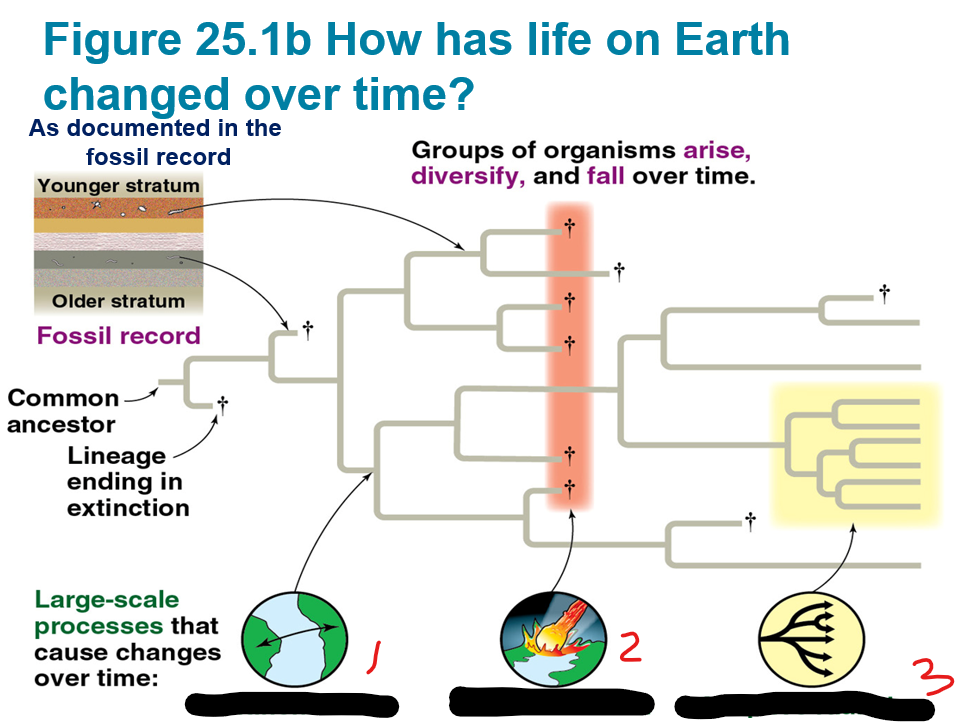
continental drift
mass extinction
adaptive radiation
(blank) were very different from those presently living
past organisms
i.e. fossils found in the Saharan Desert document the transition of whales from land to sea
macroevolution
the broad pattern of evolution above the species level
The fossil record shows macroevolutionary changes over large time scales, for example:
the impacts of mass extinctions
the origins of key adaptations, such as flight
the emergence of terrestrial vertebrates
Chemical and physical processes could produce simple cells through 4 stages:
Abiotic synthesis of small organic molecules
Joining of these molecules into macromolecules
packaging of these molecules into protocells
origin of self-replicating molecules
protocells
droplets with membranes that maintain an internal chemistry different from the environment
when did earth form
4.6 billion years ago
what prevented sea formation before 4 billion years ago
the early atmosphere had little (blank) but lots of (blank) vapor plus compounds released by (blank)
collisions with rocks and ice vaporized water
oxygen, water, volcanic eruptions
(Compounds included nitrogen and its oxides, such as carbon dioxide, methane, ammonia and hydrogen)
in the 1920s A.I Oparin and J. B. S. Haldane hypothesized what
that the early atmosphere was a reducing (electron-adding) environment in which organic compounds coukd have formed from simple molecules
in 1953 Stanley Miller and Harold Urey did what
demonstrated that the abiotic synthesis of organic molecules was possible in a reducing atmosphere
some evidence suggests that earth’s early atmosphere was neither (blank) nor (blank)
The first organic compounds may have formed in reducing conditions near the openings of (blank)
(blank) were formed under conditions simulating volcanic eruption
reducing, oxidizing
volcanoes
amin acids
organic compounds could’ve been made in deep sea (blank)
(blank) and (blank) flow through these vents from beneath (blank) and into the ocean
Organic compounds are unstable in the (blank) heat released by (blank) vents.
other vents called (blank) vents release (blank) water with a (blank) PH. This environment would have been more suitable for life than near (blank) vents
hydrothermal vents
water, minerals, Earth’s surface
extreme, black smoker
alkaline, warm, high, black smoker
Meteorites could have been a source of (blank) molecules
fragments of the 4.5 billion-year-old (blank) meteorite contained (blank), (blank), (blank) and (blank)
organic
murchison, amino acids, lipids, simple sugars, nitrogenous bases
The first genetic material was likely (blank) not (blank)
RNA plays an essential role in (blank) synthesis
RNA molecules called (blank) have been known to catalyze many different reactions
why do scientists believe that RNA was the first genetic material
RNA, DNA
protein
ribozymes
because RNA has both information storage and catalytic properties
self-replicating ribozymes have been produces through (blank) in laboratory experiments
RNA molecules with different (blank) sequences fold into different shapes
(blank) errors produce new shapes that enable faster (blank) with fewer errors.
The RNA molecule with the greatest (blank) ability leaves the most (blank) molecules
natural selection
nucleotide
copying, replication
replication, descendant
How could have protocells formed on Earth
from vesicles that grew, split and passed RNA to their “daughters”
Double-stranded DNA is more chemically (blank) than RNA and can be (blank) more easily
stable
replicated
what reveals the changes in the history of life on Earth
The fossil record
the accumulation of fossils in sedimentary rock layers
strata
Most fossils are found in (blank) rock
Explain the conditions under which sedimentary rock forms
Sedimentary
Sedimentary rocks are formed from the accumulation of mud, sand, and shells in low-energy environments like riverbeds, lakes, and oceans. They are formed under low temperature and pressure.
(In contrast to igneous and metamorphic rocks, which are formed under high heat and pressure.)
some fossils form as (blank) seep into and replace organic matter
minerals
Trace fossils
footprints or other traces of an organism’s activities
Amber
Entire organisms can be found in hardened resin from a tree
True or False: Bodies of larger organisms can rarely be preserved in frozen soil, ice or acid bogs
True
why is the fossil record incomplete
few organisms were preserved as fossils
many fossils were destroyed via geologic processes
only a fraction of fossils have yet to be discovered
The known fossil record is biased in favor of species that
(blank) for a long time
were (blank) and (blank)
had (blank) parts such as shells and skeletons
existed
widespread, abundant
hard
used to determine the age of fossils based on the decay of radioactive isotopes
radiometric dating
half life
time required for 50% of a parent isotope of decacy
A fossil’s age can be estimated based on the ratio of what
carbon 14 (radioactive) to carbon 12 (stable) isotopes it has
Mammals belong to a group of animals called (blank) named for having four limbs
tetrapods (synapsids)
most tetrapods have undifferentiated, (blank) pointed teeth
mammalian teeth are specialized for their (blank)
Canines are used for (blank)
molars are used for (blank)
single
function
piercing, crushing and grinding
layered rocks that form when prokaryotes bind thin layers of sediment together
stromatolites
On early earth, oxygen produced by (blank) likely reacted with dissolved (blank) in the sea and precipitated out to form (blank) sediments
photosynthesis
iron
iron oxide
oxygen can attack (blank)
the oxygen revolution likely drove what
some survivors found refuge in (blank) habitats; others adapted to use O₂ for (blank)
chemical bonds
the death of many prokaryotes
anaerobic, cellular respiration
what does the cytoskeleton allow eukaryotes to do
change shape and engulf other cells
eukaryotes likely originated from
both mitochondria and plastids are thought to have descended from (blank) cells
the original host cell is thought to be an (blank) or a descendant of (blank)
endosymbiosis
bacterial
archaean, archaea
theorizes that Earth’s crust is composed of plates floating on the underlying mantle
plate tectonics
how many mass extinctions have there been
5, we might be experiencing a 6th one due to human activity