Energy Changes
 Call Kai
 Learn
Learn Practice Test
 Spaced Repetition
 Match
Match Flashcards
 Knowt Play
1/66

There's no tags or description
Looks like no tags are added yet.
Name | Mastery | Learn | Test | Matching | Spaced | Call with Kai | Chat |
|---|
No analytics yet
Send a link to your students to track their progress
67 Terms
Describe the signs that show a chemical reaction has taken place.
Colour change, temperature change, gas given off (bubbling/fizzing), precipitate (solid) formed
State the law of conservation of mass.
The total mass of reactants is equal to the total mass of products.
Describe what happens to atoms in a chemical reaction.
Atoms are not created or destroyed, they are only rearranged to form a new substance.
exothermic reaction meaning
An exothermic reaction is one that transfers energy to the surroundings.
what temperature change does an exothermic reaction result in?
Exothermic reactions result in a temperature increase in the surroundings.
examples of exothermic reactions
Combustion, neutralisation and many oxidation reactions are exothermic reactions.
Exothermic reactions can also be used in real life, in handwarmers and self-heating cans.
endothermic reaction meaning
An endothermic reaction is one that takes in energy from the surroundings.
what temperature change does an endothermic reaction result in?
Endothermic reactions result in a temperature decrease in the surroundings.
examples of endothermic reactions
Endothermic reactions include thermal decompositions and the reaction of citric acid and sodium hydrogencarbonate
Endothermic reactions can also be used in real life, in sports injury packs
is photosynthesis an exothermic or endothermic reaction? & why
Endothermic
The bonds in glucose store a lot of chemical energy, so building them needs an input of energy.
Chlorophyll absorbs light energy and uses it to drive the reactions.
Photosynthesis is endothermic because the energy needed to make glucose is greater than the energy released when bonds in CO₂ and H₂O are broken.
Photosynthesis is endothermic because it requires energy from light to convert low‑energy molecules into high‑energy glucose.
is aerobic respiration an exothermic or endothermic reaction? & why
exothermic
When glucose is broken down, the products (CO₂ and H₂O) have very stable bonds. Forming these stable bonds releases energy.
The energy released is transferred to ATP, which cells use for movement, active transport, protein synthesis, etc.
Aerobic respiration is exothermic because more energy is released when new bonds form in the products than is required to break the bonds in the reactants.
A chemical reaction can be identified by…
a colour change, a solid being formed, a gas being given off or a temperature change
For a chemical reaction to occur, the particles of the reactants have to…
collide with each other with enough energy, otherwise the reaction cannot occur
activation energy meaning
The minimum amount of energy that particles need to have in order to react
catalyst meaning
a substance that speeds up a chemical reaction without being used up
Catalysts & activation energy
Catalysts work by providing an alternative reaction pathway, with a lower activation energy, so that more particles are able to react with each other in a given time.
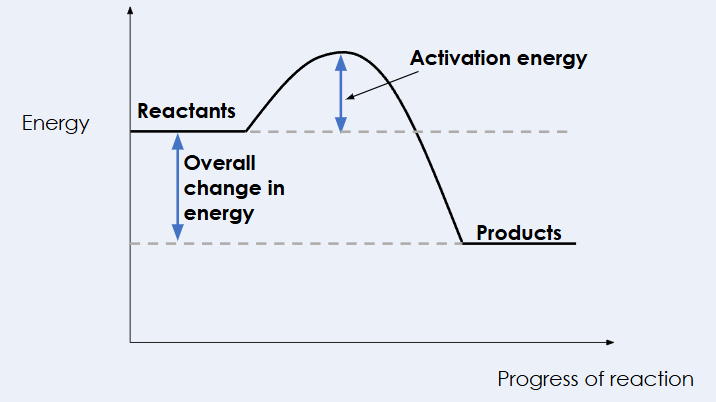
Energy Level Diagram - Exothermic
In an exothermic reaction, energy is transferred to the surroundings.
This means the products have less energy than the reactants:

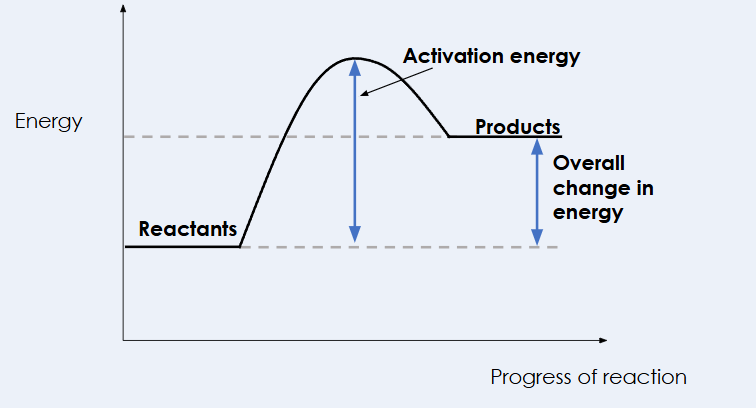
Energy Level Diagram - Endothermic
In an endothermic reaction, energy is transferred from the surroundings.
This means the products have more energy than the reactants:

the reaction profile for an exothermic reaction
the reaction profile for an endothermic reaction
Activation Energy and Catalysts on a reaction profile

Suggest what it means for a reaction to be ‘highly exothermic’
The reaction transfers a lot of energy to the surroundings.
When chemical bonds are broken, energy is…
needed
When chemical bonds are made, energy is…
released
The process of breaking chemical bonds is …thermic as it…
endothermic , requires energy to be taken in from the surroundings
The process of making bonds is ….thermic, which
exo, releases energy
A reaction is exothermic overall if…
the amount of energy released when making the new bonds in the products is greater than the amount of energy that was taken in to break the bonds in the reactants.
A reaction is endothermic overall if…
the amount of energy released when making the new bonds in the products is less than the amount of energy that was taken in to break the bonds in the reactants.
bond energy meaning
A bond energy is the amount of energy needed to break up one mole of a given covalent bond.
overall energy change of the reaction meaning
The difference between the sum of the energy needed to break bonds in the reactants and the sum of the energy released when bonds in the products are formed
the explicit formula and sign rules of bond breaking & making
Energy Change=∑(bonds broken)−∑(bonds formed)
Sign Rules:
If the answer is negative (-), the reaction is exothermic.
If the answer is positive (+), the reaction is endothermic.
Why Yield Is Less Than 100%
Some reactants may be left behind in the equipment
The reaction may be reversible and in these reactions a high yield is never possible as the products are continually turning back into the reactants
Some products may also be lost during separation and purification stages such as filtration or distillation
There may be side reactions occurring where a substance reacts with a gas in the air or an impurity in one of the reactants
Products can also be lost during transfer from one container to another
Actual & theoretical yield
The actual yield is the recorded amount of product obtained
The theoretical yield is the amount of product that would be obtained under perfect practical and chemical conditions
The percentage yield compares the actual yield to the theoretical yield
For economic reasons, the objective of every chemical producing company is to have as high a percentage yield as possible to increase profits and reduce costs and waste
Calculating percentage yield
The percentage yield is a good way of measuring how successful a chemical process is
There are often several methods of creating a compound and each method is called a reaction pathway
Reaction pathways consist of a sequence of reactions which must occur to produce the required product
Companies often investigate and try out different reaction pathways and these are then compared and evaluated so that a manufacturing process can be chosen
The percentage yield of each pathway is a significant factor in this decision making process
The equation to calculate the percentage yield is:

atom economy meaning
a measure of the amount of starting materials (reactants) that end up as useful, desired products in a chemical reaction
The atom economy formula is:

Why Atom Economy Matters
Economic reasons: Reactions with low atom economy waste a lot of raw materials. Buying raw materials costs money, and disposing of large amounts of unwanted waste products is expensive. Higher atom economy means higher profits.
Environmental/Sustainable reasons: Using reactions with high atom economy conserves limited natural resources and reduces harmful or polluting waste.
Unwanted byproducts can sometimes be put to use so although a low atom economy is a sign that a process is not green (sustainable) it doesn’t necessarily imply that the process is not economically viable.
Explain why iron would not be a suitable material for an electrode.
It would corrode when in contact with the water of an electrolyte solution.
Which types of reactions usually have a lower/higher atom economy?
Addition reactions (where two or more reactants combine to form a single product) always have an atom economy of 100% because there are no waste by-products.
Reactions that produce multiple products usually have a lower atom economy, meaning some atoms are wasted.
Accuracy vs precision
Accuracy is how close measurements are to the true value.
Precision is how close measurements are to each other.
a method is valid if it...
accurately measures or tests what it claims to measure
Investigate how the volume of sodium hydroxide added to hydrochloric acid affects the temperature change method
Independent Variable: The volume of sodium hydroxide solution added
Dependent Variable: The temperature change
Control Variables: The volume and concentration of the hydrochloric acid, the concentration of the sodium hydroxide solution, and the level of insulation used.
Measure 25.0 cm3 of hydrochloric acid and pour it into the polystyrene cup
Stand the cup in a beaker to provide support
Measure and record the temperature of the acid
Measure 5.0 cm3 of sodium hydroxide solution using a measuring cylinder
Add the sodium hydroxide to the cup, fit the lid and stir gently
Record the highest temperature reached when the thermometer reading stabilises
Repeat steps 1–6
Add an additional 5.0 cm3 of sodium hydroxide each time
Repeat until a maximum of 40.0 cm3 of sodium hydroxide is added
Repeat the entire experiment for a second trial
why a polystyrene cup and lid are used instead of a regular glass beaker for temperature change practical
Polystyrene is an excellent thermal insulator, and the lid reduces evaporation; together, they minimize heat loss to the surroundings, making your final temperature readings much more accurate
Adding insulation or a lid means that less energy would be dissipated to the surroundings, giving a truer value of the real temperature change. If measurements are close to the true value, they are accurate.
This means adding insulation or a lid would affect the accuracy of the measurements.
Investigate how the volume of sodium hydroxide added to hydrochloric acid affects the temperature change method:
is it exothermic or endothermic & why
This reaction is exothermic because it releases heat
Investigate how the volume of sodium hydroxide added to hydrochloric acid affects the temperature change method: why temperature starts to fall again
The excess alkali absorbs heat
The excess alkali does not contribute to further reaction
This leads to a fall in temperature
Explain how using a digital thermometer would affect measurements.
A digital thermometer has a higher resolution than a normal thermometer. A higher resolution means that more precise measurements can be taken.
This means using a digital thermometer affects precision of the measurements.
Explain how using repeats would affect measurements.
Repeats are done so that any anomalous results can be identified. They are then removed before calculating the mean, which means that the measurements would be closer to the true value.
This means taking repeat measurements affects the accuracy of measurements.
Explain the difference between a cell and a battery.
A battery is two or more cells connected together.
What is a chemical cell?
Chemical cells use chemical reactions to transfer energy by electricity.
A simple cell is made by connecting two different metals to an electrolyte.
A battery is made by connecting two chemical cells together in series.
This adds the voltages produced together.
How do cells work?
A chemical reaction takes place on the surface of each of the metals, releasing energy which is transferred electrically.
These chemical reactions generate a voltage.
The voltage generated depends on the metals used for the electrodes and the type of electrolyte used.
The greater the difference in reactivity between the metals, the greater the voltage generated.
Rechargeable and non-rechargeable cells
In a non-rechargeable cell, eventually one of the reactants runs out. The chemical reaction can no longer take place.
In a rechargeable cell, the chemical reaction can be reversed when an external current is supplied.
Rechargeable cells reduce waste and preserve resources, but are much more expensive.
How could you increase the voltage of a chemical cell?
The voltage is produced by the chemical reactions taking place on the surface of the electrodes, so the factors that affect it would be:
Type of electrolyte
Type of electrodes (biggest difference in reactivity)
Concentration of electrolyte (more ions available for reaction)
Volume of electrolyte (more ions available for reaction)
Temperature of electrolyte (ions moving more quickly)
Mass/size of electrodes (more reactant for reaction)
Surface area of electrodes (more room for reaction to take place)
Explain why iron is not suitable as an electrode.
Iron would corrode in contact with the water of an electrolyte solution.
A student is investigating the factors that affect the voltage of the cell.
Describe how the student could investigate how using different substances for the electrolyte affects the voltage produced.
The student should choose the materials for the electrodes and keep these the same
The student should add a given volume of an electrolyte
The student should record the voltage
The student should repeat for different electrolytes
The concentration and volume of the electrolyte should be kept the same
The temperature of the electrolyte should be kept the same
A student is investigating the factors that affect the voltage of the cell.
Describe how the student could investigate how using different materials for the electrodes affects the voltage produced.
The student should choose materials for the electrodes
The student should add a given volume of an electrolyte
The student should record the voltage
The student should repeat for electrodes made of different materials
The type, concentration and volume of the electrolyte should be kept the same
The temperature of the electrolyte should be kept the same
A student is investigating the factors that affect the voltage of the cell.
Describe how the student could investigate how the concentration of electrolyte affects the voltage produced.
The student should choose the materials for the electrodes and keep these the same
The student should add a given volume of an electrolyte
The student should record the voltage
The student should repeat for different concentrations of the same electrolyte
The volume of the electrolyte should be kept the same
The temperature of the electrolyte should be kept the same
What is a fuel cell?
Fuel cells work using the electrochemical oxidation of a fuel.
This means that energy generated in the reaction is transferred electrically rather than by heating.

Fuel cells can provide a continuous voltage, as long as they have:
A supply of fuel
A supply of oxygen
One type of fuel cell is a
hydrogen-oxygen fuel cell, where hydrogen is the fuel.
Hydrogen fuel cell advantages
Voltage can be produced as long as there is fuel
Cells do not get less efficient over time
As they produce water, this can be a source of drinking water on spacecrafts
Hydrogen fuel cell disadvantages
Use hydrogen, which is an explosive gas, so can be difficult to store safely
Produce a lower voltage than chemical cells, so often several are used
Rechargeable chemical cell advantages
They can produce a greater voltage than hydrogen fuel cells
They do not use dangerous fuels so are often safer to store
Rechargeable chemical cell disadvantages
They run out and need to be recharged
They become less efficient the more charging cycles they go through, so eventually need to be replaced


evaluate the use of the different types of cell in electric cars
Possible points:
Hydrogen fuel cell is 9 times more expensive to recharge
Hydrogen fuel cell takes 1/5 of the time to recharge
Hydrogen fuel cell has double the range
Hydrogen fuel cell costs nearly three times as much
Hydrogen is an explosive gas so is dangerous to store
Hydrogen does not require toxic/corrosive chemicals to be disposed of