CAPE Chemistry - Bonding
 Call Kai
 Learn
 Practice Test
 Spaced Repetition
 Match
 Flashcards
 Knowt Play
1/33

Earn XP
Description and Tags
Ionic, covalent, dative covalent, metallic, hydrogen, intermolecular bonding, intramolecular bonding
34 Terms
What is an ionic bond?
an attraction between oppositely charged ions, which are formed
by the transfer of electrons from one atom to another.

What is covalent bonding?
A covalent bond is a pair of electrons shared between two atoms.

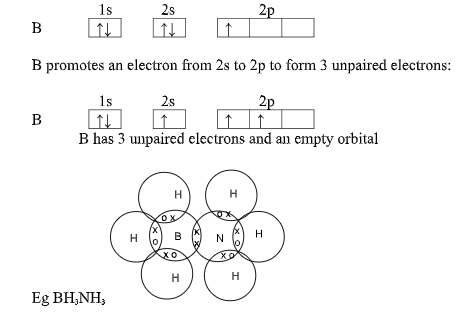
What is a dative covalent bond?
A dative covalent bond is a pair of electrons shared between two atoms with one atom providing both electrons to the bond.

How is a dative covalent bond represented?
like so

Covalent bonds should not be regarded as shared electron pairs in a fixed position, rather as….
charged clouds
What is metallic bonding?
A metallic bond is an attraction between cations and a sea of electrons.
Metallic bonds are formed when atoms lose electrons and the resulting electrons are
attracted to all the resulting cations.
what does it mean for an electron to be delocalized?
they are not attached to any particular atom but are free to move between the atoms.
What is electronegativity?
the relative ability of an atom to attract electrons in a covalent
bond and hold onto them.
What is the trend in electronegativity across a period? Explain
Electronegativity increases across a period as the nuclear charge on the atoms increases but the shielding stays the same, so the electrons are more strongly attracted to the atom.
What is the trend in electronegativity down a group? Explain.
Electronegativity decreases down a group as the number of shells increases, so shielding increases and the electrons are less strongly attracted to the atom.
What are electropositive atoms?
an atom which
does not have a high electronegativity
What is the scale of electronegativity, what are the units?
0.7 to 4.0, no units
Which group of elements have no electronegativity as they do not form bonds
noble gasses
Describe how electronegativity may help in predicting the type of bonding between two atoms
If two atoms have a similar electronegativity, both atoms attract the electrons with similar power and the electrons will remain midway between the two. The bond will thus be covalent - the electrons are shared between the two atoms.
Using electronegativity, explain how polar covalent bonds are formed.
If one atom is significantly more electronegative than the other, it attracts the electrons more strongly than the other and the electrons are on average closer to one atom than the other. The electrons are still shared, but one atom has a slight deficit of electrons and thus a slight positive charge and the other a slight surplus of electrons and thus a slight negative charge.
Using electronegativity, explain how ionic bonds are formed.
If the difference between the two atom’s electronegativity is large, then the sharing of electrons is so uneven that the more electronegative atom has virtually sole possession of the electrons. The more electropositive atom is positively charged and the more electronegative atom is negatively charged.

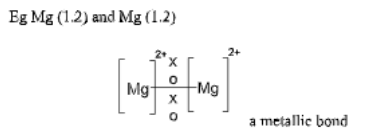
Using electronegativity, explain metallic bonding.
If both atoms are electropositive, neither has a great ability to attract electrons and the electrons do not remain localized in the bond at all. They are free to move, both atoms gain a positive charge and the bonding is metallic.
If both atoms have electronegativities less than ___ to ___ then the bond is metallic.
1.6 - 1.9
If either atom has an electronegativity greater than ___ and the difference is less than ___ then the bond is covalent.
1.9 , 0.5
If either atom has an electronegativity greater than ___ and the difference is more than ___ but less than ___ then the bond is polar covalent.
1.9, 0.5, 2.1
If the difference in electronegativity greater than ___ then the bond is ionic
2.1
What are some exceptions to the bondnig rules?
the bond between Cu (1.9) and Cu (1.9) is metallic. T
the bond between Na (0.9) and H (2.1) is ionic but the bond between Si (1.8) and F (4.0) is polar covalent.
what is a lattice?
A lattice is an ordered and
infinitely repeating arrangement of particles.
Using kinetic and potential energy, explain why the particles in a solid stay together
the kinetic energy of the particles is not nearly enough to overcome the potential energy caused by their mutual attraction.

what is the coordination number of an ion in an ionic solid
the number of oppositely charged ions which surround it.
usually 4, 6 or 8

why is the melting and boiling point of ionic compounds so high?
The attraction between opposite ions is very strong. A lot of kinetic energy is thus required to overcome them.
Why do ionic compounds not conduct electricity in their solid state and are rather good insulators?
the
ions are not free to move since they are tightly held in place by each other.
why are metals soft, malleable and ductile?
The metal cations can be moved around and there will still be delocalized electrons available to hold the cations together. The metal cations can thus slip over each other fairly easily.
for an atom to provide both electrons for a dative covalent bond, what condition must their valence shell orbitals fufil?
they must be filled

which element groups can provide atoms for dative covalent bonds?
5, 6, 7, 8
most common in N, O and Cl
which element groups can accept atoms for dative covalent bonds?
1, 2, 3
most common in Be, B and Al
What is a σ-bond (sigma), covalent btw
A σ-bond is a bond resulting from direct overlap of two orbitals along the internuclear axis.
All single bonds between two atoms are sigma-bonds.
