Chapter10
 Call Kai
 Learn
 Practice Test
 Spaced Repetition
 Match
 Flashcards
 Knowt Play
1/25

There's no tags or description
Looks like no tags are added yet.
26 Terms
KM is
a. a measure of the catalytic efficiency of the enzyme.
b. equal to half of Vmax.
c. the rate constant for the reaction ES → E + P.
d. the [S] that half-saturates the enzyme.
the [S] that half-saturates the enzyme.
In order for an enzymatic reaction obeying the Michaelis-Menten equation to reach 3/4 of its maximum velocity
[S] would need to be equal to KM
[S] would need to be ½ KM
[S] would need to be 3KM
[S] would need to be ¾ KM
not enough information is given to make this calculation
[S] would need to be 3KM
When [S] = KM, ν0 = (_____)× (Vmax).
[S]
0.75
0.5
KM
0.5
A Lineweaver-Burk plot is also referred to as
a sigmoidal plot.
a linear plot.
a Michaelis–Menten plot.
a double reciprocal plot.
a linear plot and a double reciprocal plot.
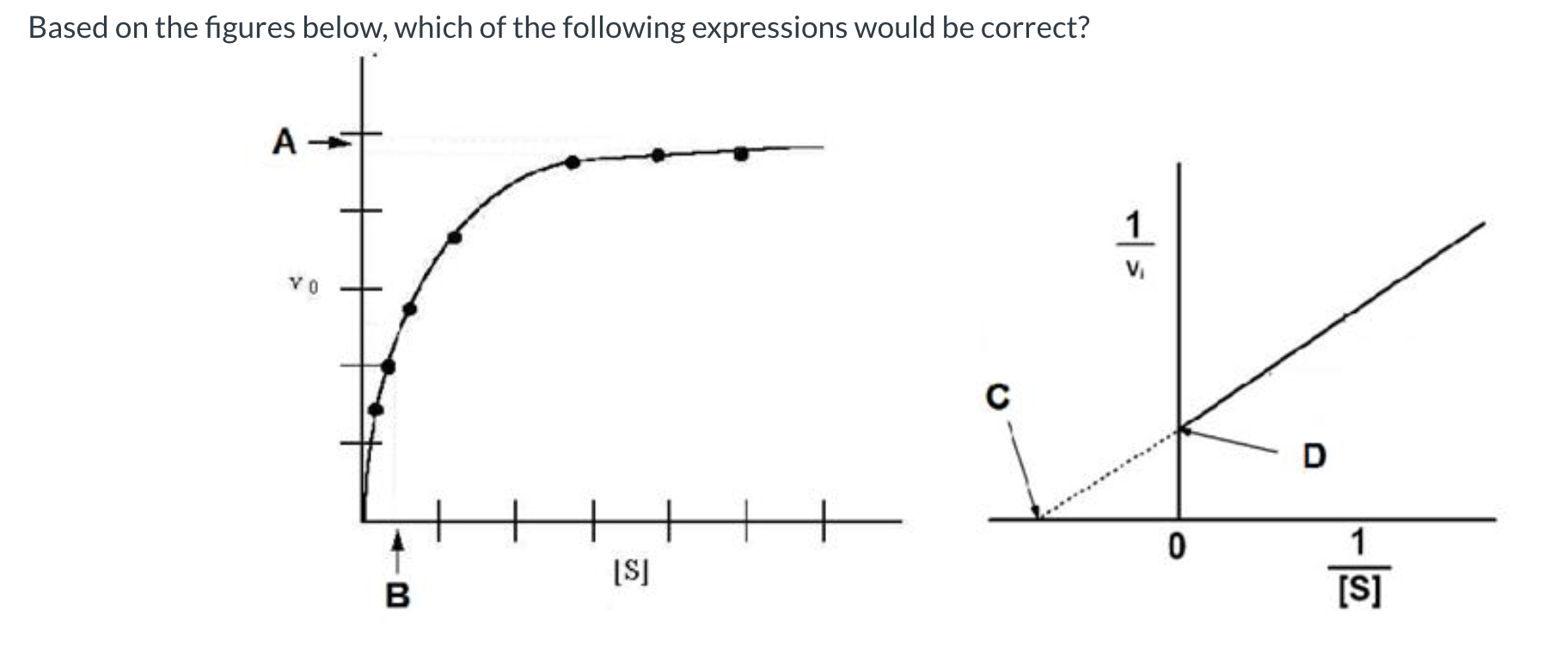
Vmax = 1/B
C = 1/ Vmax
D= Vmax
D = 1/ Vmax
D = 1/ Vmax
Parallel lines on a Lineweaver-Burk plot indicate
an increase in KM.
decrease in KM.
decrease in Vmax.
uncompetitive inhibition.
decrease in KM.
decrease in Vmax.
uncompetitive inhibition.

competitive inhibitor
uncompetitive inhibitor
mixed inhibitor
allosteric activator
competitive inhibitor
The effects of uncompetitive inhibition on Vmax are not reversed by increasing substrate concentration.
True
False
TRUE
Protein kinases are involved in
the digestion of drugs to potentially toxic byproducts.
the degradation of enzymes to the component amino acids.
the phosphorylation of a wide variety of proteins.
the metabolism of drugs to water soluble, excretable compounds.
the phosphorylation of a wide variety of proteins.
The catalytic activity of an enzyme can be regulated by controlling the amount of the enzyme available and by structural alterations of the enzyme that influence substrate binding.
True
False
TRUE
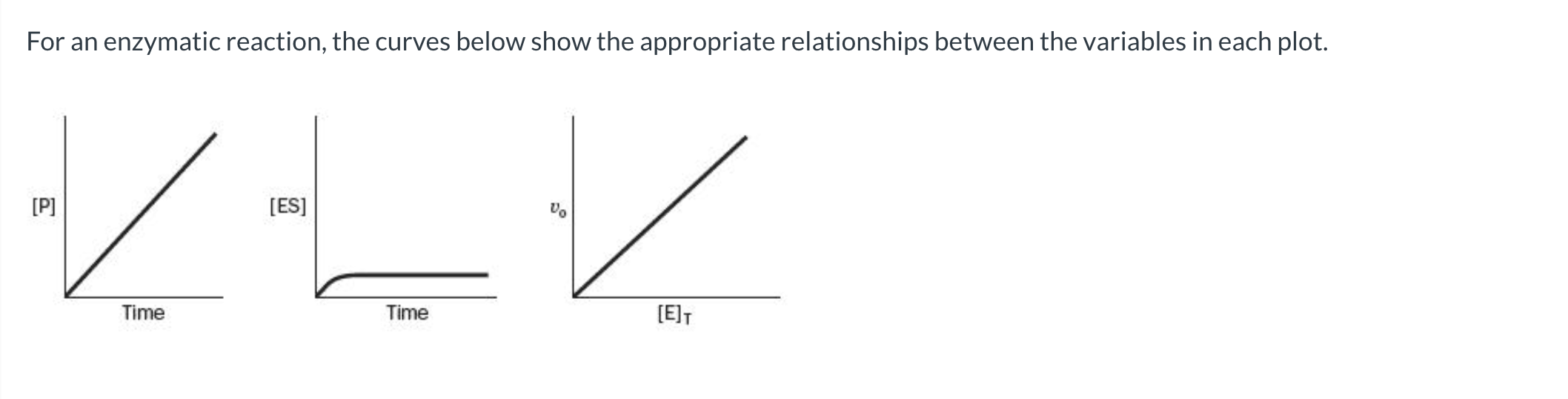
TRUE OR FALSE
TRUE
It is not necessary for velocity measurements to be made in units of concentration per time (M·s-1, for example) in order to calculate Km because the Km is a _____1 (the concentration when the _____2 velocity equals the _____3 velocity divided by two.
substrate
initial
maximum
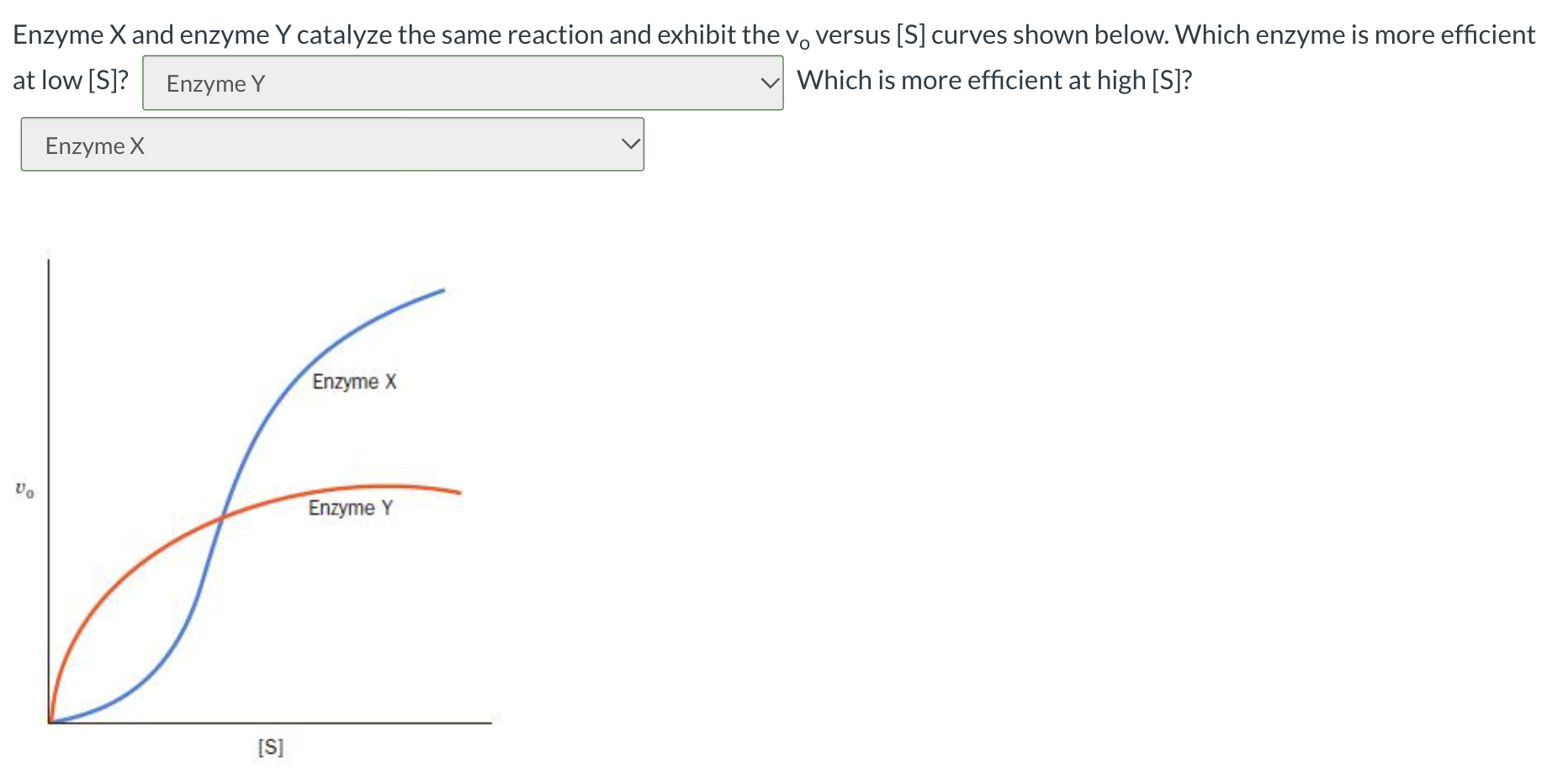
The effects of competitive inhibitors can be diluted out by substrate but those of uncompetitive and mixed inhibitors cannot.
True
False
TRUE
The Lineweaver-Burk plot is also known as the double- _____ plot.
reciprocal
______ reactions are enzyme reactions with two substrates.
Bisubstrate
The Michaelis-Menten equation describes a rectangular hyperbola.
True
False
TRUE
Substances that reduce an enzyme's activity by reversibly combining with the enzyme are called ______
inhibitors or reversible inhibitors
A ______ inhibitor binds only to the free enzyme, not to the enzyme-substrate complex
competitive
In ______ inhibition, the inhibitor binds only to the enzyme-substrate complex, not to the free enzyme.
uncompetitive
An enzyme's substrate-binding affinity may vary with the binding of small molecules called _____ effectors.
allosteric
Noncovalent modifications of an enzyme cannot significantly influence its activity.
True
False
FALSE
In ______ inhibition, the inhibitor binds both to the free enzyme and to the enzyme-substrate complex.
Mixed
If an inhibitor binds irreversibly to an enzyme, the inhibitor is called an _____
inactivator
A product is a ______ inhibitor if it inhibits an earlier step in its own biosynthesis.
feedback