C.3 Wave phenomena
 Call Kai
 Learn
Learn Practice Test
 Spaced Repetition
 Match
Match Flashcards
 Knowt Play
1/30

There's no tags or description
Looks like no tags are added yet.
Name | Mastery | Learn | Test | Matching | Spaced | Call with Kai | Chat |
|---|
No analytics yet
Send a link to your students to track their progress
31 Terms
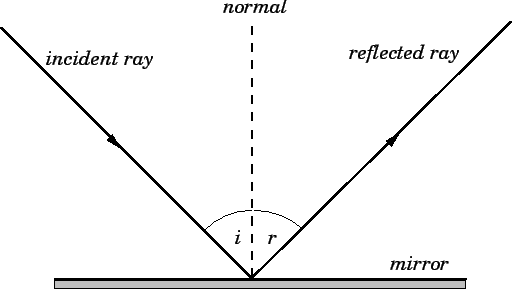
State the Law of Reflection
When a wave is reflected the incident angle is equal to the angle of reflection.
What do wave fronts show?
They show the parts of waves that are in phase with each other.
How wavelengths change across mediums.
Change in direction.(Rays also show this)
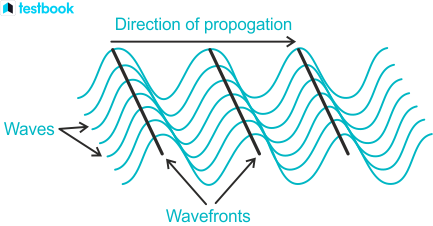
What are perpendicular to wave fronts and what do they show.
Rays are perpendicular to wave fronts and show direction of energy transfer.
What is a point source?
A source that emits waves in all directions.
When does wave speed change?
When:
The mass per unit length of a rope changes
The optical density of a transparent substance changes
The depth of water changes
What happens when a wave enters a medium with a lower wave speed?
The ray bends towards the normal.
What happens when a wave enters a medium with a higher wave speed?
The ray bends away from the normal.
Define refraction.
The change in wavelength, speed and direction of a wave as it passes through a new medium.
Define the index of refraction. What is the formula?
The Index of Refraction is the ratio of the speed of light in a vacuum to the speed of light in a medium.
n1 = c/v1
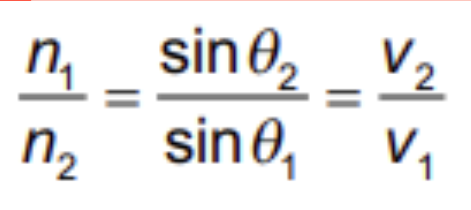
Define Snell’s Law. What is the formula ?
The relationship between the incident angle, refracted angle and speed of wave.
What happens when light enters a less optically dense medium?
The refracted angle is greater than the incident angle.
It speeds up
Wavelength increases

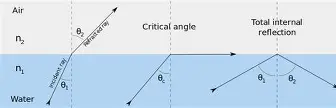
What is the critical angle and what happens when the angle is beyond this?
The angle at which the light is refracted along the boundary (i.e. r = 90). Any angle beyond this will result in total internal reflection.
What is the principle of superposition?
When two or more waves cross, the resultant displacement equals the vector sum of the waves.
Interference
The result of superposition of two or more values.
Constructive Interference
When two waves meet to make a larger displacement. If a crest and a crest meet or two waves are in phase then constructive interference occurs.
Destructive Interference
When two waves meet to make a smaller displacement. If a crest and a trough meet or two waves are out of phase then destructive interference occurs.
When are two waves said to be coherent?
If they have a constant phase difference between them. They also need to have the same wave speed, frequency and wavelength.
What is diffraction?
It is the spreading out of waves when they pass through a gap —> aperture/slit or around an obstacle .
Diffraction is greatest when the wavelength is comparable to the width of the slit.
What is Young’s Double Slit Experiment?
Two slits act as two coherent sources.
Curved wave fronts now overlap and interference occurs.
An interference pattern is produced on the screen with equally spaced bright and dark fringes.
When is a bright fringe produced?
When the rays arrive in phase - constructive interference.
When is a dark fringe produced?
When the rays arrive out of phase - destructive interference.
Two source inteference formula

What is Huygens Principle?
Huygens Described a wave front as a sum of multiple tiny wavelets created by each point in a medium.
The wave front of a travelling wave consists of circular wavelets created by every point on the previous wave front.
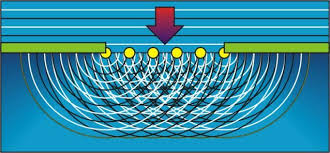
Single Slit Diffraction
A wave will diffract through a single slit
The greatest diffraction will happen when the wavelength is equal to the slit.
From Huygens Principle, each point on the wave can act as its own point source of wave.
Each point of the wave can interfere and superpose with another point on the same wave.
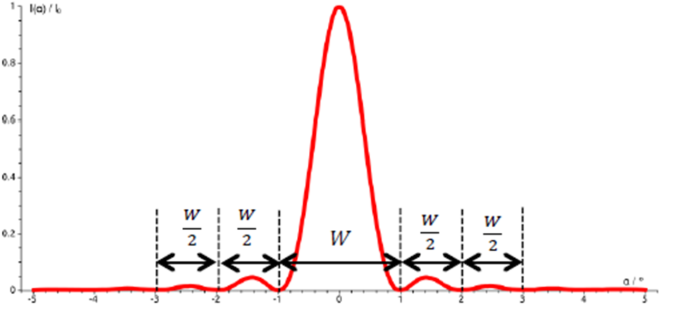
Compare the central maximum and the secondary maxima in the intensity angle graph.
Central maximum is double the width of the secondary maxima on either side.
And secondary maxima greatly reduce in intensity.
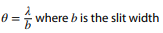
What is the single slit equation?
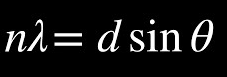
Multiple slit diffraction
The slit must be small therefore the single slit envelope gets very wide.
The slit spacing must be small therefore the primary maxima are spread out.
Many slits means many infinitesimally small secondary fringes
Primary fringes narrow and brighten
Multiple slit diffraction equation
Why is there no maximum in a double slit?
Double slit has a maximum that constructively interferes.
The single slit will have a minimum that destructively interferes.
The double slit pattern is modulated by the single slit.

How do you work out the number of secondary maxima and what happens when the number of slits increases?
N - 2 where N is the number of slits
Intensity of primary maxima increases
Primary maxima become sharper (narrower)
The secondary maxima become less bright
What do diffraction gratings do?
A diffraction grating contains many parallel slits,(typically hundreds of slits per mm.)
The grating produces bright maxima at discrete points on the screen.