Kidney pt. 2
 Call Kai
 Learn
 Practice Test
 Spaced Repetition
 Match
 Flashcards
 Knowt Play
1/147

There's no tags or description
Looks like no tags are added yet.
148 Terms
What is another name for acute kidney injury (AKI)?
Acute tubular necrosis (ATN)
More specific
What is the most COMMON cause of acute renal failure?
Acute kidney failure (AKI/ATN)
~50% of hospitalized cases
What is the primary structural injury in ATN?
Tubular epithelial injury
What is the characteristic functional change in AKI?
A rapid decline in renal function
Often with oliguria
Sometimes polyuria in toxic ATN
What urine output is considered oliguria in AKI?
<400 mL/day within 24 hours
What are the major causes of AKI/ATN?
Ischemia
Direct toxins
Acute interstitial nephritis
Urinary obstruction
Understand the flow of urine
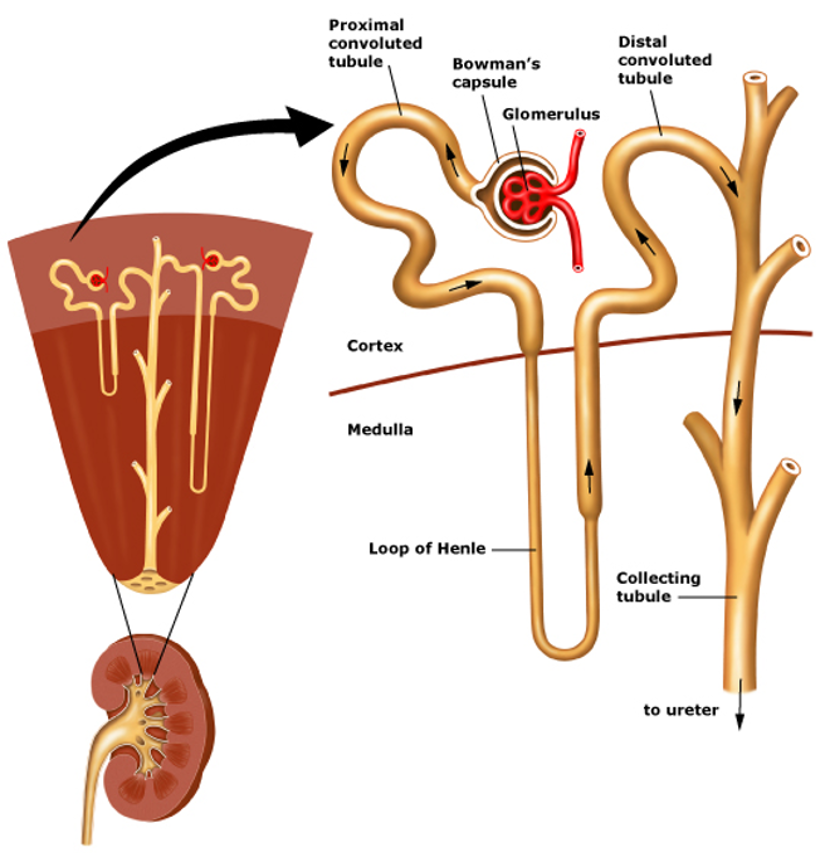
What are examples of ischemic causes of ATN?
Shock
Severe hypotension
Sepsis
Is ATN generally reversible?
Yes—Renal function often recovers once the underlying insult resolves
What causes ischemic ATN?
A period of inadequate renal blood flow
Usually associated with marked hypotension or shock
What is the characteristic distribution of tubular necrosis in ischemic ATN?
Focal necrosis scattered along the nephron with intervening “skip” areas
Tubulorrhexis
Cast obstruct lumens
What is tubulorrhexis?
Rupture of the tubular basement membrane
What happens to tubular lumens in ischemic ATN?
Sloughed epithelial cells and casts can obstruct the lumens
What cellular pattern is characteristic of ischemic ATN?
Necrotic/sloughed epithelial cells occur alongside regenerating cells with mitotic activity
What interstitial finding may occur in ATN?
Interstitial edema
Where is necrosis most prominent in nephrotoxic ATN?
The proximal convoluted tubule
What other portions of the nephron can be affected by nephrotoxic ATN?
Distal tubule
Loop of Henle
What are some causes of nephrotoxic ATN?
Drugs
Radiographic contrast agents
Poisons
Organic solvents
Myoglobin
Radiation
What is nephrotoxic ATN?
Extensive necrosis concentrated in the proximal convoluted tubular
Distal tubule/Loop of Henle can also be affected
What classic toxins cause nephrotoxic ATN?
Mercuric chloride
Carbon tetrachloride
Ethylene glycol
What crystal is associated with ethylene glycol toxicity?
Calcium oxalate crystals
What happens to tubular epithelial cells during ATN?
Some become necrotic and detach from the basement membrane
While others become:
Swollen
Vacuolated
Regenerate

What is an important morphologic difference between ischemic and nephrotoxic ATN?
Ischemic ATN — Patchy with skip areaa
Nephrotoxic ATN — More extensive proximal tubular necrosis

What are the three phases of AKI/ATN?
Initiation
Maintenance
Recovery
What occurs during the initiation phase of AKI?
Slightly decreased urine output
Rising BUN
Approximately how long is the initiation phase of AKI?
The first ~36 hours
What characterizes the maintenance phase of AKI?
Sustained oliguria
Volume overload
Hyperkalemia
Metabolic acidosis
What urine output may occur during the maintenance phase of AKI?
~40–400 mL/day
What happens during the recovery phase of AKI?
Urine output increases
Hypokalemia
Increased infection risk
Why can patients be at increased risk for infection during recovery?
Prolonged course of renal injury and recovery can increase susceptibility to infection
How long can recovery from ATN take?
Recovery can take months
What percentage of toxic ATN cases recover?
More than 95%
What factors are associated with poor outcomes in ATN?
Shock/sepsis
Burns
Multiorgan failure
(>50% mortality)
What characterizes tubulointerstitial nephritis?
Heterogenous group of renal disease
Tubular and interstitial abnormalities predominate over glomerular abnormalities
How can tubulointerstitial nephritis be classified?
Acute vs. chronic
Primary vs. secondary
What is the functional hallmark of tubulointerstitial disease?
Impaired urine-concentrating ability
What clinical findings can result from impaired urine concentration?
Polyuria
Salt wasting
Metabolic acidosis
What characterizes acute tubulointerstitial nephritis microscopically?
Interstitial edema
Leukocyte infiltration
Focal tubular necrosis
Which inflammatory cells are particularly associated with acute tubulointerstitial nephritis?
Neutrophils
Eosinophils
What characterizes chronic tubulointerstitial nephritis?
Mononuclear inflammation
Prominent interstitial fibrosis
Widespread tubular atrophy
Understand the additional causes if tubulointerstitial nephritis
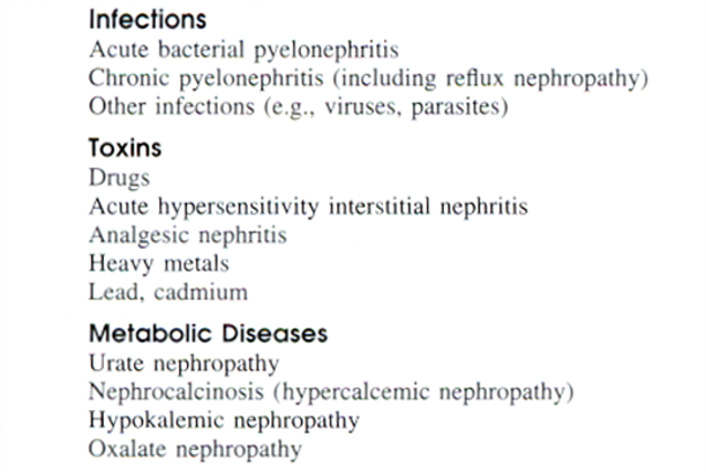

What is acute pyelonephritis?
A bacterial infection of the kidney
Associated with a urinary tract infection (UTI)
What are causes of chronic pyelonephritis?
Bacterial infection
Vesicoureteral reflux
Urinary obstruction
What is the most common route by which pyelonephritis develops?
Ascending infection from the lower urinary tract
What organisms commonly cause ascending pyelonephritis?
Intestinal gram-negative bacilli
Especially E. coli > Proteus > Klebsiella

Who is more commonly affected by ascending pyelonephritis?
Females > Males
Due to shorter urethra
What conditions promote ascending pyelonephritis?
Urinary obstruction
Vesicoureteral reflux
Urinary instrumentation
What is the less common route of renal infection?
Hematogenous spread
What conditions can produce hematogenous pyelonephritis?
Septicemia and infective endocarditis
What are risk factors for pyelonephritis?
Pregnancy
Preexisting renal lesions
Diabetes mellitus
Immunosuppression
HIV, chronic infection, drugs
What are the classic clinical features of acute pyelonephritis?
Fever
Malaise
Dysuria
Costovertebral angle pain
Pyuria w/ leukocyte cast


What does the presence of leukocyte casts suggest?
Renal inflammation/infection involving the:
Tubules
Interstitium
What is the characteristic gross/microscopic inflammatory pattern in acute pyelonephritis?
Patchy interstitial suppuration with:
Intratubular neutrophils
Tubular necrosis
What inflammatory cell is particularly characteristic of acute pyelonephritis?
Neutrophils (intratubular)
What are complications of acute pyelonephritis?
Papillary necrosis
Pyonephrosis
Perinephric abscess
Renal scarring
What is pyonephrosis?
Accumulation of pus within the renal collecting system
What is the typical gross appearance of acute pyelonephritis?
Variable, small (< 2 mm)
Yellow-white cortical abscesses
Zones of hyperemia
Friable

What are the major morphologic features of chronic pyelonephritis?
Chronic tubulointerstitial inflammation
Renal scarring
Deformed/dilated calyces

What are the two major forms of chronic pyelonephritis?
Reflux nephropathy
Chronic obstructive pyelonephritis
What is reflux nephropathy associated with in chronic pyelonephritis?
Congenital vesicoureteral reflux
Often presents in childhood
What causes chronic obstructive pyelonephritis?
Recurrent infections occurring in the setting of urinary obstruction
What is the classic cortical scarring pattern in chronic pyelonephritis?
Irregular, asymmetric, coarse corticomedullary scars
Often involving the upper and lower poles
Why are the upper and lower poles commonly affected in reflux nephropathy in chronic pyelonephritis?
Intrarenal reflux tends to occur at these locations
What is “thyroidization” of the kidney?
Tubular atrophy and dilation containing casts
Create a thyroid-like appearance
What microscopic findings characterize chronic pyelonephritis?
Interstitial fibrosis
Tubular atrophy/dilation
Chronic inflammation

What are the major clinical consequences of chronic pyelonephritis?
Insidious hypertension
Renal insufficiency
What does significant proteinuria in chronic pyelonephritis suggest?
Secondary focal segmental glomerulosclerosis (FSGS)
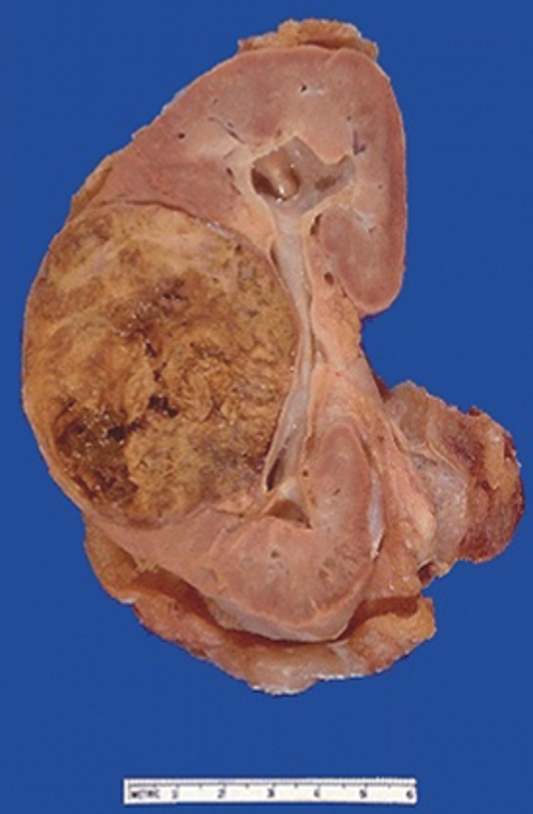
What is xanthogranulomatous pyelonephritis?
A rare, mass-forming variant of chronic pyelonephritis
What two conditions are strongly associated with xanthogranulomatous pyelonephritis?
Proteus infection
Urinary obstruction
What cells characterize xanthogranulomatous pyelonephritis?
Foamy macrophages
Plasma cells
Lymphocytes
PMNs
Occasional giant cells

What organism is classically associated with xanthogranulomatous pyelonephritis?
Proteus
Motile gram-negative rod with flagellated form
What is the significance of xanthogranulomatous pyelonephritis being “mass-forming”?
Can produce a renal mass-like lesion
What is the mechanism of acute drug-induced interstitial nephritis?
An idiosyncratic hypersensitivity reaction
When does acute drug-induced interstitial nephritis typically develop after drug exposure?
~2 weeks AFTER exposure
What drugs are commonly associated with acute drug-induced interstitial nephritis?
Synthetic penicillins
Sulfonamides
Diuretics
NSAIDs
What is the classic clinical presentation of drug-induced interstitial nephritis?
Fever
Rash
Eosinophilia
Hematuria
Mild proteinuria
What serious complication can acute drug-induced interstitial nephritis cause?
Acute renal failure
What hypersensitivity mechanisms can cause drug-induced interstitial nephritis?
Type I IgE-mediated
Type IV (delayed) hypersensitivity
What is the usual treatment for drug-induced interstitial nephritis?
Withdrawal of the offending drug
What is analgesic nephropathy?
Chronic renal injury associated with prolonged combined analgesic use
What analgesics are classically associated with analgesic nephropathy?
Phenacetin, aspirin, and acetaminophen combinations
What is the characteristic lesion of analgesic nephropathy?
Papillary necrosis
What renal disease develops from chronic analgesic use?
Papillary necrosis → Chronic tubulointerstitial nephritis
Which sex is more commonly affected by analgesic nephropathy?
Women > Men
What malignancy has a small increased risk with analgesic nephropathy?
Transitional cell carcinoma of the renal pelvis
What is NSAID nephropathy?
Loss of vasodilatory prostaglandins → Acute renal failure
What glomerular diseases can NSAIDs also cause?
Minimal change disease
Membranous glomerulonephritis
What is the gross appearance of kidneys in analgesic nephropathy?
Normal-sized or slightly reduced kidneys
Cortical depressions overlying necrotic papillae
Various stages of papillary necrosis
What happens to the renal papillae in analgesic nephropathy?
Papillary necrosis (unlike DM) can progress to:
Calcification
Fragmentation
Sloughing

What are the microscopic findings in analgesic nephropathy?
Papillary necrosis (patchy or complete)
Cortical atrophy
Interstitial fibrosis
Cortical columns of Bertin spared
What structures are spared in the cortex in analgesic nephropathy?
The cortical columns of Bertin
What causes acute urate nephropathy?
Precipitation of uric acid crystals within tubules and collecting ducts
When is acute urate nephropathy classically seen?
After tumor lysis
Especially following chemotherapy for leukemia or lymphoma
How does acute urate nephropathy cause AKI?
Uric acid crystals obstruct the tubules and collecting ducts
What causes chronic/gouty urate nephropathy?
Chronic hyperuricemia with urate deposition
What are the chronic morphologic changes of gouty nephropathy?
Tophi — Lesion of gout; Build-up of uric acid/crystal in blood in joints (feet/toes)
Cortical atrophy
Renal scarring
What type of kidney stone is associated with hyperuricemia?
Uric acid nephrolithiasis
What causes acute phosphate nephropathy?
High-dose oral phosphate exposure
Ex. Colonoscopy prep solutions
What is a clinical setting associated with acute phosphate nephropathy?
Use of oral phosphate solutions for colonoscopy preparation
What precipitates within the renal tubules in acute phosphate nephropathy?
Calcium phosphate