L93 Pathogenesis and Laboratory Detection of Pancreatitis
 Call Kai
 Learn
 Practice Test
 Spaced Repetition
 Match
 Flashcards
 Knowt Play
1/26

There's no tags or description
Looks like no tags are added yet.
27 Terms
Pathogenesis of Pancreatitis
Direct injury to pancreatic acinar cells by bacteria, ischemia, hypoxia → Inappropriate activation of trypsinogen to trypsin → Premature activation of proelastase and phospholipase in acinar cells to → Elastase and phospholipase A
Causes digestion of:
Pancreatic tissue → release of cytokines and free radicals
Mesenteric fat → lipemic plasma
Blood vessels → hemorrhage into pancreas ± effusion into peritoneal cavity
Pancreatitis release of proteolytic enzymes into systemic circulation leads to:
Consumption of plasma protease inhibitors (α-macroglobulins)
Multisystemic involvement
DIC & shock
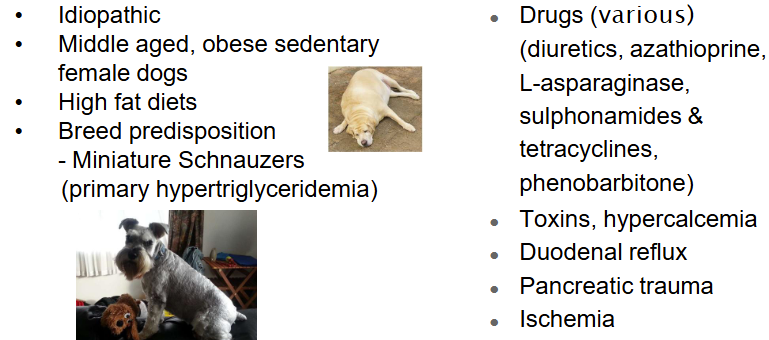
Causes / Risk Factors of Exocrine Pancreatic Inflammation - Pancreatitis in Dogs
Causes / Risk Factors of Feline Pancreatitis are Idiopathic
Infections (toxoplasma, coronavirus)
Hypotension due to anesthesia
Pancreatic trauma following road accidents, falls, surgery
risk factors for pancreatitis in cats
DM, Hepatic lipidosis, Enteropathies, Nephritis, IMHA
K-9 Pancreatitis: Clinical signs
Anorexia, depression, vomiting, diarrhea, weakness, abdominal pain
Can be non-specific, Sometimes death, Lipemic blood samples
Dogs that survive acute phase may develop chronic low grade pancreatitis
Feline Pancreatitis: Clinical signs are non-specific (vague)
○ Lethargy, anorexia, vomiting, weight loss, diarrhea
○ Dehydration, abdominal pain
○ Dyspnea, ataxia
○ Samples not necessarily lipemic
Canine vs Feline Pancreatitis

Hematology Findings in Canine Pancreatitis

Laboratory Findings / Evaluation of Feline: Hematology Pancreatitis
Relative erythrocytosis due to anorexia and fluid loss
Acute inflammation and DIC
Feline pancreatitis: Serum chemistry
Increased hepatic enzyme activity due to concurrent hepatic lipidosis or cholangitis
Azotemia pre-renal (most likely) or renal
Hypo/hyperglycemia, Hypertriglyceridemia is absent
Feline pancreatitis: Ultrasonography - routine diagnostic imaging technique
Should be part of the minimum database
Assess co-morbidities including liver and GI
Additional US changes can occur later in the disease process
Dog with acute pancreatitis: clusters of exocrine cells, (arrows), non-degenerate neutrophils and RBCs

Cat with acute pancreatitis: a cluster of acinar cells (arrow), non-degenerate neutrophils(arrowhead) and RBCs

Amylase & Lipase in Pancreatitis Questionable diagnostic relevance in pancreatitis in dogs & especially cats
Half-life = Amylase 5 hours, Lipase 2 hours, Should be run together
Measurement completely useless in large animals and cats
Non-pancreatic sources including: Intestinal (70%) & hepatic Lipase also gastric, LPL
Amylase and lipase sensitivity in testing
Amylase Sensitivity 55%; specificity 80%
Lipase Sensitivity 90%; specificity 80%
Amylase & Lipase in Pancreatitis Increases can occur in:
Renal disease (Azotemia up to 10x increases reported)
Corticosteroids (↑ lipase up to 5x normal, but can ↓ amylase)
Hepatic disease, neoplasia
Intestinal FB
Testing of choice for pancreatitis is?
pancreatic specific tests Canine cPLI or Feline (fPLI)
Species Specific antibody directed to pancreatic lipase molecule
Pancreatic-specific; measures lipase of pancreatic origin only
Pancreatic lipase Immunoreactivity (PLI)
Species-specific, thus fPLI (feline) and cPLI (canine)
Pancreatic lipase Immunoreactivity (snap and spec cPLI, fPLI)
Little enters blood in healthy pancreas vs larger amounts enter blood in pancreatic inflammation
No interference by hemoglobin, bilirubin, lipids, Not affected by sample transportation/ mailing
Precision testing: Measured by ELISA (or radioimmunoassay)
Snap PLI measured qualitatively in-house using ELISA
Spec PLI measured quantitatively in reference labs
High sensitivity (90%) & specificity (100%) for Acute pancreatitis
Reduced sensitivity and specificity for Chronic pancreatitis
IdexxSnap cPL
Semi-quantitative
Sensitivity 90%; specificity 77%
Should be confirmed with spec cPL
VetScan cPL rapid Abaxis
Quantitative assay
Sensitivity 83%%; specificity 83%
No interference by hemoglobin, bilirubin, lipids
SNAP PLI vs Spec PLI

Acute Pancreatitis

Chronic Pancreatitis

Pancreatic disease in large animals(rare)
Amylase and lipase are meaningless
Horses - Amylase increases usually mild and can be with intestinal diseases
50% of horses with proximal enteritis
25% of horses with other causes of colic