Astronomy Study
 Call Kai
 Learn
 Practice Test
 Spaced Repetition
 Match
 Flashcards
 Knowt Play
1/93

There's no tags or description
Looks like no tags are added yet.
94 Terms
kepler’s first law
planets orbit a star but star is off center called focal point
kepler’s second law
during part of an orbit, it goes fast, at another it goes slow (faster when closer to the star), speed not constant
kepler’s third law
orbital period is proportional to radius (closer to the sun = shorter the year)
T2 = r3 (time takes planet to orbit is proportional to distance to the sun)
newtons first law of motion
law of inertia
—> every object continues in its state of rest as long as there is no net force acting on it
(rest = rest, motion = motion, unless influenced by outside force)
newtons second law of motion
relation between acceleration and force
—> acceleration is proportional to force and inversely proportional to mass
(force is a product of mass and acceleration); F = ma
newtons third law of motion
whenever one object exerts a force on a second object, the second exerts an equal force in the opposite direction on the first (F1 = – F2)
50kg is how many newtons?
400 newtons
force exerted on an object by gravity, close to the surface of the Earth, where the gravitational force is nearly constant the ______ is…
FG = mg
weight
newtons law of universal gravitation
FORCE OF GRAVITY EQUATION
F = G × (m₁ × m₂) / r²
f = force
r = radius
m = masses
G = 6.67 × 10⁻¹¹
Given this information, use the force of gravity equation to solve:
F = G × (m₁ × m₂) / r²
mass of Sun: 1.99 × 1030 kg
mass of Earth: 5.97 × 1024 kg
radius from sun to Earth: 150,000,000,000m or 1.5 × 10¹¹
answer: 79.24/2.25 or 35.2 × 10²¹ N
GRAVITY FIELD STRENGTH EQUATION
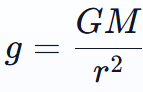
SATELLITES ORBITAL VELOCITY
v = orbital velocity
G = universal gravitational constant
M = mass of the central body (e.g., Earth)
R = radius of the orbit (distance from the center of the Earth)

in the FORCE OF GRAVITY EQUATION, what does G=?
F = G × (m₁ × m₂) / r²
G = 6.67 × 10⁻¹¹

SATELLITES ORBITAL VELOCITY
Given this information, use the force of gravity equation to solve:
r: 3.84 × 10⁸ m
ME = 5.97 × 1024 kg
Mm = 7.35 × 10²² kg
G = 6.67 × 10⁻¹¹
answer:
square root of 10.37 × 10⁵ or ~1,018

Given this information, use the orbital velocity equation to solve:
r: 1.5 × 10¹¹ m
MS = 1.99 × 1030 kg
G = 6.67 × 10⁻¹¹
answer:
square root of ~8.85 × 10⁸ or 29,249 mps (meters per second)
stellar spectroscopy
When light from a star passes through a prism, it reveals a
spectrum of colors interrupted by dark absorption lines.
stellar spectroscopy
Dark lines indicate ____________ in the star’s atmosphere
elements
stellar spectroscopy
The pattern of lines reveals…
chemical composition
stellar spectroscopy
___________ determines the strength of specific lines
temperature
OBAFGKM sequence
O and B
the hottest, most massive stars
bluish in color
temperatures over 20,000 K
OBAFGKM sequence
A, F, G
intermediate stars like our Sun
colors from white to yellow-white
OBAFGKM sequence
K and M
coolest star
red in color
temperatures below 5,000 K
COMMON
thermal radiation
all objects emit light based on their temperature
stars are near perfect blackbodies
blue is hot
high-energy photons have shorter wave lengths
class O stars peak in UV spectrum
red is cool
lower-energy photons have longer wavelengths
class M peak in infrared
the visible window
our eyes perceive the mix of these wavelengths as the star’s distinct color
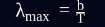
wien’s displacement law
b =

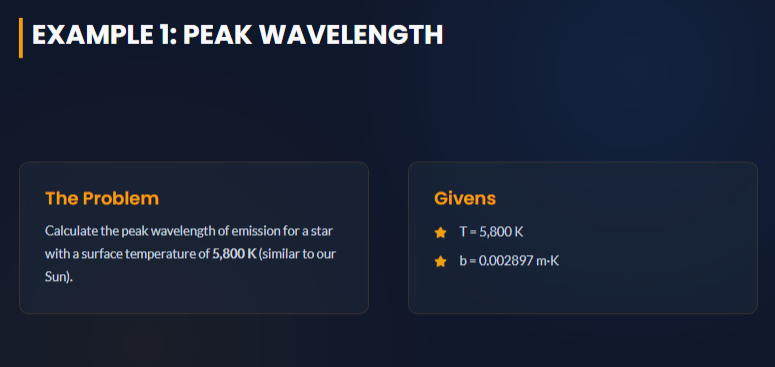
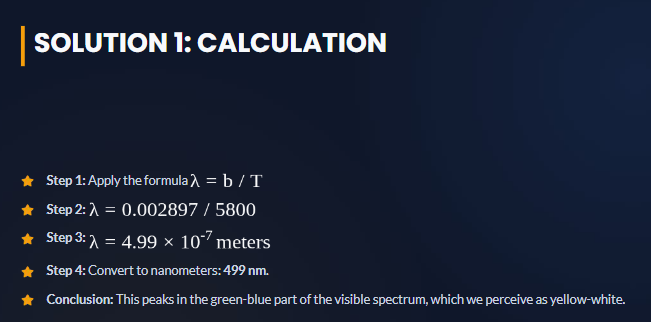
Use the Wien’s displacement Law equation: b/t where b is 2.897 × 10³ m x K
class I
type: supergiants
extremely large and luminous
class III
type: giants
large stars that have left the main sequence
class V
type: main sequence
dwarf stars fusing hydrogen
class WD
type: white dwarfs
hot, dense remnants of low-mass stars
stefan-botlzmann law equation


nebulae
stars are born in cold, dense clouds of gas and dust called __________
molecular clouds
Gravity begins to pull this matter from the nebulae together in a
process of fragmentation.
protostar
As the cloud collapses, it spins faster and heats up, forming
a ________ at its core.