Basic Pharmacology and Drug-Nutrient Interactions
 Call Kai
 Learn
 Practice Test
 Spaced Repetition
 Match
 Flashcards
 Knowt Play
1/56

There's no tags or description
Looks like no tags are added yet.
57 Terms
Why do we study pharmacology?

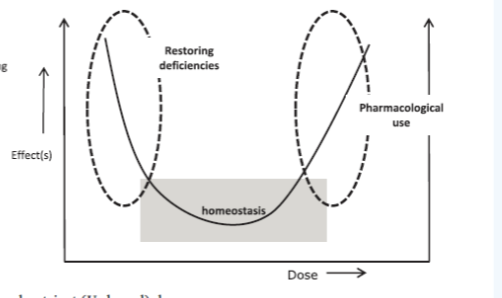
What is the difference between food dose response curves and pharma dose response curves?
drugs
sigmoid dose-response curve

nutrients
have a U-shaped dose-response curves
What is the connection between nutrients and oral drugs?
nutrients and oral drugs share same metabolic processes and can have overlapping molecular targets
Describe characteristics associated w/ the sigmoid dose response curve.
have a drug receptor interaction model; have a specific defined chemical structure and metabolic effects
may act at single site or multiple tissues
Describe characteristics associated w/ the U-shaped dose-response curve.
don’t function in isolation, act on multiple tissues and organ systems
typically consumed in various forms in mixed meals, multiple nutrients contained within a specific food and mixed meals, and nutrient effects are usually subtle compared to drugs
nutrients at high doses can have pharmacologic type of effects sand toxicity
What are xenobiotics?
a compound from outside the body
could be a nutrient, drug, environmental toxins, etc.
seen as foreign and thus our body tries to metabolize it
What is the issue w/ drug-nutrient interactions of clinical significance?
can lead to treatment failure, adverse side effects, and possible changes in nutritional status and malnutrition
potential for drug-nutrient interaction exists with all drugs
interactions are bi-directional

What are two things that indicate a drug-nutrient interaction is clinically significant?
alters the therapeutic drug response
compromises nutrition status
What are the four processes under pharmacokinetics?
ADME
absorption
distribution
metabolism
excretion

What are pharmacodynamics?
the goal for the medication, what you want to see in terms of effect aka the body’s physiologic response to a drug or combination of drugs
What is the role of membrane transport proteins present in intestinal epithelial cells?
facilitate absorption of polar drug compounds and function through numerous mechanisms
they act as gatekeepers to regulate uptake and efflux of nutrients and drugs
What are five examples of transporters for drugs, nutrients, and endogenous substrates?
ATP Binding Cassette transporter family (ABC transporters)
Solute Carrier Proteins (SLC) transporters
Organic anion transporting polypeptide (OATP) family of drug transporters
Peptide transport protein (PEPT) transporters
multidrug resistance protein (MRP)
General characteristics associated w/ membrane transport proteins.
found in many tissues, at apical and basolateral sides of cells
have many different isoforms
transport a wide range of substances
are capable of transporting large array of structurally divergent drugs
Describe first pass metabolism in terms of drugs?
oral medication come into the GI tract, taken across into the enterocyte where some metabolism occurs, then it goes out the basolateral side into the portal vein
from the portal vein it gets transported to the liver for further metabolism before it reaches systemic circulation
changes bioavailability (would be different if we give the drug via iv)

During first pass metabolism, what do we find in the enterocytes and hepatocytes?
biotransformation enzymes
What can biotransformation enzymes do? (2)
turn an active drug into less active/inactive
turn a pro drug (inactive/less active) into a more active drug
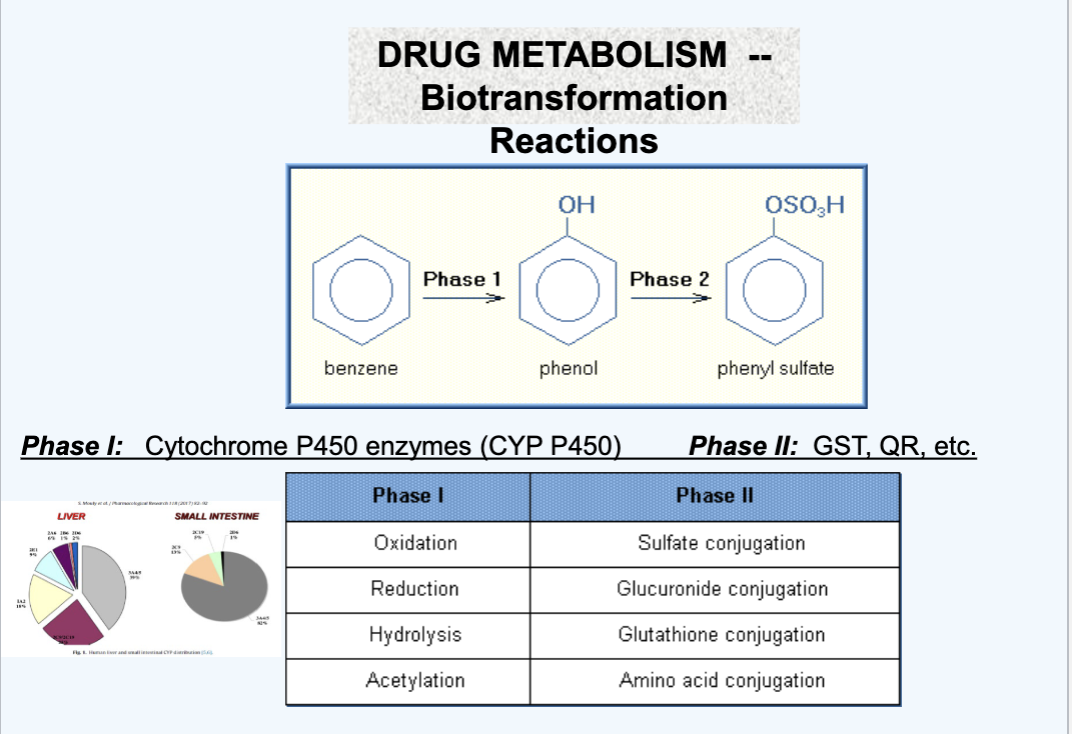
What are two phases that occur through biotransformation reactions carried out by biotransformation enzymes.
phase I reactions (non-synthetic)
phase II reactions (synthetic)
helps to make them be more polar so that they can circulate in the blood and be excreted from the kidney
What occurs during phase I reactions (non-synthetic)?
drugs are oxidized or reduced to a more polar form
What enzymes carry out phase I reactions?
cytochrome P45- enzymes (CYP P450)
What occurs during phase II reactions (synthetic)?
a polar group is conjugated to the drug
What enzymes carry out phase II?
GST, QR, etc.
What are 7 drug excretion routes?
urine
feces
exhaled air
sweat
saliva
tears
breast milk
What are 7 factors that can alter drug pharmokinetics and thus alter the physiological drug effects?
age and body weight
pregnancy status
smoking and drinking habits
GI physiology
liver or kidney disease
pharmacogenetics
drug-drug and drug-nutrient interactions
In general, what are two different ways that food and nutrition status can affect drug therapy?
alter drug absorption/availability
alter drug distribution and metabolism
How does food impact drug absorption and availability?
absorption can be decreased, delayed, increased, or unaffected by physiologic changes occurring in the GI tract when food is present
What are five things drug absorption is influenced by?
stomach and intestinal pH
gastric emptying/GI tract motility
absorptive capacity of cells
presence of food
presence of certain nutrients
How does stomach and intestinal pH influence drug absorption?
achlorhydria (decreased gastric acid secretion) w/ aging decreases drug absorption
How does gastric emptying/GI tract motility influence drug absorption?
high fat meals slow down gastric emptying rate
vomiting and diarrhea will alter absorption
both alter absorption
How does the absorptive capacity of the cells influence drug absorption?
malnutrition can damage the integrity of GI enterocytes and decrease absorption
How does the presence of food influence drug absorption?
some foods decrease and increase absorption
What are examples of drugs that have decreased and increased absorption as a result of the presence of food?
Fosamax (used to prevent osteoporosis and influence rebuilding of bone): if food is present then it decreases absorption of this drug
Levodopa (used for those w/ Parkinson’s): taken w/ proteins w/ neutral aas, absorption is decreased
some medication have increased absorption w/ CHO or fats
How does the presence of certain nutrients influence drug absorption?
calcium can chelate tetracycline (antibiotic) and decrease absorption
citrus juice can increase plant based Fe absorption
What are four examples of how food and nutrition can impact drug distribution and metabolism?
John’s Wort
Tyramine (pressor agents in food) + MAO inhibitor drugs
Vitamin K and Coumadin
Grapefruit
How does St. John’s Wort impact drug distribution and metabolism?
it is a herbal supplement that decreases the effectiveness of many drugs
How do Tyramine (pressor agents in food) + MAO inhibitor drugs impact drug distribution and metabolism?
when paired together, a hypertensive crisis is possible
What foods do people on MAO inhibitor drugs need to avoid?
foods high in tyramine
red wines
cured meats (salami)
aged cheeses
fermented foods
What is coumadin?
blood thinner medication to help reduce the rate at which blood clots form
import for conditions such as atrial fibrillation
blocks a vit K dependent step in clotting factor production, decreasing the amount of vit K that is recycled, inhibits bleeding a little bit
not all blood thinners interact w/ vit K, some newer ones have different mechanisms
What are 7 sources of foods high in vitamin K?
kale
spinach
turnip greens
collards
swiss chard
broccoli
brussel sprouts
What do we want to keep in mind for individuals who take coumadin?
want a consistent vitamin K intake, don’t want to avoid it all together
goal is to keep a balance between the amounts of vit K and the medication
How does grapefruit juice impact drug distribution/metabolism?
impacts at the level of biotransformation enzymes in phase I, aka CYP P450s
furanocumarins in grapefruit juice inhibit CYP3A4 enzymes (within cytochrome family) which affect the rate of Phase I drug biotransformation, slowing down the metabolism of the drug
What are examples of drugs affected by grapefruit juice? (3)
statin drugs (but not all)
calcium channel blocker drugs
immunosuppressant drugs
What are statin drugs used for?
used to lower cholesterol
ex: Lovastatin, Simvastatin, etc.
What are calcium channel blocker drugs used for?
used to decrease BP
ex: Nifedipine
What is an example of an immunosuppressant drug?
Cyclosporine
What are five ways that drugs can affect nutrient ingestion/appetite?
Changes in GI function
Decreased appetite via anorexic agents
Increased appetite
Alter or diminish taste perception or saliva production
Drugs w/ high caloric content
How does changes in GI function impact nutrient ingestion/appetite?
can cause nausea, vomiting, diarrhea, constipation
decreases want to eat
What are two types of unintended drugs that decrease appetite?
drugs that act on CNS
drugs for cancer treatment
What class of drugs intentionally decrease appetite?
anorexic agents
often used for weight management
What are three groups of anorexic agents for weight management?
adrenergic agents (amphetamines)
serotoninergic agents (phentermine, Lorcaserin)
GLP-1 receptor agonists (Ozempic, Wegovy)
What is the mechanism behind adrenergic agents (amphetamines)?
stimulates the secretion of norepinephrine
What is the mechanism behind serotoninergic agents (phentermine, Lorcaserin) ?
inhibit the reuptake of serotonin, and or norepinephrine
What is the mechanism behind GLP-1 receptor agonists (Ozempic, Wegovy) ?
slow GI motility and act on brain and other tissues
What is an example of a drug that unintentionally increases appetite?
corticosteroids
What is a drug that intentionally increase appetite?
Megestrol acetate
used in individuals w/ AIDS-related wasting syndrome or in treatment of cancer-related cachexia
What are two ways that taste perception are altered or diminished?
dysgeusia: altered in tate perception
hypogeusia: reduced acuity of taste perception
What is an example of a drug w/ high caloric content and thus alters nutrient ingestion/appetite?
propofal
sedative w/ 10% soybean oil, 1663 kcal/day