11. Enzyme Kinetics & the Michaelis-Menten Equation
 Call Kai
 Learn
 Practice Test
 Spaced Repetition
 Match
 Flashcards
 Knowt Play
1/15

There's no tags or description
Looks like no tags are added yet.
16 Terms
reaction velocity considering reaction A → B
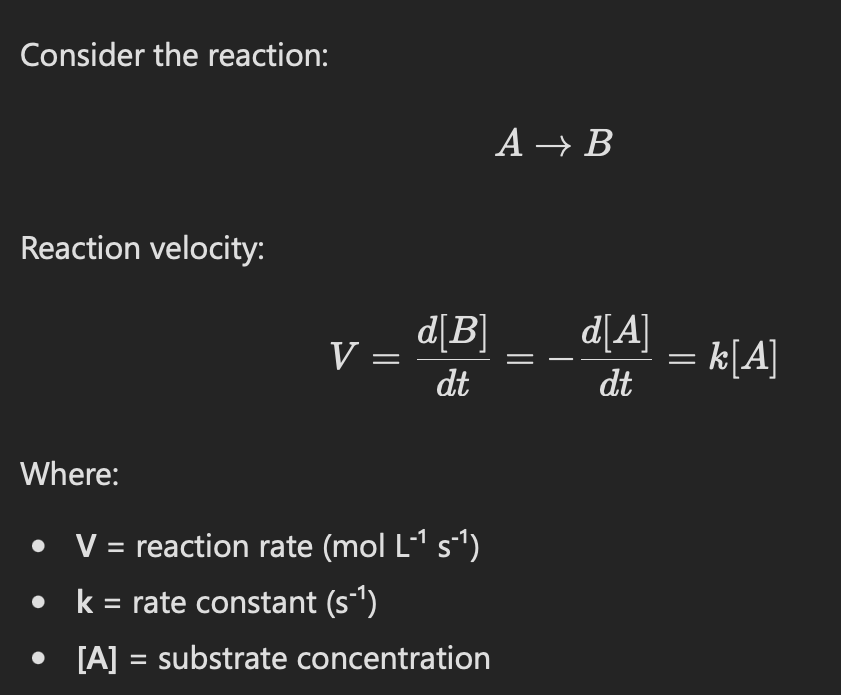
first order reaction
rate depends on first power of substate concentration:
V = k[A]
integrated rate equation
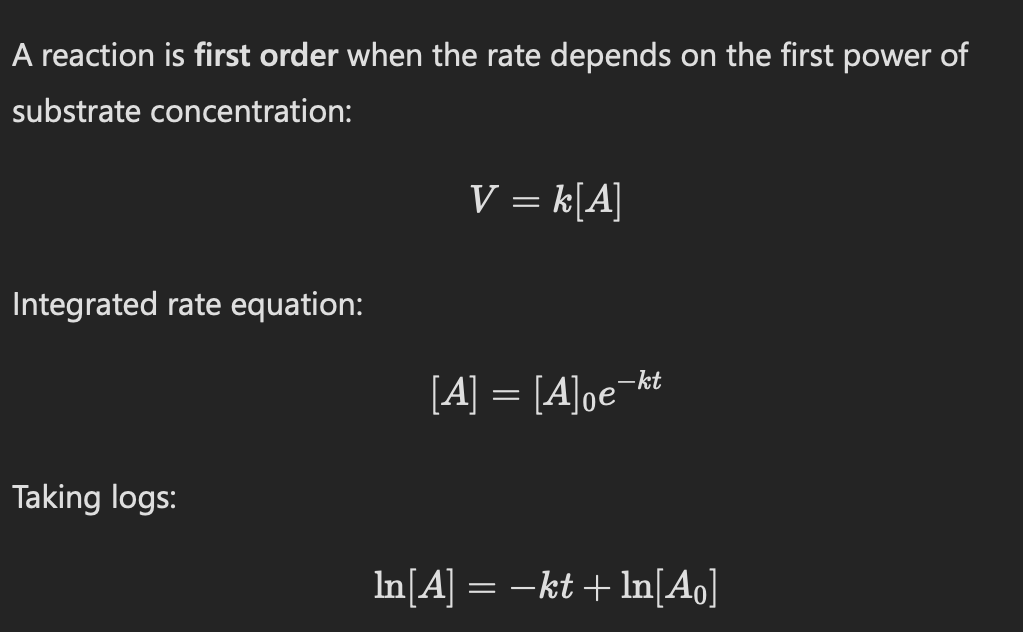
graph of ln[A] against time

gives a straight line and gradient = -k
rate equation
V = k1[A] − k2[B]
what does V = at equilibrium
0
what does rate of A equal at equilibrium
rate of B
equation for rate at equilibrium
equilibrium rate = concentration of B at equilibrium / concentration of A at equilibrium
so,
equilibrium rate = rate 1 / rate 2
do enzymes change rate at equilibrium
no, enzymes only increase the rate at which equilibrium is reached

equilibrium rate for trios phosphate isomerase: example

general scheme for basic enzyme kinetics

rate of product formation equation
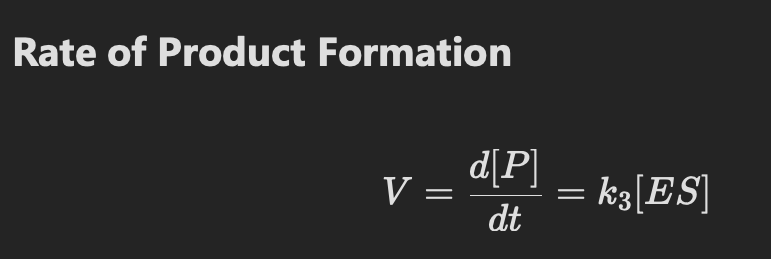
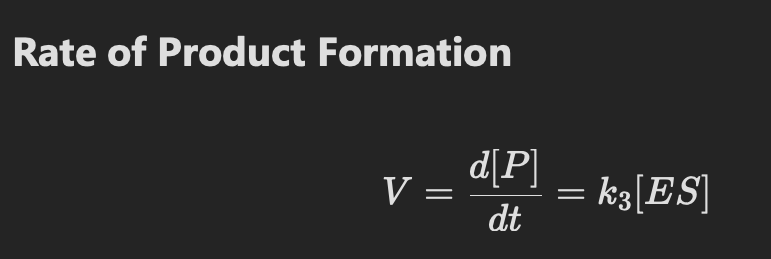
what does rate depend on in this equation
concentration of ES complex

enzyme saturation at low substate concentration
Many active sites are empty.
Increasing [S] greatly increases reaction rate.
enzyme saturation at high substrate concentration
All active sites become occupied.
Enzyme is saturated.
Rate approaches a maximum value (Vmax).

why does Vmax occur
At infinitely high substrate concentration:
Every active site is occupied.
No more ES complexes can form.
Rate cannot increase further.
