Astronomy Pre-Exam Chapters 1-4
 Call Kai
 Learn
Learn Practice Test
 Spaced Repetition
 Match
Match Flashcards
 Knowt Play
1/67

There's no tags or description
Looks like no tags are added yet.
Name | Mastery | Learn | Test | Matching | Spaced | Call with Kai | Chat |
|---|
No analytics yet
Send a link to your students to track their progress
68 Terms
Although all the known stars rise in the east and set in the west, we might someday discover a star that will rise in the west and set in the east.
This statement does not make sense. The stars appear to rise and set because of Earth's rotation. So, during the day, all the stars must move in the same direction.
In spring, the axis points toward
Polaris
This diagram represents a person's local sky. What does the red semicircle represent?
Meridian

This diagram represents a simplified model of the celestial sphere. The unlabeled circle that is highlighted in purple represents:
Celestial equator

What is the approximate latitude and longitude of the South American location marked by the black dot on this diagram?
latitude = 15°S, longitude = 45°W

When it is summer in Australia, the season in the United States is
Winter
If the Sun rises precisely due east,
It must be the day of either the March or the September equinox.
You observe a full Moon rising at sunset. What will you see at midnight?
A full moon high in the sky
Why do we always see the same face of the Moon?
We always see the same face of the Moon because the Moon displays synchronous rotation, meaning that the Moon's rotation period and its orbital period around Earth are the same.
A week after full moon, the Moon's phase is:
Third quarter.
What is this a picture of?
A total solar eclipse

When we see Saturn going through a period of apparent retrograde motion, it means:
Earth is passing Saturn in its orbit, with both planets on the same side of the Sun.
This multiple exposure photograph shows the apparent retrograde motion of Mars. To make this picture, the photographer needed to combine individual photos of Mars taken over a period of:
Several months

The north celestial pole is 35 above your northern horizon. What does it tell you?
You are at latitude 35 N
*Beijing and Philadelphia have about the same latitude but different longitudes.*
What can be said about the tonight's night sky in these two places?
The sky will look about the same
How does a 12-month lunar calendar differ from our 12-month solar calendar?
It has about 11 fewer days
The names of the 7 days of the week are based on _________.
The seven naked-eye objects that appear to move among the constellations
How did the Ptolemaic model explain the apparent retrograde motion of the planets?
The planets moved along small circles that moved on larger circles around the Earth.
The ancient Greeks get a lot of attention for their contributions to science because _________.
They were the first people known to try to explain nature with models based on reason and mathematics, without resort to the supernatural
What do we mean by a geocentric model of the universe?
A model designed to explain what we see in the sky while having the Earth located in the center of the universe.
This figure shows the circle upon circle motion of a planet in the Ptolemaic model. At which point(s) is the planet in the middle of its period of retrograde motion in our sky?
Point 2 only

When Copernicus first created his Sun-centered model of the universe, it did not lead to substantially better predictions of planetary positions than the Ptolemaic model. Why not?
Copernicus used perfect circles for the orbits of the planets.
Galileo observed all of the following. Which observation offered direct proof of a planet orbiting the Sun?
Phases of Venus
Earth is closer to the Sun in January than in July. Therefore, in accord with Kepler's second law:
Earth travels faster in its orbit around the Sun in January than in July.
Tycho Brahe's contribution to astronomy included:
Collecting data that enabled Kepler to discover the laws of planetary motion.
What its average distance (semimajor axis) from the Sun?
*Express your answer in astronomical units to three significant figures.*
Eris's semimajor axis = 67.7 a.u.
How does its average distance compare to that of Pluto?
*Express your answer to three significant figures.*
aEris
------ = 1.71
aPluto
The great contribution of Nicholas Copernicus was to _________.
Create a detailed model of our solar system with the Sun rather than Earth at the center
Which of the following was not observed by Galileo?
Stellar parallax
This diagram shows a planet at four points in its orbit around the Sun. At which of the points shown is it traveling slowest in its orbit? (The planet is not real, as all the planets of our solar system have orbits much more circular than the one shown.)
4

In science, a broad idea that has been repeatedly verified so as to give scientists great confidence that it represents reality is called _________.
Theory
Which of the following represents a case in which you are not
accelerating?
Driving in a straight line at 100 kilometers per hour
Why are astronauts weightless in the Space Station?
Because the Space Station is constantly in free-fall around the Earth
A net force acting on an object will always cause a change in the object's _________.
Momentum
Suppose you are in an elevator that is traveling upward at constant speed. How does your weight compare to your normal weight on the ground?
It is the same.
Compared to their values on Earth, on another planet
Your mass would be the same but your weight would be different.
The acceleration of gravity on Earth is approximately 10 m/s^2
(more precisely, 9.8 m/s^2). If you drop a rock from a tall building, about how fast will it be falling after 3 seconds?
30 m/s
Momentum is defined as _________.
Mass multiplied by velocity
Suppose you lived on the Moon. Which of the following would be true?
Your weight would be less than your weight on Earth, but your mass would be the same as it is on Earth.
The planets never travel in a straight line as they orbit the Sun. According to Newton's second law of motion, this must mean that _________.
A force is acting on the planets
If you want to make a rocket turn left, you need to:
Fire an engine that shoots out gas to the right.
Newton's Second Law of Motion tells us that the net force applied to an object equals its _________.
Mass multiplied by acceleration
Compared to its angular momentum when it is farthest from the Sun, Earth's angular momentum when it is nearest to the Sun is:
The same
When a spinning ice skater pulls in his arms, he spins faster because _________.
His angular momentum must be conserved, so reducing his radius must increase his speed of rotation
The energy attributed to an object by virtue of its motion is known as _________.
Mass-energy
Absolute zero
is _________.
0 Kelvin
What does temperature measure?
The average kinetic energy of particles in a substance
In the formula E = mc^2, what does E represent?
The mass-energy, or potential energy stored in an object's mass
The diagram above shows a planet at four positions in its orbit. At which position does it have the greatest angular momentum?
The angular momentum is the same at all four points.

The diagram above shows a planet at four positions in its orbit. At which position does it have the greatest gravitational potential energy?
3
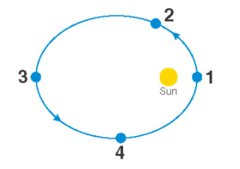
The diagram above shows a planet at four positions in its orbit. At which position does it have the greatest total orbital energy?
(Orbital energy is the sum of the planet's kinetic and gravitational potential energy.)
The total orbital energy is the same at all four positions.

Newton showed that Kepler's laws are _________.
Natural consequences of the law of universal gravitation
According to the universal law of gravitation, if you triple the distance between two objects, then the gravitational force between them _________.
Decreases by a factor of 9
Why is Newton's version of Kepler's third law so useful to astronomers?
It can be used to determine the masses of many distant objects.
Which statement must be true for a rocket to travel from Earth to another planet?
It must attain escape velocity from Earth.
Which of the paths shown represent unbound orbits?
Both 2 and 3

A television advertisement claiming that a product is light-years ahead of its time does not make sense because _________.
light-years can only be used to talk about light
it uses "light-years" to talk about time, but a light-year is a unit of distance
a light-year is an astronomically large unit, so a product could not possibly be so advanced
it doesn't specify the number of light-years
it uses "light-years" to talk about time, but a light-year is a unit of distance
Our solar system consists of _________.
the Sun and several nearby stars, as well as the planets and other objects that orbit these stars
a few hundred billion stars, bound together by gravity
the Sun and the planets, and nothing else
the Sun and all the objects that orbit it
the Sun and all the objects that orbit it
Which of the following has your "cosmic address" in the correct order?
You, Earth, solar system, Local Group, Local Supercluster, Milky Way Galaxy, universe
You, Earth, Milky Way Galaxy, solar system, Local Group, Local Supercluster, universe
You, Earth, solar system, Local Group, Milky Way Galaxy, Local Supercluster, universe
You, Earth, Local Group, Local Supercluster, solar system, Milky Way Galaxy, universe
You, Earth, solar system, Milky Way Galaxy, Local Group, Local Supercluster, universe
You, Earth, solar system, Milky Way Galaxy, Local Group, Local Supercluster, universe
When we look at an object that is 1,000 light-years away we see it _________.
looking just the same as our ancestors would have seen it 1,000 years ago
as it was 1,000 light-years ago
as it is right now, but it appears 1,000 times dimmer
as it was 1,000 years ago
as it was 1,000 years ago
Could we see a galaxy that is 20 billion light-years away? (Assume that we mean a "lookback time" of 20 billion years.)
No, because it would be beyond the bounds of our observable universe.
Yes, if we had a big enough telescope.
No, because a galaxy could not possibly be that far away.
Yes, we have already detected galaxies at that distance.
No, because it would be beyond the bounds of our observable universe.
If you could count stars at a rate of about one per second, how long would it take to count all the stars in the Milky Way Galaxy?
Several weeks
Several thousand years
Several days
Several years
Several thousand years
The star Betelgeuse is about 600 light-years away. If it explodes tonight,
we'll know because it will be brighter than the full Moon in the sky.
we won't know about it until about 600 years from now.
we'll know because debris from the explosion will rain down on us from space.
we won't know about it until about 600 years from now.
Where is our solar system located within the Milky Way Galaxy?
Very near the center of the galaxy
In the halo of the galaxy
At the far edge of the galaxy's visible disk
Roughly halfway between the center and the edge of the visible disk of the galaxy
Roughly halfway between the center and the edge of the visible disk of the galaxy
Consider a raisin cake expanding uniformly in an oven. Viewed from one of the raisins, you would see _____.
all raisins, including your own, growing in size as the cake expands
all other raisins moving away from you at the same speed
all other raisins moving away from you, with more distant raisins moving faster
all other raisins moving away from you, with more distant raisins moving slower
all other raisins moving away from you, with more distant raisins moving faster
Powers of 10…
10^1=
10²=
10³=
10^4=
10^0=
10^8=
10^-1=
10^-4=
10^-2=
10^-3=
10
100
1,000
10,000
1
100,000,000
0.1
0.0001
0.01
0.001
(10³x10²) + 10^-3=
10^5+0.001 (100,000.001)
100 Billion Stars =
10^11