Lecture 14: Cell Cycle 1 - DNA Replication and Mitosis
 Call Kai
 Learn
Learn Practice Test
 Spaced Repetition
 Match
Match Flashcards
 Knowt Play
1/43

There's no tags or description
Looks like no tags are added yet.
Name | Mastery | Learn | Test | Matching | Spaced | Call with Kai | Chat |
|---|
No analytics yet
Send a link to your students to track their progress
44 Terms
What is NASA's working definition of life?
A self-sustaining chemical system capable of evolution.
What is the overarching concept of the cell cycle?
When cells divide, two genetically identical sister cells are the products.
What are the phases of the cell cycle?
Interphase (G1, S, G2) and M phase (mitosis).

What occurs during the G1 phase of the cell cycle?
Cells perform normal functions including protein production.
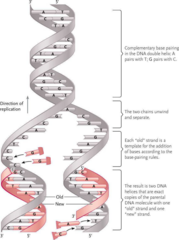
What happens during the S phase of the cell cycle?
DNA replication occurs, creating two identical copies of the genome.
What is the purpose of the G2 phase?
Cells continue normal activities, duplicate organelles, and prepare for mitosis.
What is the G0 phase?
Differentiated cells exit the cell cycle and perform specific functions in their tissue.
What makes up a nucleotide?
sugar, phosphate, nitrogen base
Which bases are purines?
Adenine (A) and Guanine (G)
Which bases are pyrimidines?
cytosine, thymine (DNA), uracil (RNA)
What type of bonds hold the backbone of DNA together?
Covalent phosphodiester bonds. (Hard to break)

What type of bonds hold the two strands of DNA together? (easy to break)
Hydrogen bonds between complementary base pairs (A+T and G+C).

What's on the 5' end of DNA?
phosphate group
What's at the 3' end of DNA?
Hydroxyl group
What is the purpose of polarity in DNA strands?
dNTP with three phosphates make a condensation reaction with 3' hydroxyl group
What happens in Initiation step?
proteins bind to DNA sequence in origin of replication (ori) to unwind and stabilize DNA.
What is the goal of the S phase?
To create two identical copies of the genome.
What is the role of DNA helicase during DNA replication?
It separates the strands of the double helix.
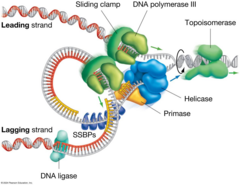
What do single-strand binding proteins do during DNA replication?
They stabilize single strands of DNA to prevent unwanted hydrogen bonds.
What is the function of topoisomerase in DNA replication?
It relieves strain caused by unwinding the DNA helix.
What does primase do during DNA replication?
It lays down an RNA primer to provide a starting point for DNA polymerase.

In what direction does DNA polymerase synthesize new DNA?
From 5' to 3'. (new DNA is added to the 3' end)

What happens during Elongation?
DNA polymerase binds to primer and adds complementary DNA bases
What is the difference between leading and lagging strand synthesis?
Leading strand is synthesized continuously, while lagging strand is synthesized in Okazaki fragments.
What are the 3 steps of lagging strand elongation?
RNA primers between Okazaki fragments are removed, DNA polymerase 1 fills in nucleotides, DNA ligase creates covalent bonds in the backbone between okazaki fragments
What are Okazaki fragments?
Short segments of DNA synthesized on the lagging strand during replication.
What is the role of DNA ligase in DNA replication?
It creates covalent bonds between Okazaki fragments on the lagging strand.
What happens to the RNA primers after DNA replication?
They are removed and replaced with DNA nucleotides by DNA polymerase I.

What is semi-conservative replication?
The process where each new DNA molecule consists of one parent strand and one new strand.

What occurs during the mitotic phase?
DNA condenses and is divided equally into two cells.
What are the stages of mitosis?
Prophase, Metaphase, Anaphase, Telophase, and Cytokinesis.
What is the function of histones in DNA?
They organize DNA in the nucleus.
What happens during interphase?
The cell grows, copies its DNA into two sister chromatids, and prepares for cell division.
What is a centrosome?
the centrosome is the region of a cell that contains the centrioles
What is a centriole?
Used by Animal Cells to produce spindle fibers that help with cell division
What happens during prophase?
chromosomes condense and spindle fibers form
What happens during prometaphase?
nuclear envelope breaks down, some spindle microtubules attach to the kinetochores of chromosomes and begin to move the chromosomes
What happens during metaphase?
1. The mitotic spindle is fully formed
2. The microtubules attached to kinetochores move the chromosomes to the metaphase plate, an imaginary plane equidistant from the poles.
What happens during anaphase?
The chromosomes separate and move along spindle fibers to opposite ends of the cell
What happens during telophase?
Chromosomes uncoil, spindle microtubules break down, nuclear envelope reforms.
What is cytokinesis?
Actin-myosin ring causes plasma membrane to close in, two daughter cells form
What is different about the process of bacterial cell division?
protein filaments separate copied DNA, membrane is pulled inward by protein ring
What is the structure of DNA?
Two antiparallel strands arranged as a double helix.

What is the significance of the 5' and 3' ends of a nucleic acid?
They determine the directionality of DNA synthesis.