Carbon Cycle
 Call Kai
 Learn
 Practice Test
 Spaced Repetition
 Match
 Flashcards
 Knowt Play
1/26

There's no tags or description
Looks like no tags are added yet.
27 Terms
The Earth formed approximately ____ billion years ago
This age comes from the age of the oldest _____ in our Solar System
Life greatly ______ in the most recent half billion years
4.5; meteorites; diversified
Rocks as Created and Destroyed over Time
There are three rock types:
______: formed from sediment
_____: formed from molten rock (associated with volcanoes)
______: altered by temperature and pressure
Sedimentary; Igneous; Metamorphic
Pathways move rock through the reservoirs in the rock cycle
Weathering and erosion generates _______
sediment

A: _________
B: _________
Weathering and erosion; Sedimentation
The Face of the Earth Changes Over Time
The cycle of _____ ______ causes plates to move relative to each other. This generates _______ and volcanoes
Over time, _____ continents and oceans form. ______ crust is modified or recycled
plate tectonics; earthquakes; new; Old
Ways to consider carbon in the earth system: ______ Carbon, _____ Term, Short Term, and Inorganic Carbon
Organic; Long

A: ______
B: ________
Inorganic Carbon; Organic Carbon
Carbon Reservoirs
Almost all carbon on Earth is stored in the _______ as rock
The majority of carbon is stored in _______ rocks
Remember that in system science:
A ______ is where material is stored for a period of time. Reservoir sizes are expressed in terms of ______
A _______ is how materials are transferred between reservoirs. This can also be expressed in terms of mass per unit _____
The _____ ______ is the average length of time that a substance spends in a given reservoir
geosphere; sedimentary; reservoir; mass; pathway; time; residence time
Steady State
If the rates of inflow and outflow to a system are equal, a system is at ______ ______. This is to say, the conditions are ______ over time
Without _________ carbon emissions, the Earth's atmosphere maintains a steady state because of this _______ feedback loop
steady state; constant; anthropogenic; negative
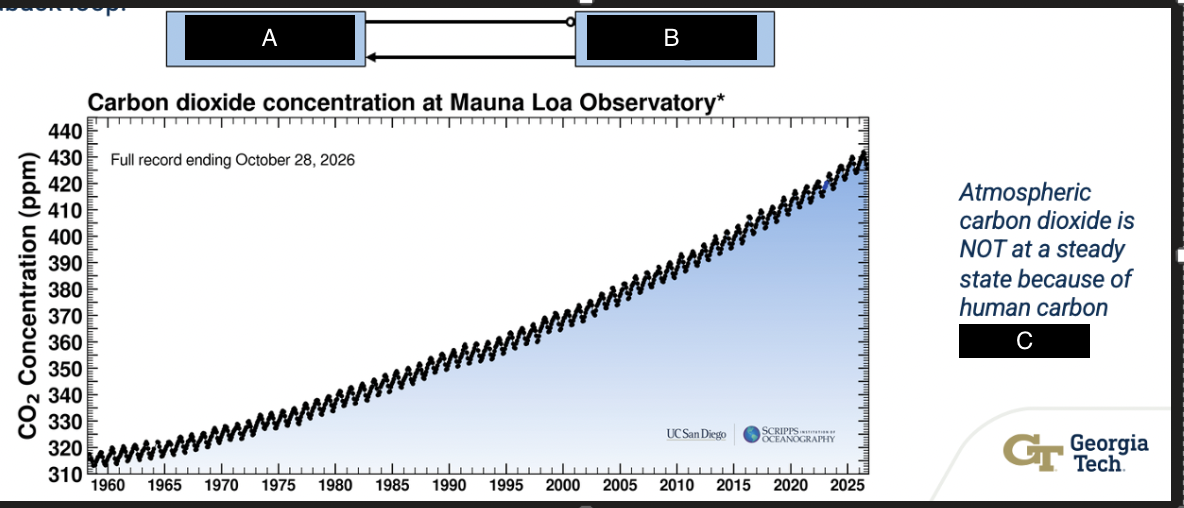
A: ______
B: _______
C: _______
Photosynthetic rate; Atmospheric CO2; emissions
Short-Term Carbon Cycle
________: the conversion of atmospheric inorganic carbon (CO2) to organic carbon (plant sugar)
________: the reverse of photosynthesis, where plant sugar and oxygen yield CO2 and water
________: the process by which plant material yields CO2 and CH4 in the absence of oxygen (this can happen in the wetland sediment)
Photosynthesis; Respiration; Methanogenesis
Don't Forget About the Ocean
_________ form the base of the oceanic food web. Their blooms can be seen from ______
Phytoplankton; space
Carbon in the Ocean: The Biological Pump
Ocean phytoplankton do not utilize atmospheric CO2 _____, rather, they utilize atmospheric CO2 that has _______ into the surface layer of the ocean
The ______ ______ refers to the transfer of carbon and nutrients from the shallow waters to the deep ocean
_____ ______ is the term used by oceanographers to describe carbon-rich material that sinks through the ocean
Consists of pieces of _______ (shed scales, pieces of tissue ripped apart during feeding), fecal material, and dead organisms
Because this process is driven by ______, larger, denser "snow" settles ______
________ brings cold, nutrient-rich bottom water to the surface. Regions were upwelling occurs have ______ fish populations because phytoplankton _______
directly; dissolved; Biological Pump; Marine snow; organisms; gravity; faster; Upwelling; abundant; flourishes;
Carbon in the Ocean: Burial in Sedimentary Rocks
Over geologic time, much marine snow is buried by _______
Low-temperature processes (_______) convert the sediment to sedimentary rocks. When organic material and cook the organic material to _______ (oil and natural gas)
Sizable deposits of petroleum can be exploited for _____ _____ development
Petroleum is ______ carbon locked in clastic _______ rocks, like shale
Mineral-rich sediment is delivered to the ______ by _____ because of ________ of _______ rocks
These minerals ______ into the ocean water and can be _______ throughout the ocean
Organisms use these nutrients to build ____:
Some build shells of _____ (SiO2)
Others build shells of ______ (CaCO3)
_____ ________ by organisms consumes CO2 and encourages CO2 diffusion from the atmosphere into the ocean
When these organisms _____, their shells make their way to the depths of the ocean
______, or CaCO3, is an inorganic, bioclastic or chemical sedimentary rock
sediment; diagenesis; petroleum; fossil fuel; organic; sedimentary; oceans; rivers; weathering; continental; dissolve; transported; skeletons; silica; carbonate; Carbon precipitation; die; Limestone

A: ______
B: _______
F: _______
C: _______
D: ________
E: _______
Above; dissolve; lysocline; carbonate compensation depth; Below; acidic
Carbon on Land: Burial in Sedimentary Rocks
When terrestrial plant materials are _____, _____ forms
_____ is compressed plant matter
Different ranks of coal form, based on how _______ they are. This compaction ______ void space, thereby ______ density and carbon content
The highest rank coal, ______, generates the _____ heat when burned. However, deposits are ______ abundant. The most commonly exploited coal rank in the United States is _____ coal
Coal is ______ carbon that makes up its own bioclastic sedimentary rock
buried; coal; Coal; compacted; reduces; increasing; anthracite; most; not; bituminous; organic
Fossil Fuels
Petroleum and coal are referred to as _____ _____ because the energy contained in them is "_____ ______". These are the products of ______, millions of year ago
These fossil fuels are _____ and combusted, _____ the natural timeline of carbon cycling through the _____. This is why CO2 concentrations are _____ at steady state in our atmosphere
fossil fuels; fossilized sunshine; photosynthesis; mined; accelerating; geosphere; not
Limestone Deposition happens in the _______. Fossils (clasts) of marine organisms in limestone. The fossils are surrounded by carbonate mud (chemical sediment). Some limestone is pure carbonate mud
ocean;
Ocean - Atmosphere Carbon Exchange (it goes both ways)
CO2 moves from _____ concentration to _____ concentration
Atmospheric CO2 ______ into the ocean in areas of high primary productivity. These areas are ________
______ brings those cold, nutrient-rich, and CO2 - rich waters up from the depths. CO2 outgasses from the ocean (moves from the _____ to the ______), this upwelling areas are ______ _____
high; low; dissolves; carbon sinks; Upwelling; ocean; atmosphere; carbon sources
Chemical Weathering
_____ _____, H2CO3, is naturally formed when carbon dioxide dissolves into water
Rainwater has a natural pH of _____ (slightly acidic) but can be made more acidic by _____ atmospheric CO2 concentrations, or by _______ in soils or wetlands
_______ ________ is the process that produces chemical sediment. Acids, even when dilute, can ____ ______ rock
Carbonic acid; 5-6; higher; enrichment; Chemical weathering; break down
Chemical Weathering of Carbonates and Silicate
_____ _______ breaks down carbonate rocks, like (sedimentary) limestone and (metamorphic) marble
______ _______ breaks down silicate rocks (which include sedimentary, igneous, and metamorphic rocks)
______ ________ consumes atmospheric CO2 (in the form of carbonic acid, H2CO3)
All other factors equal, carbonate weathering is much ______ than silicate weathering
Carbonate weathering balances ______ ________
Carbonate weathering; Silicate weathering; Chemical weathering; faster; carbonate precipitation
What about Silicate Weathering?
Silicate weathering consumes _____ the carbonic acid (H2CO3) that carbonate weathering does, therefore it consumes ____ the CO2
Some of the products of silicate weathering are _____ in carbonate precipitation
CO2 _____ into the ocean, creating _____ ______
SiO2 is utilized by ______ organisms that build ______ shells, like diatoms and radiolaria
twice; double; consumed; diffuses; carbonic acid; marine; silicate
The Carbonate - Silicate Geochemical Cycle
_______ ______ is stored for _____ periods of time in ______ (CaCO3)
____, as CO2, is ______ to the atmosphere through ______ and igneous processes
In ______ ______, carbonate (CaCO3) and silicate (SiO2) sediment is exposed to ______ temperatures and pressures. ________ converts the sediment/sedimentary rock to metamorphic rocks and CO2
If temperatures and pressures continue to ______, ______ can occur. Melts are ______ in the Earth and rise to its surface, erupting at volcanoes. Volcanic eruptions include molten rock and CO2
Carbonate metamorphism and igneous processes _____ silicate weathering, carbonate precipitation, and ocean-atmosphere exchange of CO2
Inorganic carbon; long; limestone; Carbon; returned; metamorphic; subduction zones; higher; Metamorphism; increase; melting; buoyant; balance
Rates in the Carbonate-Silicate Geochemical Cycle
The rate of chemical weathering is controlled by:
______: rates of chemical reactions increase with temperature
_______ ______: water dissolves mineral material and transports it downstream
Temperature; Rainfall amount

A: ______ ______
B: _______
C: _______ ______
D: ________ _______
Carbon Dioxide; Methane; Nitrous Oxide; Sulfur Hexafluoride
The Enhanced Greenhouse Effect & Climate Change
Like putting more blankets on the bed in the winter, adding _____ greenhouse gases to the atmosphere traps _____ heat
The greenhouse effect is ______ for life on Earth because it ______ surface temperatures where water exists in all three phases
Human addition of greenhouse gases is trapping ______ heat in our atmosphere, impacting the Earth's _____
more; more; essential; maintains; extra; climate
Greenhouse Gas Emissions in Georgia
The term ____ ______ refers to balancing greenhouse gas emissions with removals
Greenhouse gas _______ can be completed through _______: the process of storing carbon by enhancing a sink
Removing carbon from the atmosphere is also referred to as ______ or carbon removal
The IPCC refers to this same concept as _____ ______ _____ (CDR)
net zero; removals; sequestration; drawdown; carbon dioxide removal