L8Microbial Genetics+inclass
 Call Kai
 Learn
 Practice Test
 Spaced Repetition
 Match
 Flashcards
 Knowt Play
1/66

There's no tags or description
Looks like no tags are added yet.
67 Terms
Define RecA
is a bacterial protein that helps repair damaged DNA. It binds single-stranded DNA and helps match it with a similar DNA sequence, allowing the cell to repair the damage through homologous recombination. It also helps trigger the SOS response, a system bacteria use when DNA damage is severe.
Define Lateral (or Horizontal) Gene Transfer
gene transfer between unrelated cells
Define Vertical Gene transfer
gene transfer from mother to daughter cells
Define Transformation
gene transfer by taking up soluble DNA from the environment
Define Transduction
gene transfer by means of bacteriophages. Can be generalized or specialized.
Define Conjugation
gene transfer that requires cell-cell contact. Includes R plasmid, F plasmid, F’ plasmid, Hfr transfer.
Define Natural Transformation
A naturally competent bacterium takes up environmental DNA without human intervention. (naturally competent cells can be found in dense cultures. The DNA source for natural transformation is thought to be from dead or lysed cells, although this is controversial.)
Define Artificial Transformation
Scientists make chemically competent cells take up DNA in the lab, often using chemicals and heat shock or electroporation (DNA entry through transient holes in cell membranes made by a pulse of high voltage). This is a fundamental technique in recombinant DNA technology
Define Competence
The ability of a prokaryotic cell to take up DNA from its surroundings, which is the first step in transformation.
Define Phage
A common name for bacteriophage, i.e., for viruses that infect Bacteria .
Define Virulent Phage
a type of bacteriophage (a virus that infects bacteria) that strictly/always follows the lytic cycle to reproduce.
Define Temperate Phages
a type of bacteriophage (a virus that infects bacteria) that can replicate using the lytic cycle or the lysogenic cycle.
Define Lytic Cycle
The series of actions of a lytic phage beginning with cell entry and culminating with release of progeny virions by host lysis.
Define Lysogenic Cycle
A phage that, at the start of each infection, has the option to either replicate immediately or choose lysogeny .
Define Lysogeny
A phage life cycle in which the phage postpones lytic replication and resides in the host as a prophage.
Define Prophage
The DNA of a temperate phage in a lysogen, typically inserted in the chromosome of the host cell. Some of its genes may be transcribed but genes for lytic replication are repressed.
Define Lysogen
A prokaryote that contains one or more prophages
Define F plasmid (fertility plasmid)
is a circular DNA molecule in some bacteria, such as E. coli. It carries genes that enable a cell to form a sex pilus and enables horizontal gene transfer to another cell by conjugation. A cell with the F plasmid is called F⁺.
Define Hfr strain (High Frequency Recombination strain)
a bacterium that has a conjugative fertility (F) plasmid integrated directly into its main circular chromosomal DNA rather than existing as a separate, free-floating plasmid.
Define F’ strain
a bacterial strain that carries an autonomous F-plasmid containing a segment of host chromosomal DNA, formed through the imprecise excision of an integrated F-factor from an Hfr (High-Frequency of Recombination) strain
Define R plasmid (Resistance plasmid or R-factor)
a specific type of plasmid that carries genes conferring resistance to antibiotics, heavy metals, or cellular toxins.
Define Virulence Plasmid
a small, circular piece of extra-chromosomal DNA found in bacteria that carries genes responsible for turning a strain into a pathogen capable of causing disease.
Define oriT (Origin of Transfer)
A specific DNA sequence on a conjugative plasmid where a relaxase enzyme makes a single-stranded cut ("nick") to initiate the directional transfer of DNA into a recipient cell during bacterial conjugation.
Define tra (Transfer) genes
A cluster of genes on conjugative plasmids that encode the structural and enzymatic components—such as the sex pilus and relaxosome machinery—required to execute bacterial conjugation.
Define Mutation
any change in a cell’s DNA sequence. Mutations can be small changes (point mutations) or large changes (e.g. deletions, insertions) in DNA.
Define Mutagen
A physical or chemical agent (such as UV radiation or specific chemicals) that alters DNA, increasing the frequency of mutations above natural background levels.
Define Genetic screen
An experimental procedure used to search a large, mutagenized population of organisms to identify and isolate rare individuals exhibiting a specific, altered phenotype or trait. (Find out the function of a specific gene)
How is gene exchange in eukaryotes different from gene exchange in prokaryotes?
Many eukaryotes (but not all) reproduce sexually, which requires meiosis and fusion of gametes | Prokaryotic reproduction never requires gene exchange. Prokaryotes reproduce asexually, by binary fission or budding. |
Genetic exchange among eukaryotes occurs only by gamete fusion. | In contrast, prokaryotes have 3 different mechanisms for gene exchange: transformation, transduction, and conjugation. |
In sexual reproduction of eukaryotes all of the DNA mixes during gamete fusion. | During prokaryotic gene exchange, only a relatively small amount of DNA is transferred
|
Most higher eukaryotes are diploid | Prokaryotes are haploid. Thus, recessiv alleles or mutations are expressed in prokaryotes. This property streamlines genetic studies with prokaryotes. |
What mechanisms are commonly used for gene exchange in eukaryotes vs in prokaryotes?
Genetic exchange among eukaryotes occurs only by gamete fusion. In contrast, prokaryotes have 3 different mechanisms for gene exchange: transformation, transduction, and conjugation.
Why is gene exchange important?
Gene exchange is important because it drives genetic diversity, which serves as the fundamental engine for evolution, adaptation, and survival. Without genetic exchange, populations become uniform clones, making them incredibly vulnerable to sudden environmental changes, diseases, and harmful genetic mutations.
What needs to happen or be present before genes on a foreign piece of DNA can be inherited by progeny bacterial cells?
Transferred DNA must be integrated into a chromosome or plasmid, or be a plasmid itself to be inherited by progeny.
Condition 1: If the foreign DNA is an autonomous molecule (like a plasmid), it must possess a functional origin of replication
Condition 2: The DNA must physically integrate into the Host Chromosome
If the foreign DNA is a linear fragment (such as DNA picked up via transformation or delivered via transduction), it cannot replicate on its own. It must become a physical part of the bacterium's main circular chromosome. This integration requires:
Homologous Recombination Machinery: The recipient bacterium must possess functional recombination proteins, most notably the RecA enzyme.
If a linear piece of foreign DNA enters a bacterial cell, what are its possible fates?
1. Degradation (Destruction):
If the DNA fails to integrate quickly, the cell's defense systems—specifically host nucleases and restriction enzymes—will recognize it as foreign and chop it up into individual nucleotides to be recycled by the cell.
2. Integration (Recombination):
If the foreign DNA has enough sequence similarity to the host's genome, it can undergo homologous recombination (facilitated by bacterial proteins like RecA). It physically splices itself directly into the host bacterium's main chromosome, allowing it to be permanently maintained and replicated whenever the cell divides.
If a plasmid enters a bacterial cell, what are its possible fates?
Stable Autonomous Replication (Maintenance)
This is the most common and successful outcome. If the plasmid is compatible with the host cell, it establishes itself as an independent genetic element.
The Process: The plasmid's origin of replication (ori) is recognized by the host cell's replication machinery.
The Outcome: The plasmid replicates independently of the main chromosome. When the bacterium undergoes binary fission, copies of the plasmid are distributed to the daughter cells, ensuring the plasmid is inherited by progeny.
How is lateral gene transfer different from vertical gene transfer?
Vertical Gene Transfer (VGT): This is the traditional "parent-to-offspring" transmission of genetic material. In bacteria, it happens through binary fission (cloning), where a parent cell copies its entire genome and passes it down to its daughter cells. It follows a strict generational line, preserving ancestral lineages.
Lateral Gene Transfer (LGT)—(also known as Horizontal Gene Transfer): This is the transfer of genetic material between organisms that are not parent and offspring. Crucially, LGT can occur across vast evolutionary distances—meaning a bacterium can acquire genes from an entirely different species, genus, or even phylum.
Why does lateral gene transfer make the study of bacterial evolutionary relationships difficult?
Lateral gene transfer confounds taxonomists studying prokaryotes, where due to lateral gene transfer, organisms with similar genes may not have evolved from a common ancestor.
How is transformation different from the other two mechanisms of genetic exchange?
Mode of Transfer: This process involves the uptake of "naked" extracellular DNA directly from the surrounding environment. For transformation to occur, the recipient bacterium must be in a physiological state called competence, allowing it to transport DNA fragments across its cell wall and membrane. No physical contact between cells or external vectors are required.
Types of Genes Transferred: Typically limited to small, random fragments of chromosomal DNA or small plasmids released into the environment when nearby cells lyse (burst open).
How is transduction different from the other two mechanisms of genetic exchange?
Mode of Transfer: This process is mediated entirely by bacteriophages (viruses that infect bacteria). When a phage infects a bacterium, it hijacks the cell's machinery to make new viruses. During viral assembly, the phage accidentally packages a piece of the host bacterium's DNA instead of its own viral genome, injecting that bacterial DNA into the next cell it infects.
Types of Genes Transferred:
Generalized __: Any random fragment of the host's chromosomal DNA can be packaged and transferred. (Result of an error in phage replication –packaging bacterial DNA into a phage head rather than phage DNA, by accident)
Specialized __: Only specific, restricted sets of host genes—specifically those located right next to where a temperate phage integrates into the chromosome—are transferred. (production of transducing phage from a rare mistake in prophage excision from the chromosome, leads to infection of a recipient cell by a transducing phage)
How is conjugation different from the other two mechanisms of genetic exchange?
Mode of Transfer: requires direct physical contact between two living cells. A donor cell forms a specialized protein tube called a sex pilus (or mating bridge) to attach to a recipient cell and directly transfer a single strand of DNA.
Types of Genes Transferred: Primarily plasmids (such as resistance plasmids or virulence plasmids). Because plasmids often carry genes that benefit survival under stress, conjugation is a primary driver for spreading multi-drug resistance and pathogenicity across bacterial populations. Sometimes, if a plasmid has integrated into the chromosome (an Hfr strain), large chunks of chromosomal DNA can also be transferred. (In general, a much larger quantity of DNA can be transferred by means of ____ than by transformation or transduction.)
Describe the two strains of the pneumococcus bacterium Griffith worked with in his 1928 experiment with pneumococcal infections in mice
The S (Smooth) Strain: Covered by a smooth polysaccharide capsule. This capsule protects the bacteria from the host's immune system, making it virulent (pathogenic) and deadly to mice.
The R (Rough) Strain: Lacks the protective capsule. Because the immune system can easily clear it, this strain is non-virulent (harmless).
What are the four stages Griffith performed his 1928 experiment with pneumococcal infections in mice
Stage 1: Injected mice with living S-strain → The mice died of pneumonia. → Live S cells recovered in blood.
Stage 2: Injected mice with living R-strain → The mice lived. → No Live R Cells recovered in blood.
Stage 3: Heat-killed the deadly S-strain, then injected it → The mice lived. -> No Live S Cells recovered in blood.
Stage 4: Mixed the heat-killed S-strain → with the living R-strain and injected the mixture → The mice died. → Live R cells with S capsule recovered in blood
What conclusion did Griffith make from his 1928 experiment with pneumococcal infections in mice ?
Conclusion: something from the dead S cells had “transformed” the R cells, making them smooth and virulent. (establishes his “transforming principle”)
In 1944, Avery, MacLeod, and McCarty discovered that the “transforming” material was DNA.
How is generalized transduction different from specialized transduction? Consider what “mistake” occurs in each process, which type of phage can perform each, which genes can be transferred, and how the transferred genes can be inherited by progeny cells.
generalized transduction: any of the host bacterium’s genes can be transferred
Mediator: Virulent or temperate phages
DNA in transducing particle: only host cell DNA
Genes transduced: Any host gene
ANY bacterial gene could be transferred to a recipient bacterial cell due to an error in phage replication (packaging bacterial DNA into a phage head rather than phage DNA, by accident)
specialized transduction: only certain genes can be transferred
Mediator: Only temperate
DNA in transducing particle: Phage and host cell DNA
Genes transduced: Only genes close to insertion site of prophage
Production of transducing phage from a rare mistake in prophage excision from the chromosome leads to infection of a recipient cell by a transducing phage
If specialized transduction occurs, the same genes are always excised!
How is F plasmid conjugation different from the other two forms of conjugation? Consider the genes that can be transferred and how the transferred genes can be inherited by progeny cells.
The donor cell carries a separate, autonomous F plasmid.
Genes Transferred: Only the genes encoded on the F plasmid itself (such as genes for the sex pilus, surface exclusion, and plasmid replication). Host chromosomal genes are left behind and not transferred.
Inheritance by Progeny: The recipient cell receives a complete copy of the F plasmid, turning it into a new donor (F+). Because the F plasmid possesses its own origin of replication, it replicates independently within the cell and is passed down to all daughter cells via standard plasmid segregation during binary fission.
How is Hfr plasmid conjugation different from the other two forms of conjugation? Consider the genes that can be transferred and how the transferred genes can be inherited by progeny cells.
the F plasmid physically integrates directly into the host bacterium's main chromosome, creating an Hfr strain.
Genes Transferred: During conjugation, the transfer machinery starts inside the integrated F plasmid sequence and begins dragging a long, linear chunk of the host bacterium's chromosomal genes along with it into the recipient cell. (The amount of DNA transferred depends on the amount of time the conjugation lasts.). Because conjugation usually breaks before the entire chromosome can cross, the recipient almost never receives the complete tail-end of the F plasmid, meaning the recipient remains F- (non-donor).
Inheritance by Progeny: Because the transferred host genes are linear and lack an independent origin of replication, they cannot survive on their own. For progeny cells to inherit them, the linear fragments must undergo homologous recombination with the recipient cell's own chromosome. If recombination occurs, the traits are permanently integrated and passed down vertically through binary fission.
How is F’ plasmid conjugation different from the other two forms of conjugation? Consider the genes that can be transferred and how the transferred genes can be inherited by progeny cells.
An F' plasmid is born from a "mistake." When an integrated F plasmid tries to loop out and exit the chromosome of an Hfr strain, it makes an imprecise excision, accidentally pulling a specific piece of adjacent host chromosomal DNA out with it into a new, circular plasmid–the F’ plasmid, the F plasmid that also carries some chromosomal genes. The genes on the F’ plasmid are transferred to a recipient F- cell during conjugation.
Genes Transferred: The modified F' plasmid, which carries both the standard F plasmid genes and specific host chromosomal genes that were trapped during excision.
When this F' plasmid is transferred to a recipient cell, the recipient becomes an F' donor and is temporarily a partial diploid (having two copies of those specific host genes). Because the F' element is a self-replicating plasmid, it replicates autonomously and is stably passed down to progeny cells during division, though its chromosomal components can also undergo recombination.
Why are genetic screens useful?
Discovering Unknown Gene Functions (Forward Genetics)
If a scientist wants to know which genes control a process—like how a bacteria builds a cell wall or how a cell regulates growth—they can use a forward genetic screen. By randomly mutating thousands of cells and looking for the ones that can no longer build a wall or control growth, they can pinpoint the exact genes that were damaged, revealing their normal functions
Identifying Drug Targets and Disease Pathways
In medical research, genetic screens (especially using CRISPR-Cas9 or RNA interference) are used to find weaknesses in diseases like cancer. In addition they are used to find out what drugs will target.
What is the purpose of the following step in a genetic screen?
1.) Determine the Phenotype of the Mutant You’re Looking For
To establish your experimental target and design criteria. Before you can find a mutant, you must clearly define what abnormal trait you are hunting for (e.g., an inability to synthesize tryptophan, sensitivity to heat, or a weak outer membrane). This guides how you will design your selective (restrictive) environments later.
What is the purpose of the following step in a genetic screen?
2.) Make a Pool of Mutants
To introduce random genetic variation. By treating wild-type cells with a mutagen, you generate a diverse library of thousands of individual cells where different genes are randomly altered or knocked out, ensuring that your library contains a disruption in the exact pathway or gene you want to study.
What is the purpose of the following step in a genetic screen?
3.) Let Mutants Grow Up in "Permissive" Conditions
To safely preserve and cultivate all viable cells without killing off your mutants. By providing an environment where even fragile mutants can survive (such as a nutrient-rich plate or an optimal temperature), you create a stable "master plate" copy of your entire mutant pool so you don't lose them before screening.
What is the purpose of the following step in a genetic screen?
4.) Replica Plate and Grow in "Restrictive" Conditions to Identify Mutants
To physically expose and spot the mutants with your desired trait. By transferring the colony layout to a stressful environment (like a plate lacking a nutrient, a high temperature, or a detergent), wild-type cells survive while your specific mutants fail to grow. Comparing the plates allows you to pinpoint the exact missing colonies.
What is the purpose of the following step in a genetic screen?
5.) Identify Which Gene Contains the Mutation
To connect the macroscopic trait back to the microscopic genetic code. By going back to your live master plate colony, extracting its DNA, and sequencing it, you can pinpoint the exact base-pair change or disruption, revealing which specific gene is responsible for the phenotype you observed.
Describe how you would conduct a genetic screen to identify E. coli genes important for: synthesis of tryptophan
1.) Determine the Phenotype of the Mutant You’re Looking For
The Target Phenotype: You are looking for a tryptophan auxotroph.
How it behaves: Wild-type E. coli are "prototrophs," meaning they can synthesize all necessary amino acids, including tryptophan, from basic nutrients. Your mutant will have a broken tryptophan-synthesizing gene (part of the trp operon), meaning it cannot grow unless tryptophan is explicitly provided in its growth environment.
2. Make a Pool of Mutants
The Action: Take a healthy, growing culture of wild-type E. coli and expose them to a mutagen (such as chemical agents like EMS or UV radiation).
The Result: This introduces random point mutations or disruptions across their genomes, generating a diverse library of thousands of mutant cells where different genes are randomly knocked out.
3. Let Mutants Grow Up in "Permissive" Conditions
The Action: Plate your mutagenized E. coli pool onto a permissive medium—which, in this case, is a nutrient-rich agar plate (or minimal medium supplemented with tryptophan).
Why it works: Because tryptophan is already provided in the environment, both normal wild-type cells and your tryptophan-deficient mutants can comfortably grow, divide, and form visible colonies without dying. This allows you to safely capture and maintain every viable mutant in your pool on a "master plate."
4. Replica Plate and Grow in "Restrictive" Conditions to Identify Mutants
The Action: Use a sterile velvet stamp to create an exact replica of the colony layout from your permissive master plate, and stamp it onto a restrictive medium—which is a minimal agar plate completely lacking tryptophan.
The Result: Wild-type cells will thrive because they can still build their own tryptophan. However, your tryptophan mutants will fail to grow on this restrictive plate. By comparing the master plate to the restrictive plate, you can spot the "missing" colonies and identify them as your target mutants.
5. Identify Which Gene Contains the Mutation
The Action: Go back to the original permissive master plate, pick the corresponding live mutant colony, and analyze its DNA.
How it's done: You can use PCR amplification and DNA sequencing of the trp operon genes (like trpA, trpB, trpC, etc.) to find the exact mutation (ID the mutated genes in those cells). Alternatively, you can use complementation testing by introducing healthy plasmids containing individual trp genes to see which one rescues the mutant's ability to grow without tryptophan.
Describe how you would conduct a genetic screen to identify E. coli genes important for: helping wildtype E. coli to survive higher than optimal temperatures
1. Determine the Phenotype of the Mutant You’re Looking For
The Target Phenotype: You are looking for a temperature-sensitive (ts) mutant.
How it behaves: These mutants have a mutation in an essential gene that produces a structurally unstable protein. At normal or cool temperatures, the protein still functions well enough to keep the cell alive. However, at high temperatures, the protein unfolds (denatures) and fails, causing the cell to die or stop growing.
2. Make a Pool of Mutants
The Action: Take a healthy, growing culture of wild-type E. coli and treat them with a mutagen (such as UV radiation or a chemical mutagen like EMS).
The Result: This introduces random mutations across their genomes, generating a diverse library of thousands of mutant cells where different genes are randomly altered.
3. Let Mutants Grow Up in "Permissive" Conditions
The Action: Plate your mutagenized E. coli pool onto a nutrient-rich agar plate and incubate it at a permissive temperature (such as 30°C, which is cooler than optimal).
Why it works: At this cooler temperature, your temperature-sensitive mutants can still fold their fragile proteins well enough to survive, divide, and form visible colonies on a "master plate" without dying off.
4. Replica Plate and Grow in "Restrictive" Conditions to Identify Mutants
The Action: Use a sterile velvet stamp to create an exact replica of the colony layout from your permissive master plate, and stamp it onto a duplicate plate. Incubate this duplicate plate at the restrictive temperature (such as 42°C or 45°C, which represents heat stress).
The Result: Wild-type cells will thrive at this higher temperature. However, your temperature-sensitive mutants will fail to grow because their vital heat-shock or folding proteins will denature under the heat stress. By comparing the 30°C master plate to the 42°C restrictive plate, you can spot the missing colonies.
5. Identify Which Gene Contains the Mutation
The Action: Go back to the original permissive master plate (kept safely at 30°C), pick the corresponding live mutant colony, and extract its DNA.
How it's done: You use whole-genome sequencing or PCR to sequence the mutant's DNA and compare it to the reference wild-type E. coli genome. Finding the precise spelling error or disruption will point you directly to the mutated gene (such as a chaperone protein like dnaK or groEL) that was responsible for heat survival.
Describe how you would conduct a genetic screen to identify E. coli genes important for: helping wildtype E. coli to survive in low concentrations of detergent
1. Determine the Phenotype of the Mutant You’re Looking For
The Target Phenotype: You are looking for a detergent-sensitive mutant.
How it behaves: Wild-type E. coli are Gram-negative bacteria protected by a robust outer membrane and lipopolysaccharide (LPS) layer, allowing them to resist mild detergents. Your mutant will have a genetic defect in its cell envelope, outer membrane assembly, or LPS biosynthesis, making it unable to survive even low, sublethal concentrations of a detergent (such as SDS or Triton X-100) that normal cells easily tolerate.
2. Make a Pool of Mutants
The Action: Take a healthy, growing culture of wild-type E. coli and expose them to a mutagen (such as UV radiation or a chemical mutagen like EMS).
The Result: This introduces random mutations across their genomes, generating a diverse library of thousands of mutant cells where different genes involved in cell structure and membrane integrity are randomly altered.
3. Let Mutants Grow Up in "Permissive" Conditions
The Action: Plate your mutagenized E. coli pool onto a permissive medium—which is a standard, non-selective nutrient-rich agar plate completely free of detergent.
Why it works: Because no detergent is present in this environment, both normal wild-type cells and your fragile, detergent-sensitive mutants can comfortably grow, divide, and form visible colonies without dying. This creates a safe "master plate" containing your entire library of live mutants.
4. Replica Plate and Grow in "Restrictive" Conditions to Identify Mutants
The Action: Use a sterile velvet stamp to create an exact replica of the colony layout from your permissive master plate, and stamp it onto a restrictive medium—which is an agar plate containing a low, sublethal concentration of detergent (e.g., a low percentage of SDS).
The Result: Wild-type cells will thrive on this plate because their intact outer membranes can handle the stress. However, your detergent-sensitive mutants will fail to grow because their compromised envelopes break down under the chemical stress. By comparing the detergent-free master plate to the detergent-containing restrictive plate, you can spot the missing colonies.
5. Identify Which Gene Contains the Mutation
The Action: Go back to the original permissive master plate (kept safely without detergent), pick the corresponding live mutant colony, and extract its DNA.
How it's done: You use PCR amplification and whole-genome sequencing to sequence the mutant's DNA and compare it to the reference wild-type E. coli genome. Pinpointing the mutation reveals the specific gene responsible for outer membrane integrity or cell envelope maintenance (such as genes in the lpx pathway for LPS synthesis or the bam complex for outer membrane protein assembly).
Why is CRISPR-Cas important for prokaryotes?
CRISPR-Cas (Clustered Regularly Interspaced Short Palindromic Repeats and CRISPR-associated proteins) serves as an adaptive immune system for bacteria and archaea.
Unlike innate defenses (like restriction enzymes that cut any unmethylated DNA blindly), the CRISPR-Cas system gives prokaryotes immunological memory. It allows them to record past viral or plasmid infections, store that genetic data, and use it to rapidly recognize and destroy future attacks from the exact same invading pathogens. This defense is vital for survival in environments swarming with bacteriophages.
Briefly explain how CRISPR- Cas works in prokaryotes.
The ___ mechanism operates in three main stages:
1. Adaptation (Acquisition / Memory):
When a bacterium survives an infection by a virus or alien plasmid, Cas proteins capture a small fragment of the invader's DNA. The cell inserts this fragment directly into its own chromosome within the CRISPR array as a new "spacer" sandwiched between repeating DNA sequences. This acts like a biological mugshot gallery.
2. Expression (CrRNA Processing):
The cell transcribes the CRISPR array into RNA and chops it up into small pieces called crRNAs (CRISPR RNAs). Each crRNA contains the specific "mugshot" sequence of a past invader and binds to a Cas endonuclease protein to form a surveillance complex.
3. Interference (Defense & Destruction):
If the cell is infected by that same virus or plasmid again, the Cas-crRNA complex patrols the cell and scans incoming genetic material. When it finds a matching DNA sequence, the Cas protein acts as molecular scissors to cut and destroy the invader's DNA, stopping the infection in its tracks.
Which of the following methods of gene transfer REQUIRE homologous recombination for the transferred genes to be inherited by progeny? Why?
•transformation with linear DNA
•transformation with plasmid DNA
•generalized transduction
•F plasmid conjugation
•Hfr conjugation
•R plasmid conjugation
Transformation with linear DNA: When a bacterium takes up linear DNA fragments from its environment, these pieces lack an origin of replication. Because they cannot replicate autonomously, they will be degraded or lost during cell division unless they integrate into the host chromosome via homologous recombination.
Generalized transduction: In this process, a bacteriophage accidentally packages a fragment of the host bacterium's linear chromosome instead of viral DNA. When injected into a new recipient cell, this linear chromosomal fragment lacks an origin of replication and must undergo homologous recombination with the recipient's chromosome to be stably maintained and inherited.
Hfr conjugation: An Hfr (High Frequency of Recombination) cell has the F plasmid integrated directly into its chromosome. During conjugation, it transfers a linear strand of its chromosome into the recipient. Because this transferred piece is linear and lacks an autonomous origin of replication, the genes on it must undergo homologous recombination with the recipient's chromosome to survive and be passed on to progeny.
Theoretically can any gene be transferred by Hfr conjugation?
Yes. Given sufficient time and an unbroken conjugation bridge, an Hfr strain can theoretically transfer the entire circular bacterial chromosome starting from the origin of transfer within the integrated F plasmid. Additionally, because the F plasmid can integrate at multiple different sites around the chromosome across various strains, any specific gene can theoretically be positioned near the leading edge of transfer.
Theoretically can any gene be transferred by F’ conjugation?
No. An F' plasmid is generated by the imprecise (aberrant) excision of an integrated F plasmid from the chromosome. As a result, it can only carry the plasmid sequences along with a small, specific set of host genes immediately flanking the integration boundaries. It cannot transfer arbitrary genes located elsewhere on the chromosome.
Theoretically can any gene be transferred by generalized transduction?
Yes. Because lytic bacteriophages package random fragments of host chromosomal DNA into capsids by mistake during the packaging stage, any gene has a theoretical chance of being packaged and transferred to a new host.
Theoretically can any gene be transferred by specialized transduction?
No. This mechanism is strictly site-specific and restricted to temperate phages that integrate into a specific attachment site (such as the attB site). Only genes directly adjacent to the prophage insertion site can be aberrantly excised and transferred.
Theoretically can any gene be transferred by transformation?
Yes. Because any portion of the bacterial chromosome can be sheared into naked extracellular DNA and taken up by a competent recipient cell, any gene can theoretically be acquired and integrated via homologous recombination.

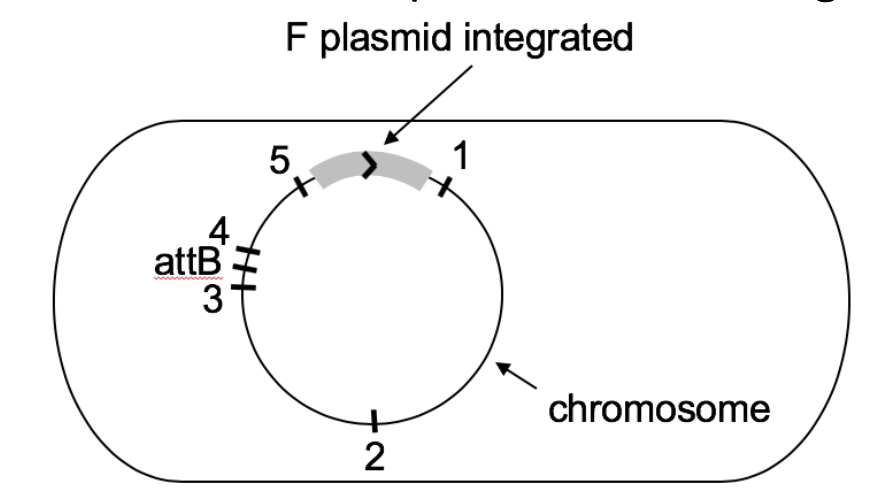
Which genes (1, 2, 3, 4, and/or 5) are more likely to be transferred via Hfr conjugation and explain why.
5 is most likely because of directionality of where the integrated F plasmid is going to be dragged
which is → according to picture
Which genes (1, 2, 3, 4, and/or 5) are more likely to be transferred via F’ conjugation and explain why.
1 and 5, because they are the closest to the F plasmid
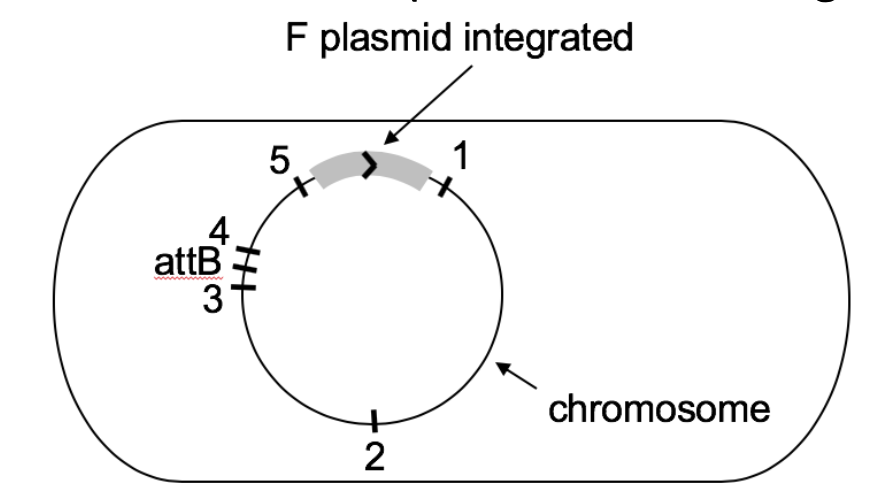
Which genes (1, 2, 3, 4, and/or 5) are more likely to be transferred via generalized transduction and explain why.
All of them are equally likely, and there is no favoritism because of the randomness in the mistake in phage replication

Which genes (1, 2, 3, 4, and/or 5) are more likely to be transferred via specialized transduction and explain why.
3 and 4, because they are closest to the attb (excision) site

Which genes (1, 2, 3, 4, and/or 5) are more likely to be transferred via transformation and explain why.
All genes are equal, because it’s completely random.