radiation protection in diagnostic and interventional radiology
 Call Kai
 Learn
 Practice Test
 Spaced Repetition
 Match
 Flashcards
 Knowt Play
1/51

There's no tags or description
Looks like no tags are added yet.
Name | Mastery | Learn | Test | Matching | Spaced | Call with Kai | Chat |
|---|
No analytics yet
Send a link to your students to track their progress
52 Terms
quantities
describe what’s being measured
units
describe how much of a quantity is being measured
physical quantities
fluence, Q
kerma, K
absorbed dose, D
protection quantities
organ absorbed dose, DT
organ equivalent dose, HT
effective dose, E
operational quantities
area monitoring
ambient dose, H*
directional absorbed dose, D’individual monitoring
personal dose, HP
personal absorbed dose, DP
what is Exposure? what is its unit?
exposure is a quantity used to measure the amount of ionizing radiation in the air that is produced by photons, x rays, or gamma rays.
rontgen (R) is the popular unit
the SI unit of exposure is coloumb per kilogram (C kg-1)
exposure can be measure directly using…
ionizing chambers
how is exposure expessed mathematically?
exposure can be expressed as the absolute value of total charge of the ions of one sign, produced in air, when all of the liberated electrons by photons (x rays, or gamma rays) are completely stopped in air
X = dQ/dm
x is exposure, dQ is the charge and dm is the mass
exposure is not defined for particulate radiation such as alpha or beta radiation
1 Rontgen = 258 uC kg-1
exposure rate
exposure rate is defined as the exposure per unit of time
the common unit for exposure rate is rontgen per second (R s-1)
the SI unit of exposure rate is coulomb per kilogram per second (C kg-1 s-1)
what is the absorbed dose (gray)?
the absorbed dose (D), is the quantity of ionizing radiation energy absorbed per unit mass
1 Gy equals 1 joule of energy absorbed into 1 kg of mass (1 Gy = 1 J kg-1)
the former unit of absorbed dose was known as the rad (1 Gy = 100 rads)

what is kerma and how is it expressed?
kerma is an acronym for “Kinetic Energy Released per unit Mass”
it specifies the sum of the initial kinetic energies of all the charged particles released per unit mass, as a result of the interaction of radiation with that mass
the SI unit of kerma is therefore also the joule per kilogram (J kg-1) and referred to as gray (gy)

what is the difference between exposure and kerma?
exposure measures the number of charged ions in the air and is measured with c/kg or rontgen
kerma measures the energy of the charged ions in the air and is measured with joule/kg (gray)
what is the relationship between absorbed dose & kerma? what are the differences?
both absorbed dose and kerma are related to the interaction of radiation with matter
the differences are:
- kerma is used to describe the radiation field
- absorbed dose is used to describe the effects of radiation
- kerma relates to the loction where energy is transferred from uncharged particles to charged particles
-absorbed dose relates to the location where the energy of charged particles is spentdespite the differences, in mamy cases in diagnoist radiology, kerma ~ absorbed dose
can you make an estimate of the absorbed dose (D) from the exposure (X)?
yes, by using f-factors where D = f . X
f-factors are medium and energy dependent

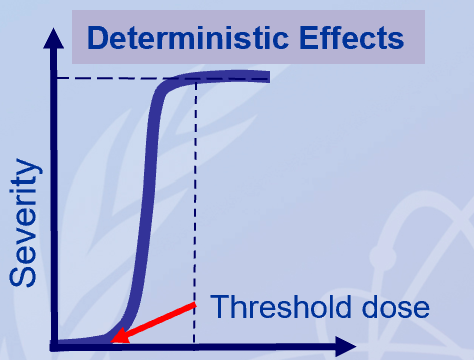
for deterministic effects, the nature and magnitude of the effect is determined by….
the absorbed dose (D) to the organs or tissues
for stochastic effects, the probability of an effect is…
proportional to the sum of the organ and tissue absorbed dose multiplied by risk coefficients
stochastic effects predict the probability of the occurrence of such effects but not the severity

what is the mean absorbed dose?
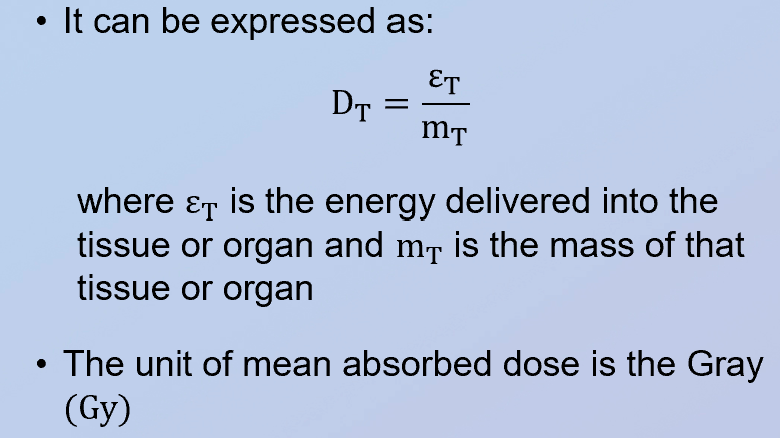
the mean absorbed dose in a tissue or organ, DT, is the energy delivered into the organ divided by the mass of said organ
what is equivalent dose? (sievert)
it’s a measure of the radiation dose delivered to a specific organ or tissue, adjusted to reflect the biological damage different types of ionizing radiation cause
the same value of absorbed dose of different types of ionizing radiation can result in stochastic effects of different magnitudes
how does the equivalent dose adjust the dose to different organs?
the equivalent dose, HT, takes account of the differences through the use of radiation weighting factors (WR)
what is the weighting factor (WR)?
it is a dimensionless multiplier that is used to convert physical radiation dose into a standardized measure of biological risk
what is the relative biological effectiveness (RBE)?
It’s a term used to compare the biological effectiveness of different types of ionizing radiation in causing a specific biological response, typicall cell death
WR is related to the RBE of the given radiation in producing stochastic effects
how is the Relative biological effectiveness given?
it’s given by the ratio of the dose of the reference radiation, usually c-60, to the dose of a test radiation that produces the same biological effect
equivalent dose (HT) is derived from…
the product of the absorbed dose (DT) and a dimensionless radiation weighting factor (WR)

in diagnostic radiation, what are the WR factors for different types of radiation?
x rays, gamma rays, beta particles are all equal to 1
alpha particles used in therapies have a weighting factor of 20

why do different organs and tissues have different tissue weighting factors?
because they have different radiosensitivities therefore the same equivalent dose delivered to two different organs may have different probabilities of harm or different severity
what is the “detriment”?
the combination of probability of harm occurring and the severity, or “length of life lost”
what is the effective dose?
it’s a measure of the combination of detriment from stochastic effects for all organs and tissues for an average adult

what are the tissue weighting factors for different organs/tissue?

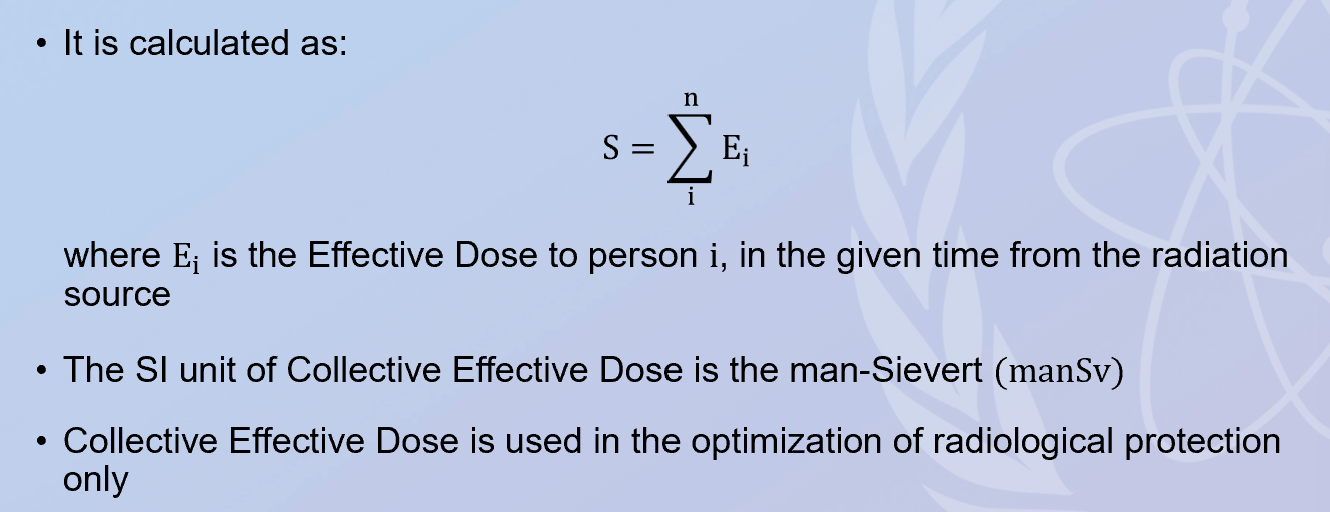
what is the collective effective dose?
it’s the measure of the sum of individual effective doses received by a specified population within a specified time period that have been exposed to a radiation source
what are the problems with effective and equivalent doses?
in individual dose monitoring, it is not possible to directly measure the effective dose and can be quite difficult to measure the equivalent dose
personal dose equivalent (HP(d)) is a quantity which is comparable to the effective and equivalent dose. it is defined as…
the dose at depth (d) in soft tissue at the point where the dosimeter is worn
3 depths are typically used with HP (d):
10mm is used for effective dose (E)
- referred to as HP (10) or sometimes “deep dose” or “whole body dose”0.07mm is used for dose to the skin and extremities (equivalent dose (H))
- referred to as HP (0.07) or sometimes as “shallow dose”3.0mm is sometimes used for the dose to the lens of the eye (equivalent dose (H))
public dose limits

modality specific quantities are..
practical dosimetrist quantities for particular x ray modalities
commonly used modality specific quantities are:
incident air kerma
the air kerma from incident x ray beam measure on the central beam axis at the position of the patient/phantom surface used in radiography, mammography, and fluoroscopyentrance surface air kerma
the air kerma measured on the central beam axis at the position of the patient or phantom surface including the contribution of backscatter used in mammographyreference point air kerma
the cumulative air kerma at the interventional reference point (IRP) located 15cm back toward the focal spot from isocentre and used in fluoroscopy

entrance surface air kerma can be estimated from…
free-in-air measurements by introducing correction factors known as backscatter factors

backscatter factors are highly variable and depend on….
radiation field size, beam quality, the incident angle of the radiation, and the backscatter material

what is kerma area product?
it is defined as the product of the kerma and the integrated area of the x ray beam in a plane perpendicular to the beam axis
it is a dose quantity frequently used with fluoroscopy

what is computed tomography dose index (CTDI)? and how is it expressed?
it is a standardized measure of radiation dose output of a CT scanner that reflects the average dose to a cylinder in the central region of a series of scans

why does a CT require this special dose quantity?
because the irradiation geometry is significantly different from planar imaging modalities
what is CTDI100?
it is a measurement used to describe the radiation output of a CT scanner with the use of a pencil ionizing chamber having a 100mm active length
the measurement can be made free-in-air or in-phantom

quantification of scanner outputs have been standardized using:
16cm diameter standard head phantom
32cm diameter standard body phantom
CTDIW is expressed as:

what is the volume computed tomography dose index (CTDIvol)?
it is a CT dose index which takes into account the scanner’s helical pitch to describe the average radiation output over the scanned volume
*pitch = the distance that table moves during one complete rotation divided by the total nominal x-ray beam width
CTDIvol is expressed as:

what is the dose length product (DLP)?
It is a reference dose quantity used in CT to reflect the total energy absorbed in a given scan and therefore also the potential biological effects
dose length product can be expressed as:
DLP = CTDIVol X scan length
where scan length is the integrated scan length in the z direction
mammography - what is the mean glandular dose (MGD)?
It’s the mean dose to the glandular tissue of the breast which has the highest risk of radiation-induced cancinogenesis
the MGD is therefore the primary quantity of interest for risk assessment of radiation-induced cancer associated with breast imaging
how is MGD measured?
MGD cannot be measured directly and is typically calculated using conversion factors derived from measurements that relate input air kerma to the dose in a breast of a specific size and composition
the standard formula for calculating MGD is given by:

for more advanced tomosynthesis units, the formula is modified such that:
