Biology Chapter 14 Part 2
 Call Kai
 Learn
 Practice Test
 Spaced Repetition
 Match
 Flashcards
 Knowt Play
1/68

There's no tags or description
Looks like no tags are added yet.
69 Terms
Model of DNA Replication image


DNA Replications start at origins
Replication begins at specific DNA sequences called organs of replication
E coli (Prokaryote): One origin on its circular chromosome; two replication forks move bidriectionally
Eukaryotes: Many organs on each linear chromosome so large genomes can be copied effeinctlh
E Coli (Prokaryotes) DNA replication orgin
One organ on its circular chromosome; two replication forks move bilatterally
Eukaryotes DNA Replication Origin
Many origins on each linear chromosome so large can be copied efficiently

Opening and stabilizing the replication fork
At the origin, helicase separates the DNA strands by breaking hydrogen bonds
Single strand binding proteins keep the separated strands from reforming the helix
Topoisomerase relives twisting and supercoiling ahead of the replication fork.
Exam Q: Which enzyme separates (unzips) the two DNA strands during replication
Helicase
Single Binding proteins keep the separated from ______
reforming the helix

What does topoisomerase do?
Relieves twisting and supercoiling ahead of the replication fork
DNA polymerase Needs A Primer (slide)
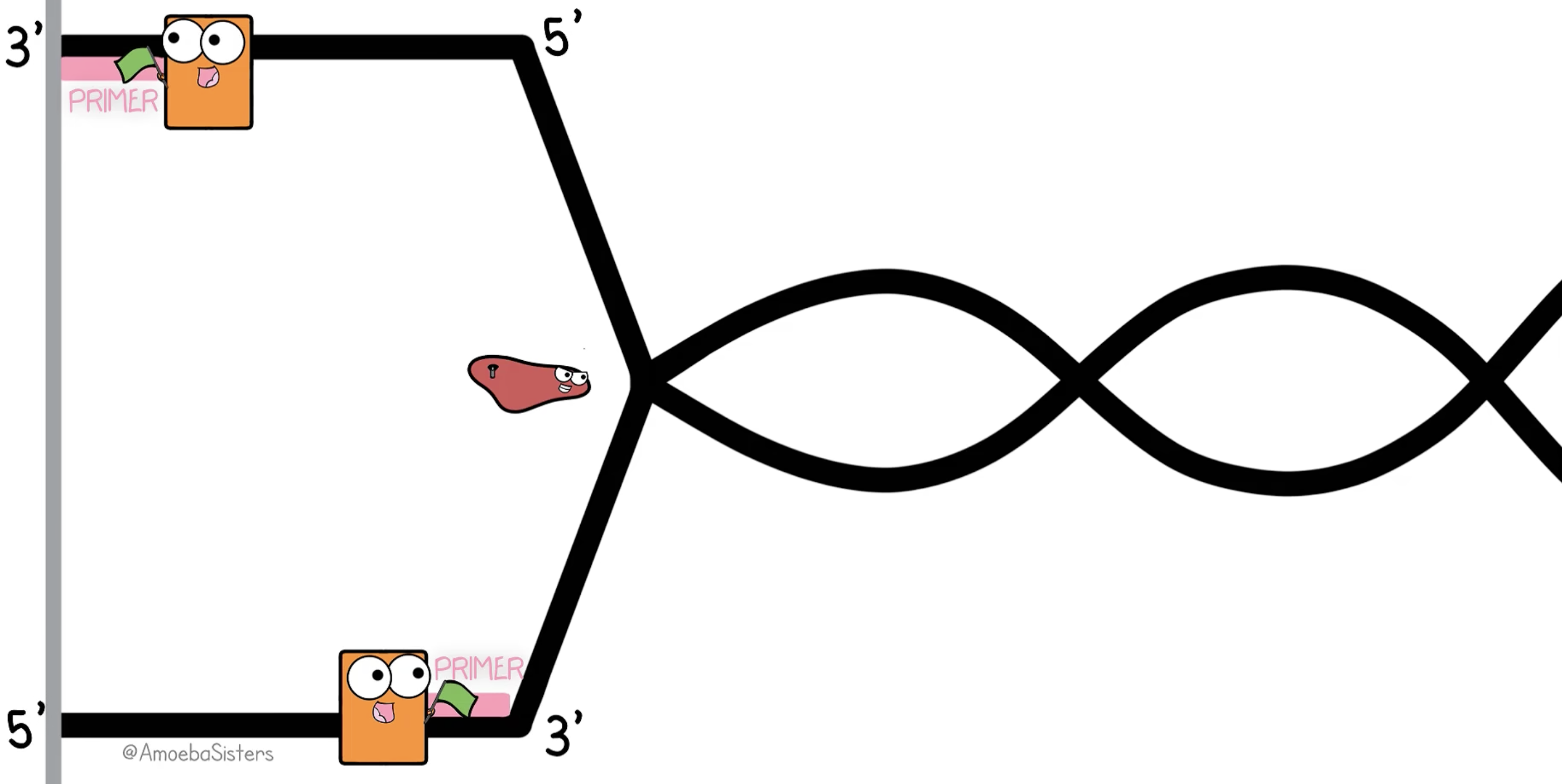
Primarse makes a short RNA primer that provides a free 3’- OH
Dna polymerase III extends from the primer by adding complimentary DNA nucleotides
DNA synthesis always proceeds 5→3’
DNA polymerase I later removes RNA primers and replaces them with DNA
Don’t really need to know all of the primers
Want to unkown unzips, keeps them sticking, torsional sticking, adds new nucleotide
What does Primase do?
Comes in and makes a short RNA primer that provides a free 3’OH (important because otherwise DNA Polymerase won’t know where to start)

What does DNA Polymerase III do?
Extends from the primer by adding complementary DNA Nucleotides
What was does DNA synthesis always proceed?
5’ → 3’
What does DNA polymerase I do?
Later removes RNA primers and replaces them with DNA

Leading vs Laggins Strand Slide
DNA polymerase can synthesize DNA only 5’ → 3’
Because the template strands are antiparallel, the two new strands are made differently
Leading strand: synthesized continuously toward the replication fork
Lagging strand: synthesized discontinuously away rom the fork as Okazaki fragments.
DNA Polymerase can synthesize DNA only ’ - ‘
5’ → 3’
Because the template strands are antiparallel, the two new strands are made _____
differently

Leading Stand
synthesized continuously toward the replication fork

Lagging Strand
Synthesized discontinuously away from the Okazaki Fragments
How do leading and lagging strands differ?
Leading: continuous toward fork. Lagging: discontinuous away from fork.
Finishing the Lagging Strand
Each Okazaki fragment begins with an RNA Primer
DNA polymerase I removes each RNA primer and replaces it with DNA
DNA ligase seals the remaining nicks, joining the fragment into one continuous strand
What are Okazaki fragments?
Short DNA sections synthesized on the lagging strand, each beginning with an RNA primer.
What do DNA polymerase I and DNA ligase do?
Polymerase I replaces RNA primers with DNA; ligase seals nicks between fragments.
Finishing the lagging strand: Each Okazaki fragment begins with an _____
RNA Primer
Finishing the lagging strand: DNA polymerase I removes each _______ _____ and replaces it with DNA
RNA primer
Finishing the lagging strand: DNA Ligase _____ the remaining nicks, joining the fragments into one continuing strand
Seals
Proofreading During DNA Replication
DNA polymerase checks each newly added nucleotide as replication proceds
If a base is mismatched, the incorrect nucleotide is removed and replaced
Proofreading greatly lowers the DNA replication error rate
What is DNA proofreading?
DNA polymerase detects, removes, and replaces incorrect nucleotides during replication.
Proofreading During DNA Replication: DNA polymerase check each ____ _____ _____ as replication process
newly added nucleotide
Proofreading During DNA Replication: if a base pair is mismatched, what happens
the incorrect nucleotide is removed and replaced
_______ greatly lowers the DNA replication error rate
Proofreading

Mismatch Repair: Fixing Errors After Replication
Some mismatches escape DNA polymerase proofreading
Mismatch repair proteins identify the newly synthesized strand and remove the region containing the wrong base
DNA polymerase fills the gape; DNA ligase seals it
What is mismatch repair?
After replication, proteins remove mismatched DNA; polymerase fills and ligase seals.
Nucleotide Excision Repair: Fixing DNA Damage
Nucleotide excision repair removes damaged DNA rather than a simple replication mismatch
UV light can create covalent links between adjacent pyridines, often called thymine dimers
The damaged stretch is cut out, replaced by DNA polymerase, and sealed by DNA ligase
What is nucleotide excision repair?
Removes damaged DNA, such as UV-induced thymine dimers; polymerase and ligase repair it.
What does Nucleotide excision repair do?
Removes damaged DNA rather than a simple replication mismatch
Nucleotide Excision Repair: UV light can create covalent links between adjacent pyridines, often called ____ ______
thymine dimers
The End-Replicaiton Problem
Eukaryotic chromosomes are linerar
On the lagging strand, removal of the final RNA primer leaves no upstream 3’-OH for DNA polymerase
Without a solution, chromosome ends become shorter after repeated rounds of replication
Telomeres are repetitive, noncoding DNA that protect chromosome ends
What is the end-replication problem?
Removing the final lagging-strand primer leaves a gap, causing chromosome shortening.

The End-Replicaiton Problem: On the lagging strand, removal of the final RNA primer leaves _______
no upstream 3’-OH for DNA polymerase
The End-Replicaiton Problem: Without a solution, chromosome ends become _______
shorter after repeated rounds of replication
The End-Replicaiton Problem: ________ are repetitive, noncoding DNA that protect chromosome ends
Telomeres
What are telomeres?
Repetitive, noncoding DNA sequences that protect the ends of linear chromosomes.
Telomerase Extends Chromosome Ends slide
Telomerase is a reverse transcriptase that carries its own RNA template
It extends the 3’ end of the parental DNA strand with telomeric repeats
Primase and DNA polymerase can then synthesize the complementary strand
Telomerase is active in germ cells, many stem cells, and many cancer cells
What is telomerase
a reverse transcriptase that carries its own RNA template. It extends the 3’ end of the parental DNA strand with telomeric repeats. Primase and DNA polymerase can then synthesize the complementary strand. It is active in germ cells, many stem cells, and many cancer cells.
What does telomerase do, and where is it active?
Extends chromosome ends using its RNA template; active in germ, many stem and cancer cells.
Telomerase is a __________ ____ transcriptase that carries its own ____ ________
Reverse transcriptase, RNA template

_______ extends the 3’ end of the parental DNA strand with telomeric repeats
Telomerase
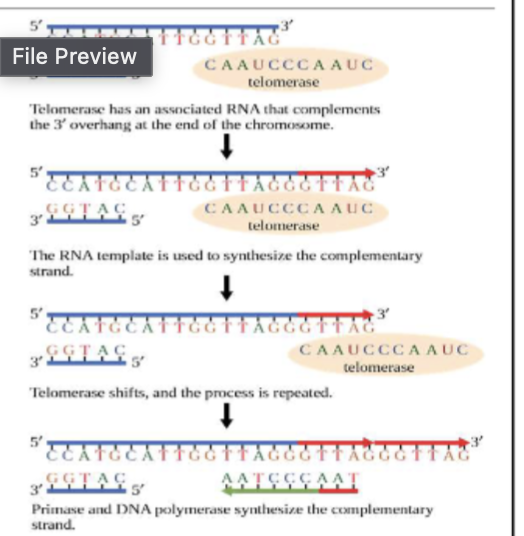
Telomerase extends the 3’ end of the parental DNA strand with telomeric repeats
Primase and DNA polymerase can then ______ the complementary strand
synthesize
______ is active in germ cells, many stem cells, and many cancer cells
Telomerase
PCR: Copying a specific DNA region in Vitro
PCR = Polymearse chain reaction
PCR amplifies the DNA between two known primer-binding sites
Required: template DNA, two primers, dNTPs, and a heat stable DNA polymerase
What does PCR do?
amplifies the DNA between two known primer-binding sites

What is required for PCR:
template DNA, two primers, dNTPs, and a heat stable DNA polymerase

PCR Uses Repeated Temperate Cycles
Denaturation: heat separates the DNA strands
Annealing: primers bind to complentary target sequeences
Extension: DNA polymerase synthesizes new DNA from each primer
The cycle is related many times
First Step of PCR
Denaturation: heat separates the DNA strands
Second Step of PCR (after denaturation)
Annealing: primers bind (stick) to complentary target sequeences
Third Step (after annealing)
Extension: DNA polymerase synthesizes new DNA from each primer

PCR produces exponential amplification
Ideally, the target DNA approximately doubles each cycle
After n cycles, up to ~2n copies can be produced from one starting molecule
Applications: diagnostics, forensics, genetic testing, cloning and research
How does PCR amplification increase each cycle?
Ideally doubles each cycle: 2ⁿ copies after n cycles from one starting molecule.
Ideally, the target DNA approximately doubles each _____ cycle
PCR
PCR: After n cycles, up to ~____n copies can be produced from one starting molecule
2
Applications for PCR
diagnostics, forensics, genetic testing, cloning and research

Gel electrophoresis Separates DNA by size
DNA is negatively charged and moves toward the positive electrode
Agarose gel acts as a molecular sieve
Smaller DNA fragments move through the gel faster and farther than larger fragments
Compare bands with a DNA ladder to estimate fragment size
A common use is checking the size of PCR products
How does gel electrophoresis separate DNA?
Negative DNA moves toward the positive electrode; smaller fragments travel farther. A ladder estimates size.
DNA Replication Image Overview


Helicase “The unzipping Enzyme”
This enzyme unzips the two strands of DNA, and breaks through the hydrogen bonds that hold the DNA bases together

DNA Polymerase “The Builder”
This enzyme replicates DNA molecules to build a new strand of DNA
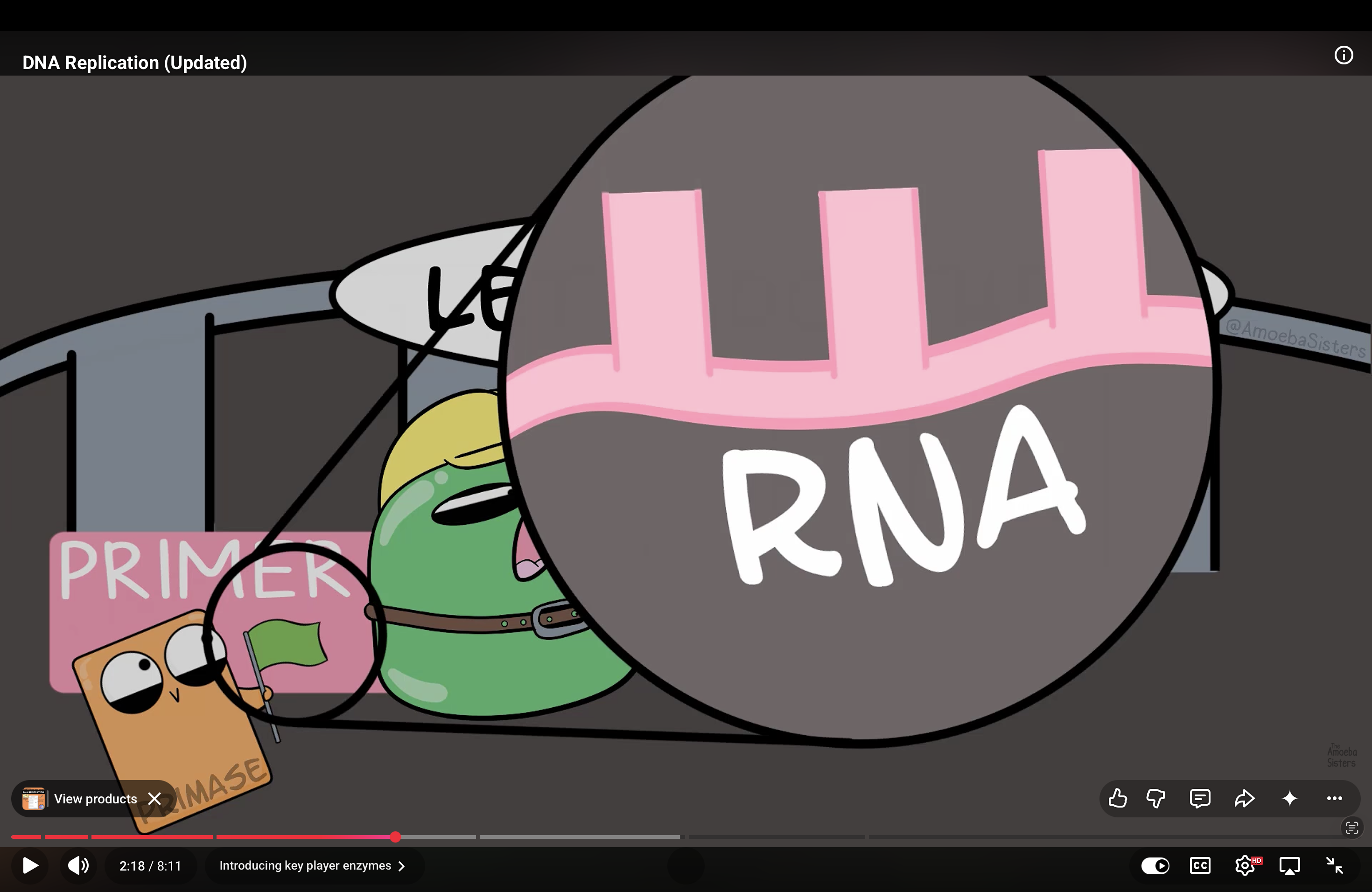
Primase “The initializer”
DNA polymerase can’t figure out where to get started without a primer. This enzyme makes the primer (made of RNA) so that DNA polymerase can figure out where to go to start to work

Ligase “the gluer”
Seals the gaps between the Okazaki fragments to create one continuous DNA strand
Summary of DNA Replication Steps
DNA unwinds at the origin of replication.
Helicase opens up the DNA—-forming replication forks; these are extended bidirectionally.
Single-strand binding proteins coat the DNA around the replication fork to prevent rewinding of the DNA.
Topoisomerase binds at the region ahead of the replication fork to prevent supercoiling.
Primase synthesize (creates) RNA primers complementary to the DNA strand.
DNA polymerase starts adding nucleotides to the 3'-OH end of the primer.
Elongation of both the lagging and the leading strand continues.
RNA primers are removed by exonuclease activity.
Gaps are filled by DNA pol by adding dNTPs.
The gap between the two DNA fragments is sealed by DNA ligase, which helps in the formation of phosphodiester bonds.