EEB 468 - Midterm
 Call Kai
 Learn
Learn Practice Test
 Spaced Repetition
 Match
Match Flashcards
 Knowt Play
1/132

There's no tags or description
Looks like no tags are added yet.
Name | Mastery | Learn | Test | Matching | Spaced | Call with Kai | Chat |
|---|
No analytics yet
Send a link to your students to track their progress
133 Terms
Dikarya phyla
Ascomycota
Basidiomycota
brown rot
SPECIFIC for basidiomycota
degradation of only cellulose and hemicellulose
more common on conifers
more efficient at cellulose degradation
utilizes hydrolytic enzymes and fenton chemistry (production of OH free radicals by iron)
NOT monophyletic
Soft Rot
caused by ascomycota (mostly sordariomycetes)
function by cellulose attack by cellulases
form cavities in the cell walls of wood tissue
mostly found on lower lignin content wood
blue stain fungus is example
Spore dormacy
can germinate readily or become dormant
constituative dormacy: requires heat shock, cold stratification, or a maturation period before germination
exogenously imposed dormancy: require the proper conditions to germinate
Isogamous mating
gametes same size
Crozier
IN ASCOMYCOTA
like clamp connection, connection that maintains n + n in cells but the crozier has one n as does the stalk cell (first straight cell after bend)
5 classes of agaricomycotina
Agaricomycetes (98%)
Tremellomeycetes
Dacrymycetes
Geminibasidiomycetes
Wallemiomycetes
Basic life cycle of a fungus steps
spore germination → sexual reproduction → plasmogamy (cell fusion) → karyogamy (nuclear fusion) → meiosis

Fungi phylum

Opisthokonta
major group of eukaryotes that include fungus, animals, and some microbes
united based on shared presence of single posteriorly flagellated reproductive cells
orbiliomycetes
apothecia
inoperculate asci
nematode trappers
orbilia
monophyletic
A group of taxa that contains an ancestor and all of its decendents
clade
monophyletic set of taxa
polyphyletic
A group whose most recent common ancestor is not part of the group
paraphyletic
A group contains its most recent common ancestor but not all decendants
What are the taxonomic ranks, and what are their terminations?
Domain → Eukarya
Kingdom → Fungi
Phylum → -mycota
Class → -mycetes
Order → -ales
Family → -aceae
Genus
Species
Domineering King Phillip Can Order Five Green Shirts.
Opisthokonta
clade uniting fungi and animals based on a single posterior flagellated reproductive cells
similarities (4) and differences (2) between Fungi and Animals
similarities
heterotrophy
presence of chitin
mitocondria with flattened cristae
flagellation
Differences
animals lack a cell wall
ingestion (move around to find food) vs. osmohetertophy (eat what they grow in)
What are the synapomorphies and general characteristics that could be used to circumscribe Fungi?
NO TRUE SYNAPOMORPHY
eukaryotes
osmoheterotrophs
have cell walls with chitin
Fungi are a clade and share a common ancestor
Why has mushroom taxonomic classification been so dynamic in the last 30 years?
form is a bad measure of phylogeny bc traits evoloved convergent (homoplasy)
fungi also have few charecteristics and many are microscopic.
DNA changed everything and messed with the whole tree
Phylogeny and feild guide are different, cant know for sure until DNA test!
What characters are useful for making an evolutionarily consistent phylogeny and what about those for making a field guide?
phylogenies rely on DNA to identify homologous trats
feild guide rely on diagnostic traits

Zygomycota fungal life cycle


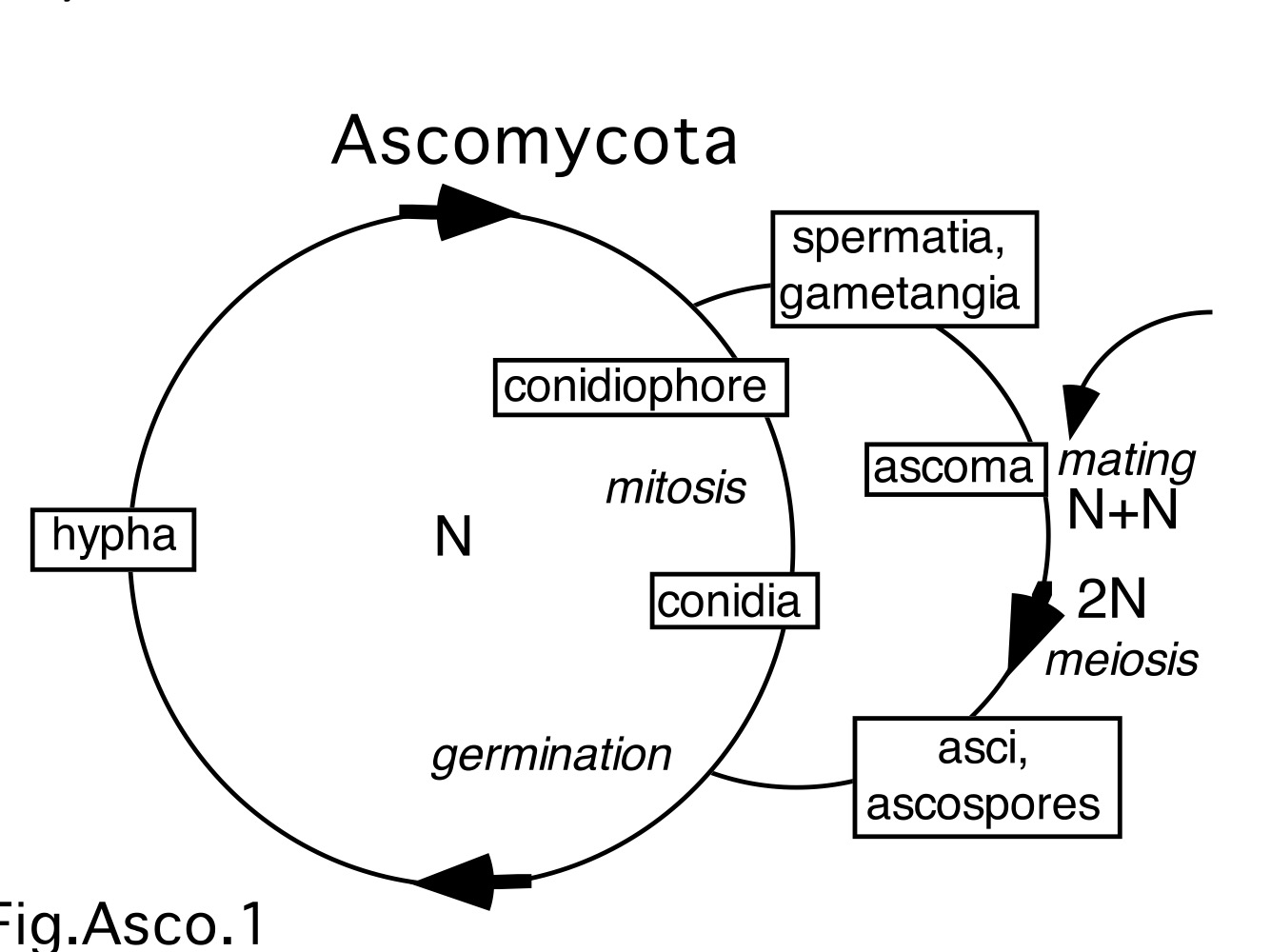
Life cycle of Ascomycota

Life cycle of Basidiomycota
What is the synapomorphy for the Dikarya?
dikaryon (2 nuclei that mate with one another and live in the same cell)
clamp connection
crozier
How is the mushroom life cycle atypical?
dikaryon is longest phase
plasmogamy involves reciprocal nuclear migration with little cytoplasmic exchange
constant remating in clamp connections
karyogamy occurs only in basidium
Rust life cycle (and 5 spore types).
pycinospores (n, spermatia)
aeciospores (n+n)
urediniospores (n+ n, the repeating step)
teliospores (n+n, then 2n after karyogamy)
basidiospores (n)

Rusts hosts
barberry and wheat. Teliospores germinate into promycelium that acts as a basidium
Visual ID of urediniospores vs teliospores
urediniospores: single celled, orange-rede, spiny, n+n
teliospores: dark, thick-walled, two-celled, 2n when mature

Hypha
filaments of the mycelium
may be septate
or can be coenocytic (zygomycete) and lack cross walls
often have septal pore
mycelium
root-like network of hyphae
septa
cross walls, often with a septal pore
(coenocytic means lacking septa)
Woronin bodies
dense membrane bound structure (organelle) involved in sealing off of the septal pore in ascomycota
Dolipore septum
barrel-shaped septal pore of agaricomycotina, capped by a parenthesome
parts of a mushroom

What are the consistent components of fungal cell walls and how they organized?
Inner exoskeleton → b(1,3) glucan, chitin, and melanin
Outer gel-like matrix → mannosylated glycoproteins, a(1,3) glucan, mannans, and hydrophobins
Chitin (b-1,4-N-acetylglucosamine) is the main shape determining component
What sterols are incorporated into the fungal membrane?
ergosterol is the primary sterol
EXCEPT: chytrids and rusts have cholesterol
Spitzenkorper
vesicle aggregation at the hyphal tip that secretes proteins and sugars and delivers chitin synthatase and chitinase/glucanase for wall growth
What is the hyphal growth unit?
mean volume of cytoplasm per hyphal tip or ratio of total mycelial length to number of tips
What are the reasons that turgor pressure is important for fungal cells?
fungi grow using turgor which is the force pushing the plasma membrane against the wall, which stretches the hyphal apex. TUrgor also powers ascospore discharge via glycerol
What is the overall model of how fungal cells grow apically by hyphal extension?
Cell keeps turgor → the tip is weakest/most elastic
cytoplasmic flow brings vesicles to the Spitzenkorper → delivers chitin synthase and chitinase/glucanase
actin supports the tip
turgor stretches the apex
later cross-linking stiffens the subapical region.
What are skeletal and binding hyphae?
Skeletal: thick-walled, unbranched, rigid.
Binding: thick-walled, highly branched, bind other hyphae
4 ascocarp types of ascomycota
perithecia
pseudothecia
apothecia
cleistothecia

Ascus types
Prototunicate
Unitunicate Operculate
Unitunicate Inoperculate
Bitunicate (2 cell walls)

What are teleomorphs and anamorphs and how are they connected?
Teleomorph = sexual stage
anamorph = asexual (conidial) stage of the same fungus
many Ascomycota are known only as anamorphs. Linked by culture or DNA data.
Life cycle of Neurospora and terms used to describe fertilization
Ascogonium produces a trichogyne
a conidium of the opposite mating type fuses with it
dikaryotic ascogenous hyphae form in the perithecium
asci form after karyogamy and meiosis.
General characteristics of basidiomycota
meiocyte is basidium
isogamous mating except for rusts
dikaryon is longest phase in life cycle
individuals can be very larg
What patterns are observed across major fruiting body types and what evidence is there for convergent evolution?
Hibbett 2004 shows:
transitions among resupinate, pileate, coralloid and gasteroid forms across Agaricomycetes (some transitions more likely than others)
Further evidence: diverse forms within Russulales, and brown rot arising repeatedly (Polyporales, Agaricales, Boletales, Gloeophyllales).
Why is gasteromycetization a dead end?
Statismospory (passive relaese of spores) replaced ballistospory (active) in gasteromycetes, and Hibbett 2004 treats the gasteroid form as a one-way transition. easier to lose soemthing than gain it
Phragmobasidia/heterobasidia
phragmobasidium (in class hetero) → is a specialized, spore-bearing cell (basidium) that is divided by septa into separate cells.
jelly fungi
Holobasidium
has no septae in basidium
Promycelium/probasidium
specialized fungal structures involved in the sexual reproduction of certain fungi, most notably the rusts (Pucciniales) and smuts (Ustilaginales). They represent different stages of the developing basidium
promycelium: The initial, encysted, or resting stage of a basidium.
probasidium: The germ tube or short hypha that grows out of a probasidium.
What is the most common fungus on your skin and what skin maladies is it associated with?
Malassezia spp.
dandruff
atopic eczema
found on skin where theres sebaceous glands
difficult to grow, requires lipids to grow
What are differences between fungal communities as estimated from spore morphology versus DNA sequencing?
Spores: Limited by visual similarity (cryptic species) and the fact that many fungi do not fruit or produce distinct, identifiable spores under standard conditions. Different genera can share nearly identical spore shapes
DNA: Uncovers unculturable taxa, hidden mycelial fragments, and fastidious species that morphology or culture-based counts completely miss. It distinguishes closely related species via genetic barcodes.
How far to do spores travel and what determines their rate of sedimentation?
Most fungal and plant spores drop within a few millimeters to 200 meters of their parent source, though a small fraction (often around 1% to 10% or more depending on atmospheric conditions) escape local deposition and can travel thousands of kilometers on upper-air currents.
Sedimentation follows Stokes' law
Fd = 6 * viscosity * Radius * Velocity
What is the evidence for and against long distance dispersal of fungi?
For: transatlantic aircraft sampling, global spread of coffee rust, Aspergillus sydowii in sea fans.
Against: phylogeographic structure is the rule rather than the exception (e.g., shiitake), and steep short-distance dispersal gradients (e.g., Podaxis).
How does ballistospory launch a basidiospore?
bullers drop (hilar appendix is involved in the formation of the drop)
rain drop disturbes it
Buller's drop grows near the hilar appendix and coalesces with fluid on the spore, acting as a surface tension catapult. Sugars and mannitol lower water potential to condense water.
What is the weakest part of the argument for global dispersal of free-living microbial species as proposed by Finlay?
Finlay’s framework relied heavily on traditional morphospecies (classifying microbes by physical shape under a light microscope). Subsequent high-throughput molecular sequencing (DNA/RNA) revealed that organisms looking identical under a microscope often harbor massive genetic and physiological divergence, proving that true species are far more geographically restricted than morphospecies suggest
The argument assumes that massive population sizes and small size make physical barriers irrelevant to microbes. However, modern molecular and biogeographical studies demonstrate clear spatial structuring, distance-decay relationships, and endemism—particularly in habitats like soils, deep-sea sediments, and isolated extremes (such as Antarctic soils), where local environmental filtering and dispersal limits strongly shape communities
The global datasets used to claim that species are cosmopolitan suffered from extreme sampling bias (heavily favoring well-studied regions like European or North American freshwater ponds). As sampling intensity increased in neglected regions, many microbes previously thought to be globally ubiquitous turned out to have distinct biogeographies
Why do spore communities show diurnal patterns?
show diurnal (daily) patterns primarily to optimize the survival, timing, and distance of their dispersal based on changing atmospheric conditions, humidity, temperature, and light
What are adaptations and conflicting biophysical demands used by Ascomycota to both cross the boundary layer and to disperse in wind?
Spores must pass the still boundary layer (mm to m thick), which depends on mass/drag, initial velocity and wind speed. Ascospores are shot by turgor using osmolytes such as glycerol, released in puffs.
must balance the energy required for microscopic "spore guns" against the physical limitations imposed by fluid drag
Understand the results, methods, and implications of the Abrego paper.
Results: airborne DNA showed predictable spatial and seasonal dynamics. Mean annual temperature was the key driver of large-scale distributions. In temperate and polar-continental zones (not tropical), mean asexual spore size peaked in autumn and sexual spore size in spring.
Methods: 7 sites on six continents collected air samples twice weekly for 1-2 years (2,768 samples). Fungal DNA (ITS2) was sequenced and clustered into ~28,000 species-level units, then linked to climate, weather, spore size, and feeding strategy (guild). The authors modeled spatial, seasonal, and phylogenetic patterns.
Implications: Fungi follow the same global patterns as larger organisms (latitudinal diversity gradient, temperature as the main driver), and warming will likely restructure fungal communities. Airborne DNA is a useful monitoring tool, though it underrepresents some groups like ectomycorrhizal and lichenized fungi, and the data are biased toward Europe.
How are pathogens classified into lifestyles and how are the lifestyles different?
primarily classified by where they live and replicate relative to host
extracellular: Live and multiply in the spaces between cells, in blood, or in body fluids (such as mucus or the gut lumen) without entering host cells
facultative intracellular: Can live and multiply either inside or outside host cells. They can transition between the extracellular environment and an intracellular habitat
obligate intracellular: Cannot replicate outside a living host cell. They completely depend on host cellular machinery to survive and reproduce (all viruses fall into this category)
What values of population-based models indicate an epidemic is ongoing?
the basic reproduction number (R₀) or effective reproduction number (Rt) remains strictly greater than 1.
What aspects of the fungal life style could explain why they may be more likely to cause extinctions relative to other pathogen groups (viruses, etc.)?
Long-lived environmental stages: Fungi can survive outside the host, either as durable spores or as free-living saprophytes. The authors call this probably the most important feature driving emergence.
High virulence plus high reproductive potential
Broad host ranges and tolerant “reservoir” hosts
Dispersal ability and human-mediated spread
What are the common themes in emerging fungal diseases that explain emergence?
Introductions via long-distance dispersal, hybridization or sex, and hyperparasites. Examples: chestnut blight (introduced from Japan, 1904), white-nose syndrome (introduced from Europe), late blight of potato.
White rot
most common type
degradation of cellulose, hemicellulose and lignin at equal rates
utilizes hydrolytic and oxidative enzymes to break down cellulose (glycoside hydrolases) and lignin (laccases and class II peroxidases)
mostly basidiomycota (agaricomycetes) but also Xylariales
What are the fungal roles in global carbon and nitrogen cycles?
Carbon: Saprotrophic fungi break down tough organic matter like lignin and cellulose, releasing CO₂ and converting dead material into soil organic carbon. Mycorrhizal fungi (especially ectomycorrhizal and arbuscular types) receive plant sugars and move a large share of photosynthetic carbon belowground, where it is stored in fungal biomass and soil.
Nitrogen: Fungi mineralize organic nitrogen into forms plants can use, and mycorrhizae transfer nitrogen (and phosphorus) to host plants in exchange for carbon. Some fungi also take part in denitrification, releasing N₂O, and fungal biomass acts as a temporary nitrogen reservoir that slows nutrient loss.
What is the mycoloop?
Movement of energy from large phytoplankton to zooplankton through zoospores of parasitic chytrid fungi
By what mechanism do fungi promote bioweathering?
Fungi promote bioweathering mainly through organic acid and chelator secretion (e.g., oxalic and citric acids, siderophores) that dissolve minerals and release nutrients like P, K, Mg, and Fe, plus physical penetration by hyphae that wedge into mineral cracks and grain boundaries. Proton release during cation uptake also lowers local pH and speeds dissolution.
What is the association of fungal decay enzymes and the end of the Carboniferous.
lignin degradation (class II peroxidases) may have originated around the end of the Carboniferous, coinciding with a sharp drop in organic carbon burial.
(fungi decomposing trees made it so they did not have time to become fossil fuels)
conidium
asexual spore formed at end of hypha or within exisiting hypha
sporangium
sac-like asexual reproductive structure where sporangiospores are stored and formed from internal cleavage of the sporangium
chlamydospore
thick walled asexual spore formed by thallic development (internal cleavage)
sclerotium
hard resting body that can remain dormant
conidiophore
hypha that bears conidia (asexual, non-motile fungal spores) produced on end of the conidiophore
zoospore
sporangiospore that is motile
have flagella and swim around
sporocarp
fruiting body or larger organ producing (primarily sexual) spores
ascus
site of karyogamy and meiosis
produce ascospores (usually 8)
produced by free-cell formation (cell produced within cell)
ascospores are usually forcibly ejected
ascospore
meiospore formed in an ascus.
ascogonium
female gametangium in Ascomycota; produces the trichogyne
antheridium
male gametangium
trichogyne
receptive hypha from the ascogonium that fuses with a conidium.
promycelium/probasidium
structure formed when a teliospore germinates; functions as the basidium.
microconidium/ spermatium
small male cell that fertilizes the female structure, e.g., rust pycniospores
zygospore
meiocyte produced by the Zygomycetes (group of fast-growing, terrestrial fungi)
basidium
meiocyte of Basidiomycota; the only place karyogamy occurs.
basidiospore
meiospore borne on a sterigma of the basidium.
statismospory
passive spore release; replaced ballistospory in gasteromycetes.
ballistospory
forcible discharge of basidiospores via Buller's drop.
sterigma
projection of the basidium that bears a basidiospore.
volva
cup-like remnant of the universal veil at the base of the stipe
annulus
ring on the stipe, remnant of the partial veil
lamellae
gills
stipe
stalk of a mushroom
capillitium
sterile threads mixed with the spores in puffballs
Melzer’s reagent
iodine reagent
amyloid = blue-black
dextrinoid = reddish-brown
inamyloid = no reaction
unitunicate
spore bearing cell with only one cell wall
ascus with a single functional wall layer
bitunicate
ascus with two functional wall layers
prototunicate
Type I ascus; thin wall releases spores passively.
hymenium
fertile layer on which meiocytes are produced. sides of gills