Biology L112 Exam #1
 Call Kai
 Learn
 Practice Test
 Spaced Repetition
 Match
 Flashcards
 Knowt Play
1/139

There's no tags or description
Looks like no tags are added yet.
140 Terms
1. Proteins
2. Lipids
3. Carbohydrates
4. Nucleic Acid
What are the 4 main classes of macromolecules
Dehydration Reaction
What does this:
-Links two monomers together and removes a molecule of water
-Forms polymer
Hydrolysis
What does this:
-Adds a molecule of water and reverses the dehydration reaction
Hydrolysis

Dehydration Reaction

In Animals:
-Carbohydrates are a primary source of energy (ATP)
-Dietary energy and storage energy
In Plants
-Carbohydrates serve as building material (strength) and storage energy
What is the function of carbohydrates in plants vs. animals
Monosaccharides
These are monomers & main fuels (ATP)
Glucose + Oxygen = Carbon dioxide + water + ATP
Formula for cellular respiration
Glucose, fructose
What are two examples of monosaccharides
Starch, cellulose
What are two examples of polysaccharides
Store energy in plants
What is the function of starch (polysaccharide)
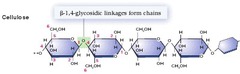
Strength in plants
What is the function of cellulose (polysaccharides)
Storage in animals; made up of glucose molecules in C1-4 (linear) & C1-6 (branch)
What is the function of glycogen (polysaccharide)
Starch; alpha glucose monomer

Cellulose; Beta glucose monomer
Energy storage, cushioning, insulation, and membranes
What are the four functions of Fats in the human body
Triglyceride (fats)
What is this a component of?

A hydrophilic head (water loving) and a hydrophobic tail (water fearing)
What does a typical fat (triglyceride) consist of
Unsaturated
If a carbon skeleton of a fatty acid has fewer than maximum number of hydrogens, it is what?
Saturated
If a carbon skeleton of a fatty acid has the maximum number of hydrogens it is what?
Saturated Fat

Unsaturated Fat

-No double bonds, all single bonds
-All three of its fatty acids are saturated
Saturated fat has what two things?
Saturated
Most animals have what kind of fatty acid
Heart Attack, Stroke
What does too much saturated fat typically lead to
High in unsaturated fatty acids, liquid at room temp
Most plant and fish oils tend to be?
Trans fat
Hydrogenation converts unsaturated fat to saturated fat, what does this then create
Steroids
This four fused rings are components of what?

Synthetic anabolic steroids
What are variants of testosterone, can cause serious physical and mental problems,may be prescribed to treat diseases (AIDS, cancer) and are used to enhance performance
more stored energy
Fats contain more what than carbohydrates
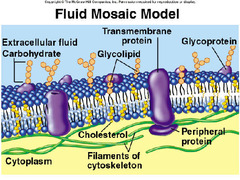
Phospholipid membrane (fluid mosaic model)
20 amino acids
All proteins are macromolecules constructed from what?
-A carboxyl group (-COOH)
-An amino group (NH2)
-A hydrogen atom
-A unique R group
Each amino acid is composed of what
Amino acid

Forming peptide bonds and creating long chains of amino acids called polypeptides
Proteins as polymers; cells link amino acids together and they form what
Protein Structure
There are 3-4 levels of protein structure. They key to protein function is its shape
Primary Structure
Unique sequence of amino acids arranged in a long chain
Primary Structure

Secondary Structure
Affected by a pattern of hydrogen bonds between amino acids in a long chain
Secondary Structure

Tertiary Structure
Dictated by primary and secondary structure, leading to 3D shape
Tertiary Structure

Quaternary Structure
Made up of several polypeptide chains that must fit together to form a functional protein; example: hemoglobin
Quaternary Structure

Sensitive to the surrounding environment; an unfavorable change in temperature and of pH can cause denaturation of protein
What effects protein shape?
Enzymes
What is a protein molecule that acts as a catalyst
Reaction Mechanism

Inhibitor
What is a factor that affects enzyme activity that decreases reaction rate
Competitive Inhibition
Compounds similar in shape to the Substrate. The inhibitor competes with the substrate by binding to the active site on the enzyme, displacing the substrate
7
Most enzymes work best around what level oh pH
Denaturation
Destruction of 3D structure of the enzyme
Diseases such as, Alzheimers, mad cow, Parkinson's, Sickle cell anemia
Misfolded proteins are responsible for what?
Nucleic Acid
Examples such as DNA and RNA
Information storage
What is the function of Nucleic Acid
DNA

RNA

Nucleotides
What are nucleic acids made up of
1. a five-carbon sugar
2. a phosphate group
3. Nitrogen-Containing base (A,G,C,T)
What is a nucleotide made up of
A --> T G--> C
What is the paring rule for A, G, C, T
Polynucleotides; which are phosphodiester linkages
Dehydration reaction links nucleotide monomers into long chains called what
RNA
-Single Stranded
-Thymine is replaced with Uracil (U)
-exists as different forms
-Complementary pairing
DNA
-Double Helix
-A-->T
-G-->G
1. Light Microscope
2.Transmission Electron Microscope (TEM)
3. Scanning Electron Microscope (SEM)
What are the three types of microscopy?
Light Microscope
What type of microscopy is this?
-Enlargement provided by objective lends & ocular glass lenses
-Illumination provided by light
What type of microscopy is this?
-Very high resolution
-Lenses are electromagnetic
-Observation is made under Vacuum
Scanning Electron Microscope (SEM)
What type of microscopy is this?
-Electrons do not pass through specimen
-Lower resolution
-great advantage, great depth of focus (3D image)
Prokaryotic Cells
Bacteria & Archaea; do not have membrane enclosed organelles
Eukaryotic Cells
Protists, plants, fungi, and animals
Contain a system of membranous organelles with specialized functions
Prokaryotic Cells
Smaller, simpler, most do not have organelles

Eukaryotic Cells
Larger, More complex, have organelles

Animal Cell
`

Plant Cell

Chloroplasts, cell wall, central vacuole
What do plant cells have that animal cells don't
Fluid mosaic
Fluid due to the bilayer of phospholipids and mosaic due to the embedded proteins
Proteins
what regulates traffic across the membranes, provides structure, transport, catalytic activity
Nuclear envelope
The nucleus is separated from the cytoplasm by what
True
Pores are highly selective T of F
nuclear membrane, which contains pores
What is a nucleus surrounded by
Chromatin
Stored in the nucleus are long DNA molecules and associated proteins that form fibers called what?
rRNA's
Nucleolus contains what?
Ribosomes
the sites of protein synthesis; found on Rough ER, and in the cytoplasm
messenger RNA (mRNA)
DNA programs protein production in the cytoplasm by transferring its coded information into where?
A protein
DNA is transcribed in to mRNA which then gets read by ribosomes to create what?
Make proteins to be sent out of the cell or to the membrane
Why is the nucleus studded with ribosomes?
Helps produce lipids and detoxify the body
Why does Smooth ER surrounds the nucleus?
Rough ER
What organelle produces membrane proteins and secretory proteins
Smooth ER
What organelle produces lipids, and detoxify's circulating drugs
Golgi Apparatus
What organelle adds chemical groups to proteins & shuttles them off; acts as a distribution center for the cell
Lysosomes
What organelle contains digestive enzymes that break down excess, food, microbes, and cellular waste; known as the garbage man of the cell
A lysosome digesting food
What is happening here?

Peroxisomes
What organelle breaks down fatty acids, drugs, and alcohol; found in liver cells
Chloroplasts, found in plant cells
What undergoes photosynthesis
Vacuoles
What organelle stores organic nutrients, breaks down waste, absorbs waters, contains pigments or poison
Central Vacuole; in a plant cell
What organelle is this

Mitochondria
What organelle is found in almost all plants and animal cells, undergo cellular respiration to provide ATP for the cell
Mitochondria

Endosymbiont Theory
A theory that s that postulates that mitochondria & chloroplasts were once free living prokaryotes that become incorporated into eukaryotic cells establishing a symbiotic relationship with eukaryotic cells
Mitochondrial inheritance
Moms mitochondria are passed from generation to generation; you do not inherit any of dad's mitochondria
Mechanical support, shape, and movement
What are the main functions of the cytoskeleton
Microtubules
Are straight and hallow tubes that guide the movement of organelles and chromosomes