pharmacology - principles of drug action at receptors
 Call Kai
 Learn
 Practice Test
 Spaced Repetition
 Match
 Flashcards
 Knowt Play
1/26

There's no tags or description
Looks like no tags are added yet.
27 Terms
define a receptor
a receptor is a protein macromolecule inserted across the lipid bilayer of cells. their functions are to recognise extracellular molecules and transduction ( change cell activity after detecting presence of an extracellular molecule ). receptors bind with their complimentary ligands as they are highly specific
define the lock and key model of binding
drug molecules bind to receptors complimentarily to produce an effect
what are the two ways that drugs can act when binding to a receptor
they can either mimic or block the effects of endogenous messenger molecules
define what endogenous messenger molecules means
drugs produced in the body to bring about certain biochemical changes
what is the name of the receptor that the neurotransmitter that exogenous nicotine and neurotransmitter ACh bind to
nicotinic acetylcholine receptors
how does the high specificity of drug binding affect side effects of drugs
it means fewer side effects in clinical trials
what graph does the binding of receptor to drug produce and what equation can map this
D on x-axis, percentage on y-axis forming a rectangular hyperbola
D + R ←> DR

plot the proportion of receptors occupied (p) vs log[D]
it produces a log graph showing a symmetrical sygmoid

define the affinity of a drug for its receptor
the affinity of a drug for its receptor is quantified as the molar concentration of drug required to occupy 50% of receptors at equillibrium
NOTE: drugs with high affinity have low KD
notation of drug concentration
KD
what is KD
the equillibrium dissociation constant a measure of how tighly a receptor holds on to its drug once bound
how does KD affect dissociation rate
drugs with high affinity/low KD have optimal binding to the receptor and stay bound for a long time by having a slow dissociation rate
compare the binding graphs of drugs with high vs low affinity

what is the role of K+1 and K-1 in the equillibrium dissociation constant KD. include equations
K+1 is the rate constant telling us the liklihood of the forward rate occuring while K-1 tells the liklihood of the backward rate.
rate of forward reaction = K+1[D][R]
rate of backward reaction = K-1[DR]
at equillibrium, backward rate = forward reaction so
K+1[D][R] = K-1[DR]
KD = K-1/K+1 = [D][R] / [DR]
define an agonist
a chemical substance with affinity to its receptor, binds to activate the receptor and then produces a receptor by having efficacy to the receptor. agonists cause a conformational change of the receptor active site shape leading to a response in the cell or tissue
use an equation to show the pathway of agonists activtating receptors to produce a biological response
A + R < - > AR < - > AR* → response
(the transition from AR < - > AR* represents the efficacy i.e. the ability of a drug to activate its receptor)
define efficacy in a binding reaction
the ability of a drug to activate its receptor and produce a response
differentiate E50 (50% drug response) and KD (50% occupance of available receptors) in agonists
overall response to an agonist is determined by its affinity and efficacy while receptor occupance is determined only by affinity
there are many steps between agonist drug binding and the measured response
outline the two broad types of agonists
all naturally occuring neutrotransmitters and hormones are agonists e.g. adrenaline, ACh, insulin, dopamine
agonists can be FULL or PARTIAL agonists
full agonists have high efficacy and so are very effective when activating receptors and producing biological response (often produce maximal response whilst only activating a fraction of available receptors)
partial agonists have low efficacy and therefore less effective at activating receptors and less able to produce a biological response (often fail to produce a full response despite occupying all available receptors)
draw a log graph depicting the binding response with full versus partial agonists
Emax achieved with full agonists but not in partial

define an antagonist
drugs than inhibit the effects of ligands like neurotransmitters, hormones and some drugs
they dont have efficacy but have affinity
commonly used clinically
e.g. beta blockers inhibit the beta-1 receptor thus lowering blood pressure
outline and explain 3 forms of antagonism and include examples of each
chemical - use one drug to chemically inactivate another e.g. dimercaprol in arsenic poisoning (no receptors involved)
pharmacokinetic - one drug alters the way the body deals with another e.g. some antacids reduce absorbtion of the antiepileptic drug phenytoin from the gut (no receptors involved)
physiological - two drugs acting to produce opposing effects and cancelling eachother out e.g. noradrenaline increasing HR while acetylcholine decreases it. both drugs are antagonists but working on different receptors
outline the 2 forms of antagonism
competitive: compete with the agonist for the same site on the receptor molecule but dont activate it i.e. have affinity but no efficacy . can be reversible or irreversible
non-competitive antagonists act on an allosteric site of the receptor or another molecule closely associated with it. they are also reversible or irreversible
examples of reversible competitive antagonists and how they are overcome
pancuronium, cetirizine, propranolol
used to inhibit the effects of a neurotransmitter or hormone
their inhibitory effects can be overcome by increasing the concentration of the agonist i.e. the blockade is surmountable
graph the response of reversible competitive vs non competitive antagonists
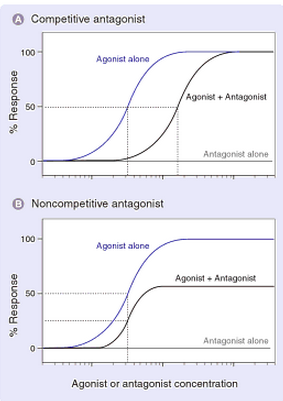
graph the response of irreversible competitive vs non competitive antagonists

explain the effects of irreversible competitive antagonist
the graph shift is not parallel when adding the antagonist to the agonist as the inhibition is not surmountable when increasing concentration of the agonist