lecture 5 rna molecules in translation
 Call Kai
 Learn
 Practice Test
 Spaced Repetition
 Match
 Flashcards
 Knowt Play
1/25

There's no tags or description
Looks like no tags are added yet.
26 Terms
rna polymerase ii transcribes a protein-coding gene. what is the initial transcript called, and what does it become?
pre-mrna, also called heterogeneous nuclear rna (hnrna), is processed into mature mrna.
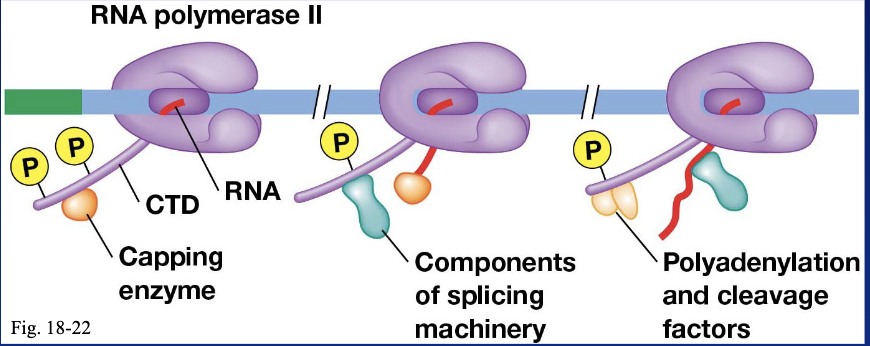
pre-mrna processing includes 5′ capping, splicing, and poly-a tail addition. which happen during transcription, and which happens after the rna is cut?
co-transcriptionally: the 5′ cap is added, and splicing can remove introns while the rna is still being made.
after cleavage: a poly-a tail is added to the newly formed 3′ end.
during pre-mrna processing, a cap is added to the 5′ end. what is it made of, and how is it attached?
7-methylguanosine is attached by a 5′–5′ triphosphate linkage. the first one or two nucleotides can also have methyl groups added to the 2′-oh of their ribose sugars.

once the 5′ cap is attached, how does it protect mrna and help it leave the nucleus?
the cap protects the 5′ end from exonucleases. it also provides a binding site for the cap-binding complex, which helps export processed mrna from the nucleus.
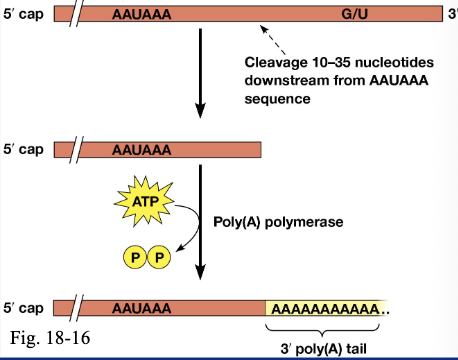
after pre-mrna is cut 10–35 nucleotides downstream of the aauaaa signal, how is the poly-a tail added?
poly(a) polymerase uses atp to add 50–250 adenine nucleotides to the new 3′ end.
once the poly-a tail is added, how does it protect mrna and help it leave the nucleus?
the tail acts as a buffer that 3′ exonucleases can shorten before reaching the coding region. a longer tail generally gives the mrna a longer half-life. the tail also binds proteins that help export processed mrna from the nucleus.
pre-mrna contains both introns and exons. what happens to each during splicing?
introns (intervening sequences) are removed, and the exons are joined (ligated) together to form the mature mrna.

during pre-mrna splicing, what provides the catalytic activity that cuts out introns and joins exons?
catalytic rna within the spliceosome carries out these reactions. an rna molecule that catalyzes a reaction is called a ribozyme.
how do small nuclear rnas (snrnas) and proteins assemble into a spliceosome?
snrnas combine with proteins to form small nuclear ribonucleoproteins (snrnps). the snrnps assemble with other proteins on the pre-mrna to form the spliceosome.
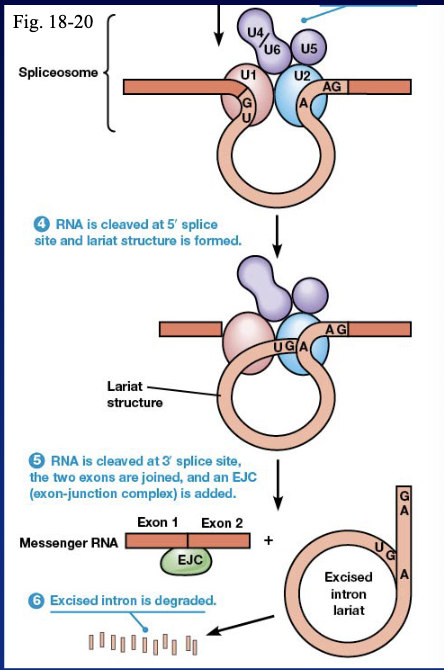
as the spliceosome assembles on pre-mrna, where do u1 and u2 bind, and what do the other snrnps do?
u1 binds the 5′ splice site at the start of the intron.
u2 binds the branch point region near the intron’s 3′ end, leaving the branch-point adenine exposed.
u4/u6 and u5 join the complex, helping bring the intron’s ends together for splicing.

once the spliceosome brings the intron’s ends together, how does it form a lariat and join the exons?
the spliceosome cuts at the 5′ splice site. the intron’s 5′ end joins the branch-point adenine, forming a lariat. the spliceosome then cuts at the 3′ splice site and joins the two exons.
after the exons are joined, what happens to the spliced mrna and the intron lariat?
the exon-junction complex (ejc) is deposited near the new exon–exon junction and helps support mrna export from the nucleus. the released intron lariat is degraded.
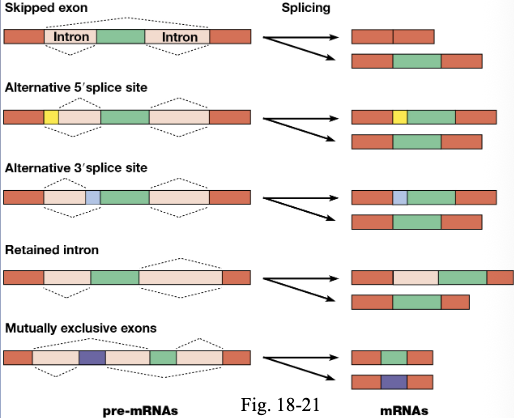
alternative splicing lets one gene produce more than one polypeptide. how does this happen, and what can regulate it?
the same pre-mrna can be spliced in different ways, such as by skipping an exon, retaining an intron, or using a different splice site. this produces different mature mrnas that can encode different polypeptides. splicing patterns can vary by tissue, hormone signaling, or developmental stage.
how can exon shuffling give a protein a new function?
dna rearrangements can bring an exon that encodes a protein domain into another gene. the resulting protein gains that domain, which can give it a new function.
mature mrna leaves the nucleus and enters the cytoplasm, where it is translated into a polypeptide. what two other types of rna are required, and what do they do?
trna (transfer rna) brings amino acids to the ribosome.
rrna (ribosomal rna) combines with proteins to form the ribosome and catalyzes peptide bond formation.
mrna uses four different bases to specify 20 amino acids. why does a codon need three bases?
- 1 base gives (4^1 = 4\ possible codes.
- 2 bases give (4^2 = 16) possible codes.
- 3 bases give (4^3 = 64) possible codes.
three bases are the minimum needed to specify all 20 amino acids. each three-base sequence is called a codon.
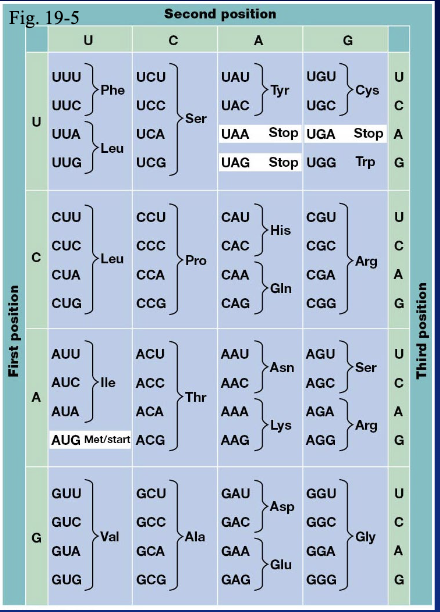
the genetic code is read in three-base codons from 5′ to 3′. what does it mean that the code is redundant, and where is the wobble position?
redundant means that more than one codon can specify the same amino acid. these codons often differ at the third base, called the wobble position.
animals have about 50 different tRNAs. what genes encode them, which polymerase transcribes them, and how long are they?
tRNA genes (tDNAs) encode them and may be present in multiple copies. RNA polymerase III transcribes these genes. mature tRNAs are typically 70–80 nucleotides long.
after transcription, what changes can occur as pre-tRNA matures?
the 5′ and 3′ ends are processed, some tRNAs have introns removed, and some adenosines are converted to inosine.

each tRNA has a specific three-base sequence that pairs with one or more mRNA codons. what is this sequence called?
the anticodon. it base-pairs with a matching codon on the mRNA during translation.

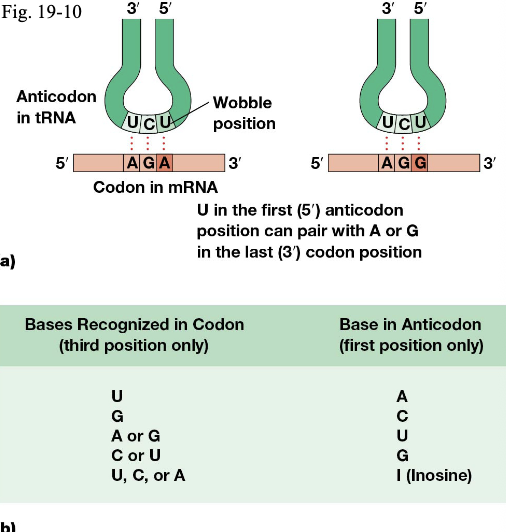
61 codons specify amino acids, but there are only about 50 different tRNAs. how can one tRNA recognize more than one codon?
wobble pairing allows a tRNA’s anticodon to pair with codons that differ at the third base of the codon.
what does an aminoacyl-tRNA synthetase do when it charges a tRNA?
it attaches the correct amino acid to the 3′ end of the tRNA, forming an aminoacyl-tRNA.
there are typically 20 aminoacyl-tRNA synthetases, one per amino acid. why can one synthetase recognize tRNAs with different anticodons?
different tRNAs can carry the same amino acid. the same synthetase attaches that amino acid to each of those tRNAs.
what are the four steps of tRNA charging by aminoacyl-tRNA synthetase?
binding — the amino acid and ATP enter the enzyme’s active site.
activation — AMP attaches to the amino acid, and pyrophosphate is released and broken down.
transfer — the amino acid attaches to the tRNA’s 3′ end, releasing AMP.
release — the charged tRNA (aminoacyl-tRNA) leaves the enzyme.
