Ch 4: Chemical & Enzyme Kinematics: Rate Law
 Call Kai
 Learn
 Practice Test
 Spaced Repetition
 Match
 Flashcards
 Knowt Play
1/151

There's no tags or description
Looks like no tags are added yet.
152 Terms
What is a rate law?
A rate law is a mathematical (algebraic) equation that describes the relationship between the rate of a chemical reaction and the concentrations of its reactants.
A general example is: Rate=k[A]m[B]n
Where:
Rate = how quickly the reaction occurs.
k= rate constant.
[A] and [B] = concentrations of reactants.
m and n = experimentally determined reaction orders with respect to the respective reactants.
Essential rule from the lecture: A rate law contains the reaction rate and reactant concentrations, not product concentrations.
What must a rate law contain?
The reaction rate.
The concentration of one or more reactants, raised to appropriate powers.
A rate constant, k, when needed to make the units on both sides of the equation consistent.
A rate law relates the rate to reactant concentration. It is not simply the balanced chemical equation rewritten algebraically.
A rate law is an equation showing the relationship between rate and reactant concentration.
What are the units of reaction rate?
reaction rate is expressed as molarity per second: M s-1. This is equivalent to: mol L-1/s
It can also be written as: M/s or M s-1
Meaning: Reaction rate measures the change in concentration per unit time.
Why do we need a rate constant in a rate law?
The rate constant, k, ensures that the equation has the correct units and provides the proportionality between the rate and the concentration terms. For example, if:
Rate=k[A]
the concentration term has units of M, while the rate has units of M s−1. Therefore, k must have units of s−1, because: s−1×M=M s−1
Without the rate constant, the units would not match.
What are the units of the rate constant for a first-order reaction?
For a first-order reaction: Rate=k[A]. Rate units are M s−1, and concentration units are M. Dividing rate by concentration gives: [k] = Ms-1/M, therefore, [k] = s-1.
A rate constant with units of inverse seconds indicates an overall first-order rate law for the ordinary concentration-based rate laws being discussed.

What are the units of the rate constant for a second-order reaction?
k = M-1 s-1

How can the units of k tell you the overall reaction order?
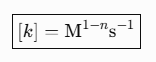
For a conventional rate law with overall order n: [k] = M1-ns-1
Examples:
Zero order: k has units M s−1
First order: k has units s−1
Second order: k has units M−1s−1
Third order: k has units M−2s−1
What is the order of a reaction?
The overall order of a reaction is the sum of the exponents on the reactant concentration terms in its experimentally determined rate law.
EX: Rate = [k][A]2[B]1
Overall Order: 2 + 1 = 3
The reaction is third order overall, second order with respect to A, and first order with respect to B.
These exponents describe how the rate depends on concentration. They are not automatically the same as the coefficients in the balanced chemical equation.
What is a zero-order rate law?
A zero-order rate law has no dependence of the rate on the concentration of the reactant in question.
EX: Rate = k[A]0
since any nonzero quantity raised to the zero power equals 1: [A]0 = 1
Therefore: Rate = k
The rate is independent of [A] under the conditions described by this rate law.
The units of k are the same as the rate: M s−1
Is Rate=k a valid rate law?
Yes. It is a valid zero-order rate law. Although it does not visibly contain a concentration term, it can be written as: Rate=k[A]0
Because [A]0=1, the concentration term disappears algebraically.
Where do the exponents in a rate law come from?
The exponents must be determined experimentally.
To determine them, scientists:
Carry out the reaction in the laboratory.
Measure initial reactant concentrations.
Measure the initial reaction rate.
Change a reactant concentration.
Observe how the initial rate changes.
Use the change in rate to determine the relevant exponent.
Why can't you automatically use stoichiometric coefficients as rate-law exponents?
Because rate-law exponents describe experimentally observed kinetic behavior, whereas stoichiometric coefficients describe the proportions in the balanced chemical equation. They may coincide for certain elementary reactions, but they do not necessarily coincide for an overall reaction involving multiple steps.
What happens to the rate if [A] doubles in a first-order reaction?
If concentration of A in a first order doubles then the rate doubles.
What happens to the rate if [A] doubles in a second-order reaction?
doubling the concentration of A in a second order reaction, the rate quadruples.
What happens to the rate if [A] doubles in a zero-order reaction?
Doubling [A] has no effect on the rate. The rate remains unchanged because the reaction is zero order with respect to A.

What happens to reactant and product concentrations as a reaction proceeds?
Concentration-versus-time graph: Suppose a reaction begins with only reactant A present: A—> P
Reactant A: Its concentration starts high and decreases as it is converted into product.
Product P: Its concentration starts at zero and increases as product forms.
At equilibrium: Both concentrations level off and remain constant over time, assuming the system remains undisturbed.
The product concentration may rise by a small or large amount depending on the equilibrium position of the reaction.
The curves level off at equilibrium; this does not mean the reaction has stopped.
Dynamic equilibrium
A state in a reversible reaction where the forward and reverse reaction rates are equal.
Rate forward = Rate reverse
At equilibrium:
Reactant concentrations remain constant.
Product concentrations remain constant.
Forward and reverse reactions continue.
There is no net change in concentration.
Equilibrium does not necessarily mean equal reactant and product concentrations. It means equal forward and reverse rates.
Initial rate, V0
The reaction rate measured at or extrapolated to the very beginning of a reaction. It is measured near t=0, when the reaction has just started.
Tangent line
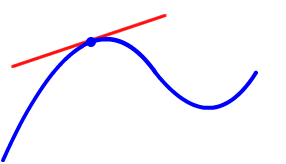
A line that touches a curve at a particular point and has the same instantaneous slope as the curve at that point. For a concentration-versus-time graph, the tangent tells us the instantaneous rate of concentration change at the selected time.
A tangent can cross a curve in some mathematical situations. The defining property is that it matches the curve's local slope at the point of tangency, not that it can never cross the curve elsewhere.
How do you calculate the initial rate from a graph?
Steps:
Plot concentration against time.
Select a point at or as close to the start of the reaction as practical.
Draw a tangent line at that point.
Calculate the tangent's slope.
Slope = (delta [concentration]))/(delta t). Slope units are M/s
see image

Why is the initial rate measured early?
Reaction rates often change as the reaction proceeds. As reactants are consumed, their concentrations may decrease, and the reaction rate may decrease. The tangent becomes less steep as the rate slows. Measuring early helps researchers determine the rate before substantial reactant depletion or product accumulation occurs. It also minimizes complications from the reverse reaction in enzyme-kinetics experiments.
Reaction velocity, V
A term commonly used in biochemistry to refer to the reaction rate. The initial velocity,V0, means the initial reaction rate. Despite the name, it does not refer to an enzyme physically moving through space. It refers to the rate of a chemical process, often measured by product formation over time.
What is an enzyme?
A biological catalyst that increases the rate of a chemical reaction without being consumed overall. Enzymes bind substrates, facilitate their conversion into products, and can be reused. Only a small amount of enzyme may be required because the enzyme is regenerated and can catalyze multiple reaction cycles.
What is a substrate?
Substrate, S: The reactant molecule on which an enzyme acts. In enzyme kinetics, substrate concentration is written as: [S]. The goal of the Michaelis–Menten model is to describe how the initial reaction rate depends on substrate concentration.
What is the enzyme–substrate complex [ES]?
The intermediate complex formed when an enzyme binds its substrate.
E+S⇌ES
Here:
E = free enzyme.
S= free substrate.
ES= enzyme bound to substrate.
The enzyme and substrate must interact for the enzyme-catalyzed reaction to proceed through this mechanism.
What is the basic Michaelis–Menten reaction mechanism?
Enzyme reaction mechanism:
(see image)
Meaning of each step:
Binding: Free enzyme and substrate combine to form the enzyme–substrate complex.
Dissociation back to reactants: The complex breaks apart into free enzyme and substrate.
Product formation: The complex converts into free enzyme and product.
Reverse product reaction: Product and free enzyme can, in principle, reform the enzyme–substrate complex.

What do the rate constants k1, k−1, k2, and k−2 mean?
Elementary-step rate constants:
(see image)
The subscript minus sign indicates the reverse direction of the corresponding step.

Why is the enzyme regenerated (catalyst regeneration)?
During product formation, the enzyme–substrate complex produces product and releases free enzyme:
ES⟶E+P
The enzyme is available to bind another substrate molecule and catalyze another reaction cycle. The enzyme participates in the mechanism but is regenerated rather than consumed overall.
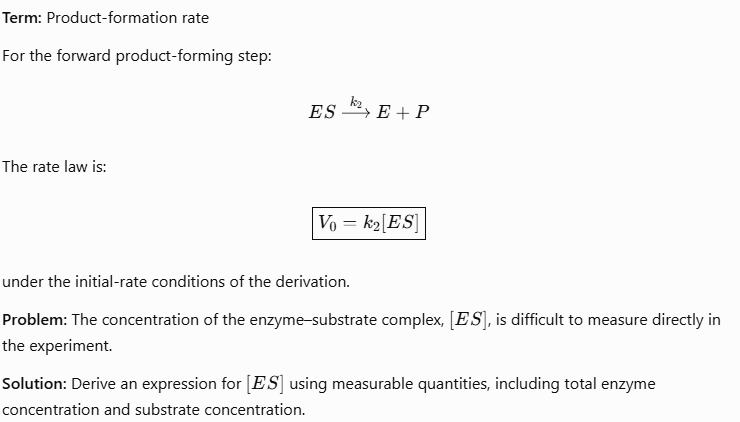
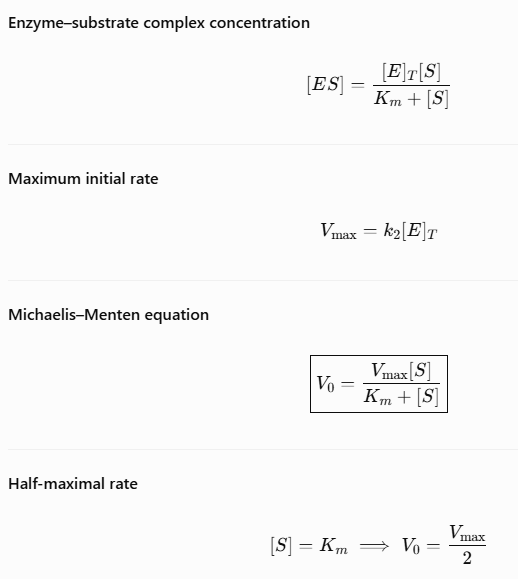
What rate law describes product formation from ESES?
Product-formation rate: For the forward product-forming step: (see image)
What is the goal of enzyme kinetics?
Enzyme kinetics: The study of the rates of enzyme-catalyzed reactions and the factors affecting those rates.
Who developed the Michaelis–Menten approach?
Leonor Michaelis and Maud Menten. They published influential work on enzyme kinetics in 1913, establishing an important analytical approach for quantifying enzyme-catalyzed reactions. Why their work matters: Their research helped establish a mathematical framework for describing the relationship between substrate concentration and enzyme reaction rate.
What historical barriers did Michaelis and Menten face?
Maud Menten:
She was a woman working in science during a period when women faced serious institutional and legal barriers to scientific careers.
She worked in Canada and moved away from it to obtain opportunities to continue laboratory research, as described in the lecture.
Leonor Michaelis:
He was a Jewish scientist working in Germany.
The political and social climate became increasingly dangerous for Jewish people in Germany during the following decades, particularly in the 1920s and 1930s.
He also had to leave his original environment.
Takeaway: Their contributions were made despite substantial social and professional obstacles, using the scientific tools available at the time.
What is the Briggs–Haldane contribution?
George Briggs and John Haldane developed the steady-state treatment of the enzyme–substrate complex in 1925. The lecture explains that the steady-state assumption was added about a decade after the original Michaelis–Menten work.
Why it matters: The steady-state approach assumes that after an initial transient, the concentration of ES remains approximately constant because its formation and breakdown rates balance.
Important distinction: The Briggs–Haldane steady-state assumption is not the same as requiring the entire reaction to be at equilibrium.
The three assumptions behind the derivation
What is the initial-velocity assumption?:
Measure the reaction rate at the very beginning of the experiment, ideally at t=0, immediately after enzyme and substrate are mixed.
At the beginning:
Product concentration is approximately zero: [P]≈0
The reverse product-forming step contributes negligibly.
The reverse reaction E+P→ES, with rate constant k−2, can be ignored in the initial-rate derivation.
Remember: This approximation applies to the beginning of the reaction, not necessarily to later times when product has accumulated.
What is the excess-substrate assumption?
The initial substrate concentration is much greater than the total enzyme concentration.
[S]0≫[E]T
Here, [E]T represents the total enzyme concentration. Why is this physically reasonable? Enzymes are catalysts and can be reused, so a small amount of enzyme can process a much larger amount of substrate.
Why does it simplify the mathematics? Binding a small amount of substrate to the enzyme removes only a tiny fraction of the total substrate present. Therefore, substrate depletion through binding has little effect on its concentration.
The free substrate concentration can be approximated as the total substrate concentration added initially:
[S]≈[S]0 This is an approximation, not an exact identity. It is useful when substrate is present in large excess.
What is the steady-state assumption?
Steady-state assumption (Briggs–Haldane assumption)
Definition: After a short initial transient, the concentration of the enzyme–substrate complex remains approximately constant.
d[ES]/dt = 0. This means: Rate of formation of ES = Rate of breakdown of ES.
What it does not mean:
The reaction has stopped.
All molecules have stopped moving or reacting.
The entire reaction system must be at thermodynamic equilibrium.
Instead, ES continues to form and break down, but its concentration remains approximately constant because the two rates balance.
Why it matters: It gives us an equation that can be rearranged to solve for [ES].
What is the difference between dynamic equilibrium and steady state?
Dynamic equilibrium: For a reversible elementary reaction, the forward and reverse rates are equal.
Steady state: The concentration of a particular intermediate remains approximately constant because the total rate of its formation balances the total rate of its consumption.
In the enzyme mechanism: d[ES]/dt = 0
The formation rate of ES equals its combined breakdown rate.
Key distinction: The enzyme–substrate complex can be at steady state even though the overall reaction continues producing product. The steady-state assumption does not require every individual forward and reverse step to be at equilibrium.
What is the rate law for formation of ES?
Rate of enzyme–substrate complex formation. The forward binding reaction is: E+S→k1ES
It’s rate law is: v formation = k1[E][S]
Why multiply the concentrations? For this elementary bimolecular step, the rate depends on the concentrations of both free enzyme and free substrate.
Here, [E] is the concentration of free enzyme, not total enzyme concentration.
What causes ES to break down?
The breakdown of the enzyme-substrate complex (ES) is caused by two fundamental processes:
Dissociation (Reversible Unbinding): The ES complex breaks apart in a reverse direction, releasing the original substrate (S) and the free enzyme (E) completely unchanged (ES —> E + S)
Catalysis (Product Formation): The chemical reaction takes place within the active site, breaking down or modifying the substrate into the final product (P) and releasing the free enzyme (E) (ES—>E+P)
Both processes consume ES, so their rates must be added to obtain the total rate of breakdown.
What is the total rate of ES breakdown?
see image

What equation represents the steady-state assumption?
see image

What is total enzyme concentration(E)t?
The total concentration of enzyme present in the reaction mixture, including enzyme that is free and enzyme that is bound to substrate.
The enzyme exists in two forms in the simplified model:
Free enzyme: [E]
Enzyme–substrate complex: [ES]
Therefore:
[E]T=[E]+[ES]
This relationship is an enzyme mass balance.
Important: Binding changes the distribution between free enzyme and bound enzyme, but it does not change the total amount of enzyme.
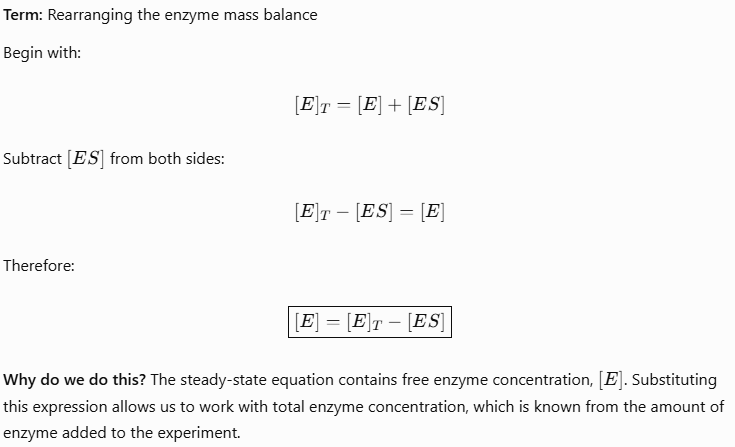
How do you express free enzyme concentration in terms of total enzyme?
see image
Why distinguish free enzyme from total enzyme?
Free versus total enzyme:
[E] is only the enzyme that is not bound to substrate.
[E]T includes all enzyme, both free and substrate-bound.
The free enzyme concentration changes as substrate binds and product forms. Total enzyme concentration remains constant in the basic Michaelis–Menten model.
Exam tip: Never automatically substitute [E]T for [E]. They are equal only when [ES]=0, or approximately equal when the bound fraction is negligible.
Full algebraic derivation of the Michaelis–Menten equation: Steps 1 & 2
see image

Full algebraic derivation of the Michaelis–Menten equation: Steps 3 & 4
see image

Full algebraic derivation of the Michaelis–Menten equation: 5 & 6
see image

Why does the derivation divide the numerator and denominator by k1?
see image

What is the Michaelis constant, Km?
see image
Why does the substitution work? The two rate constants in the numerator are added and divided by another rate constant, giving a concentration-valued constant for this mechanism.

How do you turn the expression for [ES] into an expression for initial rate?
see image
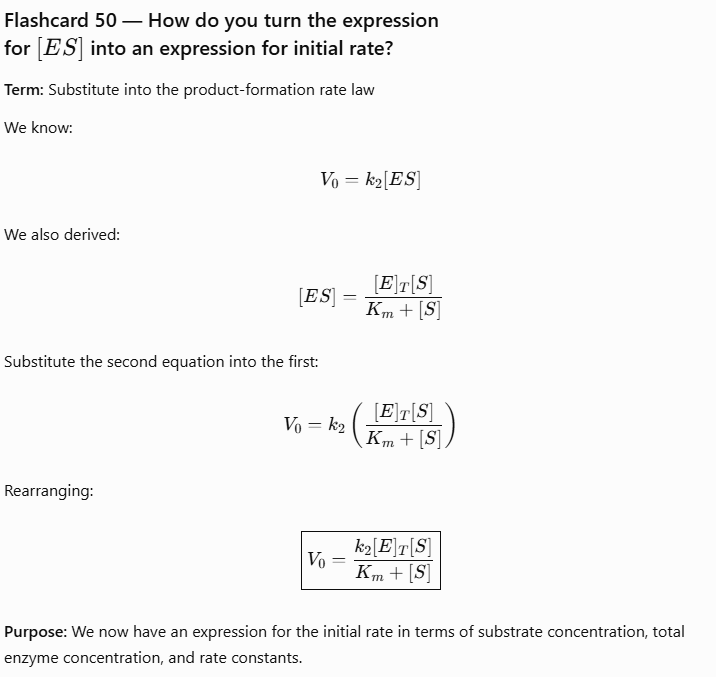
How isVmax introduced?
Maximum reaction velocity:
see image

What is the final Michaelis–Menten equation?
see image:
This equation relates the initial reaction rate to the substrate concentration.
What the symbols mean:
V0: initial reaction rate.
Vmax: maximum initial rate under substrate-saturating conditions.
[S]: substrate concentration.
Km: Michaelis constant.
Central takeaway: The equation describes a rate that increases with substrate concentration and approaches a maximum as the enzyme becomes saturated.

What is Vmax?
Maximum initial reaction velocity: The maximum initial rate approached when the enzyme is saturated with substrate. Vmax = k2[E]T
What does enzyme saturation mean?
Nearly all available enzyme molecules are bound to substrate, leaving very little free enzyme.
Important points:
Vmax increases when total active enzyme concentration increases, provided the other conditions remain the same.
Vmax is approached as substrate concentration becomes very high.
In the basic Michaelis–Menten model,Vmax is a limiting rate rather than a rate that must be reached at a finite substrate concentration.
Vmax has the same units as reaction rate, such as M/s.
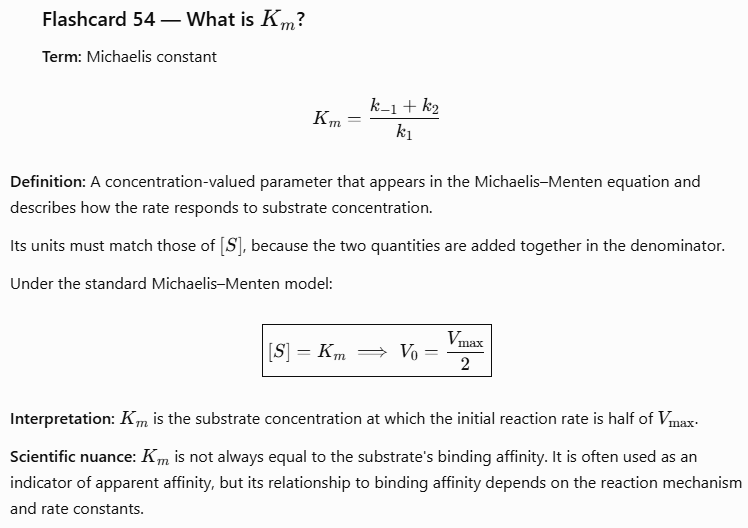
What is Km?
A concentration-valued parameter that appears in the Michaelis–Menten equation and describes how the rate responds to substrate concentration.
Its units must match those of [S], because the two quantities are added together in the denominator.
Under the standard Michaelis–Menten model: Interpretation: Km is the substrate concentration at which the initial reaction rate is half of Vmax.
(see image)
Why is the Michaelis–Menten equation a rate law?
Enzyme rate law: A rate law expresses the relationship between reaction rate and reactant concentration.
The Michaelis–Menten equation does exactly this for the initial rate of a standard enzyme-catalyzed reaction:It relates the initial rate to substrate concentration, using VmaxVmax and KmKm as parameters.
Difference from a simple chemical rate law: The Michaelis–Menten equation is not simply a constant multiplied by a fixed power of [S]. It contains a denominator that allows the rate to approach a maximum as the enzyme becomes saturated. (see image)

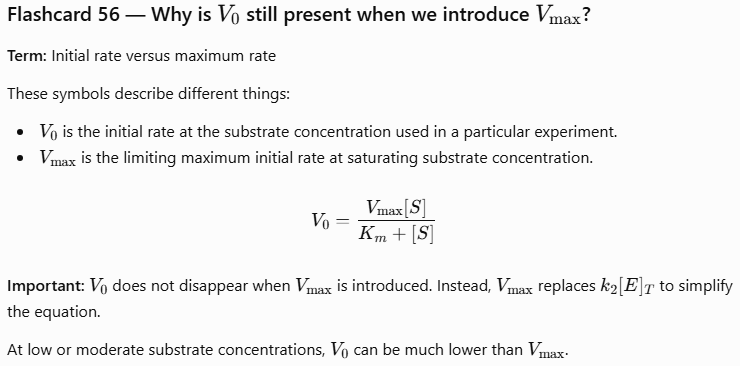
Why is V0 still present when we introduceVmax?
Term: Initial rate versus maximum rate
These symbols describe different things:
V0 is the initial rate at the substrate concentration used in a particular experiment.
Vmax is the limiting maximum initial rate at saturating substrate concentration.
see image
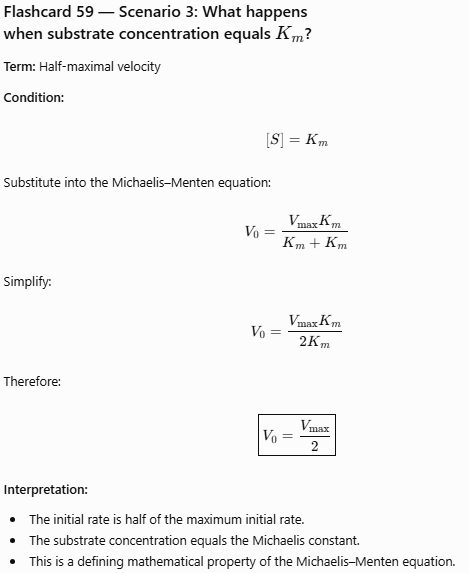
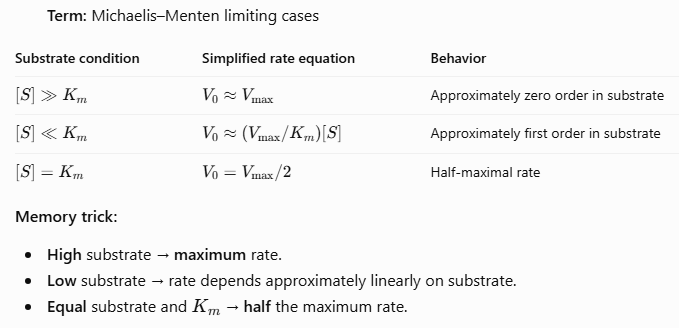
The three substrate-concentration scenarios (1)
see image

The three substrate-concentration scenarios (2)
see image

The three substrate-concentration scenarios (3)
see image
How do the three scenarios compare?
see image
What is a differential rate law?
An equation that expresses the instantaneous reaction rate in terms of reactant concentrations.
see image

What is an integrated rate law?
An equation obtained by integrating a differential rate law, relating reactant concentration to elapsed time.
see image

Core Rate Law Equations (Part 1)
see image

Core Rate Law Equations (Part 2)
see image
What is enzyme kinetics?
Enzyme kinetics studies the rates of enzyme-catalyzed reactions and how those rates depend on factors such as substrate concentration and enzyme concentration.
Important variables include:
v0: initial reaction rate.
Vmax: maximum initial rate under specified conditions.
[S]: substrate concentration.
Km: Michaelis constant.
kcat: catalytic turnover number.
What is a rate law, and what does reaction order mean?
A rate law is an equation describing how the reaction rate depends on the concentration(s) of reactants.
General examples:
Zero order: Rate=k
First order: Rate=k[A]
Second order: Rate=k[A]2 or Rate=k[A][B]
Here, k is a rate constant.
Reaction order describes the exponent(s) of concentration in the rate law. It determines how the rate responds to concentration changes.
How does changing reactant concentration affect the rate in zero-order versus first-order kinetics?
Zero order: The rate does not depend on the concentration of the reactant in the rate law. Doubling that concentration does not change the rate.
First order: The rate is directly proportional to the concentration. Doubling the concentration doubles the rate.
The same enzyme-catalyzed reaction can exhibit different apparent reaction orders under different substrate-concentration conditions.
What is the Michaelis–Menten equation?
v0: initial reaction rate.
Vmax: maximum initial rate attainable at the specified enzyme concentration and under the specified conditions.
[S]: substrate concentration.
Km: Michaelis constant, which under the usual Michaelis–Menten model equals the substrate concentration at which v0=1/2Vmax
The equation describes how the initial rate changes as substrate concentration increases for a simple enzyme-catalyzed reaction.

The Michaelis constant Km
the substrate concentration at which an enzyme-catalyzed reaction runs at half of its maximum velocity Vmax
Substrate Concentration at Half-Max: When the substrate concentration [S] equals Km, the reaction rate (v) is equal to Vmax/2
Enzyme-Substrate Affinity: Km reflects how tightly an enzyme binds to its substrate:
Low Km: High affinity; the enzyme binds the substrate very tightly and reaches half-velocity at a low concentration.
High Km: Low affinity; the enzyme binds the substrate weakly and needs a much higher concentration to reach half-velocity.
(affinity refers to the strength of the binding interaction between two molecules, such as an enzyme and its substrate, or a receptor and its ligand)
Km is expressed in units of molarity
Think of it like a car reaching its top speed.
Vmax is the car's Top Speed (e.g., 100 mph).
Half of Vmax is just half that speed (50 mph).
Km is how hard you have to step on the gas pedal to reach that 50 mph mark
They are measuring completely different things:
One is a speed1/2 Vmax
One is the amount of gas needed to get to that speed Km
In Enzyme Terms:
½ Vmax is a Speed: It tells you how fast the enzyme is working.
Km is an Amount: It tells you how much substrate (chemical food) you need to feed the enzyme to make it go at that half-speed.
What does a Michaelis–Menten graph look like, and what goes on each axis?
A Michaelis–Menten plot is a rectangular hyperbola.
x-axis: substrate concentration, [S].
y-axis: initial reaction rate, v0.
At low substrate concentrations, the rate increases steeply as substrate is added. At high substrate concentrations, the curve gradually flattens as the enzyme approaches saturation.
The curve approaches Vmax as an upper limit.

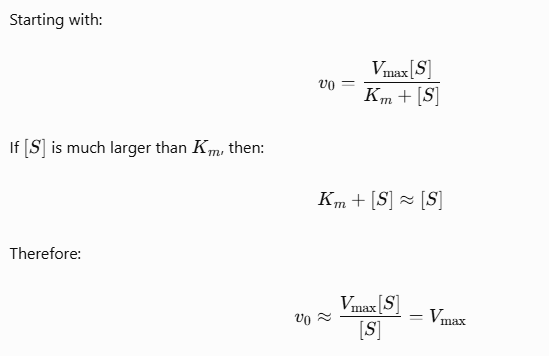
What happens when substrate concentration is much greater than Km?
When [S]≫Km, the enzyme's active sites are largely occupied by substrate, and the enzyme is approaching saturation.
(see image)
The substrate concentration cancels out.
Conclusion: v0≈Vmax. The rate becomes approximately independent of substrate concentration, so the reaction exhibits apparent zero-order behavior with respect to substrate.
This explains why the high-substrate end of the Michaelis–Menten curve becomes nearly horizontal.
Can an ordinary Michaelis–Menten curve become a perfectly horizontal line at a finite substrate concentration?
Under the standard Michaelis–Menten equation, the curve approaches Vmax asymptotically. It does not reach a perfectly flat maximum at any finite, positive substrate concentration.
(Asymptotically means approaching a specific value, line, or trend closer and closer as a variable grows extremely large (towards infinity) or small, without necessarily reaching or touching it.)
In practice:
The rate becomes progressively less sensitive to additional substrate.
Experimental data may look almost horizontal at sufficiently high concentrations.
A measured graph can appear flat because of experimental precision and plotting scale.
The instructor's main point was that the graph shows approximately zero-order behavior, not that the entire reaction is inherently zero order under every condition.
What does [S]≪Km, and how does it simplify the Michaelis–Menten equation?
It means the substrate concentration is much smaller than the Michaelis constant.
(see image)
The term in parentheses is constant when the experimental conditions are fixed.
This has the form:
Rate=kobs[S]
Conclusion: At low substrate concentrations, the reaction exhibits approximately first-order behavior with respect to substrate.
(In chemical kinetics, kobs stands for the observed rate constant)

Why can Vmax/Km act as the rate constant in the low-substrate rate law?
Under fixed experimental conditions:
Vmax is constant if the enzyme concentration and relevant conditions are held constant.
Km is constant for the particular enzyme–substrate system under specified conditions.
Therefore, their ratio is constant:
kobs=Vmax/Km
This gives:
v0≈kobs[S]
The expression behaves like a first-order rate law.
Important distinction: Vmax is not an absolute constant independent of enzyme concentration. Increasing the amount of active enzyme generally increases Vmax. The value of Km, in the standard model, does not depend on the total enzyme concentration.

Why does the beginning of the Michaelis–Menten curve resemble a straight line?
At low substrate concentrations:
v0 = Vmax/Km [S]
This is a linear relationship between v0 and[S].
The line passes approximately through the origin.
Its slope is Vmax/Km
Doubling substrate concentration approximately doubles the initial rate in this region.
The full Michaelis–Menten plot is curved, but its initial, low-substrate region approximates a straight line.
Derive the rate when the substrate concentration equals Km
(see image)
Conclusion: When substrate concentration equals Km, the initial rate is half the maximum initial rate.

Define Vmax in enzyme kinetics.
Vmax is the maximum initial reaction rate that can be attained by a given concentration of active enzyme under specified conditions when substrate saturation is approached.
It is the upper limiting rate of the Michaelis–Menten curve.
It depends on the amount of active enzyme present.
More active enzyme generally means a greater Vmax
It is an initial rate, just like every other rate plotted on the Michaelis–Menten graph.
Key idea: Vmax is not simply the highest rate recorded in an experiment. It is the maximum rate estimated from the enzyme's saturation behavior.
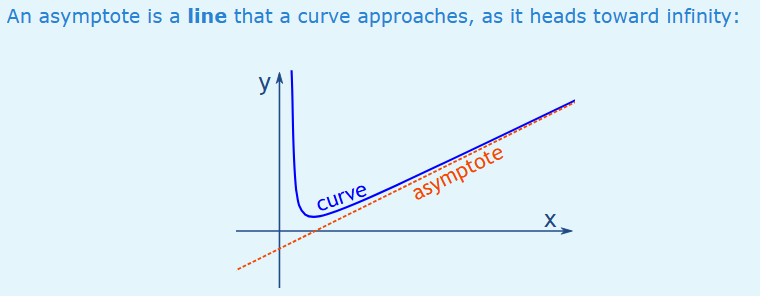
What is an asymptote, and how does it relate to Vmax?
An asymptote is a line that a curve approaches increasingly closely.
On a standard Michaelis–Menten plot:
The curve rises as substrate concentration increases.
Its rate of increase becomes progressively smaller.
It approaches a horizontal asymptote representing VmaxVmax.
In the mathematical Michaelis–Menten model, the curve approaches this line but does not reach it at any finite substrate concentration.
The instructor described imagining a meter stick held horizontally near the curve to estimate where the asymptote should be drawn.
What steps should you follow to estimate Vmax from a Michaelis–Menten plot?
Perform experiments using different initial substrate concentrations.
Measure the corresponding initial rates.
Plot initial rate, v0, against substrate concentration, [S]
Fit or draw the rectangular hyperbola that describes the data.
Estimate the horizontal asymptote approached by the curve.
Read the corresponding y-value. That value is Vmax
The asymptote is an estimate when drawn by eye. Modern data analysis can estimate the parameters more systematically by fitting the Michaelis–Menten equation to the experimental measurements.
Why isn't the highest experimental rate necessarily Vmax?
If the highest measured initial rate is 95 units, can you automatically say that Vmax=95
No.
The highest measured rate is the largest rate among the experimental points collected. It does not necessarily equal the true or estimated Vmax
The experiment may not have used a sufficiently high substrate concentration.
The enzyme may not have been fully saturated.
Experimental variation can affect individual measurements.
The saturation curve may approach a higher limiting value than the largest measured point.
You should estimate Vmax from the fitted saturation curve or another appropriate parameter-estimation method, rather than simply choosing the largest data point.
What is Km, in terms of reaction rate?
(see image)
Km is the substrate concentration at which the initial reaction rate is half the maximum initial rate, under the standard Michaelis–Menten model.
Graphically:
Identify Vmax on the y-axis.
Divide it by two.
Find that half-maximum value on the y-axis.
Move horizontally to the Michaelis–Menten curve.
Move vertically down to the x-axis.
Read the substrate concentration. This is Km.

What are the units of Km?
The Michaelis–Menten equation contains the sum: Km + [S]
Quantities can only be added if they have compatible units. Since [S] is a concentration, Km must also have units of concentration.
Common units include:
M (molar)
mM (millimolar)
μM (micromolar)
For example, if [S] is measured in mol/L, then Km must also be expressed in mol/L.
True or false: Km= 1/2Vmax
False. The two quantities represent different things:
Km is a substrate concentration, so it belongs on the x-axis.
1/2Vmax is half the maximum initial rate, so it belongs on the y-axis.
The correct relationship is: (see image)
In other words, Km is the x-value associated with the y-value 1/2Vmax
The two numerical values could happen to be equal if particular units and numbers make that so, but they are not equal by definition and represent different physical quantities.

What do the x-coordinate and y-coordinate mean on a Michaelis–Menten plot?
A Cartesian coordinate system relates two variables.
The x-coordinate represents the substrate concentration, [S]
The y-coordinate represents the initial rate, v0, produced at that substrate concentration.
Every substrate concentration corresponds to a particular initial rate under the experimental conditions.
At the specific x-coordinate [S]=Km, the corresponding y-coordinate is v0=1/2Vmax
Memory tip: Km is the concentration; half-Vmax is the rate.
What is the alternative definition of Km in terms of rate constants?
(see image)

Does Km depend on enzyme concentration?
Under the standard Michaelis–Menten model and unchanged conditions:
Km remains unchanged because it is determined by the relevant rate constants.
Vmax changes with the concentration of active enzyme.
The relationship is: Vmax=kcat[E]T
where [E]T is the total active enzyme concentration.
Increasing [E]T increases Vmax, while the intrinsic Km for that enzyme–substrate system remains the same.
What does a low Km generally suggest?
A lower Km means a lower substrate concentration is required to reach half-Vmax
In the introductory interpretation used in the lecture, a lower Km generally suggests that the enzyme achieves substantial substrate-dependent activity at a lower substrate concentration and may have a stronger apparent interaction with its substrate.
Important scientific qualification: Km is not always a direct measure of binding affinity. It depends on multiple rate constants, including substrate association, dissociation, and catalysis. A lower Km does not universally prove a stronger binding affinity.
What does a high Km generally suggest?
What does a high Km tell you about the substrate concentration needed to reach half-Vmax?
A high Km means a greater substrate concentration is required to reach half the maximum initial rate.
In the simplified interpretation:
A relatively low Km means half-Vmax is achieved at a relatively low substrate concentration.
A relatively high Km means half-Vmax is achieved at a relatively high substrate concentration.
A high Km can suggest a weaker apparent interaction in an introductory comparison, but the exact relationship with binding affinity depends on the enzyme's kinetic mechanism.
Compare two enzymes with Km values of 10−3 M and 10−1 M. What is the difference?
(see image)
Therefore:
Enzyme A reaches half-Vmax at a substrate concentration of 0.001 M.
Enzyme B reaches half-Vmax at a substrate concentration of 0.1 M.
Enzyme B requires 100 times the substrate concentration required by enzyme A to reach half of its own maximum rate.
Interpretation: Enzyme A has the lower Km and reaches its half-maximum rate at a much lower substrate concentration
Why isn't Km always a perfect measurement of enzyme–substrate binding affinity?
The Michaelis constant is: Km = (k-1 + kcat)/k1
It depends on more than just how readily the substrate binds to the enzyme.
Binding affinity is more directly related to the dissociation constant under appropriate conditions. For the simplest enzyme mechanism, when product formation is much slower than substrate dissociation, Km can approximate the substrate–enzyme dissociation constant. Otherwise, the two may differ substantially.
The instructor acknowledged that more advanced kinetics courses examine better ways to quantify enzyme–substrate interactions. For an introductory course, comparing Km values as an indication of the substrate concentrations needed for activity is useful.
How do you read Km from a Michaelis–Menten graph?
Estimate Vmax from the curve's horizontal asymptote.
Calculate 1/2Vmax.
Locate 1/2Vmax on the y-axis.
Move horizontally until you reach the curve.
Move vertically down to the x-axis.
Read the corresponding substrate concentration.
That x-coordinate is Km
The accuracy of this graphical estimate depends on how accurately the curve and its asymptote are determined.
What does it mean to take the reciprocal of a quantity?
The reciprocal of a nonzero quantity is 1 divided by that quantity.
Examples:
Reciprocal of 5 is 1/5.
Reciprocal of 10 is 1/10.
Reciprocal of Vmax is 1/Vmax
Reciprocal of [S] is 1/[S]
A larger positive number has a smaller positive reciprocal. For example, 1/100=0.01, whereas 1/2=0.5
Taking reciprocals of both variables in the Michaelis–Menten equation gives a linear relationship.
How is the Michaelis–Menten equation converted into the Lineweaver–Burk equation?
(see image)

Why is the Lineweaver–Burk equation a straight line?
The equation for a straight line is: y=mx+b
Compare it with: (see image)
The terms correspond as follows:
y=1/v0
x=1/[S]
m=Km/Vmax
b=1/Vmax
Plotting reciprocal initial rate against reciprocal substrate concentration therefore gives a straight line under the ideal Michaelis–Menten model.
What are the x-axis and y-axis of a Lineweaver–Burk plot?
x-axis: 1/[S], the reciprocal of substrate concentration.
y-axis: 1/v0, the reciprocal of initial reaction rate.
This differs from a Michaelis–Menten plot, which uses [S] and v0 directly.
The transformation converts the ideal rectangular hyperbola into a straight line.
What is the slope of a Lineweaver–Burk plot?
Slope = Km/Vmax
The slope is the Michaelis constant divided by the maximum initial rate.
This relationship allows Km and Vmax to be estimated when the line and its intercepts are known.
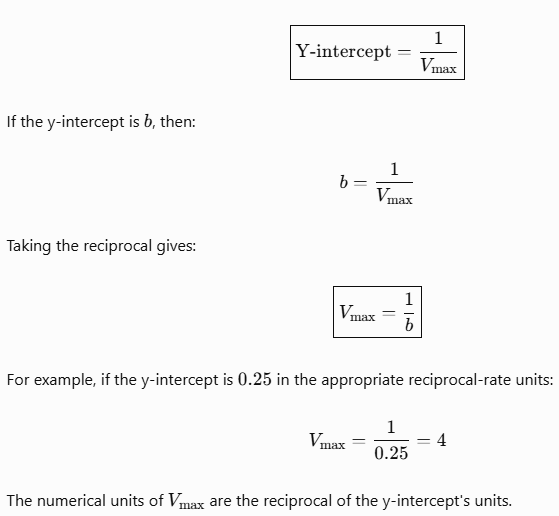
What is the y-intercept of a Lineweaver–Burk plot?
Y-intercept = 1/Vmax
(see image)
What is the x-intercept of a Lineweaver–Burk plot?
(see image)

Why is the slope of a standard Lineweaver–Burk plot positive?
Slope is: Km/Vmax
For a standard Michaelis–Menten system:
Km is a positive concentration.
Vmax is a positive rate.
Their ratio is positive, so the line has a positive slope.
A negative x-intercept does not mean that the slope is negative. The line rises from left to right while crossing the x-axis at −1/Km
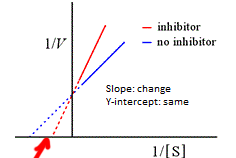
Why does the Lineweaver–Burk plot use a dotted or dashed line in the negative x-region?
The negative x-intercept is an extrapolated mathematical result. Since: x = 1/[S]
and physical substrate concentrations are positive, the negative x-region does not represent physically attainable positive substrate concentrations.
However, the straight-line equation can be extended mathematically to find the x-intercept.
A dashed segment indicates an extrapolated portion of the line rather than a region directly supported by measured positive-substrate data.
Why use a Lineweaver–Burk plot instead of a Michaelis–Menten plot?
A Michaelis–Menten plot is curved and requires estimating the asymptotic Vmax to determine Km graphically.
The Lineweaver–Burk transformation produces a straight line, allowing the kinetic parameters to be related to:
The y-intercept, 1/Vmax
The x-intercept, −1/Km
The slope, Km/Vmax
This provides an alternative method of estimating the kinetic parameters and avoids visually locating a horizontal asymptote directly.
Scientific limitation: The reciprocal transformation magnifies errors at low substrate concentrations and low rates. Modern analyses often prefer nonlinear fitting of the original Michaelis–Menten equation to experimental data rather than relying on a double-reciprocal plot.
How do points on a Michaelis–Menten plot translate to a Lineweaver–Burk plot?
Taking reciprocals reverses the relative sizes of positive numbers.
Large [S] gives small 1/[S]
Small [S] gives large 1/[S]
Large v0 gives small 1/v0
Small v0 gives large 1/v0
Consequently:
High-substrate, high-rate measurements tend to appear near the origin of the Lineweaver–Burk plot.
Low-substrate, low-rate measurements tend to appear farther from the origin, toward the upper-right region.
Memory tip: Reciprocal plots reverse the relative sizes of positive values on both axes.
What units are typically used for an initial reaction rate in enzyme kinetics?
Reaction rate measures concentration change per unit time.
Common units include: M s-1
This means molarity per second, or moles per litre per second.
Because v0 and Vmax are rates, they have the same units.