Animal Behavior - Sociality and Addiction
 Call Kai
 Learn
 Practice Test
 Spaced Repetition
 Match
 Flashcards
 Knowt Play
1/96

There's no tags or description
Looks like no tags are added yet.
97 Terms
Which example shows ‘intermediate parental care?
-An octopus protecting its eggs before they can hatch, then passing away
-A pig nurturing its piglets until it reaches maturity
-A lion father abandoning his cubs during the barren season
-A mosquitofish that lays it eggs in a cave before abandoning them
An octopus protecting its eggs before they can hatch, then passing away
What factors affect when males provide parental care?
-It increases in species where females use internal fertilization
-Larger clutch size leads males to shower greater defensive behavior
-They are more likely to do so when paternity is uncertain
-They do so when they have an opportunity to mate with multiple females
Larger clutch size leads males to shower greater defensive behavior
What costs do parents commonly pay for providing parental care?
-Decreased foraging time
-Increased chance of predation
-All answers are correct
-Decreased mating opportunities
-Necessity for brood reduction when resources are low
All answers are correct
A species which provides ‘low parental care’ would most likely have all of the following features EXCEPT:
-Semelparity
-External fertilization
-Iteroparity
-Short lived
Iteroparity
Which statement about the trends that exist in reproductive strategies, parental care behavior, and offspring survival of animals is TRUE?
-Individuals conducting exclusively brood parasitism experience the highest fitness
-Large organisms with internal fertilization are less likely to provide parental care
-Brood reduction commonly occurs in semelparity species
-Organisms with longer life cycles are more likely to provide parental care
Organisms with longer life cycles are more likely to provide parental care
How do hormones affect reproductive behavior?
-Individual hormones like prolactin work in insolation to increase parental care
-They suppress reproductive behaviors when seasonal cycles end
-They illicit parental instincts and are enhanced by behavioral feedback
-They are expressed cyclically and are unaffected by behavioral feedback
They illicit parental instincts and are enhanced by behavioral feedback
What factors affect the chances species will evolve and maintain altruism?
-Social group size and help is often limited by the amount of resources
-Indirect reciprocity must be innate and immediate rewards
-Direct reciprocal is maintained through infrequent contact
-Cooperative behavior exists only in related and more evolutionarily derived animal species
Social group size and help is often limited by the amount of resources
Which of the following ISN’T an example of the costs of sociality?
-Higher Occurrences of aggression
-Ease of contacting diseases
-Decreased prey attraction
-Increased competition
Decreased prey attraction
Indirect benefits from sociality are based on:
-Titt-for-tat
-Image Scores
-The availability of resources
-Allogrooming
Image Scores
Which of the following IS an example of the benefits of sociality?
-Conflictless access to resources
-Increased hiding ability
-Increased energy expenditure efficiency during travel
-Decreased physiological costs of competition
Increased energy expenditure efficiency during travel
A system in which individuals recognize one another through a learned physiological cue, such as smell is know as…
Indirect famliarization
Which statement about social groups is INCORRECT?
-Some groups of crows contain cohorts of individuals all born around the same time
-Some groups of primates remain with the same individuals for their entire lives
-Some groups of insects contain only individuals of the same sex
-Some species of rats band together seasonality for travel
Some species of rats band together seasonally for travel
What features distinguish a cooperatively breeding species from one that is eusocial?
Eusocial divides labor into reproductive and non-reproductive
Which hypothesis about the evolution of eusociality is explained WRONG?
-Habitat Saturation hypothesis: Species with limited breeding grounds consolidate breeding into smaller amounts of viable adults
-Fortress Defense Hypothesis: Organisms which live in secure food sustaining locations grow to defend their habitat
-Brood Care Hypothesis: Communal care of offspring leads to overall increased fitness of the species, spreading to others through indirect selection
-Haplodiploidy Hypothesis: this system results in sons which are more genetically similar than normal, making them especially likely to display altruism
Haplodiploidy Hypothesis: this system results in sons which are more genetically similar than normal, making them especially likely to display altruism
What distinguishes Bees from Wasps?
Wasp males mate with other colonies while male bees only mate with the queen
Social Queuing…
Involves individuals who change physically in response to their place in the dominance hierarchy
In Cooperative breeding…
Offspring survival is enhanced through additional feeding and helpers
What distinguishes Termites from Ants?
Worker ants are all mature adults, while termites working caste are juveniles
How is alcoholism a disease of excess?
Smelling ethanol allows for more efficient food finding but contemporarily availability exasperates this skill
Which environmental factor is NOT something that typically affects alcohol consumption?
-Self Medicating from a blood born parasite or disease
-Raised in peer only social groups
-Paternity
-Separation of Infant from parents
-Emotional Regulation
Paternity
How are the negative traits associated with alcoholism adaptive in other scenarios?
Impulsivity can lead to males acting more aggressive, protecting themselves better in isolation
Which of the following trends regarding alcohol consumption exist in nature?
-Teetotalers are alcohol abstainers who represent the vast majority of individuals
-Females drink larger quantities of alcohol than males
-Initial exposure to alcohol leads to decreased preference in the future
-Organisms have preference for higher concentration of alcohol, until a certain point
Organisms have preference for higher concentration of alcohol, until a certain point
Type 1 alcoholism…
Arises from the emotional need to quell anxiety or fearfulness
Darwinian medicine seeks to find…
Evolutionary basis for diseases such as type 2 alcoholism
Which DSM-IV criterion is NOT appropriately matched with its Behavioral Equivalent?
-Tolerance: escalation of drug use
-Loss of interest in important activities: Drug preference over nondrug rewards
-Using more than intended: Resistance to extinction
-Continued use despite knowledge of consequences: Resistance to punishment
Using more than intended: Resistance to extinction
Which of the following is NOT an experiment used to study resistance to punishment in animals?
-Shock-associated stimuli
-Intercranial stimulation
-Bitter tasting drug solution
-Post-ingestion illness
Intercranial stimulation
The Rat Park experiment…
Showed that addiction is exacerbated by isolation and decreased by sociality
Tolerance and Escalation of Drug habits is studied using all of the following EXCEPT?
-Drug self-administration
-Intracranial self-stimulation
-Conditioned place preference
-Water maze
Water maze
How does the effect of addiction change with different drug types (alcohol, cocaine, morphine)?
Ethanol and cocaine both show trends of initial sensitivity to punishment which is gradually lost
In Addiction…
Individuals chronically relapse due to loss of control over drug taking
External Fertilization
Unlikely to care for children with more offspring and less parental care; faster maturing
Internal fertilization
More likely to care for children larger with less offspring and more parental care; take longer to mature
Low Investment Parental Care
Species that do not teach or provide care in the off-spring’s cycle (Insects)
-Low number of offspring survivorship
-High number of offspring
Intermediate Parental Care
Species that provide critical protection, shelter or incubation during a highly vulnerable stage but provide no further care once offspring hatch (Octopus)
-Moderate survival and clutch size
High Investment Parental Care
Species that provide critical protection for several years until they are mature (Elephants/larger animals)
-High survivorship of offspring
-Parents risk fitness for next gen
Semelparity
When reproduction occurs once in your lifetime
Iteroparity
When multiple reproductive events occur throughout a lifetime
Benefits of Sociality
-Reduced search times for resources (food or mates)
-Increased feeding success (group hunting)
-Enhanced resource defense
-Reduced predation risk
-Lower physiological costs for movement and thermoregulation
-Division of Labor
-Communal care of young
Costs of Sociality
-Increased aggression
-Increased competition for resources
-Predator attraction
-Disease transmission
-Possibly infantcide and cannibalism
Dominance Hierarchy
an organized social system with dominant and subordinate members
Linear Dominance Hierarchy
an organized social system in which an individual is dominant to each individual below and subordinate to all above it in rank
Kin Selection
natural selection favors traits and behaviors that benefit an organism’s genetic relatives, even at direct cost to organism’s survival or reproduction
Cooperative behavior
a mutually beneficial interaction between individuals
Altruism
a behavior that results in the increased fitness of another individual performing the behavior
Allogrooming
Grooming by one individual of another individual to remove ectoparasites
Tit-for-Tat
Initial cooperation then mimicking response of other
Indirect reciprocity
A relationship in which helping individuals are more likely to receive help in the future because they obtained high image scores by helping others
Image score
an assessment of individuals propensity for helping others based on its observed prior behavior
Cooperative breeding
adults physiologically capable of reproducing forgo breeding and instead help others raise offspring; some outside breeding
Social Queuing
subordinates eventually move up the social ladder as they age, often changing physical characteristics (Clownfish)
Eusociality
an advanced level of social organization, in which a single female or caste produces the offspring and nonreproductive individuals cooperate in caring for the young; only breeds with the queen (insects)
Darwinian medicine
seeking evolutionary explanations for the susceptibility to disease
Type 1 Alcoholism
Consume alcohol to alleviate anxiety, characterized by an exaggerated avoidance of harm
-Removal from parents
-Raised with no parents only peers
Type 2 Alcoholism
rated highly in impulsivity and other measures of behavioral dyscontrol
Addiction
A chronic relapsing disorder characterized by loss of control over drug taking
Criteria for drug addiction and the behavioral equivalent
Tolerance, withdrawal | Tolerance, escalation of drug use |
Using more than intended | Impaired control, neurocognitive deficits |
Difficulty restricting | Resistance to extinction |
Great deal of time spent | Increased motivation for drug |
Other activities given up | Drug preference over nondrug rewards |
Continued use despite problems | Resistance to punishment |
Drug self-administration
animal is given free access to drug to use at leisure
Punishment setups
Shock-associated stimuli
Post-ingestion illness
Bitter tasting drug solution
Bitter Tasting drug solutions
After a lengthy period of ethanol drinking followed by a period of forced abstinence if bitter quinine is added to ethanol
Post-ingestion illness
Tested whether devaluation of orally ingested ethanol or cocaine, by pairing by consumption with lithium chloride-induced illness
Shock-associated stimuli - The Shock Box
Cocaine seeking in rats was punished with foot-shock condition stimulus
Under what circumstances do males provide the majority of parental care? What type of fertilization method is tied closer with male parental care? Why?
They do so when they will not have the ability mate with multiple females. It increases in species where females use external fertilization because males have certainty they are guarding their eggs. Males are more likely to do so when they are guarding a larger amount of eggs or offspring, clutch size

What do the figures tell us about males providing parental care?
This shows that males who view rival males near their female will be less likely to care for their eggs
from predators, this is because of the lack of certainty about their paternity. It is not evolutionarily
adaptive to care for offspring that you did not father.
Why are females most likely to provide parental care?
Females will be more likely to provide parental care because their paternity is always certain. They know which eggs are theirs. That being said, it is most likely to occur with internal fertilization. With the production of less eggs, mothers are more likely to put forth effort if they have already put effort into taking care of the offspring (pre birth). The longer they carry the offspring the more likely they are to provide extended parental care.

What do the following graphs tell us about the costs of parental care? Why do animals not produce massive clutches of offspring every season?
These graphs show that animals are not capable of raising offspring and producing them in constant amounts. Parents pay costs associated with the physical demands necessary to produce eggs and then care for their living offspring. In this case, we can see that females who had to incubate more eggs, lost more weight, delayed egg laying longer (longer recovery time), and layed less eggs the following year. These costs limit reproductive fitness.
Imagine a bird species with biparental feeding of young and equal biparental care. Suppose you manipulate one individual to increase its cost of flight by removing a few of its flight feathers or adding small weights to the bird. How will this manipulation affect its level of parental care in terms of providing food to offspring? Why?
The parent who has more difficulty providing food will do less parental care. This could result in losing offspring through brood reduction. They will spend more time on themselves or subsection of prioritized offspring.
Consider three female chickadees of the same age and condition. Each successfully raises a clutch of eggs with no help from her mate, but the clutches differ in size. Female A raises four offspring, B raises eight, and C raises 12. What can you predict about the overwinter survivorship and reproductive output of these females the next year?
While Female C may have more offspring, she will ultimately lose a larger percentage of offspring compared to the smaller flocks of B and A. The extra work that she puts into raising these extra offspring will lead Female C to lose much more weight, take longer to reproduce again, and in the future will produce a smaller flock. Female A is expected to have the highest overwinter survivorship and reproductive output the following year because she invested the least energy in parental care, as she raised four offspring. Female C is expected to have the lowest survivorship (percentage) and highest immediate reproductive output. This will limit her future flocks because she expended the most energy in raising her 12 offspring. Female B is expected to have intermediate outcomes. This reflects a trade-off between current reproductive investment and future reproduction, in which greater parental investment can reduce a parent’s survival and ability to reproduce in the future
What is brood reduction, why does it occur, and when is likely to occur?
Brood reduction is the neglect of one offspring in favor of another to ensure the survival of another offspring. This is likely to occur when parents are incapable of taking care of their offspring due to resource restricts, or other health/metabolism limiting. It occurs because parents are biologically compelled to ensure the survival of their genes and the most efficient way to do it is to make sure healthier larger and more developed offspring are cared for. They are more likely to survive then splitting the resources between multiple.
What does the graph to the right teach us about the fitness of brood parasitism by cuckoo birds? Why is this the case?
Brood parasites are affected by frequency dependent selection like many deceptive traits. Species which have interacted with them, either recently or evolutionary, will be more likely to reject the false offspring. This includes species which are used to dealing with cuckoo’s or individuals who have dealt with it before. Thus, it is not 100% fit for parasites to only place eggs in other nests. By doing so, they offset some of their work, but risk losing eggs. Thus, the most successful parasites not only lay eggs in other nests but also raise their own young. The species with the shorter history are nearly always an egg acceptor, while the species with the longer history are more likely to be a rejector
How does the cuckoo take advantage of parental biases in the hosts behavior? How are those behaviors otherwise evolutionarily adaptive?
Cuckoo parasites take advantage of parent’s bias towards providing care for larger and more developed offspring that are more likely to survive. Cuckoo eggs are larger than native species which tricks the host into prioritizing it. The resulting chick is often larger than the others allowing it to overpower them. They also develop quickly, often before the other eggs. The host parent does not seem to notice or care that the newborn cuckoo pushes the unhatched (thus less developed) eggs out of the nest. This is because of the bias towards providing care to an offspring you know is succeeding vs those that come after and might not develop as well.
What most often limits social group size?
Food and resource availability
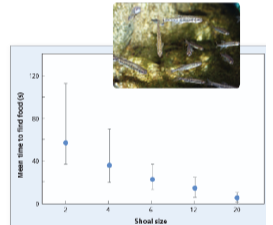
Explain the trend in the graph
Decreased energy finding food. Others provide cues to you allowing you to group up and find food more efficiently. The larger the group the faster they find food. This is a passive benefit

Explain the trend in the graph
Decreased vigilance in groups leads to increased fitness in other areas such as eating and reproduction. It also shows that females are more likely to watch in groups vs males who do so when not in groups. This also shows that animals are less likely to get eaten in large groups
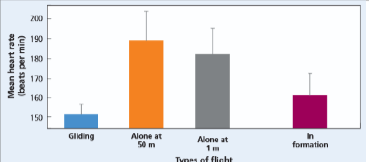
Explain the trend in the graph
Decreased energy from flight other physics-based ways of animal helping each other. This shows that the heart rat is lower in birds that fly together because they are more efficient.
What factors affect the chances species will evolve and maintain altruism?
Fitness cost vs benefit x direct relatedness. Cooperative behavior exists most often in related and more evolutionarily derived animal species. Direct reciprocal is maintained through frequent contact and tit-tat
What is direct familiarization and what happens if we raise individuals of different groups together as juveniles?
It is when an individual learns which other animals are kin by who they are familiar with and often raised with. If individuals from different groups are raised together from a young age, they will often recognize one another and consider them kin, even if they are different.
What is indirect familiarization and what happens if we raise individuals of different groups together as juveniles? How do you trick them?
Indirect familiarization is when individuals learn who is kin through unrelated cue, such as visual markings for scent; this is most often a type of pheromone, like how ants are born smelling similar to their colony mates and different from other species. Because this familiarization relies on senses, individuals of different groups who are raised together will recognize the others as different due to their smell. To trick them, you can take the smell of someone who is kin and place it on another individual and that makes them think they are related
What direct benefits do organism gain from unrelated individuals? Why are animals willing to help those who they can tell are not kin?
This takes two different forms (1) Direct reciprocal altruism and (2) Byproduct mutualism. In (1) individuals who meet many times learn to help those who have helped them in the past. By being friendly, you ensure you get help further down the line when you need it. Tit for tat. (2) is the fact that you don’t have to like or care about the other individuals to help them by accident or be helped. Animals may hunt in pacts, not because they are family but because the group ensures everyone can eat and by helping someone you are secretly helping yourself. Selfish helping
In a group of parrots, you frequently observe allogrooming. What data would allow you to determine whether kin selection or reciprocity was a better explanation for these observations?
To determine whether kin selection or reciprocity better explains allogrooming in parrots, I would collect data on the relatedness of individuals and how frequently they groom one another. If parrots groom their close relatives more often than unrelated individuals, even when controlling for how frequently they interact, kin selection may be the better explanation. However, if parrots tend to groom individuals that have groomed them previously, regardless of their genetic relatedness, reciprocity may better explain the behavior. To determine whether kin selection or reciprocal altruism best explains allogrooming in a group of parrots, you would need to collect genetic, behavioral, and observational data over time. To test for kin selection, you would collect genetic samples (such as DNA from feathers or blood) to map out pedigree relationships and determine the coefficient of relatedness (rr) between grooming partners; if allogrooming occurs far more frequently between close genetic relatives than non-relatives, kin selection is supported. To test for reciprocity, you would record detailed, long-term observational data tracking individual interactions over time, noting who grooms whom, the frequency and duration of grooming sessions, and whether grooming is returned in a "tit-for-tat" manner. If parrots frequently groom unrelated individuals who regularly return the favor or exchange other cooperative acts like food sharing, reciprocal altruism provides the better explanation
What are some indirect benefits of altruism between individuals and how do individuals choose who they are willing to help? Why do animals most often not cheat one another?
Indirect benefits such as image scores, which are social scores. This is the fact that if you help on individual, you are viewed by others as helpful. This means they are likely to treat you well in return as you might help them. It’s a spreading of direct altruism. Animals learn not to cheat each other because over many interactions they will be found out to be a cheater or not helper. You will fitness through lack of socially helpful traits

What does the following experiment show us about indirect benefits to altruism?
image scores, which are social scores. This is the fact that if you help on individual, you are viewed by others as helpful. This means they are likely to treat you well in return as you might help them. It’s a spreading of direct altruism. Animals learn not to cheat each other because over many interactions they will be found out to be a cheater or not helper. You will fitness through lack of socially helpful traits. This also shows that the relation increases over time. After a year individuals with high social scores were more socially positive and attracted to.
What distinguishes passive vs active effects of sociality? What are some examples of this in nature?
Passive is when they are helping each other by being around, with no specific need to organize or help one another. This by example is the dilution effect, and the fact that fish can help each other find food through cues.
Active are decisions that animals are making within a group that raise their survivability. This includes things such as the selfish herd effect where individuals will put others between them and a predator to make sure they are not eaten. This could also include cleaning, sharing food actively, and other activities. By product mutualism is an active choice to help others to help you gather food, without having to be kin
What traits differentiate cooperative breeding from eusociality?
Cooperative breeding occurs when individuals assist in raising another’s offspring while maintaining the ability to reproduce. These roles are behavioral, as these individuals are morphologically identical to the breeders. Eusociality is characterized by a definite division of labor where a distinct group of individuals, such as a queen or king, monopolizes reproduction, while others are sterile workers or soldiers. These roles are morphological. Eusocial species help raise the queen’s offspring and usually can’t reproduce at all, and they’re often built differently for their role, which is not flexible
In social animals, such as meerkats, that use cooperative breeding, you will often have dominant pair(s) who reproduce with some outer pairs breeding as well, though less often. In eusociality, however, the primary breeding individual (generally a “queen(s)”) is the sole reproducer and many others within the eusocial community will not be reproductively capable (other than select members such as male drones in bees in comparison to the sterile female drones)
Briefly explain the hypotheses that support the evolution of cooperative breeding and eusocial behavior
Hamilton’s Rule explains how altruism spreads when the reproductive benefit to the recipient is greater than the cost to the helper, with respect to the recipient’s genetic relatedness to the helper.
Habitat Saturation Hypothesis: When a habitat is smaller, the species will limit how many individuals are reproducing due to the lack of resources and low survivability. The habitat saturation hypothesis states that when few territories are available, breeding attempt has high cost but a low chance of survival.
Haplodiploidy Hypothesis: Males of a species are haploid (from unfertilized eggs) and females are diploid (from fertilized eggs), which can lead to individuals helping others more often due to the fact that they are more closely related.
Brood Care Hypothesis: When less individuals reproduce, it allows more individuals to care for the offspring of others (kin selection common in colonies), increasing fitness.
Fortress Defense Hypothesis: When a species inhabits a valuable area, specialized defensive/labor roles will evolve. social and cooperative behaviors can evolve when organisms inhabit a protective, resource-rich and valuable territory. This supports the defense of a group’s territory (or nest) and promotes the development of defensive behaviors and defense-specific morphology in specific groups of a population (such as soldier shrimp) aimed at protecting and preserving that food source and shelter from threats
What mechanisms do matriarchs use in cooperative breeding and eusocial species?
Matriarchs mainly use aggression and stress in cooperative breeders and chemical signals in eusocial species. In cooperative breeding, matriarchs use physical dominance and targeted aggression, social eviction, infanticide, and disrupting mating attempts of subordinates. In eusociality, matriarchs use chemical signaling, egg marking, physical aggression, oophagy, and starving larvae to stunt growth resulting in the inability to reproductively mature.
-Bees, ants, and other insects: Queens produce pheromones that help create and maintain the eusocial state in the colony.
-Clownfish: A dominance hierarchy maintains reproductive roles. The largest individual is the breeding female, and the next largest is the breeding male. If the female is removed, the male gradually changes sex, and the next-largest male becomes the breeding male
Explain dominance hierarchies and how they vary/work in cooperative and eusocial social structures.
Dominance hierarchies are when social individuals are dominant over those below them and submissive to the others above them. This lowers stress and aggression in groups. In cooperative breeding this is established by the dominant females and sometimes males. There is social mobility through associations and laterally amongst not breeding individuals. In eusocial species, this is kept in check by pheromones and production of sterile underdeveloped who are innately subordinate. There is strict physical castes, you’re born into your group
Why are we interested in studying alcohol use in animals? How can we use animals to understand alcohol dependence?
Darwinian medicine seeks to find evolutionary reasons for disease.
Evolutionarily speaking, how is alcoholism a disease of excess?
Alcohol has positive evolutionary associations with food and survival but the amount in nature is limited due to the timing of fruit and fermenting process. This means that while they can over drink sometimes, the concentration and frequency doesn’t exist. This means that alcoholism cannot happen in nature, it is brought on by human culture and brewing processes
What are the two competing hypotheses about why human have such a close relationship with alcohol (what do they each assert)?
The two theories revolve around the extreme use of alcohol from our culture and proximity to it. It been culturally put into our lives so we must do it. The drunken monkey hypothesis says we evolved to like the smell to find alcohol. This has thus been reenforced by our alcohol

What does this graph show about alcohol effects?
This shows that parasitic wasp larva die more often when flies consume alcohol. This provides an increase in blood alcohol and exposure of the larva. This has alcohol acting as a medicine

What does this graph say about brain function and emotional regulation by alcohol?
There is an association with brain function and alcohol seeking. There is more alcohol seeking in flies that have les brain activity. This lower activity is also associated with animals who have not mated.
Why do we believe that alcohol is high-jacking otherwise advantageous natural behaviors?
The two personality traits that are highest associated with alcoholism are also associated with survival behaviors. These are fear (anxiety) that keeps animals alive, and close to family members is associated with type 1 and high drinking to quell their fear. The other is impulsivity which is serotonin and type 2 alcoholism. Those who are generally more impulsive drink and cannot stop.
How are the ‘negative traits’ associated with Type 2 alcoholism adaptive in other scenarios? How do they remain in the population?
Impulsivity, which is a primary indicator of susceptible to alcoholism, can lead to males acting more aggressive which allows them to protect themselves better in isolation. Impulsivity leads to mating earlier in life, allowing them to pass on their genes before they die. Impulsive males are less likely to remain within social groups, which allows them to survive in scenarios were resources are too low to share
What does the rat park experiment teach us about addiction and how does it tie together ideas of behavioral evolution and sociality?
Showed that addiction is exacerbated by isolation and decreased by sociality. Showed rats in enriching social environments were less likely to display addictive tendencies. It reaffirmed that addictive potential exists in only a subgroup of individuals. It also reaffirmed the connection between genetics and addiction
Why are the behaviors performed by addicted social animals unusual in the context of natural selection? Explain two unusual behaviors and their negative result.
Most addicted animals act against their own self-interest to receive drugs. They provide servies and do tasks that they would not have to do otherwise (like pressing a button or taking shocks). They also take physical pain that should be a deterrent normally. When naturally social, they ignore others and no longer partake in social structure, losing benefits. They eat less which is less fit, and they decide not to reproduce as much as they are instead preferring drugs.
What are the trends seen in addiction through different drugs?
Each drug is addicting in its own ways, and to its own extremes. Males are more likely to drink and show addiction tendencies. Morphine is choose only during withdrawal while alcohol and cocaine and heroine are taking at excess until stopped. Cocaine and heroin will kill the animals if not limited.
What difficulties do we face in establishing animal models in addiction?
Because of how complex the human brain is, its hard establishing animal model for drug addiction in order to understand human addiction. We also have to consider finding the right animal to train and do an experiment with, which is another challenge to keep in mind.