LAB 7 BENZOIN project
 Call Kai
 Learn
 Practice Test
 Spaced Repetition
 Match
 Flashcards
 Knowt Play
1/23

There's no tags or description
Looks like no tags are added yet.
24 Terms
OVERAL lab 7: In our remaining laboratory sessions, we will investigate some acyl addition reactions, and in some cases these two carbonyl mechanisms will merge into a single tandem process.
This Mini-Step synthesis project uses thiamine (vitamin B1) as a catalyst for the benzoin condensation, followed by sodium borohydride reduction of the resulting benzoin. It highlights biomimetic catalysis, umpolung reactivity, and stereochemical outcomes in carbonyl chemistry.
It's describing a new two-step synthesis project involving benzoin condensation followed by reduction to hydrobenzoin.
Step 1: Benzoin condensation
- Reagents: Thiamine (vitamin B1), NaOH, benzaldehyde.
- Two molecules of benzaldehyde combine to form benzoin.
- This reaction uses umpolung reactivity.
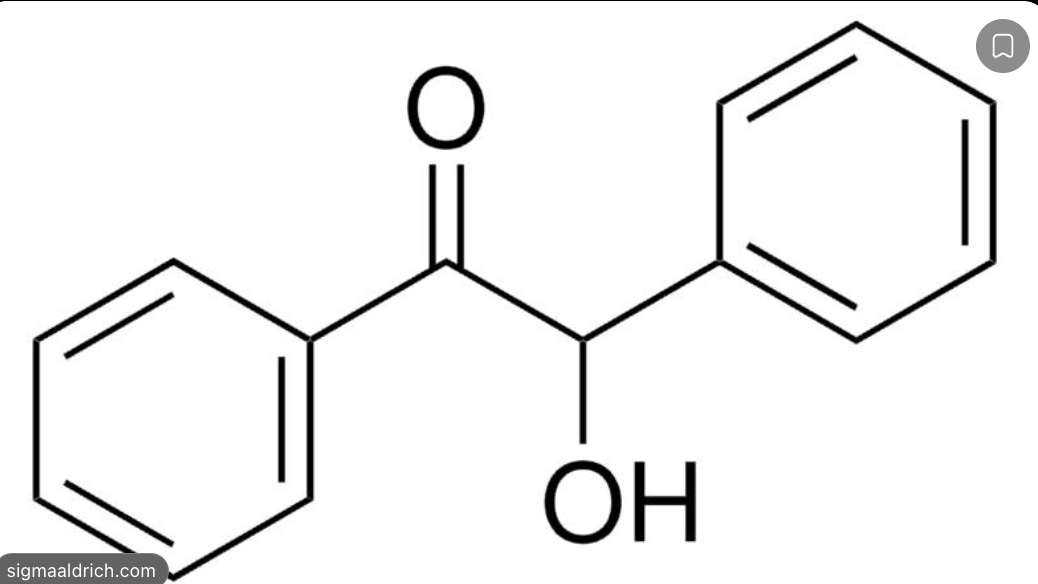
Step 2: Sodium borohydride reduction
- Reagent: NaBH₄ (sodium borohydride).
- The ketone carbonyl in benzoin is reduced to an alcohol.

his is a two-step synthesis:
1. Benzaldehyde → Benzoin (thiamine-catalyzed benzoin condensation).
2. Benzoin → Hydrobenzoin (NaBH₄ reduction).
You will also need to understand:
- Thiamine's role as a biomimetic catalyst.
- Umpolung.
- Reduction mechanisms.
- Stereoisomers (especially stereochemistry of hydrobenzoin).
- Recrystallization and purification.
- IR, NMR, melting points, and percent yield.
Identify the reagents, conditions, and reaction mechanism involved in the thiamine-catalyzed benzoin condensation.
e
Explain the role of thiamine as a biomimetic catalyst and the concept of umpolung reactivity
e
Perform the sodium borohydride reduction of benzoin and understand its stereochemical implications.
e
Explain the formation of possible stereoisomers in the diol product and factors influencing selectivity.
Apply recrystallization and other purification techniques.
Identify important structural changes between starting material and products using melting point, IR, and ¹H NMR.
Calculate percent yields and interpret analytical data to assess reaction success.
What should be done in fume hood and what in benchtop?
All chemical transfers, reactions, and recrystallizations should be conducted in the fume hood. Product isolation and TLC (keep covered) can be performed on the bench top.
Sodium Borohydride: NaBH4
Sodium borohydride is a mild reducing agent, primarily reduces aldehydes and ketones into ALCOHOLS.
Na+ - sodium ion (spectator)
BH4^-: borohydride ion cats as a hydride (H^-) donor.
The hydride acts as a nucleophile and attacks the electrophilic carbonyl carbon.
ONLY REDUCES ALDEHYDE to a PRIMARY ALCOHOL
and KETONE TO 2ndary Alcohol
Remember: NaBH₄ is more selective and milder than LiAlH₄ (lithium aluminum hydride).
mech

OUR LAB:

NaBH₄ will reduce the ketone but leave the existing alcohol and both aromatic rings unchanged.
6. Safety precautions and reaction quenching
NaBH₄ reacts with water, alcohols, and especially acids to release hydrogen gas (H₂), which is highly flammable.
Quenching means destroying any remaining reactive reducing agent after the desired reaction has occurred.
Benzoin :past and present!
prior to 1970 only few ways to create new c-c bonds, (beyond griniard and dils-alder cycloadditions).
One of the first was by Wohler and leibig, they investigated the aromatic component of bitter almond oil (benzaldehyde) and observed that reacting benzaldehyde with cyanide ion lead to a CYANOHYDRIN.
For anyone currently studying Organic chemistry, this shouldn’t be surprising, nor that cyanohydrins are governed by a reversible equilibrium.
THE SURPRISE: The surprise came from the formation of another product that could only be generated by a mechanism that resulted from cyanohydrin deprotonation, and the formation of a subsequent carbanion nucleophile. This striking reversal of polarity, now known as an umpolung, flipped the expected electrophilic character of the aldehyde carbon into a “straight-up, 6-7” carbon nucleophile (DISCOVERY OF UMPLPUNG)
UMPOLUNG WHAT IS IT:
OVERALLA: concept: reversal of polarity.
Normally, the carbonyl carbon of an aldehyde is electrophilic because oxygen pulls electron density away from it. When cyanide attacks this carbon, it forms a cyanohydrin. The cyanohydrin can then be deprotonated, meaning a hydrogen is removed from the carbon, leaving behind a negative charge and forming a carbanion. This changes the carbon from an electrophile into a nucleophile, a reversal of reactivity known as umpolung. The newly formed nucleophilic carbon can then attack the electrophilic carbon of another benzaldehyde molecule, forming a new carbon–carbon bond and ultimately producing benzoin.

The resulting carbon is called a carbanion because it carries a negative formal charge. The neighboring nitrile group helps stabilize this negative charge through resonance.
Now, instead of accepting electrons, this carbon can donate electrons and attack another electrophile.

This was such an important discovery because two aldehydes normally have electrophilic carbonyl carbons. You cannot ordinarily get one electrophilic carbon to nucleophilically attack another electrophilic carbon.
However, if you convert one of those carbons into a nucleophile through umpolung, you can form a new carbon–carbon bond.
FORMATION OF BENZOIN:

Your lab uses thiamine (vitamin B1) as an alternative catalyst to accomplish the same overall polarity reversal.
The co-mixing of this in-situ carbon nucleophile within a highly concentrated electrophilic benzaldehyde environment allowed for the formation of an acylated addition product, in this case – benzoin (see mechanism below). This early work not only introduced a new C–C bond‑forming strategy, but it laid the groundwork for other umpolung analogs, most notably the Claisen and Dieckmann condensations, the Aldol condensation, and the Robinson annulation.

In our lab, not using cyanide
Cyanide not a good idea in lab.
There are analogous c-c bond forming rxns that occur in vivo, where thiamine (vit B1) acts as a catalyst in a manner reminiscent to what was explained with cyanide.
Ronald Breslow proposed this mech for thiamine-cat reactions. BIOCATALYST!
Thiamine allows for the same umpolung process, converting a normally electrophilic aldehyde carbon into a nucleophile so that a new carbon–carbon bond can form. In 1958, Ronald Breslow proposed the mechanism explaining how thiamine accomplishes this. Since thiamine naturally participates in similar reactions in living organisms, using it in the laboratory is an example of biomimetic catalysis, meaning we imitate a process found in nature to perform a chemical reaction in a safer and more environmentally friendly way.

Activity overview
In this multi-day project, you will synthesize benzoin via thiamine-catalyzed condensation of benzaldehyde, purify it by recrystallization, and then reduce it with NaBH₄ to the corresponding diol (hydrobenzoin). You will characterize products, calculate yields, and explore stereochemical outcomes. This experiment illustrates green chemistry principles through biomimetic catalysis and provides new hands-on experiences with carbonyl addition, hydride reduction, as you revisit some old purification and reaction monitoring techniques.
RXN SCHEME
