ansc314 - intro to minerals, Ca+
 Call Kai
 Learn
 Practice Test
 Spaced Repetition
 Match
 Flashcards
 Knowt Play
1/39

There's no tags or description
Looks like no tags are added yet.
40 Terms
mineral classes
macro minerals
micro minerals
macro minerals
> 0.01% in diet (> 100 mg/kg)
Ca
P
Na
Cl
K
Mg
S
micro minerals
< 0.01% in diet (< 100 mg/kg)
Fe
Cu
I (iodine)
Zn
Mn
Se
Cr (chromium)
F
+ ultratrace minerals
ulltratrace minerals
Mo (molybdenum)
Co (cobalt)
Si (silicon)
V (vanadium)
Ni (nickel)
As (arsenic)
nutritionally important minerals
elemental compositions of various species relatively uniform
except in young animals (Ca & P ↓)
dietary requirement & body levels highly correlated

mineral functions
structural
electrochemical
catalytic
mineral function: structural
component of bone & tissues
e.g. Ca, P, & S
mineral function: electrochemical
acid-base balance, osmotic control, H2O balance
K+, Na+, Cl-
mineral function: catalytic
component of hormones & enzymes
S, Mg, Fe, Sn, Cu, I, etc
calcium (Ca2+)
most abundant mineral element in body
milk keeps casein in solution by forming a micelle w/ casein, Ca+, & P
Ca sources
humans
milk & dairy products
legume seeds
animals
milk (nursing)
legume roughage
animal by-products
fish meal
ground limestone & dicalcium phosphate
dairy cows & laying hens
bad sources
cereal grains & roots < 0.2% of DM
Ca functions
bone & teeth - 99% body Ca in bone
mineral salts in bone/teeth
egg shells - almost pure CaCO3
muscle contraction & nerve impulses
acid-base balance
cation-anion balance of diets
blood clotting
Ca blood clotting cascade
Ca++ions required at all steps in fibrin formation & allows coagulation factors to bind to membranes
EDTA - binds Ca2+ & reduces clot formation
Ca crucial for fibrin formation
allows coagulation factors to bind to membranes

Ca body distribution
99% in bone & teeth
1% in blood, body fluids & w/in cells
hens have ↑ blood Ca to favor Ca deposition into eggshell
Ca absorption
IN duodenum & jejunum
neonatal stage (mammal)
↑ [milk]
passive transport
non-saturable
paracellular (between cells)
after neonatal stage
saturable
active transport
transcellular (through cells)
regulated by vit D, parathyroid hormone, calcitonin
calcitonin
hormone that is produced by the parafollicular cells of thyroid gland
help regulate Ca & P lvls in blood
oppose action of parathyroid hormone
phytic acid
plant storage of phosphorous
natural substance in plant seeds
impairs absorption of Fe, Zn, Ca
promote mineral deficiencies → anti-nutrient
phytic acid chelation
Mg, Zn, Cu, Ca, Mn, Fe, K (all cations)
occurs in plants (grains) & precipitates minerals
↑ phytate prevents digestion of cations (Ca+)
Ca excretion
urine (20-30%)
feces (70-80%)
Ca absorption factors
Ca sources - cereals ↓ Ca + phytates (reduce absorption)
diet acidity - ↑ absorption by ↑ solubility of Ca-chelates
sugars - lactose ↑ Ca passive absorption in suckling animals
vitamins - vit D ↑ Ca via calbindin (Ca binding proteins)
estrogen - ↑ Ca absorption
post menopausal women (↓ estrogen) at risk of osteoperosis
age - ↓ w/ age
excess P - & other minerals ↓
phytate - ↓ absorption (chelates bind Ca)
oxalates - forms Ca-oxalate (insoluble) → ↓ absorption
diet fat content - excess fat ↓ absorption b/c FA Ca-soap formation
Ca homeostasis
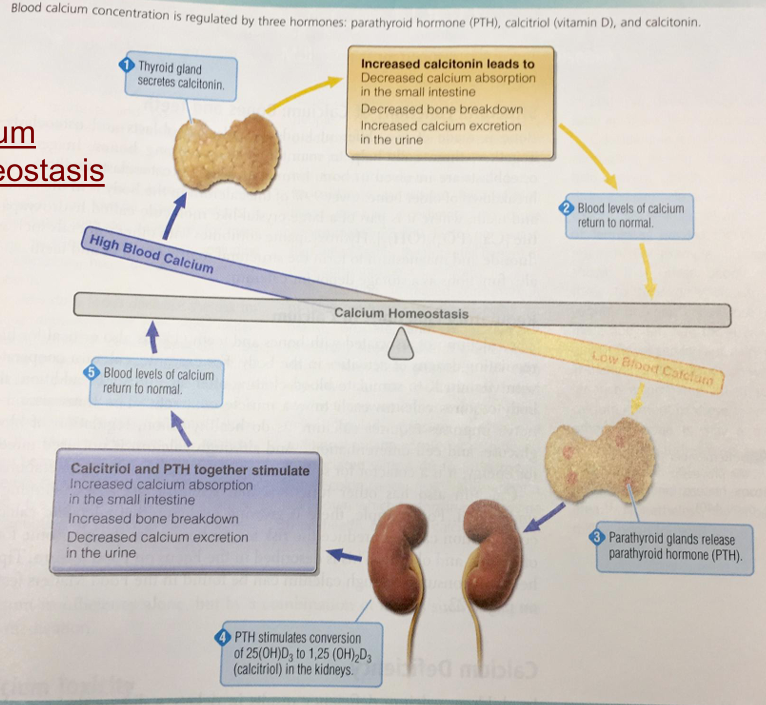
hypocalcemia
low blood Ca+
stimulates PTH release from parathyroid gland
parathyroid hormone (PTH)
↑ Ca & P resorption (de-mineralization) from bone
↑ P excretion into urine
Ca ↑ but not P
↑ synthesis of active vit D
↑ Ca absorption from GI tract
↑ Ca resorption from kidney
result: ↑ blood Ca lvl to normal
hypercalcemia
high blood Ca+
stimulates calcitonin release from thyroid gland
calcitonin reverse PTH function
results ↓ blood Ca lvl to normal
Ca homeostasis regulators
vit D → ↑ Ca & P
↑ bone resorption
↑ intestinal Ca & P absorption
↓ Ca & P excretion from kidney
parathyroid hormone (PTH) → ↑ Ca
↑ bone resorption
↑ intestinal Ca & P absorption
↑ P excretion from kidney
calcitonin
↓ bone resorption
hyper-parathyroid
primary → ↑ blood Ca & bone resorption
secondary → → ↓ Ca, ↑ P, ↓ vit D → ↑ PTH
both cause bone resorption → osteomalacia
Ca deficiencies
rickets
osteomalacia
milk fever (hypocalcemia)
osteoporosis
rickets
occurrences
young animals
causes
defic. of Ca, P, or vit D
imbalanced dietary Ca:P (not 1:1 or 2:5:1 ratio)
parathyroid tumor ↑ PTH & ↑ blood Ca
mechanisms
continued growth of collagen & organic matrix
no / insufficient mineralization for support
results
soft, light bone
muscles grow, ↑ weight on soft bone → bone bends

osteomalacia
softening of the bone
occurrences
adult animal counterpart of rickets
causes
defic. diet in Ca, P, vit D
fail to replace Ca in bone after resorption
result
brittle, demineralized bones
easily breakable
milk fever (hypocalcemia)
acute metabolic deficiency of Ca
occurrence
w/in 72 hrs after calving
prevalent in ↑ producing cow s
cant meet milk secretion demands
milk fever symptoms
↓ HR
↓ body temp (↓ blood circulation)
tetany (muscle tremors)
collapse
possible coma/death
milk fever clinical signs
blood Ca+ half of normal (5-6 mg/mL)
milk fever metabolic basis
bone Ca release inadequate to meet Ca demands for milk production
casein micelle
milk fever treatment
I.V. injections of Ca-salts
CaCl2, Ca-lactate, Ca-gluconate
milk fever prevetion
change ↑ Ca → ↓ Ca diet 14 days before calving (stimulates mobilization)
↓ dietary cationic anionic difference (DCAD)
↑ vit D injection → ↑ Ca absorption 5 days before calving
osteoporosis
reduction of bone mass
occurrence
human females > 50 yr or near menopause
causes
age, gender (male), ↓ Ca & vit D diet, ↓ physical activity
result
↓ height & ↑ susceptibility to fractures
metabolic
↓ mineralization of organic matric of bone → ↓ bone mass
prevention
↑ Ca intake (halts progression, not reverse dmg)
mineralization replenishes, organic matrix doesn’t (permanent dmg)

transcellular transport
transportation of solutes by a cell through a cell
e.g. glucose mvmt from intestinal lumen → extracellular fluid by epithelia cells
paracellular transport
transfer of substances across an epithelium by passing through intercellular space between cells
anion
ions w/ negative charge
cation
ions w/ positive charge