Emotions, Aggression, and Stress
 Call Kai
 Learn
 Practice Test
 Spaced Repetition
 Match
 Flashcards
 Knowt Play
1/39

There's no tags or description
Looks like no tags are added yet.
40 Terms
Emotion
A subjective mental state usually accompanied by distinctive behaviors and involuntary physiological changes.
Sympathetic nervous system
Prepares the body for action during fight or flight.
Parasympathetic nervous system
Prepares the body to relax and recuperate.
Folk theory of emotion
Feeling triggers an autonomic reaction.

James-Lange theory
An autonomic reaction triggers feeling.
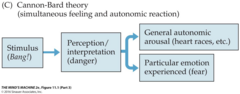
Cannon-Bard theory
Autonomic reactions and feelings occur simultaneously.
Schachter's theory
Cognitive assessment of context determines the emotional label assigned to physiological arousal.

Polygraph reliability
Guilt and anxiety can produce the same physiological responses.
Plutchik's basic emotions
Eight basic emotions form four pairs of opposites.

Cultural differences in facial expressions
Cultural conditioning shapes rules for expressing emotion.
Facial feedback hypothesis
Sensory feedback from facial expressions can affect mood.
Darwin's view of emotional expressions
Emotional expressions are universal among people.
Evolutionary function of emotion
Motivational programs coordinate responses to adaptive problems.
Brain self-stimulation
Animals work to electrically stimulate particular regions of their own brains.
Medial forebrain bundle
A tract rising from the midbrain through the hypothalamus, affected at many self-stimulation sites.
Nucleus accumbens
A reward-circuit component where dopamine release produces pleasurable feelings.
Decorticate rage
Sudden intense rage after cortex removal, suggesting cortical inhibition of rage.
Klüver-Bucy syndrome
Bilateral amygdala damage causes a dramatic reduction in fear and anxiety.
Amygdala and fear
Fear-conditioning studies identify this temporal-lobe structure as key to mediating fear.
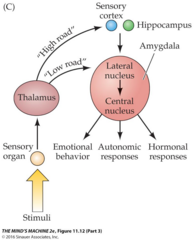
Fear's low road
Thalamic signals reach the amygdala without conscious processing, enabling immediate reactions.
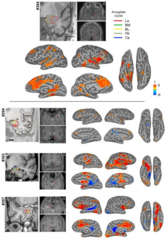
Patient S.M.
Bilateral amygdala damage was associated with impaired fear and difficulty recognizing fear in others.

Hemispheric differences in emotion
Left-hemisphere damage can lead to depression; right-hemisphere lesions can produce cheerfulness.
Emotion and brain activity
Specific emotions do not correspond one-to-one with activity changes in particular brain regions.
Aggression
Behavior intended to cause pain or harm to others.
Testosterone and human aggression
The relationship is less clear in humans than in many other species.
Serotonin and aggression
Serotonin release normally inhibits aggression.
Ventromedial hypothalamus
A brain region involved in aggressive behavior.

Maternal aggression
Aggression by mothers defending their nest or offspring.
Alarm reaction
The initial stress response, in which the hypothalamus activates the sympathetic nervous system.
Adrenal cortex response
Releases glucocorticoids such as cortisol, which mobilize energy more slowly than sympathetic activation.
Adrenal medulla response
Releases epinephrine and norepinephrine, preparing the body for action.
Stress hormone pathway
The hypothalamus signals the anterior pituitary, which stimulates glucocorticoid release from the adrenal cortex.
Stress immunization
Mild early stress may increase later resilience when accompanied by comfort or coping.
Maternal care and stress in rats
Little maternal attention is associated with greater adult stress responses and altered receptor expression.
Epigenetic regulation
Environmental factors change gene expression without changing the genes themselves.
Psychoneuroimmunology
Studies interactions between the immune system and other organs, especially hormonal and nervous systems.
Innate immunity
Nonspecific defenses include the skin and inflammatory responses.
Adaptive immunity
Recognizes specific pathogens through antigens.
Stress and immune function
Acute stress can improve immune function; chronic stress impairs it.
Coping through social affiliation
Contact comfort and reciprocity are forms of social coping.