Economics Exam 1
 Call Kai
 Learn
Learn Practice Test
 Spaced Repetition
 Match
Match Flashcards
 Knowt Play
1/35

There's no tags or description
Looks like no tags are added yet.
Name | Mastery | Learn | Test | Matching | Spaced | Call with Kai | Chat |
|---|
No analytics yet
Send a link to your students to track their progress
36 Terms
Firm (Company or Business)
A firm is an organization that produces goods and services
Entrepreneur
An entrepreneur is someone who operates a business, they decide what goods and services get produced and how to produce them
Innovation
A practical application of an invention
Goods
The process a firm uses to create good + services
Services
Activities performed for others
Revenue
Total amount received for selling a good or service
Profit
The difference between a firms revenue and its costs
Household
Suppliers of the factors of production (labor) and they demand goods and services
Factors of Production
Firms use factors of production to produce goods or services. Most important: labor and capital
Capital
In economics, capital refers to physical capital. Manufactured goods that are used to produce other goods and services. The total amount of physical capital available is called capital stock
Human Capital
The accumulated training, education, and skills workers possess
Scarcity
Situation in which unlimited wants exceed the limited resources available to fulfill those wants
Marginal Analysis
Involves comparing marginal benefits and marginal costs
Productive Efficiency
Occurs when a good or service is protected at the lowest possible price
Allocative Efficiency
A state of the economy in which production reflects consumer preferences
Centrally Planned Economy
Is an economy in which the gov. decides how economic resources will be allocated
Market Economy
Is an economy in which decisions of households and firms interacting determine the allocation of resources
Productive Possibilities Frontier
PPF is a curve showing the maximum alternative combinations of 2 products that may be produced with available resources and technology
Opportunity Cost
Is the highest valued alternative that must be given up to engage in an activity
Circular Flow Diagram

Entrepeneurship
Is someone who operates a business, bring together the factors of production in order to produce goods and services customers want
Private Property Rights
The rights individuals or firms have the exclusive use of their property including the right to buy and sell it
Change in Quantity Demanded vs Change in Demand
A change in demand represents a shift to new demand curve.
While a change in quantity demanded is a movement along the existing curve.
Change in Quantity Supply vs Change in Demand
A change in supply represents a shift to a new supply curve
While a change in supply demanded is a movement along the existing curve.
Influences on demand (Non-price)
Increase in an input price
Negative technological change
Increase in the price of a substitute in production
Decrease in the number of firms in the market
Influences on Supply (Non-price)
Decrease in an input price
Positive technological change
Decrease in the price of a substitute in production
Increase in the number of firms in the market
Price Elasticity of Demand
The elasticity of demand is the responsiveness of the quantity demanded to change in price
Elastic Demand
Occurs when the % change in quantity demanded is greater than the % change in price, so that the price elasticity is >1 in absolute value
Decrease in price by 10%—increase in quantity demanded by 20%

Inelastic Demand
Occurs when the % change in quantity demanded is less than % change in price, so that the price elasticity is <1 in absolute value
Decrease in price by 10%—increase in quantity demanded by 5%
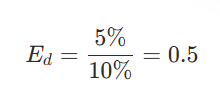
Unit Elastic Demand
Occurs when the % change in quantity demanded is = % ∆ price, so that the price is =1 in absolute value
Decrease price by 10%—increase in quantity demanded by 10%

Midpoint Formula

Determinants of Ed
The availability of close substitutes — the more substitutes available — the more elastic demand
Passage of time — the longer the time period — the more elastic the demand
Whether the product is a necessity or luxury, the demand for luxury good is more elastic
The definition of a market, the more narrowly we define the market, the more elastic the demand
The share of the product. The larger the share the purchase of the product. The larger the share of a good in a consumers budget the more elastic the demand
Ed and total revenue (TR)
Changes in price (P) and quantity demanded (Q) results in changes in total revenue (TR) received by term
TR = P*Q
Changes in TR are related Ed
If demand is elastic, changes in price (increase or decrease) will result in changes in total revenue (TR) in the opposite direction
If demand is inelastic, changes in price (increase or decrease) will result in changes in the total revenue (TR) in the same direction
When demand is unit-elastic, changes in price (increase or decrease) will result in change in total revenue (TR)— same
Cross Price Elasticity of Demand
The % change in quantity demanded of one good divided by the % change in the price of the other good
For 2 substitutes, the CPE > 0 (positive)
For 2 compliments, the CPE < 0 (negative)
For 2 unrelated goods, the CPE = 0 (no relationship)
Income Elasticity of Demand
The % change in quantity demanded divided by the % change of income
For normal goods, IE > 0
For necessities, 0<IE<1
For luxury goods, IE > 1
For inferior goods, IE < 0
Price Elasticity of Supply
ES=% ∆ quantities/% ∆ price
Because of the law of supply, this elasticity will normally have a positive value
The longer the time period, firms have to respond to a price change, the greater the ES
The value of this depends on how quickly firms can change the quantity supplied when the price changes