lecture 9 social change
 Call Kai
 Learn
 Practice Test
 Spaced Repetition
 Match
 Flashcards
 Knowt Play
1/51

There's no tags or description
Looks like no tags are added yet.
52 Terms
what is allports intergroup contact hypothesis
proposes that contact between members of different social groups, under appropriate conditions, can lead to reductions in intergroup bias
what are the conditions for successful intergroup contact
equal status, cooperation, common goals, institutional support
what did pettigrew and tropp add to the intergroup contact hypothesis
many conditions are facilitating rather than essential
there is a significant negative relationship between direct positive contact and prejudice
how was intergroup contact introduced in the robbers cave experiment
in stage 3 of integration, researchers had to introduce new tasks with superordinate goals to get group to work together, which is positive intergroup contact
aronson’s jigsaw classroom study
students in jigsaw classrooms (more diverse) show a decrease in prejudice and stereotyping, more liking towards outgroup members, higher self esteem levels and better performance on exams
what did pettigrew suggest about the 4 intergroup contact processes
learning about the outgroup corrects negative views
changing behaviour
generating affective ties
ingroup reappraisal - insight about ingroups and outgroups
how does intergroup contact reduce negative feelings
reduced intergroup anxiety = anxiety felt when anticipating/experiencing contact with outgroup
how does intergroup contact promote poisitve feelings
enocourages empathy and perspective taking, promotes mutual sharing of personal information, leads to positive intergroup emotions
what are the 4 indirect contact approaches
extended contact, vicarious contact, imagined contact, electronic contact
what is extended contact
knowledge that an ingroup member has a close relationship with an outgroup member can lead to more positive intergroup attitudes i.e friend of a friend
what does extended contact do
reduces intergroup anxiety by showing that a close relaitonship with outgroup member is possible
disliking a friend of a friend creates cognitive dissonance
shows intergroup friendships are permissible and don’t violate social norms
shows outgroup members are open to friendship and reduces fear of rejection
evidence for extended contact
wright et al study shows that the greater number of extended outgroup friends, the weaker the prejudice
paolini showed that extended contact amongst catholics and protestants lead to more positive outgroup attitudes
vazzali et al showed extended contact reduced intergroup anxiety
what is vicarious contact
observation of an ingroup member interacting with an outgroup member
evidence of indirect contact
mazziotta et al showed german participants who observed german-chinese interaction displayed more positive attitudes towards chinese people
schiappa showed watching tv programs that showed positive intergrup contact led to lower prejudice levels
what is imagined contact
the mental simulation of social interactions with outgroup members
evidence for imagined contact
turner et al’s study showed participants who imagined a positive interaction with outgroup member expressed more positive attitudes and less stereotyping
how does imagined contact help
produces more positive perceptions of outgroups, improves explicit and implicit attitudes, reduces stereotyping and reduces physiological responses to outgroup members
what is e contact
computer mediated contact involving an engagement of self in the intergroup relationship
communication via internet
evidence for e contact
white et al’s study showed intergroup bias and intergroup anxiety towards christian and muslim students decreased after e-contact
e-contact also improved catholic and protestant outgroup expectations and reduced intergroup anxiety
advantages of indirect over direct approach
evokes less intergroup anxiety, less reliant on contact opportunities which may not occur in segregated areas, doesn’t require close friendship with outgroup member, can reach a alrger audience, potentially more flexible
advantages of direct contact
affects a wider range of outcomes, creates stronger and longer lasting attitudes
what is counter stereotyping
an idea that directly challenges a traditional stereotype
changes the way people think about outgroups, boosts creativity and reduces simplistic categorizations
what is a constituent attribute
counter stereotyping evidence
blair et al found that imagining a strng women led to participants demonstraitng weaker implicit gender stereotypes
dasgupta et al found that exposure to black members led to weaker associations between black and negative stimuli
vasilejvic found that thinking counter-stereotypically leads to generalized tolerance, with participants showing less prejudice and stereotyping towards unrelated outgroups
social identity theory
groups form our social identity, we have a personal identity that is unique from others, our self esteem is linked to our social identity
consequences of social identity theory
lower group status leads to lower self esteem
how to avoid social identity linking to group identity
leave the group, hide your group membership, re-appropriate stigmatizing labels, challenge the system and engage in collective action
definition of social change
transformation over time of institutions and culture of a society
a struggle between those in positions of social power and those who colelctively challenge the status
a process of psychological change in people’s understanding of themselves and others in the broader context of intergroup relations
3 group factors in social change
marginalized grups i.e black women
third parties/general public/ majority group members
groups in power i.e authorites
what is collective action
any action that individuals undertake as psychological group members, with the subjective goal to improve their group’s conditions
what is the SIMCA - social identity mode of colective action
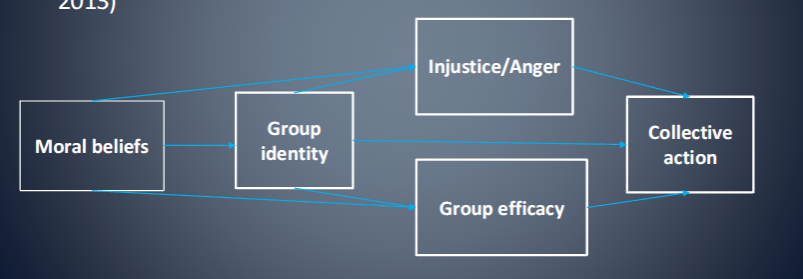
SIMCA explained
we have moral beliefs which contrbute to our group identity, then feelings of injustice and unfair treatment and the efficacy of our group in fixing that, which then leads to colelctive action
definition of moral beliefs
an individuals’ strong and subjectively absolutist belief about what is right and wrong
effect of strng moral beliefs
individuals who moralise are more likely to protect and defend those moral beliefs
shared moral beliefs bring people together but can also break them apart over differeing views on how to acheive these beliefs
moral beliefs are shaped by group identity
moral beliefs alone cannot explain participation/lack of in CA
what does group identity depend on
identification and saliency
we view ourselves and context in group terms, motivated to protect grup interests
what is politicized identification saliency
we can identify with a category but this doesn’t mean we identify with common beliefs, shared values and norms
we need PIS plus group identity to lead to collective action
group efficacy beliefs definition
individuals’ beliefs that the group is able to achieve group goals through joint effort
limitations of collective action
most research conducted in WEIRD populations
collective protests may not be approved
consequences of CA can create backlash from general public
allyship= engaging in actions to improve the status of another group , is often complex
collective action in repressive contexts
engagement associated with more danger and risks
repression decreases engagement in CA up to a point, eventually leads to new grievances and discontent
non normative actions
actions that go against the norms, rules and laws of the country
3 types of actions in CA
normative, non normative and violent actions
what is the activist dilemna
when non extreme actions prove ineffective, extreme actions must be taken to but social and financial pressure on authorities, which inreases media coverage to raise public awareness which leads to general public pressure on authorities
feinbergs proposed model of extreme action resulting in reduced support

what is the radical flank effect
the positive/negative impact of a radical faction within a social movement on more moderate factions fighting for the same cause
positive radical flank effect
the presence of a radical group makes moderate groups look more reasonable, mainstream, and appealing by comparison
negative radical flank effect
radical or violent actions backfire, tarnishing the entire movement.
social dominance orientation
an individual’s preference for a group based social hierarchy, where certain groups hold more power
explains types of status quo justification and discrimination
what do sidanius and pratto define sdt as
the extent to which an individual prefers a group based hierarchy in society as opposed to a personal hierarchy where individuals have power
a systemic and multi level approach to understanding prejudice and discrimination
what does SDT do
acknowledges cultural ideologies, policies, instituional practices, group relations
based on evolutionary drive to have certain groups dominate others i.e males
distinct systems of group hierarchy
age systems i.e older rule younger
gender male rule female
arbitrary systems i.e nationality, race, religion
evidence in support of SDT
fisher’s meta analysis found higher SDO scores linked to greater income inequality in democratic countries, and opposite for less democratic countries
criticisms of SDT
some surveys show people score low on SDO even in countries with high group dominance like US
lucas and kteily meta analysis found individuals in US and UK scored low on SDO, suggesting tendency towards egalitarianism
turner and reynolds argued evolutionary explanation unconvincing, SDT has 6 fundamental flaws and SIT is better