Week 11: Wildfires
0.0(0)
Studied by 1 person Call Kai
 Learn
Learn Practice Test
 Spaced Repetition
 Match
Match Flashcards
 Knowt Play
Card Sorting
1/38

Earn XP
Description and Tags
Last updated 12:10 PM on 10/11/26
Name | Mastery | Learn | Test | Matching | Spaced | Call with Kai | Chat |
|---|
No analytics yet
Send a link to your students to track their progress
39 Terms
1
New cards
Wildfire origins
Wildfire dates to the time when trees first evolved 400 million years ago
\
\
\
\
2
New cards
The cycle
After a fire, vegetation completes a cycle from early colonizing plants to mature ecosystem.
\
The ecosystem that evolves adapts to the climate of that location and time
\
The ecosystem that evolves adapts to the climate of that location and time
3
New cards
Adaption to wildfires
Many species have evolved to either withstand fire or promote the life of the species after a fire event.
\
Examples:
* redwood and oak trees have bark that resists fire damage
* some pine trees have seeds that only open after a fire
\
Examples:
* redwood and oak trees have bark that resists fire damage
* some pine trees have seeds that only open after a fire
4
New cards
Wildfires through history
The geologic record shows an increase in the amount of charcoal in sediment approximately 10,000 years ago.
\
This suggests high amounts of wildfire activity at the time.
Why might this be?
* a warmer and/or drier climate
* an increased use of fire by humans for clearing land and for heat, cooking, etc.
\
This suggests high amounts of wildfire activity at the time.
Why might this be?
* a warmer and/or drier climate
* an increased use of fire by humans for clearing land and for heat, cooking, etc.
5
New cards
The 3 elements of wildfires
\
1. fuel
2. oxygen
3. heat
\
* If any of these are lost, the fire will dissipate
Plants accumulate carbon dioxide and store carbon in their tissues.
\
During a wildfire this carbon dioxide is released back into the atmosphere
1. fuel
2. oxygen
3. heat
\
* If any of these are lost, the fire will dissipate
Plants accumulate carbon dioxide and store carbon in their tissues.
\
During a wildfire this carbon dioxide is released back into the atmosphere
6
New cards
There are 3 phases to a wildfire:
pre-ignition, combustion, and extinction
7
New cards
Pre-Ignition Phase
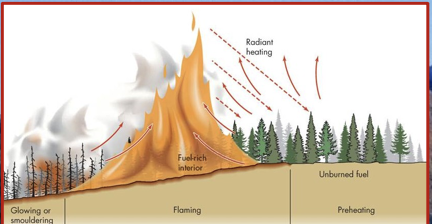
Pre-heating
During this phase, vegetation reaches a temperature at which it can ignite.
* no flames
\
As vegetation is heated, it loses water.
The presence of heat radiating from the flames of a wildfire can pre-heat nearby vegetation
During this phase, vegetation reaches a temperature at which it can ignite.
* no flames
\
As vegetation is heated, it loses water.
The presence of heat radiating from the flames of a wildfire can pre-heat nearby vegetation
8
New cards
Combustion phase
Pre-heating results in fuel that is prone to ignite.
\
The combustion phase begins with ignition; it could be natural (lightning) or human-caused.
\
Not all ignition will result in a wildfire (the vegetation must be dry)
\
The combustion phase begins with ignition; it could be natural (lightning) or human-caused.
\
Not all ignition will result in a wildfire (the vegetation must be dry)
9
New cards
Types of combustion
Flaming combustion is the rapid, high temperature conversion of fuel into heat.
\
It is characterized by flames and large amounts of unburned material.
\
Smouldering combustion occurs in areas with burned material and ash that covers new fuel.
\
It is characterized by flames and large amounts of unburned material.
\
Smouldering combustion occurs in areas with burned material and ash that covers new fuel.
10
New cards
Heat transfer
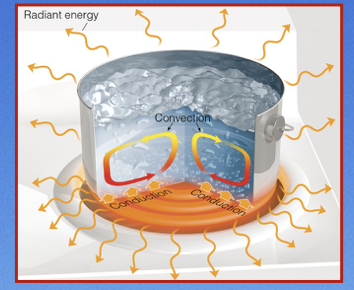
The 3 processes that control the transfer of heat?
The 3 processes that control the transfer of heat?
As a wildfire moves across the land,
three processes control the transfer of heat:
\
**Conduction**
* transfer of heat by molecule to molecule contact (they are touching)
\
**Radiation**
* Transfer of heat in the form of invisible waves
\
**Convection**
* Transfer of heat by movement of a liquid or gas
three processes control the transfer of heat:
\
**Conduction**
* transfer of heat by molecule to molecule contact (they are touching)
\
**Radiation**
* Transfer of heat in the form of invisible waves
\
**Convection**
* Transfer of heat by movement of a liquid or gas
11
New cards
Heat transfer by wildfires
In wildfires, heat transfer is mainly by radiation and convection.
\
Heat from radiation increases the surface temperature of the fuel.
\
\
The rising air removes heat from the zone of flaming and is replaced by fresh air.
\
As air is heated, it becomes less dense and rises
\
The rising air removes heat from the zone of flaming and is replaced by fresh air
\
This fresh air (oxygen) sustains the combustion
\
Heat from radiation increases the surface temperature of the fuel.
\
\
The rising air removes heat from the zone of flaming and is replaced by fresh air.
\
As air is heated, it becomes less dense and rises
\
The rising air removes heat from the zone of flaming and is replaced by fresh air
\
This fresh air (oxygen) sustains the combustion
12
New cards
Extinction phase
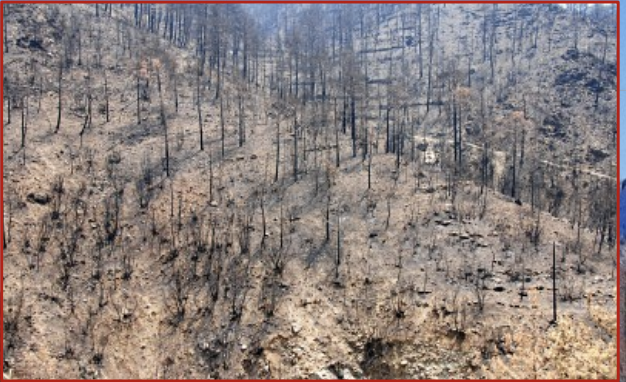
This is the time when which combustion has ceased.
\
There is no longer sufficient heat or fuel to sustain a fire.
\
There is no longer sufficient heat or fuel to sustain a fire.
13
New cards
Fuel
\
Types of fuel include leaves, woody debris, decaying organic material, grasses, shrubs, etc.
\
If diseases or storms down large number of trees, the decaying material dries and burns easily.
\
The density of the forest plays a role:
\
In Western North America, dense forest boreal forests contain abundant fuel supplies
Types of fuel include leaves, woody debris, decaying organic material, grasses, shrubs, etc.
\
If diseases or storms down large number of trees, the decaying material dries and burns easily.
\
The density of the forest plays a role:
\
In Western North America, dense forest boreal forests contain abundant fuel supplies
14
New cards
Topography
The amount of fuel can vary by slope orientation.
* In North hemisphere, south facing slopes are relatively warm and dry
* slopes exposed to prevailing winds are often drier
\
\
Wildfires burning on steep slopes preheat fuel upslope from the flames.
* this results in the rapid spread if a fire upslope
* In North hemisphere, south facing slopes are relatively warm and dry
* slopes exposed to prevailing winds are often drier
\
\
Wildfires burning on steep slopes preheat fuel upslope from the flames.
* this results in the rapid spread if a fire upslope
15
New cards
In North America, which side of a hill or a mountain would be least likely to experience a wildfire?
north east
16
New cards
Weather
Large wildfires are common following droughts.
\
‘Dry thunderstorms’ with lightning can produce wildfires but the rain evaporates before reaching the ground.
* wind can help preheat unburned vegetation
* wind carries embers that can ignite spot fires ahead of the fire front
\
‘Dry thunderstorms’ with lightning can produce wildfires but the rain evaporates before reaching the ground.
* wind can help preheat unburned vegetation
* wind carries embers that can ignite spot fires ahead of the fire front
17
New cards
Regions at risk
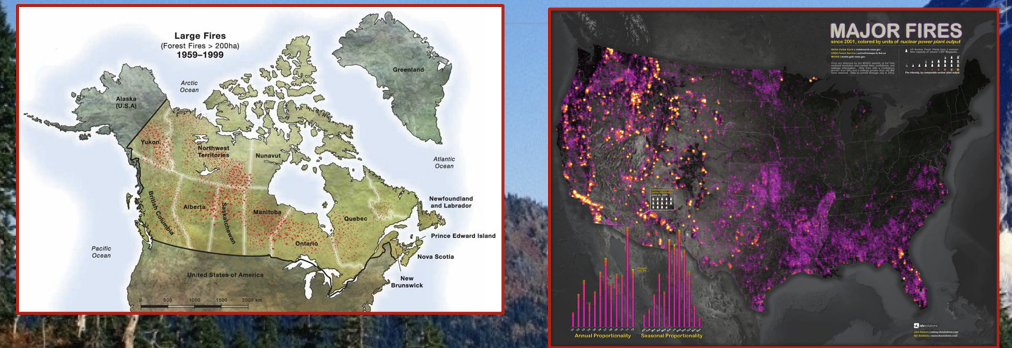
In Canada, the wildfire risk is greatest in British Columbia and in the boreal forests of the Canadian Shield region.
\
the geographic region most at risk changes annually with the weather and corresponds to areas that are experiencing drought.
\
the geographic region most at risk changes annually with the weather and corresponds to areas that are experiencing drought.
18
New cards
Yellowstone national park wildfire
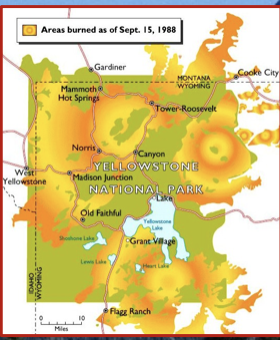
A series of lightning strikes caused 50 fires in the park in 1988.
* park officials have a policy that allows naturally caused fires to burn without intervention
This became controversial as hot, dry weather that Summer allowed the fires to spread and merge.
* officials responded to political pressure and eventually called in nearly 10,000 firefighters.
* park officials have a policy that allows naturally caused fires to burn without intervention
This became controversial as hot, dry weather that Summer allowed the fires to spread and merge.
* officials responded to political pressure and eventually called in nearly 10,000 firefighters.
19
New cards
Yellowstone cont.
The fires were beyond the control of the crews and burned for several months.
\
It is believed that the fires became uncontrollable because many years of fire-suppression policies in the past had allowed fuel amounts in the park to reach dangerous levels.
\
It is believed that the fires became uncontrollable because many years of fire-suppression policies in the past had allowed fuel amounts in the park to reach dangerous levels.
20
New cards
Benefits of the yellowstone wildfire
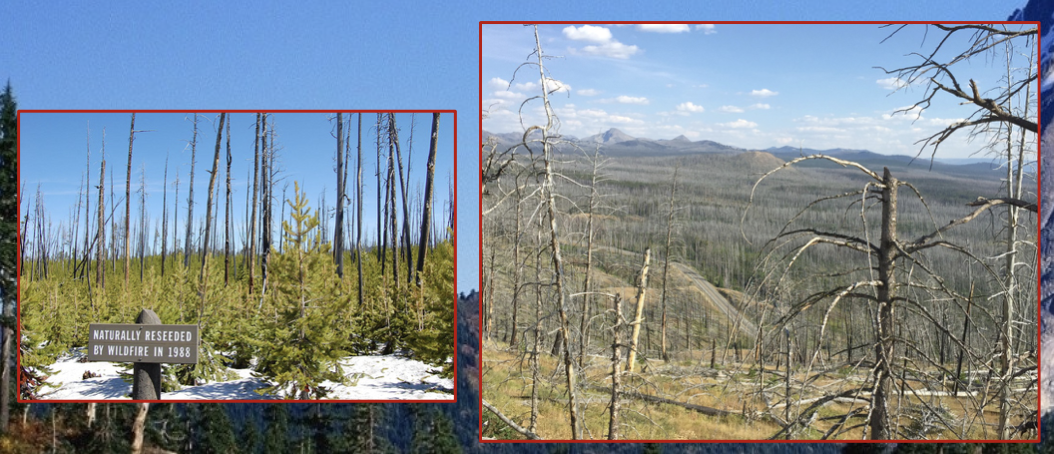
The fires of 1988 revitalized ecosystems in the park.
* Officials remain committed to the natural-burn policy today; this is a common policy in national parks
* Officials remain committed to the natural-burn policy today; this is a common policy in national parks
21
New cards
Types of fires
Wildfires are classified according to the layer of fuel that is allowing the fire to spread
\
\
\
\
22
New cards
Surface fires
23
New cards
surface or crown
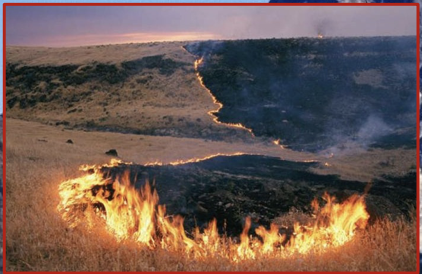
They vary in intensity but most move relatively slowly.
\
Crown fires move rapidly through the forest canopy by flaming combustion.
\
They can be fed by surface fires that move up limbs or tree trunks, or they may spread indepently
\
Intermittent crown fires consume the tops of some trees in an area.
\
Continuous crown fires consume the tops of all trees
They are driven by strong winds and are common in boreal forests.
\
Crown fires move rapidly through the forest canopy by flaming combustion.
\
They can be fed by surface fires that move up limbs or tree trunks, or they may spread indepently
\
Intermittent crown fires consume the tops of some trees in an area.
\
Continuous crown fires consume the tops of all trees
They are driven by strong winds and are common in boreal forests.
24
New cards
effects of wildfires
Fires that burn soil may leave behind a hydrophobic layer at the surface.
\
This layer is caused by the accumulation of chemicals from burning vegetation.
\
This layer increases surface runoff and erosion
\
It may persist for several years following a fire
\
This layer is caused by the accumulation of chemicals from burning vegetation.
\
This layer increases surface runoff and erosion
\
It may persist for several years following a fire
25
New cards
particles in the atmosphere
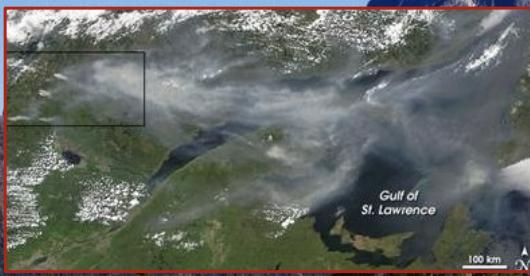
Wildfires increase the number of particulates in the atmosphere, and these can persist for weeks.
\
Increases of airborne particles and haze can be observed thousands of km downwind of large fires.
\
Increases of airborne particles and haze can be observed thousands of km downwind of large fires.
26
New cards
Linkages to climate change
Climate change may increase the intensity of wildfires.
\
Climate change affects both temperature and precipitation and can lead to severe droughts.
\
In some parts of the world, grasslands will replace forests. Current areas of forest will expand poleward.
\
Insect infestations can cause disease throughout a forest making it vulnerable to wildfire
\
Climate change affects both temperature and precipitation and can lead to severe droughts.
\
In some parts of the world, grasslands will replace forests. Current areas of forest will expand poleward.
\
Insect infestations can cause disease throughout a forest making it vulnerable to wildfire
27
New cards
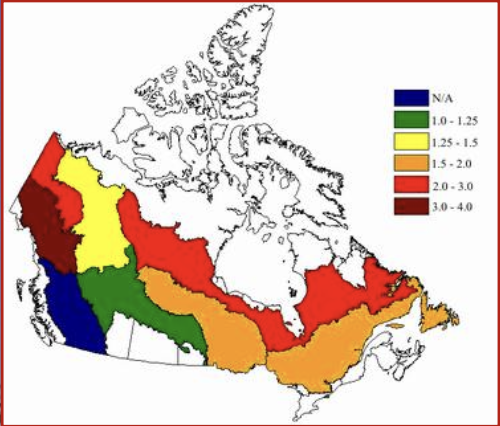
Forest fires in Canada
Image: A modelled ratio of fire activity in the year 2100 compared to current fire activity.
28
New cards
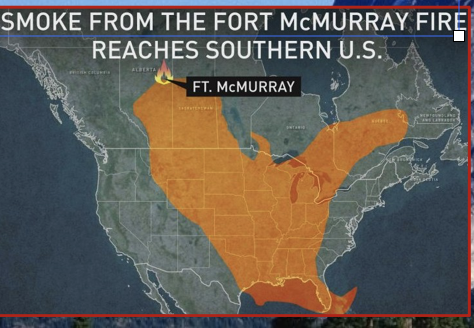
Fort McMurray Wildfire
The disaster in 2016 caused $10B in damage making it the costliest disaster in Canadian history.
* There are no deaths or injuries caused by the fire due to the evacuation of the entire community
Residents were displaced for 4 weeks and over 2000 people lost their homes in the wildfire.
\
The cause of the fire has not been determined.
* A prolonged drought occured in the area during the Winter before the fire and record high temperatures occurred in the preceding days.
* There are no deaths or injuries caused by the fire due to the evacuation of the entire community
Residents were displaced for 4 weeks and over 2000 people lost their homes in the wildfire.
\
The cause of the fire has not been determined.
* A prolonged drought occured in the area during the Winter before the fire and record high temperatures occurred in the preceding days.
29
New cards
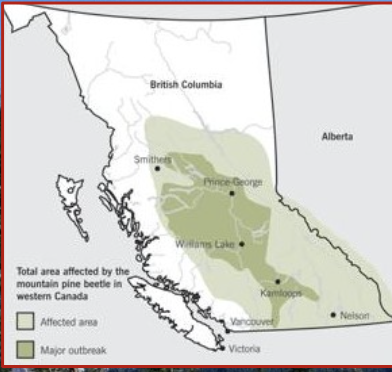
Mountain pine beetle
The beetle has destroyed forests throughout Western Canada:
* currently 80% of mature pines are impacted.
* The consequences will be felt for decades in British Columbia
\
The beetle is posing a threat to Alberta’s pine forests and the Jackpine stands of Canada’s boreal forest.
\
With warmer temperatures, the beetle has been able to survive through the Winter in B.C.
* currently 80% of mature pines are impacted.
* The consequences will be felt for decades in British Columbia
\
The beetle is posing a threat to Alberta’s pine forests and the Jackpine stands of Canada’s boreal forest.
\
With warmer temperatures, the beetle has been able to survive through the Winter in B.C.
30
New cards
Impacts of wildfires
Fires can lead to evacuations of entire towns, road and airport closures, and severe property loss.
\
In North America, organized evacuations have minimized the number of deaths.
\
Exposure to smoke and haze can affect the ocular and respiratory systems
\
In North America, organized evacuations have minimized the number of deaths.
\
Exposure to smoke and haze can affect the ocular and respiratory systems
31
New cards
Impacts on animals
Most animals can escape fires unharmed.
\
Rodents can take refuge underground and larger animals can outrun the fire.
\
Fires can produce open areas suited for grazing mammals thus acting as a natural service function
\
Aquatic species may be impacted by increased sedimentation from runoff and erosion.
\
Rodents can take refuge underground and larger animals can outrun the fire.
\
Fires can produce open areas suited for grazing mammals thus acting as a natural service function
\
Aquatic species may be impacted by increased sedimentation from runoff and erosion.
32
New cards
Natural service functions
Wildfire temporarily reduces competition for sunlight and moisture in a forest.
\
It allows both surviving and new species to thrive by allowing sunlight to reach the forest floor.
\
In some species, it triggers the release of seeds or stimulates flowering.
\
Lodgepole pine, aspen, and fireweed are examples of pioneer vegetation that grow quickly after a fire.
\
It allows both surviving and new species to thrive by allowing sunlight to reach the forest floor.
\
In some species, it triggers the release of seeds or stimulates flowering.
\
Lodgepole pine, aspen, and fireweed are examples of pioneer vegetation that grow quickly after a fire.
33
New cards
Pioneer vegetation
The first plant species to appear after a wildfire
34
New cards
More natural service functions
Fires can remove micro-organisms in the soil, some of which are parasites.
\
Fires remove surface litter and excess fuel (leaves, etc.)
\
Fires remove diseased trees and can limit the spread of bug infestations.
\
Fires remove surface litter and excess fuel (leaves, etc.)
\
Fires remove diseased trees and can limit the spread of bug infestations.
35
New cards
Fire management
The objective is to control wildfires for the benefit of ecosystems while preventing them from harming people and destroying property.
\
In Canada, the fire season is from April to October and is managed by provincial/ territorial governments
\
Good management requires research of the *fire regime* of an area.
\
Satellite imagery is providing insights on fire potential in remote areas
\
In Canada, the fire season is from April to October and is managed by provincial/ territorial governments
\
Good management requires research of the *fire regime* of an area.
\
Satellite imagery is providing insights on fire potential in remote areas
36
New cards
Fire regime
The potential for wildfire in an area
37
New cards
Fire suppression
A strategy in fire suppression is to steer the fire toward an area with no fuel (a *fire break*).
\
Examples of fire breaks include rivers, lakes and roads
\
If a natural fire break does not exist, an artificial break can be created from bulldozers clearing land.
\
Reliance on fire suppression has led to a build up of fuel in forests and a potential for intense fires.
\
Examples of fire breaks include rivers, lakes and roads
\
If a natural fire break does not exist, an artificial break can be created from bulldozers clearing land.
\
Reliance on fire suppression has led to a build up of fuel in forests and a potential for intense fires.
38
New cards
Prescribed burns
One way to counter the build-up of fuel is by prescribed burns.
\
These are controlled fires that are purposely ignited to reduce the amount of fuel
\
Difficulties relate to predicting the weather conditions under which the fire can be safely controlled.
\
These are controlled fires that are purposely ignited to reduce the amount of fuel
\
Difficulties relate to predicting the weather conditions under which the fire can be safely controlled.
39
New cards
Perception of the wildfire hazard
Population growth in areas that are prone to wildfires has increased the risk to public safety.
\
Each year, thousands of people move locations in california that are considered high risk for wildfires
\
Each year, thousands of people move locations in california that are considered high risk for wildfires