Affera Module 1: Sphere 9
 Call Kai
 Learn
 Practice Test
 Spaced Repetition
 Match
 Flashcards
 Knowt Play
1/34

There's no tags or description
Looks like no tags are added yet.
35 Terms

Top: Extension cable: connects the sphere9 cath to affera
Bottom: Irrigation tubing: connects to the luer fitting (DONT use a stopcock for this connection)
when is the cath extension cable connected?
first to prevent saline from the irrigation tubing dripping into the catheter connection

where does this connect to?
left: extension cable on sphere 9 cath
right: affera system CIU


Left: drip chamber: spike on the end connects to the saline bag
BL: mounting block: 2 tubes lock the tube to the HexaFLOW irrigation pump
BR: detector section: where the system checks for bubbles
Right: Luer lock: connects tot he luer fitting on the cath
catheter keypad menu controls what
map acquisition
3D view rotation
3D location tagging
pulling lever down next to the left keypad creates what curve
D curve
pulling lever down next to the right keypad creates what curve
F curve
friction control know directionality
CCW towards handle: steering wings move more freely
CW towards sphere: more resistance
sphere9 cath is how much Fr and what type of direction?
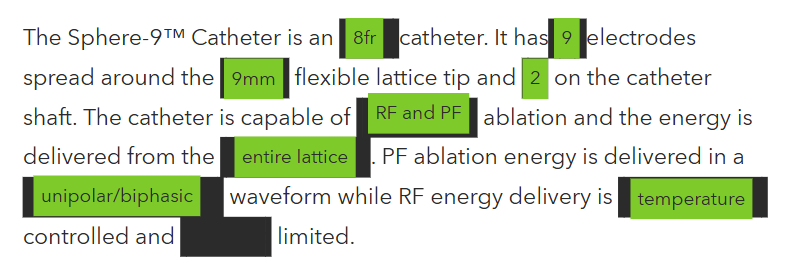
8Fr, bidirectional catheter with asymmetrical D and F curves
sphere9 requires a ____Fr sheath
8.5Fr
magnetic sensors
allow for accurate location tracking and anatomical geometry scaling
sphere9 diameter
9mm which allows for large footprint focal ablations
what part of the sphere is the ablation electrode?
the entire lattice surface
PF energy is delivered in what waveform? what about RF?
unipolar/biphasic
temp controlled and current limited: each of the 9 mini electrodes are also thermocouples
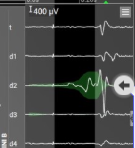
what does the green highlight mean?
increased local impedance
taller highlight represents larger increase
impedance and the lattice connection
electrode will light up on the cath model with increased impedance

orange highlight meaning?
increased local temp during ablation

what is the gray and what is the blue
gray: irrigation ports
blue: common electrode
irrigation ports default flow rates
4ml/min on standby
15ml/min for PF
30ml/min for RF ablation
common electrode purpose
each electrode on the outside of the lattice references the common electrode in the middle

cavitation
observing bubbles in the prep sequence due to rapid pressure chance even if all steps are done correctly; not necessarily from air introduction
why does cavitation occur
negative pressure generated during the backwards flushing components of the cath prep sequence
why is cavitation not air introduction
air is not introduced, it is generated via turbulence and clinically insignificant air from cath prep
is cavitation a patient safety concern?
no, the bubble dissipate once the system reaches equilibrium
what is the front of the stack for?
energy transfer and collection of info from the pt
what is the back of the stack responsible for?
communication between the system and 3rd party systems and recording systems
what connects the RFG and the remote?
fiber optic cable
how does the stack communicate with the workstation?
directly using an ethernet cable
what is the function of the central reference electrode?
close unipolar electrogram reference
what french size long sheath is the sphere9 compatible with
8F straight or 8.5Fr deflectable
where is PF delivery recommended in the IFU?
antrum of the LIPV
near collateral structures
posterior wall
mitral line
antrum of the LIPV
near collateral structures
posterior wall
how many pulses per application for PF?
12
PFA vs RF characteristics given these options
ability to stack lesions
thermal ablation
increased influence on ganglionic plexi
can cause nerve/muscle stimulation
higher risk of damage to collateral structures
unipolar biphasic causing non thermal ablation
lesion stacking has associated potential risks like steam pop
attenuation of EGMs in relatively large area of reversible electroporation
lower risk of damage to collateral structures
smaller area of reversible effect with shorter recovery period
thermal effect affected by cooling in high-flow areas
PF
ability to stack lesions
can cause nerve/muscle stimulation
unipolar biphasic causing non thermal ablation
attenuation of EGMs in relatively large area of reversible electroporation
lower risk of damage to collateral structures
RF
thermal ablation
increased influence on ganglionic plexi
higher risk of damage to collateral structures
lesion stacking has associated potential risks like steam pop
smaller area of reversible effect with shorter recovery period
thermal effect affected by cooling in high-flow areas
where can RF be delivered according to the US IFU?
mitral line
posterior wall
CTI
anterior side of all the veins
CTI