Lecture 14: Overview of the Nervous System and Anatomy of a Neuron
 Call Kai
 Learn
Learn Practice Test
 Spaced Repetition
 Match
Match Flashcards
 Knowt Play
1/33

There's no tags or description
Looks like no tags are added yet.
Name | Mastery | Learn | Test | Matching | Spaced | Call with Kai | Chat |
|---|
No analytics yet
Send a link to your students to track their progress
34 Terms
There are two parallel and complementary systems that control and regulate the functions of our bodies, what are they?
The nervous system
The endocrine system
The Nervous System

The Endocrine System

What are the two major anatomical divisions of the nervous system?

Sensory (afferent) division
carries sensory signals from receptors to CNS (central nervous system)
Somatic sensory division
signals from receptors in skin, muscles, bones, and joints
Visceral sensory division
signals from viscera (heart, lungs, etc.)
Motor (efferent) division
carries signals from CNS to gland and muscle cells, the effectors (muscles)
Somatic motor division
signals to skeletal muscles
Visceral motor division (autonomic nervous system, ANS)
signals to glands, cardiac and smooth muscle
Sympathetic division
arouses body for action (“fight or flight”)
Parasympathetic division
prepares for energy intake, conservation
Enteric division
in wall of digestive tract; coordinates and controls digestive tract
Nerve cell (or neuron)
functional unit of the nervous system; carries out communicative role
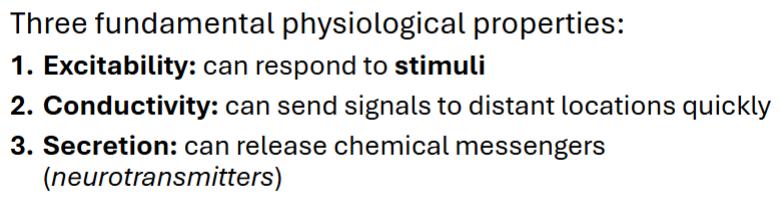
What are the three fundamental physiological properties of neurons?
What are the three functional classes of neurons?

Which class of neurons is confined to the CNS and is the most abundant neuron type?
interneurons
Cell body of neuron (neurosoma or soma)
control center of neuron; contains nucleus, cytoplasm with organelles, and cytoskeleton

Dendrites
primary sites for receiving signals from other neurons; contain smaller protrusions called dendritic spines
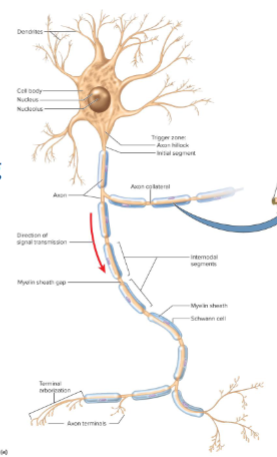

Axon (nerve fiber)
Fiber specialized for rapid conduction of outgoing signals
contains axoplasm and its membrane is the axolemma; may be surrounded by a myelin sheath
axon branches into terminal arborization; each branch ending in axon terminal (terminal bouton, synaptic knob)
How are neurons classified?
Neurons are classified structurally by number of processes extending from cell body.
What are the different structure classes of neurons?

Neuroglia (glial cells)
supportive cells of the nervous system; there are six types
What are the CNS glia?

What are the PNS glia?

Myelin sheath
insulating layer around a nerve fiber
In PNS, ______ _____ wrap round a single nerve fiber, laying down many layers of its own membrane.
schwann cells
In CNS, __________ reach out to myelinate several nerve fibers in its vicinity.
oligodendrocytes
Myelin sheath gaps (nodes of Ranvier)
gaps or spaces between myelin segments
Internodal segments (internodes)
myelin-covered segments
Most nerve cells are ________.
unmyelinated
_________ depends on fiber diameter and presence or absence of myelin.
signal conduction speed
True or False: The fastest fibers are both large and myelinated; these are employed where speed is important.
True
The presence of myelin speeds ______.
conduction