Neuronal Communication
 Call Kai
 Learn
 Practice Test
 Spaced Repetition
 Match
 Flashcards
 Knowt Play
1/30

There's no tags or description
Looks like no tags are added yet.
31 Terms
Why is the nervous system important?
Enables organisms to respond to their environment.
What does the nervous system do?
Sensory input → Integration → Response
What is neuronal communication?
When information is passed along a neurone via an action potential as well as chemical signals across a synapse.
What is the resting membrane potential of a neurone and what does it result from?
-70mV, the result of unequal distribution of ions.
What is the Nernst equation used for?
Calculating the equilibrium potential
What is the Nernst equation?
K+ being any ion, K+ used as an example. O = outside and I = inside

What is the cell membrane of a neurone permeable to at rest?
High permeability to K+ and a low permeability to Na+. So K+ leaks out more often.
What is the cell membrane of a neurone permeable to during an action potential?
Low permeability to K+ and a high permeability to Na+. So Na+ leaks in more often.
Define depolarisation.
An increase in membrane potential
Define repolarisation.
The returning of an increase in membrane potential back to resting.
Define hyperpolarisation.
When the membrane potential of a neurone decreases below resting potential (-70mV)
Show depolarisation, hyperpolarisation and repolarisation on a graph.

Describe how an action potential is generated.
1. Depolarisation occurs causing membrane potential to reach threshold potential.
2. Rapid depolarisation occurs as voltage gated Na+ channels open allowing them to enter the neurone.
3. Peak membrane potential occurs of around +40mV.
4. Na+ channels close and voltage gated K+ channels open allowing K+ to move out down a electrochemical gradient repolarising neurone.
5. Membrane potential decreases below resting however NaK-ATPase restores resting potential.
What are the two types of refractory periods?
Absolute and Relative refractory periods.

What is the absolute refractory period?
The absolute refractory period refers to a period during the action potential where a neurone cannot be restiumlated during this time.

What is the relative refractory period?
The interval of time during which a second action potential can be initiated however greater stimulation is required to trigger the next action potential and K+ channels remain open.

Why are refractory periods important?
Ensure that action potentials only move one way.
What is conduction velocity?
The speed at which an action potential is propagated along the length of an axon.
What affects conduction velocity?
Axon diameter and Myelination
How does axon diameter affect speed of conduction?
The bigger the diameter of the axon, the quicker the transmission, as there is less resistance to the flow of ions.
Why do myelinated neurones transmit action potentials quicker than non-myelinated
The action potential can 'jump' from node to node (saltatory conduction) which increase the speed.
How are neurones classified?
By the neurotransmitters they release e.g., noreadrenergic.
What are graded potentials?
a type of potential change, similar to action potentials, that serve as short distance signals.
Where do graded potentials occur?
At dendrites and cell bodies where there are no voltage-gated channels.
How are the size of the graded potential related to the size of the input?
They are directly proportional so the greater input the greater the size.
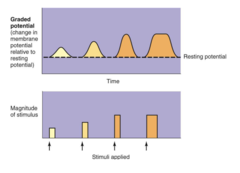
How are the size of the graded potential related to the distance away from the input?
The size of the potential decreases with distance away from the input.

What are two examples of graded potentials?
Receptor potentials and Post-synaptic potentials
What is neuronal integration?
The process by which inhibitory and excitatory postsynaptic potentials control the rate of firing of the next neurone.
What are EPSPs?
Graded potentials that depolarise the post-synaptic membrane.

What are IPSPs?
Graded potentials that hyperpolarise the post-synaptic membrane.

How do EPSPs and IPSPs affect the post-synaptic neurone?
Temporal and spatial summation of them determine the post-synaptic cellular response.