CH11: Self Identity & Development
 Call Kai
 Learn
 Practice Test
 Spaced Repetition
 Match
 Flashcards
 Knowt Play
1/44

Earn XP
Description and Tags
PSYC 207
45 Terms
self understanding
Cognitive representation of the self
Forms the basis of self-concept & identity development
Based, in part, on roles & membership categories
Develops through social interaction

self; childhood
The ____ in Early ________
Interviews, now viable, represent a more direct approach
Characteristics common in early understandings of the self
Confusion of the self, mind, & body — typically head
Defines self in terms of observable features
Concrete, physical or material descriptions
Actions & behaviors
Abstract descriptions gradually emerge, beginning between 4-5
Emotional terms & Psychological characteristics
Unrealistic overestimation of self in most children
Difficulty discriminating between real, versus ideal, selves & competencies
Failure to regularly engage in social comparison
others; childhood
______ in Early _______
Understanding of others in early childhood…
Behavioral forecasting as young as 13mo
Increases in sophistication between 4-5
Reference to psychological traits when describing or perceiving others
Recognition that others may engage in strategic deception
Much more perceptive than historical theories suggested
Similar to the self, develops through social interaction
Early childhood caregivers as function as relational catalysts
Directing attention to consequences of behavior on others
Acknowledging shared intention
Modeling appropriate emotional language & expression
self; late
The ___ in Middle and ____ Childhood
Increasingly complex, integrating perspective taking abilities
Fostering vital socioemotional skills
Greater social understanding of others
More realistic understanding of oneself
Some notable changes include…
Reference to psychological characteristics & traits
Reference to social descriptions
Tendency to engage in social comparison
Recognition of distinct “real” & “ideal” selves
Further refined w/ experience in the social environment
others; late
_____ in Middle and _____ Childhood
Perspective taking is an important aspect of social competence
The ability to adopt perspectives (thoughts & feelings) of others
Predicts adoption of prosocial behaviors & attitudes
Facilitating sympathy & understanding
Lower likelihood of aggression or behavioral issues
Less reluctance to share w/ others
Is further enriched by developments in executive function
Cognitive inhibition — regulating one’s thoughts
Cognitive flexibility — facilitates consideration of multiple viewpoints
Increasingly skeptical of distorted or unrealistic claims
self; adolescent
The Self in Adolescence
____ understanding becomes context sensitive
Fluctuating across situations & time
Greater refinement of distinction between ideal & real selves
Recognition of both positive & negative possible selves (what is desirable & what is to be avoided)
Work together to guide behavior
Other characteristics of _______ self understanding include…
Use of abstract & idealistic thinking as self-descriptors
Pre-occupation with self-consciousness
Capacity to recognize, reconcile, & integrate contradictory elements
Increases cohesion through late adolescence
complexity; awareness
Others in Adolescence
Recognition of diversity of…
Traits expressed by others
Perspectives & worldviews
Appreciation for the _______ of others
Such as adoption of public & private faces
Public performance does not necessary reflect private belief
_____ appears related to meta-cognitive development
Especially useful in monitoring the social world
More effective use of social information
Greater self-awareness in interaction w/ others
self; adulthood
The Self in Adulthood
____-awareness becomes more important in early _______
Awareness of one’s psychological strengths, weaknesses & tendencies
Further reflection & refinement of possible selves
Early Adulthood — much potential & many, often unrealistic possible selves
Middle Adulthood — Fewer, more realistic & framed in terms of familiar domains & contexts
Late Adulthood — greater focus on maintenance rather than future potential
Continued revision to match desired & achieved goals — predictive of self esteem & psychological wellbeing
reflecting; experiences
Self in Late Adulthood: Life in Review
_____ on one’s lived ______ in the interest of…
Involving processes of evaluation, interpretation, & re-interpretation
Typically, w/ greater perspective, context, & understanding
Considering positive & negative aspects creates coherent meaning
Necessary for mature self-understanding & wisdom
Important to reflect NOT ruminate
reminiscence therapy
Discusses experiences with another individual or group
Beneficial to psychological & physiological wellbeing & quality of life
esteem; concept
Important self-evaluative processes
Self-______
Global evaluations of the self
Self-______
Domain specific evaluations of the self
Positive self esteem promotes wellbeing in several domains
Interpersonal & social
Academic, Professional
Physiological & Psychological health
Also predictive of higher levels of happiness

inferiority; grandiosity
Self-Esteem: Perception & Reality
An individual’s self esteem does not necessarily reflect reality
Low self-esteem may reflect feelings of insecurity & ______
High self-esteem may reflect feelings of arrogance & _______
narcissism
Self-centered & self-concerned approach to others
Poor awareness of self & other’s perceptions
Excessively self-centered and self-congratulatory
May respond with rage when other’s perceptions don’t match their own
2 Types — Grandiose & Vulnerable Narcissism
grandiose narcissism
Characterized by an exaggerated sense of superiority, extraversion, & domineering behavior
vulnerable narcissism
Characterized by excessive self-absorption, introversion, & insecurity
development of self esteem
Self esteem typically fluctuates across the lifespan
Males typically report higher self esteem than females

childhood; adolescent
_______ and Adolescent Self-Esteem
During elementary school years, self esteem…
Increases in accuracy
Sex difference begin to emerge
_____ self-esteem
Most individuals have an overall positive self image
adult self esteem
____ self esteem
Many older individuals do not interpret change negatively or in terms of loss
Compares themselves to other older individuals
Some aspects of their lives require continued support for self esteem
Best outcomes when they know they are accepted by others
Deteriorating physical health & negative societal attitudes may explain the decline in self esteem for some older adults
improving self esteem
Inflated praise does not effectively improve self-esteem
Potentially results in…
Avoidance of challenges
Difficulty accepting criticism & coping with challenges
What actually works…
Take responsibility for one’s own self esteem
Recognize cause of low self esteem
Set & achieve goals in domains important to oneself
Identify, develop, & practice effective coping strategies
Help foster positive self esteem in others via provision of…
Emotional support & Opportunities for social approval
identity
The complex constellation of personal characteristics
Organizing principle by which we define ourselves across domains
“The sense of ____ provides the ability to experience one’s self as something that has continuity and sameness, and to act accordingly” - Erik Erikson

role confusion
Identity vs. ____ _______
Primary psychosocial crisis of adolescence
Requiring individuals to answer questions such as…
Who am I? What do I want to do with my life? What is my place in the world?
Characterized by a period of psychosocial moratorium
Role confusion can manifest in 2 ways
Social withdrawal
Social immersion
psychosocial moratorium
The intermediate period between childhood security and adult autonomy
Facilitating exploration of potential identities
contemporary; gradual
Identity: ______ Understandings
Now understood to be a more _____, lengthy process
Typically formed through a process of
Exploration
Commitment
Characteristics of healthy identities
Flexible
Adaptive
One approach to studying identity is the narrative approach
narrative approach
Interview method in which participants tell and evaluate their life stories
Narrative Identities: stories people construct and tell in order to define who they are for themselves and others
marcia identity status theory
Builds on Erikson’s emphasis on exploration
Commitment: Personal investment in a given identity
Crisis: Period of identity development during which the individual explores alternatives
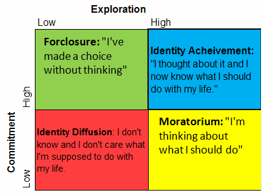
identity development 1
In early adolescence, the most common statuses is diffusion
Also common are… foreclosure & moratorium
Healthy identity development depends on…
Confidence in parental support
Sense of industry
Self-reflective stance toward the future
The dual cycle identity model distinguishes through two processes
Formation cycle
Maintenance cycle
identity development 2
Now believed that emerging adulthood is the key period
As opposed to historical emphases on adolescence
College provides an environment for further refinement
Increased cognitive complexity
Exposure to diverse perspectives
Fostering opportunities for exploration
Opportunities for greater integration
Although more certain in adulthood
Consolidation is a lifelong process
Continues through early middle adulthood

social contexts
_______ _______ in Identity Development
Optimal outcomes in family atmospheres characterized by…
Individuality
Connectedness
Other important factors of social context
Peers provide a safe context for identity-related exploration
Romantic partners are another important social factor
Navigating identity construction together
Providing context for each other
individuality
Self-assertion
Capacity to communicate one’s views
Separateness
Communication of how one differs from others
connectedness
Mutuality
Sensitivity and respect for the views of others
Permeability
Openness to the views of others
individualistic; collectivistic
Culture & Identity Development
Most historical research has relied on WEIRD samples
Differences observed between individualistic & collectivistic
________ cultures value identities characterized by individual autonomy
________ cultures value identities characterized by cohesion & connection
Dominant groups often take cultural identity for granted
Often more important dimension for ethnic minorities
Some advocate for a singular ethnic-racial identity concept
ethnic identity
Sense of membership in an ethnic group including associated attitudes and feelings
racial identity
Collective identity of a group socialized to think of itself as a racial group
trait theories
Pertaining to Personality…
Describes individual differences in terms of specific traits and tendencies
The Big Five model is a particularly popular approach
O.C.E.A.N

personality
______ is often understood as a product of trait-situation interactions
Stable individual differences
Expression is sensitive to context & environment
optimism
Another important dimension of personality
Defined as positivity concerning the future and a tendency to minimize problems
Associated with better adjustment, health, and longevity
In adolescence associated with lower risk for…
Depressive symptomology
Suicidal ideation
seasons of mans life
Adopts a stage-crisis approach to development
Each stage concerns developmental-relevant tasks to be mastered
Late teenage years
Transition from dependence to independence
Marked by formation of a dream
Twenties
Novice phase of adult development
Transition with determination of goals later in decade
Thirties
Focus shifts toward family & career
Becoming one’s own man near the end of the decade
Forties
A stable career & a midlife transition
middle age
Conceptualized as occurring between 40-45
Key conflicts to be addressed concern perceptions of self as…
Young or old; Destructive of constructive; Attached to or detached from others; Masculine or feminine
Meant to hold true for females as well as male
A period suspended between past & future of comping to ensure continuity
More recently recognized as a time for reassessment & reflection
Reflecting on the nature or adolescent & adult experiences
Only a minority of adults experience a crisis
Emotional well-being does not decrease significantly
Some psychological gains are experienced
variations; personality
_______ in Adult ______ Development
Stage theories focus on the universals and do not adequately address individual variations
Research suggest middle-aged adults individually interpret, shape, alter, & give meaning to their lives
Some individuals experience a crisis in some contexts but not in others
Turmoil & stress may characterize one are of a person’s life while things are going smoothly in another
the life event approach
Emphasizing developmental effects of life events
Mediating factors
Individual’s adaptation to the life event
Life-stage context
Sociohistorical context
Drawbacks to this approach…
Too much emphasis on change
Not enough on stability
Overestimates major life changes
Daily experiences have a stronger influence on stress

generativity; stagnation
Focused on meaningfully contributing to the future
________ refers to an adult’s desire to leave a legacy
_______ refers tot he sense of not contributing to the future
Studies confirm middle-aged adults are especially concerned about generativity
Generativity can be developed in a number of ways
May take the form of biological generativity, parental generativity, work generativity, & cultural generativity
stability; personality
The _______ of _______ is a complex issue
Big Five traits demonstrate relative stability across the adult years
Evidence exists for some aspects of adult personality development
Most dramatically observed in early adulthood
More generally…
Begin in relatively low in early adulthood, peaking in middle adulthood
Openness to experience; extraversion; agreeableness; neuroticism '
Again declining in late adulthood
Continuously increase from early to late adulthood (conscientiousness)
stability and change 1
Stability & Change in Personality (Cont.)
According to the Berkley Longitudinal Studies:
Most stable characteristics include the degree to which one is…
Intellectually oriented; Self-confident; Open to experience
Characteristics demonstrated the most change include…
Nurturance versus hostility; self-control
Demonstrated evidence of individual differences
Some experience recurrent crises and dramatic change
Others lead more stable, continuous lives with little change
stability and change 2
Stability & Change in Personality (Cont.)
Helson’s Mills College studies was a longitudinal study of 132 women
Distinguished 3 main groups: family oriented, career oriented, and those who follow neither path
Women in all 3 groups experienced similar psychological changes over their adult years
Although concerns were much like those found by Levinson in men, the Mills women experienced a midlife consciousness rather than crisis
Commitment to tasks in early adulthood appeared to help to control impulses, develop interpersonal skills, become independent, and work hard to achieve goals
stability and change 3
Stability & Change in Personality (Cont.)
Personality development continues into adulthood
Most dramatic changes observed in early adulthood
Stability increases after midlife
Typically tend towards positive outcomes and social maturity
Cumulative personality model
People increase in competence as they interact with their environment
Promoting increased stability in personality