20.2
 Call Kai
 Learn
Learn Practice Test
 Spaced Repetition
 Match
Match Flashcards
 Knowt Play
1/29

Earn XP
Description and Tags
02/06/25 YOU FINISHED THE COURSEEEEEE AYYYYYY!!!!!!1111
Name | Mastery | Learn | Test | Matching | Spaced | Call with Kai | Chat |
|---|
No analytics yet
Send a link to your students to track their progress
30 Terms
interactions
the relationships between members of an ecological community
intraspecific competition
competition between members of the same species for any resource that is in limited supply.
facts about intraspecific competition
both individuals suffer during this kind of competition
any traits that provide an individual an advantage over another, will most likely be passed down to their offspring
is density dependent, and most often occurs in k-selected populations, running near their environment’s carrying capacity
many species have developed methods of reducing intraspecific competition between parents and their offspring.
interspecific competition
when individuals from different species compete for a resource
facts about interspecific competition
both individuals will suffer during this type of competition
once again, density dependent
gause’s principle
Two species that have exactly the same niche cannot coexist. One will out-compete the other, and one will become extinct.
because interspecific competition is caused by similar niches between species, how could we reduce it?
create differences in the niches, even if only slight.
For example, five species of warbler can exist in an area by feeding on insects that are found in different parts of a spruce tree.
introduced/exotic species
a new species introduced to an environment, often by human action. if this species shares a niche with a native species, they will have to compete
predator-consumer interactions
interspecific interactions where one individual eats another. predators, for example, kill and eat their prey.
predation is a density dependent factor.
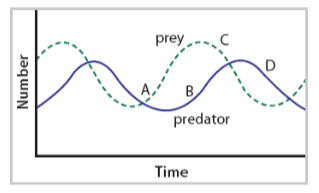
predator-consumer interactions, graphed
An increase in prey increases the resources available to predators (A), so the predator population increases (B). this leads to a reduction in the prey population (C), followed by a reduction in the predator population (as resources wear out) (D)
you could also argue that the prey just wen thru all the resources and the population crash…
co-evolution between predators and prey
the interactions between predators and prey dictate how they evolve, as they are constantly affecting each other’s populations.
this has led to many prey species evolving ways to protect themselves, like cryptic coloration (warning coloration), defensive chemicals (taste/smell bad), physical protective mechanisms (thorns, etc.), and camouflage.
as well, co-evolution leads to mimicry
batesian mimicry
when a harmless species looks or acts like a harmful species. it may mimic a species that is unpalatable, harmful, or poisonous, but the mimic is not, relying on the other species reputation to ward off predators
Mullerian mimicry
when dangerous species evolve to look similar, to reinforce the concept of what a predator can and can’t eat, to said predator.
for example, the monarch, and viceroy butterflies are both poisonous. they evolved to look similar to help the predators understand
symbiotic relationships
mutualism (+,+)
commensalism (+,0)
parasitism (+,-)
mutualism
symbiotic relationship where both species benefit
commensalism
symbiotic relationship where one species benefits, end the other dgaf
parasitism
symbiotic relationship where one species benefits, and the other is harmed
primary succession
happens when a new patch of land is created or exposed for the first time. the organisms who begin to inhabit this area (pioneer organisms) have to start from scratch (no soil, just rock). should end with a stable ecosystem
pioneer organisms
organisms that live in inhospitable places, over time making them hospitable for other organisms.
climax community
the community of species thriving after the end of primary succession
secondary succession
when the severity of disturbance is insufficient to remove all the existing vegetation and soil from a site. ex: forest fire, flooding, etc.
facts abt secondary succession
usually faster than primary succession, as soil/foundation is already laid. as well, the disturbances often also make for better growing conditions.
biological control
introducing a species in order to help manage another, (often invasive) species.
sustainability
the concept of living in a way that meets our needs without compromising the health of future generations or the health of the planet.
human population growth
humans are currently in the log (or growth) phase of their population. our numbers are exponentially increasing, with thew invention of medicines and technologies lengthening our lifespans
age pyramids
a tool that helps demographers assess a population’s potential for growth. we can use their shapes to predict growth.
stack of layers representing different age categories showing the percentage of males and females in each layer. The structure of an age pyramid makes it easy to see the proportion of a population in each of three stages of development, and thus predict any growth.
what are the three stages of development?
the pre-reproductive stage (0-14 years)
the reproductive stage (14-44)
the post-reproductive stage (45 and older).
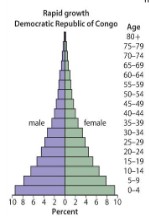
upright triangle-shaped age pyramid means…
more births than deaths in the population, and that the population is therefore growing rapidly. Because a large proportion of the population is young, the population will grow substantially when the current youth reach their reproductive years and have kids.
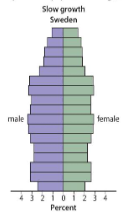
rectangle-shaped age pyramid means…
a stable population. roughly the same proportion of people in each stage of development, with the number of births roughly equal to the number of deaths.
inverted triangle shaped age pyramid means…
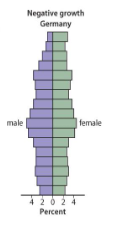
the population is declining