Class 19: Supply & Longrun Equilibrium
 Call Kai
 Learn
 Practice Test
 Spaced Repetition
 Match
 Flashcards
 Knowt Play
1/9

There's no tags or description
Looks like no tags are added yet.
10 Terms
TOPIC 1] Longrun Equilibrium
Differences between LR and SR
SR: K fixed, no entry and exit (the # of firms is fixed).
LR: L & K are variable, entry + exit is allowed so the # of firms in the industry can change.
How does varying K & L affect our equilibrium?
K changes in the LR if SRTC is not equal to LRTC
If SRATC>LRATC firms enter the market because profit is greater than zero.
If SRACT< LRATC firms exist the market because profit is less than zero.
Equilibrium
Occurs when there is no longer any tendency for change. In this context, there is no tendency for change if
(1) profit = 0, and p= min(SRATC); here, firms are done entering and exiting the industry.
(2) SATC = LATC, firms are done adjusting their K
Long run equilibrium conditions (math & graph)

TOPIC 2] LONG RUN INDUSTRY SUPPLY
Longrun versus shortrun supply
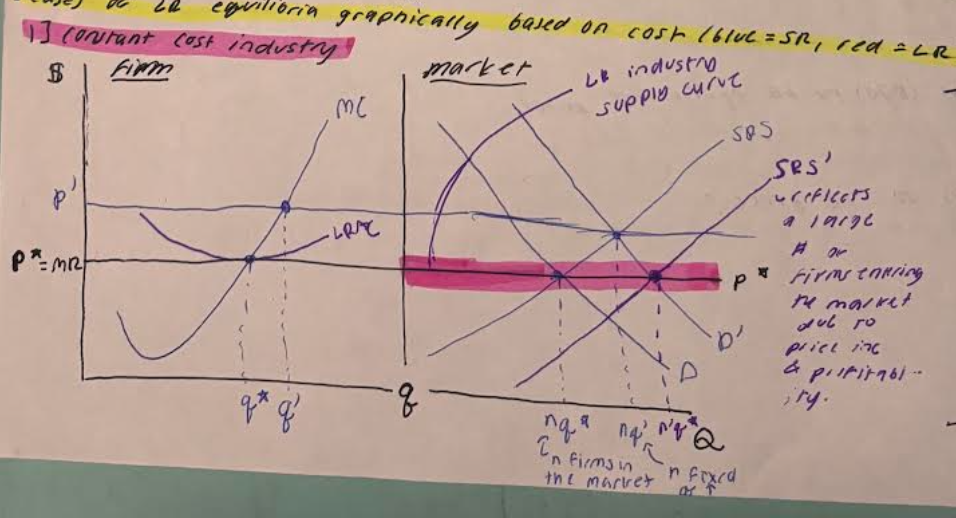
in the short-run supply is Q(p), golding all else constant (k is fixed for firms, # of firms in the industry is fixed.) In the LR nothing is held constant, LR supply illustrates a collection of LR equilibrium outputs associated with different prices.
Cases of LR equilibrium: constant cost industry
Input costs are constant
Supply relationship is perfectly elastic at P= min(SATC)=min(LATC) of all firms.
True if: (1) all firms are identical (2) costs don’t change as firms enter & exit the industry.
Cases of LR equilibrium: increasing cost industry
Assume:
identical firms with U-shaped average cost curves, free entry and exit, and rising input prices

Practice Q’s
