Chapter 11 : Development of Strength and Flexibility
 Call Kai
 Learn
Learn Practice Test
 Spaced Repetition
 Match
Match Flashcards
 Knowt Play
1/56

There's no tags or description
Looks like no tags are added yet.
Name | Mastery | Learn | Test | Matching | Spaced | Call with Kai | Chat |
|---|
No analytics yet
Send a link to your students to track their progress
57 Terms
Muscular strength and endurance are ____________ fitness components that may improve or maintain:
health related
Bone mass
Muscle mass
Glucose intolerance
Musculotendinous integrity
Ability to perform activities of daily living
Fat Free Mass
What is Muscle Mass
Sigmoid growth pattern
Sex differences minimal until puberty
Minimal changes during adulthood up to 50, then decline
Muscle Strength is the ability to
exert force
Different types of muscle strength
Isotonic, Isokinetic, and Isometric
Isotonic
Exertion of a force against constant resistance through the range of motion of a joint
bench press
Isokinetic
Exertion of force at a constant limb velocity through the range of motion of a joint
clinical setting (keeps at the same speed doing same movement)
Isometric
Exertion of force without a change in muscle length
Different ways to assess strength
Isotonic : 1Repetition Max (1RM) of a free weight
Isokinetic : Machine where speed is constant
Isometric : Dynamometer
Functional Tests : Chin-Ups, Flexed Arm Hang
Developmental Strength in youth : Strength ____ as children grow
increases
strength is related to muscle mass
Strength levels of boys and girls are similar until age
13
Development Strength - Youth : Maturation
of the Nervous System
The development of muscular strength in childhood is
controversial
Can children increase their muscular strength through participation in a program?
as long as adults are teaching them the right ways, they should be fine
Strength Training – Youth (Fritz and Coleagues (2016))
Musculoskeletal effects of physical activity
Children (6 – 9 yrs. old)
7-year period

What were the results of Fritz and Colleagues Strength Training for Youths?
Results: The children in the intervention group gained more muscular strength than the children in the control at the end of the 7 years
knee flexion strength
Tibia Cortical Thickness
Additionally, girls experienced an increase in spinal bone mass
Strength is not related to
muscle mass/size alone
__________ training programs effective an enhancing motor skill performance
Resistance
Younger children can demonstrate ______ gains in performance than adolescence (Behringer et al., 2011)
greater

Change in adolescent around 14
comparison in gender differences
boys have a lot more testosterone
Greater effect of strength training learning for an
unlearned and untrained individual
Youth strength training ____ ____ prevent injury among at risk youth: physically inactive
may help
______ ______ of children and adolescents training is key
close supervision
Resistance training programs are effective in enhancing
motor skill performance
Children and adolescence can improve muscular strength
Physical activity Interventions
What negative effects could strength training cause in youth
Susceptible to injury
Traumatic Injury
Adolescent workouts should be no more than
8-10 exercises
Intensities : body weight exercise choices
Resistance training : <80% of 1RM
Sets and Reps : 1 to 3 sets ( 6-12 reps)
When movement patterns develop, you should
add more exercise
What are the performance benefits of Resistance Training for Youth?
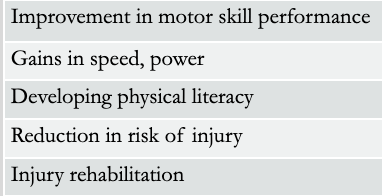
What are the health benefits of Resistance Training for Youth

For development of strength in adults, there is
sex differences
muscle mass
slow twitches and fast twitches (woman have less type II)
cultural norms
differences are not strictly biological
Strength levels are __________ throughout 20s and 30s
maintained
Isometric and Isokinetic strength __________
decline
nervous system
There is a decrease in _________ in the muscles for adults
capillaries
Child Workouts
Should be no more than 8 – 10 exercises
Intensities should be
Body weight exercise choices
Resistance training <60 1RM
Sets/Reps
1 to 2 sets
No more than 10 repetitions
Strength training is beneficial to
young and middle-aged adults
Adults over ___ can increase muscle strength training
60
60-85% of their maximum voluntary strength
3 – 4 times a week
High and Low volume training is ______
benefical for adults
Silva et al. (2014) found that the longer the training program duration for older adults
the greater the strength gains
After the growth period ceases, increases in muscle mass are associated with ________________
resistance training
Are there long term or short term effects of anabolic steroids in adults
short term : increase blood pressure, acne, increased tendon tears
long term : increased death, disorders, cardio vascular..
Summary of Strength Changes - Aging

What is flexibility
The ability to move joints through a full range of motion
Range of motion (ROM) possible at any joint depends on that
joint bone structure and the soft tissues remnants to movement
Assessing Flexibility includes
Sit-and-Reach Test
Shoulder reach Test
Goniometer
Very joint specific
Flexibility among children is ____ but it ______ in older children
high but declines
Soucie and colleagues (2011) measured the average range of motion for 4 age groups
Age 2 -8 (Greater range of motion)
Age 9 – 19
Age 20 – 44
Age 45 – 69
McKay and colleagues (2017) also measured range of motion for 4 age groups and found small sex differences - AUS
Ages 3 – 9
Ages 10 – 19
Ages 20 – 59
Ages 60+
There is _____ _____ in youth and decrease in age
greater flexibility
Differences between boys and girls for flexibility ?
Stretching exercises are more valued in other societies, culture
Activities that require flexibility are more acceptable for both boys and girls
Flexibility training in youth has
limited research
flexibility/stretching program
training WORKS
Flexibility declines from the mid to late ____
twenties
occurs faster in some joints
What are causes of loss of flexibility in adults
Osteoarthritis
Osteoporosis
Degeneration of Tissues
Disuse/Inactivity
Training can maintain range of motion in those with
full range
Training can improve range of motion in those with
limited range
RECOMMENDATIONS FOR DEVELOPMENT OF STRENGTH AND FLEXIBILITY
Muscle-strengthening: As part of their 60 minutes or more of daily physical activity, children and adolescents should include muscle-strengthening physical activity on at least THREE a week
How much activity does adults need?

As part of their weekly physical activity, older adults should do ______ ______ ________ that includes balance training as well as aerobic and muscle-strengthening activities.
multicomponent physical activity
The younger you are, the greater
ROM you have