Strategies during the pattern
 Call Kai
 Learn
 Practice Test
 Spaced Repetition
 Match
 Flashcards
 Knowt Play
1/22

There's no tags or description
Looks like no tags are added yet.
23 Terms
What are possible scenario’s after the invention?
Almost directly after invention large-scale production and diffusion
Quickly after the invention a market introduction and after that a long period of trial and error before large-scale diffusion
Long period of development before the first market introduction
After invention innovation fails in innovation phase or early in adaptation phase
“best” category of strategies

Expected yield and risk of strategies relation
Wait-and-see low risk/yield
Mass market high risk/yield
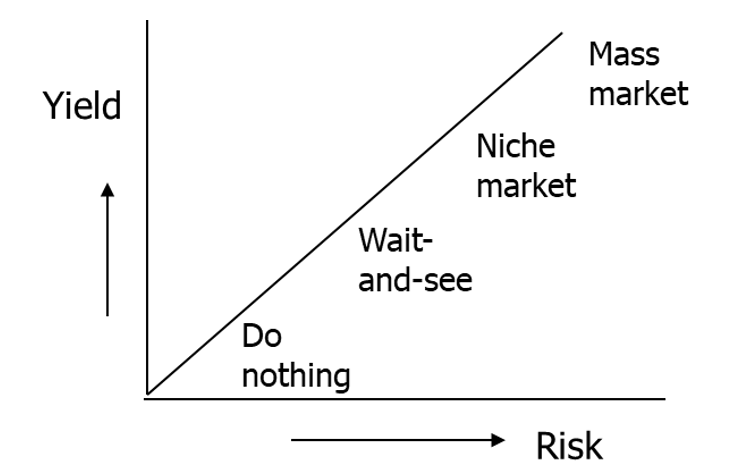
Strategies during the innovation phase
Length of the innovation phase?
Why does it take so long? (Depends on your model/theory!)
What are the activities and barriers or problems in the phase?
What are the strategies to deal with that?
Why does it take so long?

Product development issue in life cycle perspective

What are the activities and barriers or problems in the innovation phase?
Activities
Basic research to improve principle (scientific development).
Basic research on subprinciples in the larger system (scientific development).
Applied research required to complete the system (technology development).
Formation of network of actors with complementary competences/resources.
Vision on the system (function, type of use, type of product type of users).
Competition with other new or incumbent (existing) systems.
Choice product/market combination(s).
NPD-process (product/service, marketing-mix, production, organization).
Pilot/testing.
Problems to tackle
Funding problem
Principle technology immaturity problem; uncertainty performance competitive systems
(Shared) vision is lacking
Network of actors willing to learn and build up vision is lacking or scattered
Strategies during the innovation phase overview
In house-development strategy (Dupont, Philips, Bell labs) Early 20th century: corporations
Portfolio innovation strategy. Closed innovation (risk pooled in large portfolio) When?
Joint development strategy. (JSF, ..) Late 20th century: innovation networks
License in strategy. Open innovation
Buy (shares in) company strategy. Pharmaceutical companies buy (shares in) Biotech starters
Joint ventures Pool risk and resources (car brands share platform)
Subsidized development strategy. (sustainable energy technologies)
Pre-competitive subsidy (EU, ..) advantage: standard; disadvantage: not proprietary
Pre-funding development strategy.
Crowd funding strategy (drones-pre funding)
Sell (shares in) company strategy. Genentech (when? Radical promising technology)
Made-to order funded by client. (ASML)(when? If company has good track record)
Sell idea, concept or design (Medical molecule creation)
License out strategy
Sell design strategy.
Demo experiment strategy. (telegraph, video telephone)
Living lab strategy.
Wait & see strategy.

Strategies during the adaptation phase
mass market
wait and see
niche market
Niche strategies
specific product(version)-market(segment) combi to start diffusion and survive the first hurdles before mass market.
A niche is a combination of a specialized version of a product specifically
for a small group of customers.
Niche next to a mass market (car mass market, handmade car niche)
Niche before a mass market has emerged (focus of our work)
Niche after a mass market has emerged (vacuumtube amplifier for audio-enthusiasts
Managerial Relevance of niche markets for new high-tech products
Problem: Success rate for pioneers of radically new products is much lower than for incrementally new products.
Min et al. (2006): pioneer failure rate radical/incremental: 77/39%
Tellis & Golder, (1996): pioneers out of business before success: 75%
Solution (?): Niche players are relatively successful
(Lynn et al., 1996; Hultink et al., 1997; Moore, 2002;)
For managers it is important to realize that targeting niche applications can be an important initial step to create a market. Niches can form a transition path to reach a large-scale application (DeBresson, 1995).
Finally: Large-scale introduction (mass market strategy) is often not possible.
Telephone: Infrastructure for intercity use simply not available.
Nylon: ****Production to make a fine fabric was not mastered yet.
Adamson, 2003 (sustainable techn)
Primary niche niche unique functionality no competition
Secondary niche niche compete other tech limited competition
Mass market all market segments full competition
Schot & Geels, 2008; Tso & Chang, 2003; Monaghan, 2009 (sustainable tech)
Technological niche governm protected no competition
Market niche subsidized limited competition
Regime shift multiple niches substitution
Testing experimental setting; Economies of scale, learning create compl. Prod/serv
Jorgensen et al, 2007; Little et al, 2010; McFadden et al, 2009 (organic food)
Act of idealism of small group sharing an idea of ideal society, food =part
Barter, alternative systems of payment (in kind)
Buyers cooperation using home to distribute food from selected farmers
Culture building: pot luck dinners, recipe swaps
Real market segment (chains of specialized shops)
Comprising the great ideal
Mass market supermarkets
Research institutes, Tests
Data on niches
Observations
Most Business niches, then Government (military) then Consumer niches
Significant differences in number and type of niches per industry
General
Most private-private sequences (in all industries)
Public-private and reverse are almost equal in size (in all industries)
Per industry
Pharma & Healthcare is different
Public-public sequences differ per industry
Strategies
What to expect?
Why?
What to do?
What to expect? (pattern)
Development lasts long, much longer than a project takes.
Market formation last long and is different from a slow diffusion start.
Why? (actors and factors)
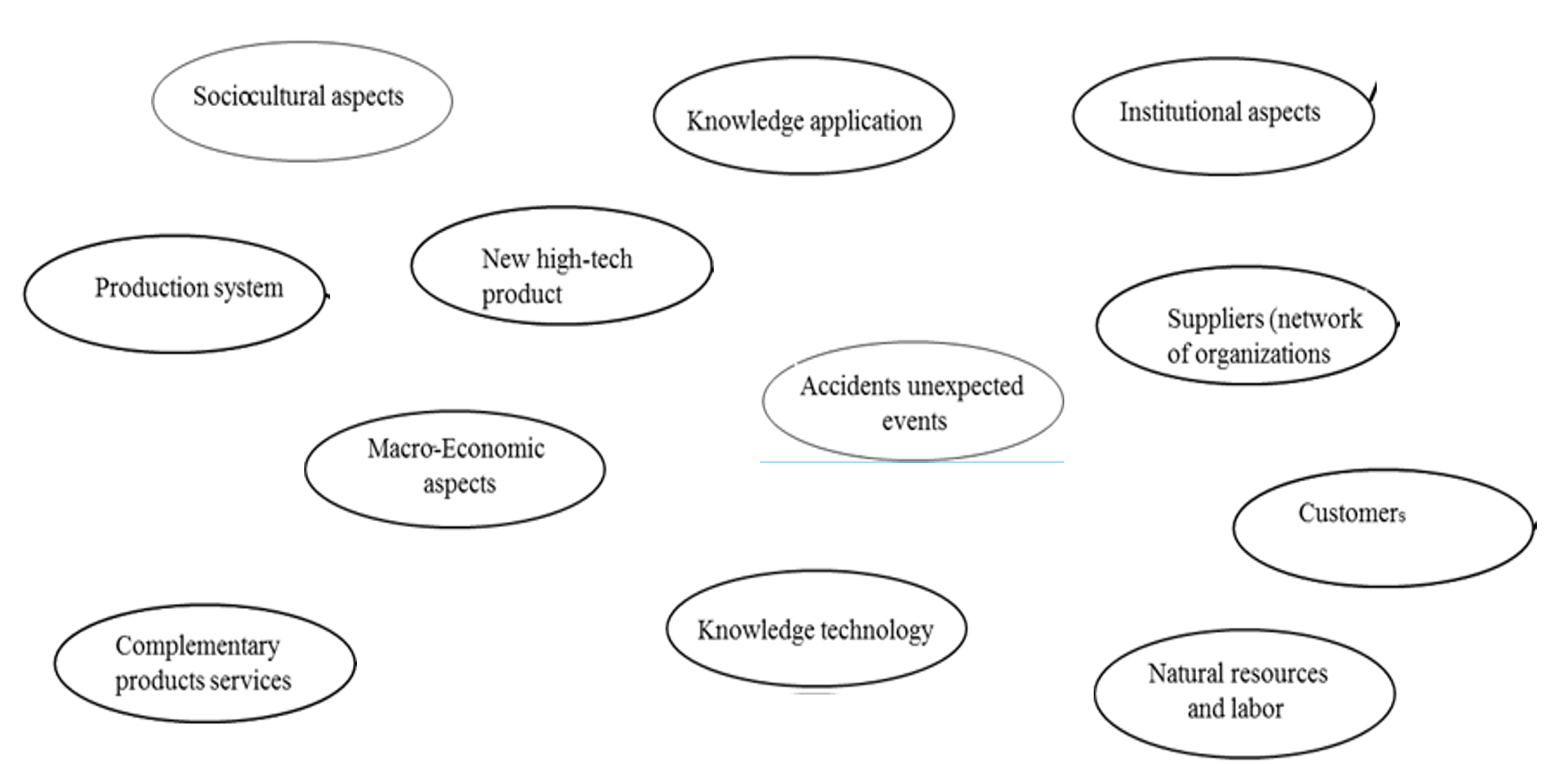
Barriers to large scale diffusion (12)
Tracked over time to choose strategy
What to do? (strategies)
We found ten niche strategies.
Barriers to large-scale diffusion
Socio cultural aspects
Production system
Knowledge application
new high-tech product
macro-economic aspects
complementary product services
accidents unexpected events
knowledge technology
institutional aspects
suppliers (network of organisations)
customers
natural resources and labor
Goal Barriers + niche?
elate barriers ---to--- niche strategies
In extant literature general list of barriers to large-scale diffusion (12)
Design strategies to deal with these barriers?
The main point: The combination of two types of barriers indicates what type of strategy to aim for

barriers + niche: layers

Ten niche strategies + application
Demo, experiment and develop niche strategy
Top niche strategy
Subsidized niche strategy
Redesign niche strategy
Dedicated system or stand-alone niche strategy
Hybridization or adaptor niche strategy
Educate niche strategy
Geographic niche strategy
Lead user niche strategy
Explore multiple markets niche strategy
Strategies during the stabilization phase
Mass market strategy
Market penetration strategy
Market skimming strategy
Differentiation strategy
Focus strategy
Logic strategies Adaptation-Stabilization

Strategy formation
Step 1: Explore alternative strategies
Step 2: Decide to innovate?
Step 3: Focus on Technological innovation (it is developed)
Step 4: Assess the pattern and current position of your technological innovation.
Step 5: Assess the status of the Technological Innovation System framework (TIS)
Step 6: Choose a strategy (fitting pattern stage + TIS)