ch18 - immunological disorders
 Call Kai
 Learn
 Practice Test
 Spaced Repetition
 Match
 Flashcards
 Knowt Play
1/19

There's no tags or description
Looks like no tags are added yet.
20 Terms
immunological disorders
Due to overstimulation of the immune system:
Hypersensitivity – Abnormal, exaggerated immune response to harmless antigens (allergens) leading to damage of host tissues
Allergies (pollen, pet dander, penicillin, peanuts), tissue transplant rejection
Autoimmune disease - when the immune system mistakenly attacks the body’s normal tissues
May occur after a serious infection
Can be organ-specific or systemic
Examples:
Rheumatoid arthritis
Type 1 diabetes
Lupus
Due to failures of the immune system
Immunodeficiency: when the body cannot initiate or sustain an adequate immune response to prevent infection
Immunocompromised – vulnerable to infections
HIV – attacks helper T cells → shuts whole immune system down
immunodeficiency disorders; primary (congenital) - present at birth
Primary immunodeficiencies – rare
Due to genetic defect (defective/missing genes)
May affect B cells, T cells, natural killer cells, phagocytes, or complement components
Examples
Selective IgA deficiency - most common
Little or no IgA is produced
DiGeorge syndrome
Recessive trait → no thymus gland (no T cells produced)
Treated with thymus cell transplant
Severe combined immunodeficiency disorder (SCID)
Neither B nor T lymphocytes are produced
Infections kill at early age
Cure with stem cell transplant
immunodeficiency disorders; secondary (acquired) - develops over an individual's life
Secondary immunodeficiencies - Acquired problems with immune function due to:
Infection/disease, malnutrition, cancer, aging, or immunosuppressive drugs
Depletion of certain immune cells
Measles virus - memory cells
HIV - CD4 helper T cells → AIDS
Most serious widespread immunodeficiency is AIDS
immunodeficiencies
HIV/AIDS
Viral STI
TH (CD4) cells affected
Acquired Immunodeficiency Syndrome (AIDS)
1981
U.S.: discover cluster of Pneumocystis pneumonia and Kaposi's sarcoma in young homosexual men; men showed loss of immune function.
1983
Discovery of virus – HIV (human immunodeficiency virus)
HIV infection is not synonymous with AIDS
HIV infection - virus enters body and is replicating
HIV disease - infection is causing signs, symptoms
AIDS - final stage of HIV disease
Causative agent: HIV
Retrovirus (Lentivirus)
Structure
Envelope with spikes
Protein capsid
Core:
Two copies of ssRNA
Three enzymes
Reverse transcriptase
Protease
Integrase
Infect CD4 cells

origin of HIV
Ancestor: endemic to monkeys/chimpanzees in Africa
Between 1884 and 1924: Crossed to humans via infected blood when animals skinned and used as food
Spread:
In Africa via urbanization and unsafe sexual practices
Throughout world via modern transportation and unsafe sexual practices
1970s: Enters United States
subtypes of HIV
HIV-1
Related to viruses that infect chimpanzees and gorillas
99% of cases
HIV-2
Related to viruses that infect monkeys and sooty mangabeys
Not often encountered outside of Africa
Less pathogenic than HIV-1
HIV
HIV attachment: HIV binds to CD4 cells (CD4 receptor + CCR5 or CXCR4 coreceptor)
CD4 receptor: HIV's gp120 glycoprotein attaches to the CD4 receptor on the host cell.
Coreceptor: HIV must also bind to a second receptor:
CCR5 – commonly found on macrophages and some T cells.
CXCR4 – commonly found on T cells.
Membrane fusion of HIV with cell
HIV's gp41 glycoprotein helps the viral envelope fuse with the host cell membrane.
HIV entry
The viral capsid (containing HIV RNA and enzymes) enters the host cell's cytoplasm.
envelope remains behind
HIV infection
Inside the cell
Viral RNA transcribed into cDNA using reverse transcriptase
cDNA integrated into host's chromosomal DNA (integrase)
Acute infection symptoms (6 days to 6 weeks post-infection)
Fever
Head and muscle aches
Enlarged lymph nodes
Rash

Progression of HIV infection
acute infection
acute retroviral syndrome (temporary flu-like symptoms) may occur
clinical latency
asymptomatic interval
cd4 lymphocytes
AIDS
lymph node enlargement, fever, weight loss, fatigue, diarrhea, etc.
opportunistic infections, malignant tumors
circulating culturable HIV
death

diseases associated with AIDS
Fungal infections
Cryptosporidium hominis
Pneumocystis jirovecii
Histoplasma capsulatum
Cryptococcus neoformans
Candida albicans
Toxoplasma gondii
Herpes simplex virus
Kaposi’s sarcoma
Varicella-zoster virus
Shingles
survival with HIV infection
80% of HIV cases → AIDS (up to 10 years or more)
Immune system slowly loses
CD4 count steadily falls
Atypical cases (other 20%)
Disease progresses rapidly to AIDS within months
Long-term non-progressors
Disease progresses slowly → do not experience fall/infection in CD4 cells
May be AIDS free for 20 years
Mechanism not known
have immune systems that are better able to control HIV replication, limiting damage to CD4 cells
Exposed, but not infected
No CCR5 gene → no coreceptor
Mutated CCR5 gene (CCR5-delta32 mutation) → smaller, so no longer on outside of cell
People immune to or has some protection against HIV infection
Mutation occurs in 20% of Caucasians of northern Europe descent → may have confer resistance to smallpox

diagnostic methods
Rapid diagnostic tests (RDTs) – most common
Detects presence/absence of HIV antibodies in blood or oral fluid and/or antigens in blood
FDA approved HIV self-tests
In clinical labs – ELISA (looks for HIV antibodies) or western blotting
PCR – detects HIV nucleic acid (viral RNA/DNA)
PCR amplifies specific segments of HIV genetic material, making them easier to detect
Can measure plasma viral load (PVL) → number of viruses within a sample
HIV testing: essential for preventing HIV transmission and prompt treatment
HIV transmission
Requires direct contact with infected body fluids:
Sexual contact
Blood-contaminated needles
Blood transfusion/organ transplants
Artificial insemination
Vertical transmission:
Transplacental infection of fetus, during birth, or breastfeeding
Without intervention, transmission rates can be 15–45%
Not spread by insect bites or casual contact
Worldwide
Most common mode: Heterosexual intercourse
Other mode: Injected drug use (IDU)
USA - 2024, 38,793 new cases of HIV
New HIV Diagnoses by Transmission Category
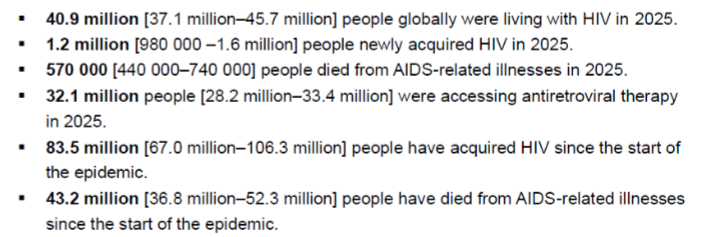
Global HIV Statistics, 2025
U.S. Epidemic 2024
New HIV infections: over 38,793
Highest rate among men
Highest rate among those aged 25-34
New HIV infections: over 38,793
Highest rate among people of color (73%)
People living with HIV/AIDS: 1,158,701
86% of people infected knew; 14% didn’t know
Deaths: 4,296
Males (77%)
Black/African American persons (41%)
Initiative to end HIV epidemic
treatment of HIV infections
No cure, but can be controlled
HIV integrates its genetic material into the host cell's DNA (provirus).
Can remain latent inside host cells, forming reservoirs.
Difficult to eliminate because medications cannot completely remove latent HIV from every infected cell.
ART prevents viral replication and allows people with HIV to live long, healthy lives
AIDS now considered a treatable chronic disease in the developed world
Medications (antiretrovirals)
Designed to block replication of HIV - prolongs life by reducing viral load
Generally, cocktails of different drugs (pills)
Shots considered for cases with undetectable viral load
Classes of FDA-approved drugs: All prevent entry or replication of virus
Fusion/entry inhibitors
Reverse transcriptase inhibitors
Integrase inhibitors
Protease inhibitors
Tetherins
drugs that inhibit HIV life cycle
Fusion/entry inhibitors
Targets the gp41 protein
Stops fusion of HIV with CD4 cells preventing HIV entry
if they cant attach, they cant fuse, and therefore cant enter and infect the host cell
Reverse transcriptase inhibitors
RNA genome is converted into DNA molecule
Both stop the function of reverse transcriptase
Nucleoside reverse transcriptase inhibitors (NRTIs)
Non-nucleoside reverse transcriptase inhibitors (NNRTIs)
very essential step in infection will be stopped → prevents the virus from converting its RNA genome into DNA, preventing further viral replication
Integrase inhibitors
integrase is the enzyme that incorporates viral DNA (cDNA) into the host cells chromosome
Inhibit integration of cDNA into host chromosome
Protease inhibitors
Inhibit cleaving of viral precursor proteins into structural and functional proteins
protease: an enzyme that cuts large viral precursor proteins into smaller, functional proteins needed to assemble new viruses
protease cuts up the protein into individual parts, including proteins needed to form the capsid
if protease is inhibited, the viral proteins remain as long, unprocessed precursor proteins and cannot properly assemble into mature, infectious viruses. this prevents the virus from becoming fully functional and inhibits replication strand
Tetherins
Tether viruses to cells, preventing release

treatment: chemotherapy
Highly Active Antiretroviral Therapy (HAART) or HIV ART:
Began in 1997
A combination of at least three of the above drugs (NRTIs, NNRTIs, etc)
Prevent resistance: if it’s resistant to one hopefully the other ones will work
32.1 million people [28.2 million-33.4 million] were accessing antiretroviral therapy in 2025
a lot more people are living longer bcuz of that
HIV prevention
Sexual Contact
Abstinence
Use of condoms
Take PrEP (pre-exposure prophylaxis) medicine
Regular testing
Blood
Blood and blood product screening
Never share needle
Take PEP (post-exposure prophylaxis)
Vertical transmission
Chemotherapy
Cesarean section delivery
No breast feeding
Health-case workers
Use universal precautions
Wear gloves, gowns, masks, goggles
don’t recap needles
Vaccine prospects
No FDA approved vaccine
Challenges
High error rate for reverse transcriptase → Mutations
HIV frequently changes its genetic makeup, making it difficult for the immune system to recognize it
Different clades/subtypes
HIV has different genetic variations (strains), making it difficult to create one vaccine that protects against all of them
Proviruses/Latent viruses
difficult to target because the virus hides inside the host cell’s DNA and may not produce viral proteins for the immune system to recognize