Italian Art History
 Call Kai
 Learn
 Practice Test
 Spaced Repetition
 Match
 Flashcards
 Knowt Play
1/69

There's no tags or description
Looks like no tags are added yet.
Name | Mastery | Learn | Test | Matching | Spaced | Call with Kai | Chat |
|---|
No analytics yet
Send a link to your students to track their progress
70 Terms
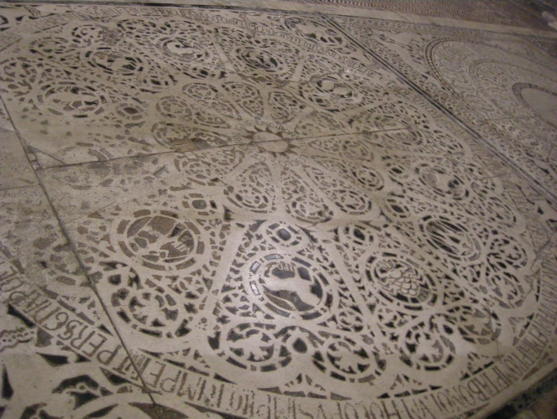
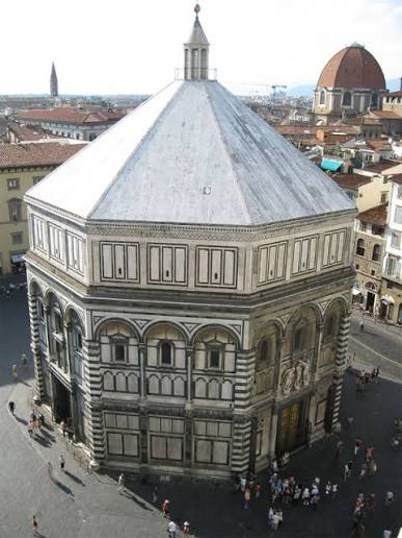
No specific architect, built overtime**
Baptistery, Romanesque building
Florence, Italy
Consecrated 1059
Marble, serpentinite, and sandstone**
Fact: Built on the Temple of Mars; dedicated to John the Baptist.
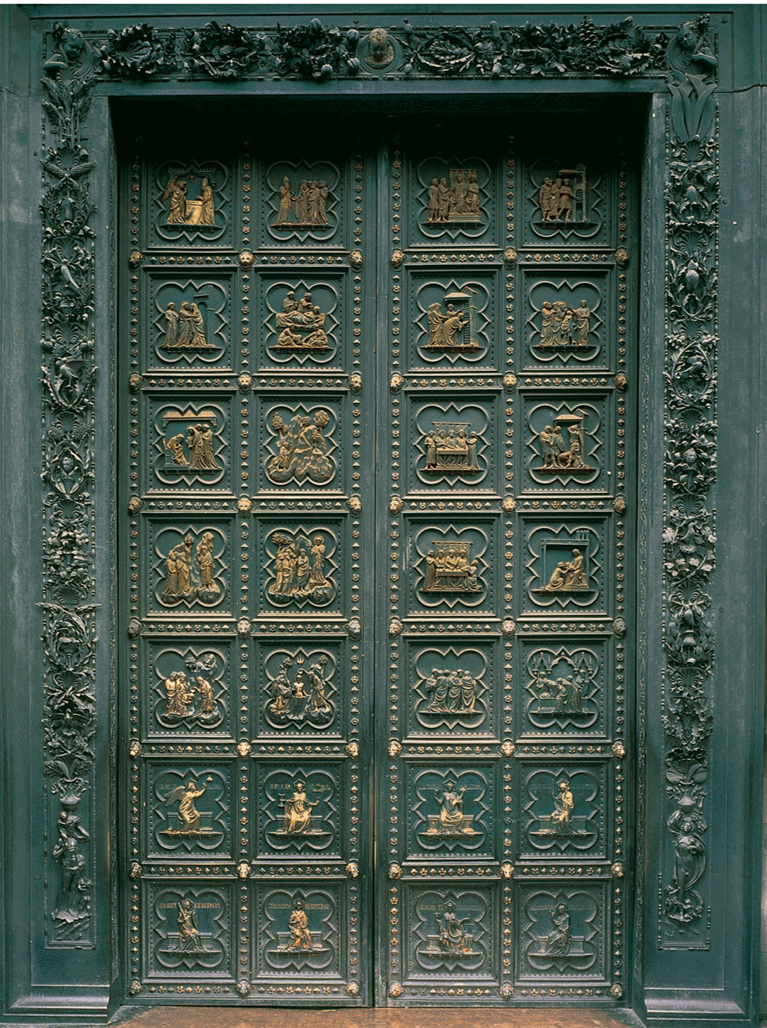
Andrea Pisano
First Baptistery Door; Stories of the Life of John
Baptistery, Florence, Italy
c. 1330
Gilded bronze
Andrea Pisano was a pupil of Giotto.

Lorenzo Ghiberti
Baptistery Doors; Stories of the Life of Christ
Baptistery, Florence, Italy
1402–1425
Gilded bronze
Fact: The story begins with the Annunciation at eye level and proceeds left to right, then upward.

Lorenzo Ghiberti
Gates of Paradise; ten panels depicting Genesis and Old Testament scenes
Baptistery, Florence, Italy
1425–1452
Gilded bronze
Fact: The professor's notes identify Il Paradiso as the space between the cathedral and Baptistery.

Cimabue
Crucifix
Sacristy, Basilica di Santa Croce, Florence
1287–1288
Distemper on wood
Fact: An Italo-Byzantine work that attempts a more realistic depiction of Christ but retains an elongated body.

Giotto
Crucifix
Santa Maria Novella, Florence
c. 1290
Distemper on wood
Fact: More naturalistic than Cimabue's crucifix; uses foreshortening to create a more convincing body.

Filippo Brunelleschi
Dome of Santa Maria del Fiore
Florence, Italy
1418–1436
Laid bricks
Fact: Uses a herringbone brick pattern and double-shell construction.

Lorenzo Ghiberti
Sacrifice of Isaac; competition panel
Bargello, Florence, Italy
1401–1402
Bronze and gold
Fact: Ghiberti's panel was praised for its narrative, visual division of space, quicker execution, and lighter, less expensive construction.

Filippo Brunelleschi
Sacrifice of Isaac; competition panel
Bargello, Florence, Italy
1401–1402
Bronze and gold
Fact: Brunelleschi’s panel was cast in multiple bronze pieces, making it heavier and more expensive to produce than Ghiberti’s. (AI)
Compare the Competition Panels
Both depicted the Sacrifice of Isaac for the 1401–1402 Florence Baptistery competition.
Ghiberti’s panel features a more harmonious composition, graceful figures, and refined detail, combining Gothic elegance with classical influence.
Brunelleschi’s panel is more dramatic and forceful, emphasizing tension, expressive anatomy, and movement.
Ghiberti won because of his effective storytelling, sophisticated casting technique, and lighter, less expensive construction,
Brunelleschi’s panel demonstrated a bolder approach to space and human emotion.


Masaccio
The Holy Trinity
Santa Maria Novella, Florence
1425–1428
Fresco
Patrons: Mr and Mrs Lenzi, their alter
Fact: The skeleton's inscription reads, “What you are, I once was; what I am, you will become.” It serves as a memento mori. (AI)


Donatello
St. George
Originally made for Or San Michele, Florence; now in the Bargello
1416–1418
Marble
Fact: Commissioned by the armorers and swordmakers guild. The statue may originally have had bronze armor fittings; traces of later dark paint were also found. (AI)
Rilievo stiacciato below (flattened squashed relief invented by Donatello)

Donatello
David
Bargello, Florence, Italy
1408–1409
Marble
Fact: The class notes mention the impression of stiffness in the fabric and the slingshot on Goliath's forehead.
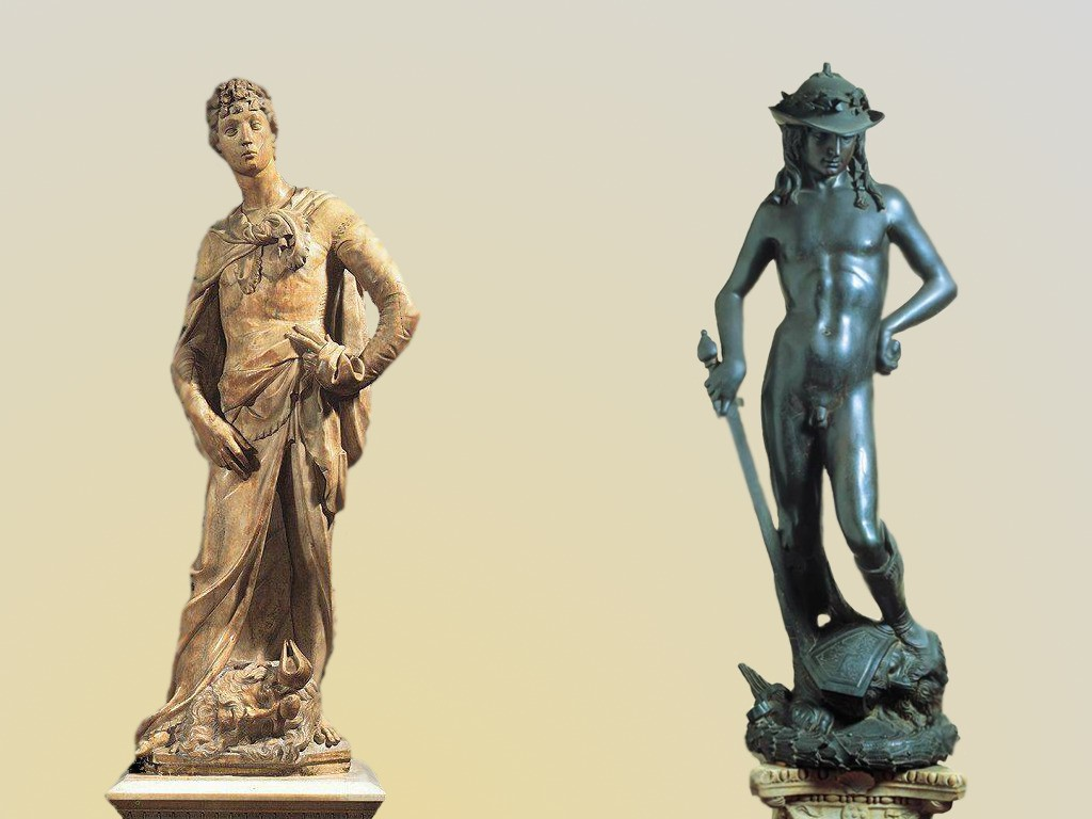
Compare
Donatello’s marble David (c. 1408–1409) was an early work commissioned for Florence Cathedral.
David is clothed in a detailed tunic, emphasizing the texture and stiffness of the fabric, while his youthful face and subtle contrapposto show emerging Renaissance interest in naturalism and classical sculpture.
In contrast, the bronze David (c. 1440) was made for the Medici family and depicts David nude except for his hat and boots, standing triumphantly with one foot on Goliath’s severed head.
Its nudity, relaxed pose, and idealized anatomy revive classical Greek and Roman ideals of the human body.
The marble sculpture retains more Gothic influences, while the bronze demonstrates a more confident Renaissance revival of Antiquity.

Donatello
David
Originally made for the courtyard of Palazzo Medici Riccardi; now in the Bargello
1440s
Bronze
Fact: Identified in the notes as the first freestanding nude statue after Antiquity. Strong homo themes

Andrea del Verrocchio
David
Bargello, Florence, Italy
c. 1469
Bronze
Fact: The face has been suggested to resemble the young Leonardo da Vinci; this identification is uncertain. (AI)

Michelangelo
Bacchus
Bargello, Florence, Italy
1497
Marble
Fact: Cardinal Riario was disappointed with the statue; it was sold to Jacopo Galli.

Michelangelo
Tondo Pitti
Bargello, Florence, Italy
1503–1505
Marble
Fact: Unfinished; Michelangelo left for Rome to work on the tomb monument for Pope Julius II.

Giambologna
Apennine Colossus
Villa Demidoff, Pratolino, commissioned by Francis I de' Medici
1580
Stone
Fact: Approximately 36 feet tall, with three interior rooms.

Giambologna
Mercury
Bargello, Florence, Italy
1578–1580
Bronze
Fact: Associated with the term figura serpentinata.


Leon Battista Alberti
Façade of Santa Maria Novella
Santa Maria Novella, Florence, Italy
1458–1470
white and green marble,
Fact: The design uses geometric proportions, a triumphal-arch motif, and scrolls connecting the upper and lower façade.
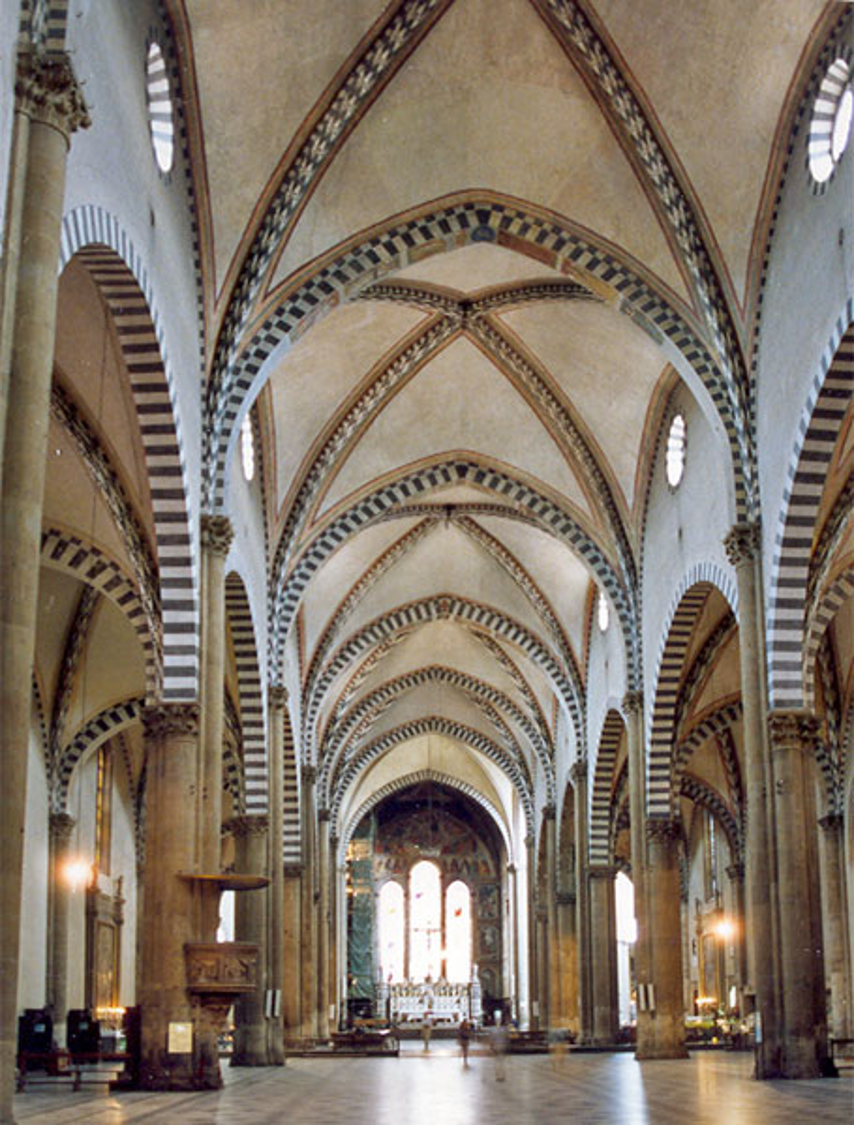
Interior of
Construction finished by Fra Jacopo Talenti, later renovated by Giorgio Vasari
Interior of Santa Maria Novella
Santa Maria Novella, Florence, Italy
c. 1246–1357
Stone masonry, plastered stone walls and vaults, and gray-brown sandstone
Fact: The interior follows a basilica plan and is designed as a T-shaped (Tau) cross; it is a Dominican church.
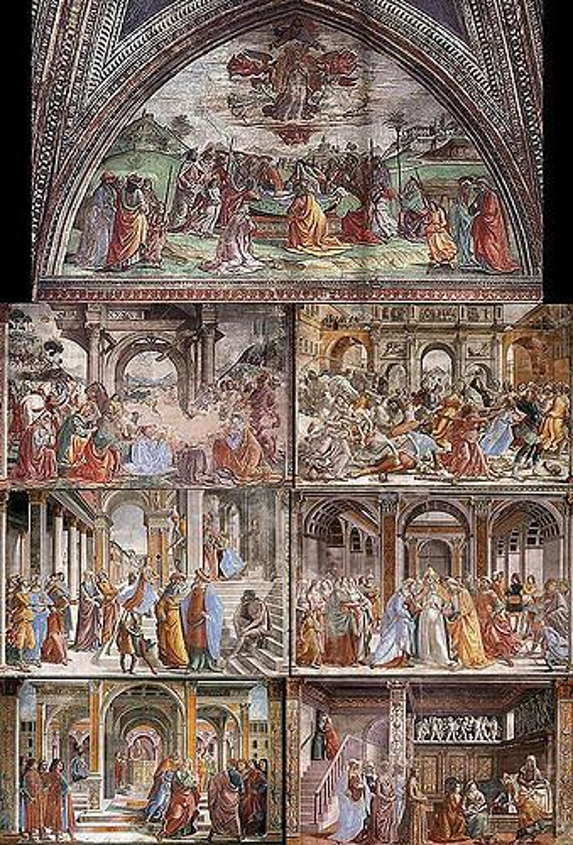
Domenico Ghirlandaio
Tornabuoni Chapel; Stories of the Life of Mary and Stories of the Life of John
Main chapel of the Basilica of Santa Maria Novella, Florence, Italy. (AI)
1485–1490
Fresco
Fact: Commissioned by Giovanni Tornabuoni, uncle of Lorenzo the Magnificent.

Domenico Ghirlandaio
Visitation; Story of the Life of St. John
Tornabuoni Chapel, Basilica of Santa Maria Novella, Florence, Italy
1486–1490
Fresco
Depicts the Virgin Mary meeting St. Elizabeth. The scene features perspective, classical architecture, and portraits of contemporary Florentine women.

Domenico Ghirlandaio
Sassetti Chapel; Life of Saint Francis
Basilica of Santa Trinità, Florence
1483–1485
Fresco
Fact: Sassetti family seen on the left and the artist's portrait in the right corner.

Piero della Francesca
Helena Finding the Three Crosses
Church of San Francesco, Arezzo
1452–1466
Fresco
Fact: The story is a fabricated legend transported into the landscape of Arezzo.

Piero della Francesca
Constantine's Dream; Legend of the Finding of the Cross
Church of San Francesco, Arezzo
1452–1466
Fresco
Fact: The scene depicts Constantine dreaming


Andrea del Bonaiuto
Triumph of the Militant Church
Spanish Chapel, Santa Maria Novella complex, Florence
1365–1367 (AI)
Fresco
Fact: The class notes identify Cimabue, Giotto, Lapo il Tedesco, and Arnolfo di Cambio in connection with the images.

Gian Lorenzo Bernini
Ecstasy of Saint Teresa
Santa Maria della Vittoria, Rome
1645–1652
Marble sculpture; stucco and gilded bronze in the chapel setting
Fact: A total work of art; commissioned by Cardinal Federico Cornaro.
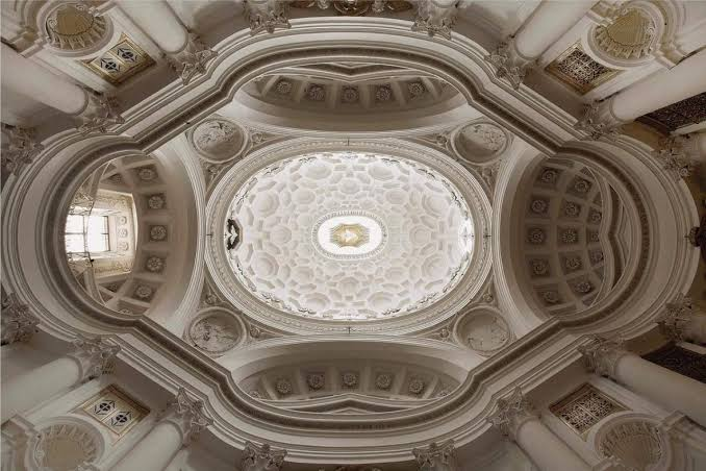

Francesco Borromini
San Carlo alle Quattro Fontane, also called San Carlino
Rome, Italy
1634–1667
Brick masonry covered with plaster and stucco, painted in pale colors. (AI)
Fact: Commissioned for the Trinitarian Order; the building is small and fitted into a tight site.


Hadrian
Pantheon
Rome, Italy
118–125 AD
: Brick-faced Roman concrete, marble, and granite columns. The dome uses concrete with lightweight volcanic aggregate near the top
Fact: The present building dates to Hadrian's reign; its inscription names Marcus Agrippa, who commissioned an earlier structure on this site. (AI)

Nicola Salvi
Fontana di Trevi (Trevi Fountain)
Rome, Italy
1732–1762
Travertine and marble
Fact: The Aqua Virgo aqueduct originally supplied the Baths of Agrippa and still supplies the Trevi Fountain today. (AI)
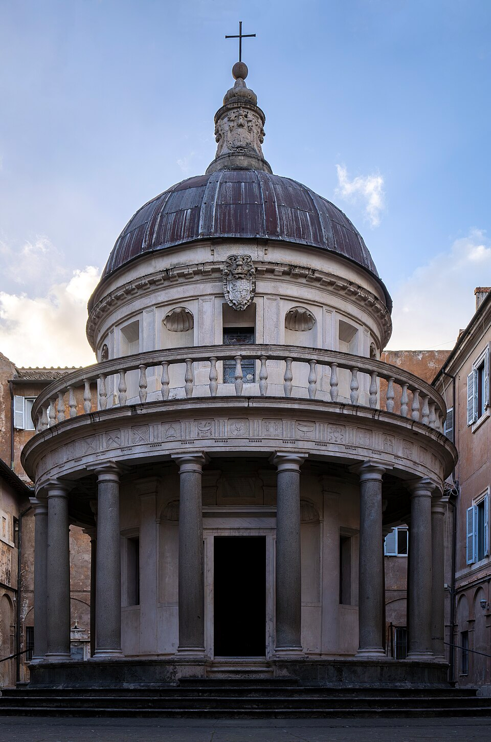
Donato Bramante
Tempietto
Site associated with St. Peter's crucifixion, Rome
1502
Granite columns, concrete dome, and polychrome marble floor. (AI)
Fact: Commissioned under the patronage of Ferdinand of Aragon and Isabella of Castile; considered a precursor to St. Peter's Basilica. (AI)
Isocephalia
Figures' heads are positioned at the same height.
Chiaroscuro
Use of light and dark to create volume and depth. (AI)
Bottega
An artist's workshop.
Fresco
Painting on wet plaster.
Cartone
Full-scale preparatory drawing transferred to a surface using pricked holes and dots.
Sfumato
Leonardo's painting mode using soft, smoky transitions without sharp outlines. (AI)
Colori cangianti
Color technique associated with Michelangelo and his followers; uses changing colors across forms. (AI)
Rilievo schiacciato
Extremely shallow relief sculpture used to suggest depth.
Vanitas painting
Painting emphasizing life's transience and the certainty of death.
Tondo
A circular painting or sculptural support.
Tau-shaped cross
A cross shaped like the letter T.
Mendicant order
Religious order relying on alms and donations. (AI)
Contrapposto
Pose in which hips and shoulders tilt in opposite directions.
Figura serpentinata
Twisting, spiral-like figure creating a sense of movement. (AI)
Horror vacui
Filling nearly all available space with figures or decoration. (AI)
Pentimenti
Changes made to an artwork during its creation, sometimes visible beneath the paint. (AI)
Sinopia
Reddish preparatory drawing beneath a fresco's final plaster layer. (AI)
Secco
Painting on dry plaster. (AI)
Tempera
Paint made by mixing pigments with a binding medium, traditionally egg yolk. (AI)
Space continuum
Perspective creates fictional space that appears to extend beyond the real space.
Refectory
Communal dining hall in a monastery or convent.
Cenacle
Dining room or chamber associated with the Last Supper. (AI)
Memento mori
Reminder of human mortality and the inevitability of death.
Bozzetto
Small preliminary study or model made before a finished artwork.
Maestà
An image of the Madonna enthroned with the Christ Child, often accompanied by saints or angels. (AI)
INRI
Iesus Nazarenus Rex Iudaeorum: “Jesus of Nazareth, King of the Jews.”
IHS
Monogram representing Jesus' name; also associated with Iesus Hominum Salvator, “Jesus, Savior of Humankind.” (AI)
Tetramorph
The four symbols of the Evangelists represented together.
Four Evangelists
Matthew: winged man/angel;
Mark: lion;
Luke: ox;
John: eagle.
Four Doctors of the Church
Ambrose, Augustine, Jerome, and Gregory the Great.
What kickstarted the 1st Style of ERA, and what was the timeframe?
1401-1460s
Kickstarted by the competition for the Baptistery Doors
Main Patrons of the 1st Style of ERA
Cosimo de ’Medici (Cosimo the Elder)
Piero de’ Medici, the Gouty
Both died in 1460s, concluding 1st Style of ERA
1st Style of ERA developments
Renaissance = rebirth of Antiquity
Artist founded a visual language based on perspective and monuments of classsical civilazation
Name 5 artists from the 1st Style of ERA
Architects: Brunelleschi - discover perspective
Manetti, Michelozzo
Sculpture: Donatello
Nanni di Banco, Luca della Robbia, Ghiberti
Painting: Masaccio
Flippo Lippi (monk), Domenico Veneziano, Paoolo Uccello, Andrea del Castagno, Fra Angelico, Benozzo Gozzolio
What kickstarted the 2nd Style of ERA, and what was the timeframe? What marked its conclusion?
1469-1480s
Kickstarted by Lorenzo de’ Medici, the Magnificent starts his reign, continued the Accademia
By 1480s visible change in art towards the High Renaissance Art, maybe due to the commission of fresco cycle in the Sistine Chapel.
2nd Style of ERA developments
Renaissance man in the center, artists who move towards gold smithing, engraving, sculpting, painting, etc: all in one.
New type of feminine portrait: PSYCHOLOGICAL PORTRAITS
Mythological subject matter besides religious
Name 5 artists from the 2nd Style of ERA
POLLAIUOLO,
VERROCCHIO,
FILIPPINO LIPPI,
BOTTICELLI,
GHIRLANDAIO