Chapter 11: The eukaryotic chromosome
 Call Kai
 Learn
 Practice Test
 Spaced Repetition
 Match
 Flashcards
 Knowt Play
1/32

There's no tags or description
Looks like no tags are added yet.
33 Terms
chromatin
the generic term for any complex of DNA and protein found in a nucleus of a cell. it is one third DNA, one third histones, and one third non-histone proteins
chromosomes
the separate pieces of chromatin that behave as a unit during cell division
how long would a stretched out version of the DNA of a single cell be?
6 feet
histones
small, positively-charged, and highly conserved proteins that bind to and neutralize negatively charged DNA. There are five types
how many molecules of non-histone proteins are there?
200-200,000 different types in each chromosome. They have a variety of functions (structural role, chromosome replication, chromosome segregation kinetochore proteins, active in transcription)
what is the fundamental unit of chromosomal packaging?
the nucleosome (resembles beads on a string). Spacing and structure of nucleosomes affect genetic function. Accessibility for proteins that initiate transcription, replication, and further compaction. Arrangements along chromatin is highly defined and varies in different cell types and under different conditions

what is the nucleosome core composed of?
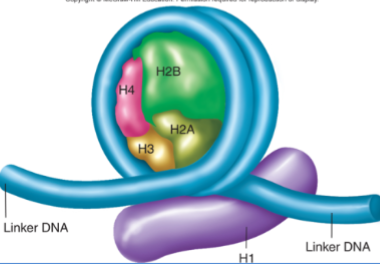
an octamer of two each of histones (H2A, H2B, H3, and H4). 160 base pairs of DNA wraps twice around a nucleosome core. 40 base pairs of linker DNA connect adjacent nucleosomes. Histone 1 associates with linker DNA as it enters and leaves the nucleosome core

core histone octamer

supercoiling
the high-order packaging of chromatin into a compact 300 angstrom fiber by supercoiling

radial loop scaffolding
several nonhistone proteins bind to chromatin every 60-100 and tether the 300 angstrom fiber into structural loops and eventually daisy-like rosettes

how thick are base pairs on chromosomes in karyotypes?
1 to 10 million base pairs
p arm
short arm of chromosome

q arm
long arm of chromosome

FISH
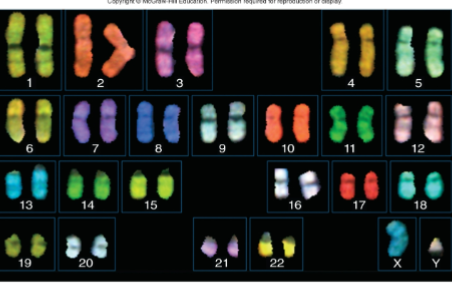
Fluorescent in situ hybridization (used to characterize genomes)

Spectral karyotyping
variation of FISH that uses labels each chromosome type with a specific fluorescent dye
heterochromatin
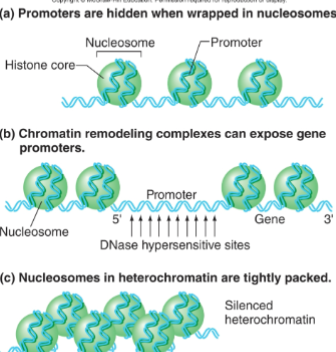
highly condensed, transcriptionally inactive regions of chromosomes. Constitutive (condensed in all cells) and facultative (condensed in only some cells and relaxed in other cells). Show up dark on stains
Euchromatin
relaxed, usually inactive regions of DNA that show up lightly stained
how are genes activated?
Promotors of inactive genes are hidden in nucleosomes. transcription factors bind to enhancers and recruit chromatin remodeling proteins. the promotors are exposed by removing/repositioning nucleosomes
four core histones
- have tails that extend outward
- can be modified with chemical groups added by enzymes
- modified tails can alter nucleosomes and bind chromatin modifier proteins

methylation of histone tails
- histone methyltransferases add methyl groups to histone tails
- affects depend on specific amino acids modified
- adding methyl group to H3 lysine 9 favors heterochromatin formation
- process is reversed by histone demethylases

acetylation of histone tails
- histone acetyltransferases add acetyl groups to histone tails
- prevents close packaging of nucleosomes
- favors expression of genes in euchromatin
- the process is reversed by histone deacetylases

dosage compensation
example of facultative heterochromatin in mammals so that x-linked genes in XX and XY individuals are expressed at the same level
inactive chromosome
Barr body
mosaic
what adult females are at x-linked genes
Xist
X inactivation specific transcript. Expressed on the inactive x but not the active x. binds to the x chromosome from which it was expressed. Initiates histone modifications that result in heterochromatin formation

rate of DNA synthesis in human cells
50 nt/sec
most mammals have how many origin sites?
10,000. many of these origins are active at the same time and provide accessible regions of DNA that are devoid of nucleosomes
replication unit (replicon)
DNA being replicated in both directions of origin
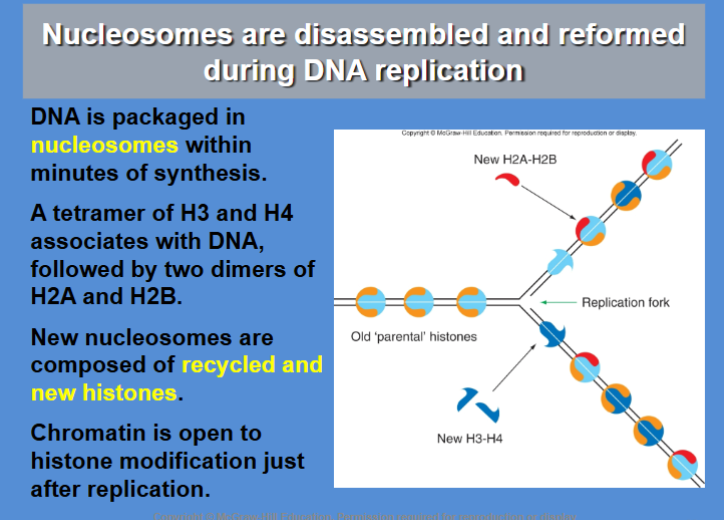
nucleosomes are…
disassembled and reformed during DNA replication
Telomeres
consist of repetitive sequences and don’t contain genes. This protects the ends of eukaryotic chromosomes and prevents chromosome fusions
telomerase
a ribonucleoprotein that extends telomeres

shelterin proteins
bind to telomeres and fold the DNA to protect against degradation by nucleases and against non-homologous end joining