History of Design Midterm
 Call Kai
 Learn
Learn Practice Test
 Spaced Repetition
 Match
Match Flashcards
 Knowt Play
1/73

There's no tags or description
Looks like no tags are added yet.
Name | Mastery | Learn | Test | Matching | Spaced | Call with Kai | Chat |
|---|
No analytics yet
Send a link to your students to track their progress
74 Terms
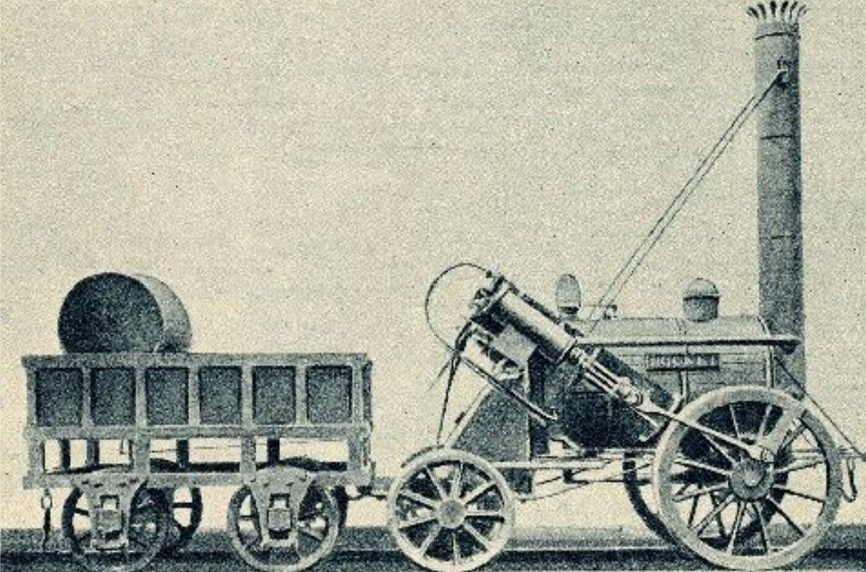
Robert Stephenson, The Rocket,
1829

Left: Henry Cole
Right: The world’s first commercially produced Christmas card Henry Cole 1843
A small example of the “consumer culture” industrialization created
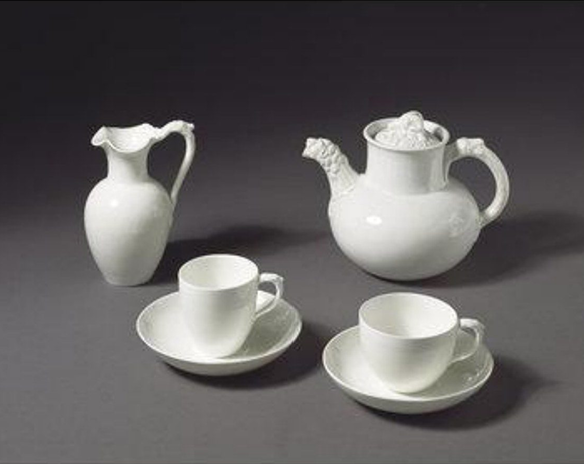
Henry Cole for Felix Summerly's Art Manufactures Tea Service (1846–71)
Designed by Henry Cole and produced by Minton and Co. as an early designer using industry to better products, to create clean, functional, and well-designed household goods.
What was the 1851 Great Exhibition?
A massive international showcase held in London's Crystal Palace to celebrate industrial technology, manufacturing, and global trade under British imperial power.


The Left : The Crystal Palace
The Right: The first Great Exhibition was held here
Designed by Joseph Paxton, 1851
Hyde Park, London
Specific Designs: Built using a modular prefabricated iron-and-glass framework that allowed for rapid construction.
Significance: Showcased global manufacturing, industrial machinery, and raw mineral wealth while celebrating British imperial power.

John Nash, Crystal Palace, 1851, the Indian Court Stuffed Elephant and Howdah
Exhibited at the Crystal Palace to display luxury goods, textiles, and raw materials from India, turning colonial extraction into imperial spectacle.

Imperial Federation Map of the World (1886)
A propaganda map published in The Graphic that visually reinforced British global dominance by coloring colonial territories red, mapping shipping lines, and framing the center with allegorical figures of colonized peoples.

-The Red House, 1859 by William Morris in collaboration Phillip Web
-This was a totally handcrafted living space
-they crafted an all-encompassing environment where the architecture, furniture, wall paintings, and even the garden flowed together seamlessly to create a unified work of art.
-Revolutionized the Victorian era by rejecting industrial mass production in favor of honest craft
-Launched the Arts and Craft Movement
What is the Arts and Crafts Movement?
-1860-1910
-arose as a reaction against the mass production, factory labor, and cheap, ornamentation brought on by the Industrial Revolution
-The movement favored traditional, handcrafted methods of production, arguing that making things by hand restored dignity and fulfillment to the worker
-Inspired heavily by thinkers like John Ruskin and William Morris, it looked to the cooperative guild system of the Middle Ages as a moral and social ideal for creative work.
-Practitioners believed that the beauty of an object should come from the natural qualities of its materials (such as wood, stone, clay, and textiles) and its functional design
-It sought to elevate everyday functional objects like furniture, wallpaper, ceramics, and books into true works of art to enrich daily living.
-Laid the philosophical groundwork for modern design and the Bauhaus movement.
What is the Art Deco Movement?
-Primarily between 1920 and 1930, peaking in the interwar period between World War I and World War II
-Embrace of the Machine Age: Unlike previous movements that rejected industrialization, Art Deco enthusiastically celebrated mass production, new technologies, & modern
-Designs heavily favored sharp angles, clean lines, zigzags, chevrons, and stylized sunburst(rays radiating outward from a central point)
-Practitioners combined cutting-edge industrial materials (like stainless steel, chrome, and plate glass) with elements such as ivory, ebony, and lacquer.
-The style drew inspiration from sources like ancient Egyptian art (popularized by King Tutankhamun's tomb discovery), Aztec architecture, and modernist art styles like Cubism & Futurism

What is the Art Nouveau Movement
-From 1890 to 1910, acting as a transitional movement right before Art Deco
-inspired by the natural world, rebelling against the academic styles of the 19th century by imitating the asymmetrical, organic rhythms found in plants, flowers, and insect wings
-Designs heavily favored flowing, winding, and curving lines like plant stems or vines
-Practitioners sought to break away from copying historical art styles (like Neo-Gothic or Neo-Renaissance)
-Much like the Arts and Crafts Movement, Art Nouveau valued total design
-Art Nouveau welcomed industrial techniques when useful, combining modern materials with traditional craftsmanship
What is Gesamtkunstwerk?
means a "total work of art" a holistic design approach where every element of a space from architecture and interior structure to custom furniture, textiles, and everyday objects is unified under a single aesthetic vision
What is the Bauhaus Movement?
-A German art, design, and architecture school founded by Walter Gropius that united fine art and functional craft,
-Coining the principle that "form follows function." the shape of an object or building should be determined purely by its function, stripping away unnecessary, purely decorative.
-from 1919 to 1933 before being forced to close under Nazi regime
-Bauhaus embraced mass production and modern technology, aiming to design practical, well-crafted goods for everyday people
-Designs favored clean lines, primary colors, and industrial materials like tubular steel, plate glass, and molded plywood
-Bauhaus integrated fine and applied arts because they believed that modern design required elevating functional everyday objects and architecture to the same level of intellectual importance as painting and sculpture
What was the industrial Revolution?
Time: Mid-18th to mid-19th century (roughly 1760–1840).
Place: Originated in Great Britain, later spreading to Western Europe and the United States.
The shift away from a farming-based economy where people relied on hand tools, animal, & human labor toward a factory-based industrial & manufacturing economy powered by machines and steam.
Key Innovations: The steam engine, mechanized textile manufacturing, and the widespread use of iron and coal.
Major Impacts: Rapid urbanization, the rise of factory systems, economic growth, and massive shifts in social and labor structures.
How did the Industrial Revolution affect design?
Division of Labor & Separation of Roles: Design became separated from production the creative role of the designer was separated from the manual labor of factory workers executing the product.
Mass Production & Uniformity: Goods were manufactured in large, standardized batches using machinery and molds, replacing custom, handcrafting.
Material & Aesthetic Changes: Inexpensive cast iron, stamped metals, and machine-printed textiles made elaborate decorative styles cheaply available to a mass audience, often resulting in over-ornamented, low-quality consumer goods.
Rise of Consumer Culture: Mass production created affordable goods for a growing middle class, which sparked the creation of modern retail spaces like department stores, catchy advertising, and consumer capitalism. This shift tied personal status directly to what people bought and owned.
Who were some designers who rejected the rise of industrialized design?
Henry Cole, A.W.N. Pugin, and John Ruskin, who promoted historical revivals, functional common sense, & a return to craft.
Who were some of the early designers who used industry to better their products?
Henry Cole: Designed simplified earthenware manufactured by Minton and Co. starting in 1846, and created Felix Summerly's Art Manufacture to combine industrial production with refined artistic design.
A.W.N. Pugin: Designed furniture, wallpaper, and decorative metalwork (such as items for the Palace of Westminster from 1840 to 1876) using historical Gothic revival principles (re‑interpreted medieval Gothic forms for 18th‑ and 19th‑century buildings using modern materials) and collaborating with manufacturers like Minton and Co..
Ludwig Grüner: Worked as an art adviser to Prince Albert and designed innovative items like a garden bench carved from cannel coal, produced by stonemason Thomas Williamson for display around 1850-1851.
Jobson & Co. (with designer Mr. Walton): Engineered and manufactured patent light- and heat-reflecting fire grates (exhibited in 1851) that utilized polished steel and specialized forms to improve heating efficiency.

Why was steam technology important?
Steam technology because fossil-fuel-powered steam engines served as the primary driving force for manufacturing and transportation during the Industrial Revolution.
Industrial & Economic Growth: Steam engines scaled up factory production.
Transportation & Space: The shift to steam-powered transit, such as Robert Stephenson’s 1829 locomotive The Rocket, rapidly connected interior mining districts to national trade networks.
Felix Summerly's Art Manufacture
Established by Henry Cole to produce well-designed, commercially available objects that bridged the gap between fine art and manufacturing
Key Dates: starting in 1846 (and produced up to 1871)
Specific Designs: Included items like simplified earthenware tea sets and the world's first commercially produced Christmas card in 1843.
Significance: It aimed to improve public taste by applying high artistic standards to mass-produced everyday goods.

Minton and Co.
A British pottery and ceramic manufacturer that collaborated with designers to produce tableware and decorative objects.
Key Figures: Worked with designers such as Henry Cole and A.W.N. Pugin
Specific Designs: Manufactured Henry Cole’s simplified earthenware tea service (designed 1846) and Pugin’s ceramic Motto Bread Plate (c. 1850).
Significance: Demonstrated how traditional ceramic firms integrated reform-minded design principles with industrial-scale production

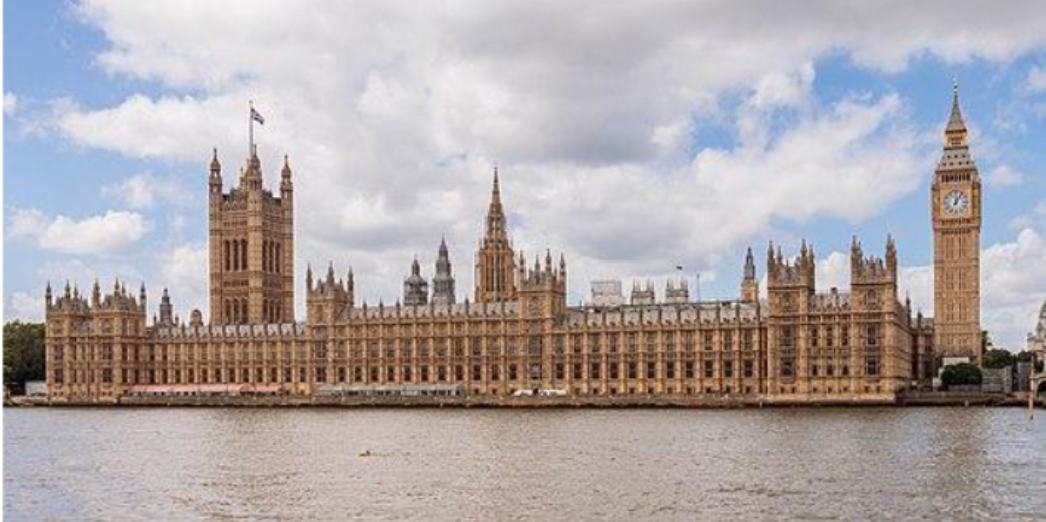
Palace of Westminster (Houses of Parliament)
Key Dates / Figures: Designed and constructed by Charles Barry and A.W.N. Pugin between 1840 and 1876
Specific Designs: Featured custom architectural elements, carved oak furniture (c. 1847), and patterned wallpapers (c. 1851) designed by A.W.N. Pugin
Significance: It stood as an example of the Gothic Revival movement, championing medieval craftsmanship and moral integrity in design over industrial machine styling

What were examples of “bad taste” ?
Showcased in Henry Cole’s False Principles Exhibition, 1853-55
Left to Right:
Wallpaper of the Crystal Palace, Produced by Heywood Higginbottom & Smith
R.W. Winfield of Birmingham, Gas Jet Lamp,1848
Furnishing Chintz, 1850, Roller printed glazed cotton
Why were they considered “bad taste”?
They were considered bad taste beuse they tried to trick the eye with fake 3D depth, copied natural objects too literally, and used messy, realistic patterns instead of keeping designs flat and honest to the material


A.W.N. Pugin, Table, c.1847, Carved Oak
Used in Palace of Westminster
Design elements: A solid rectangular top supported by exposed cross-framed legs and a structural center shaped with medieval Gothic architectural arches
Structure: Visible joinery and structure with carving that decorates the construction rather than hiding it: “truth to materials” (principle of A.W.N Pugin) and function expressed directly

A.W.N. Pugin, Wallpaper Design, c. 1851
For Palace of Westminster
Visual Characteristics: Features a symmetrical, "conventionalized" design incorporating medieval-inspired motifs like the fleur-de-lis (decorative lily flower), keeping the pattern entirely two-dimensional.
Significance: Served as a direct reform alternative to illusionistic wallpapers (such as Heywood Higginbottom & Smith or Furnishing Chintz Wallpaper) by respecting the flat surface of the wall.

Yinka Shonibare's "Gay Victorians" (1999): mannequins dressed in 1880s bustled Victorian gowns made from Dutch wax-printed cotton textiles.
Key Visual Elements: Features historical European silhouettes juxtaposed with patterns traditionally associated with West African identity
Relevance: It uses 19th-century European styles mixed with global textiles to show how trade, imperialism, and colonization connected different parts of the world during the Victorian era
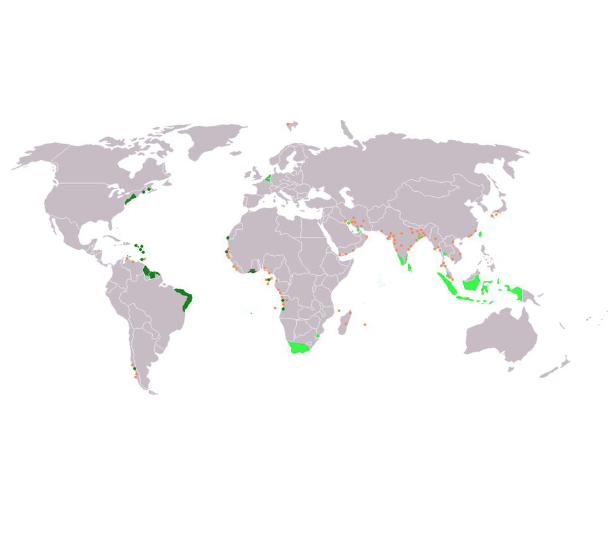

Kara Walker's Fons Americanus (2020)
13-meter-tall monumental fountain installed in the Tate Modern's Turbine Hall, inspired by the Victoria Memorial.
Key Design & Theme: Designed as a rebel version of a royal monument, using figures of enslaved people and ocean themes to criticize slavery and the British Empire.
Significance: Connects old imperial monuments to the hidden human suffering behind global power, acting as a modern update to the themes of the 1851 Great Exhibition.

Thomas Brock's Victoria Memorial (1901)
A memorial sculpture located outside Buckingham Palace in London, dedicated to Queen Victoria.
Key Design & Theme: White marble, allegorical figures representing justice, truth, and motherhood, and a figure of Victory on top, celebrating British imperial power and global dominance
Significance: Served as the direct architectural inspiration for Kara Walker’s Fons Americanus, using classical heroic imagery to project the wealth and majesty of the British Empire
How do Kara Walker’s Fons Americanus and Colin Fanning’s, ‘The Indispensable Agent: Coal and Displacement in Victorian Britain’” discuss “narratives of power?
Kara Walker's Fons Americanus: Critiques imperial narratives of power by subverting traditional heroic monuments like the Victoria Memorial, using figures of enslaved people and aquatic imagery to expose the hidden human suffering and transatlantic slavery behind global empire.
Colin Fanning's 'The Indispensable Agent': Examines narratives of power through "carboniferous capitalism" and "coal fetishism," revealing how Victorian society masked the ecological destruction, labor exploitation, and displacement driven by steam technology and industrialization.
Carboniferous capitalism
An economic system that relies heavily on coal and fossil fuel extraction to drive industrialization and mechanization
Coal fetishism
how Victorian society masked or glorified the true material, human, and environmental costs of coal
1881 Smoke Abatement Exhibition
A major public exhibition held in London and Manchester to address the severe environmental and public-health impacts of coal smoke pollution
Organized by Octavia Hill & Ernest Hart
How did some designers react to the exhibits at the Great Exhibition of 1851?
Designers strongly criticized the Great Exhibition of 1851 for its poor structural quality, gaudy ornament, and dishonest use of materials in mass-produced goods
Henry Cole responded by establishing the "Chamber of Horrors" (Gallery of False Principles) at the Museum of Manufactures in London to display examples of bad design, such as gas burners shaped like realistic plants or wallpapers with 3D perspective flowers
What were the ways that design reformers demonstrated their opposition to the machine-produced goods?
Opposed machine-produced goods
Demanded flat, conventionalized two-dimensional patterns that respected surface integrity rather than creating false spatial illusions.
They enforced "truth to materials" instead of mimicking materials
They prioritized manual craftsmanship and traditional guild production over factory automation.
Why did Ruskin and Pugin advocate the “Gothic” period of art/design?
A.W.N. Pugin used Gothic architecture in works like Contrasts and the Palace of Westminster as an embodiment of Christian moral purity and social integrity.
He argued that design should express function directly and that structural components should be decorated naturally rather than concealed.
John Ruskin celebrated Gothic craftsmanship in "The Nature of the Gothic" (The Stones of Venice) because it granted workers creative freedom, individual expression, and satisfaction in labor.
He condemned the industrial division of labor, arguing that turning human artisans into machine-like operators degraded their humanity.

How did William Morris put some of Ruskin’s ideas into practice in his own work?
Craft Firm (Morris, Marshall, Faulkner & Co.): William Morris founded his decorative arts firm in 1861 to produce handcrafted furnishings, stained glass, textiles, and wallpapers using skilled labor and fair wages
Red House: He collaborated with architect Philip Webb to design and build Red House
Revival of Traditional Techniques: He revived historic hand-printing, natural dyeing, and hand-weaving methods, arguing in his 1877 lecture "The Lesser Arts" that daily objects must be both useful and beautiful
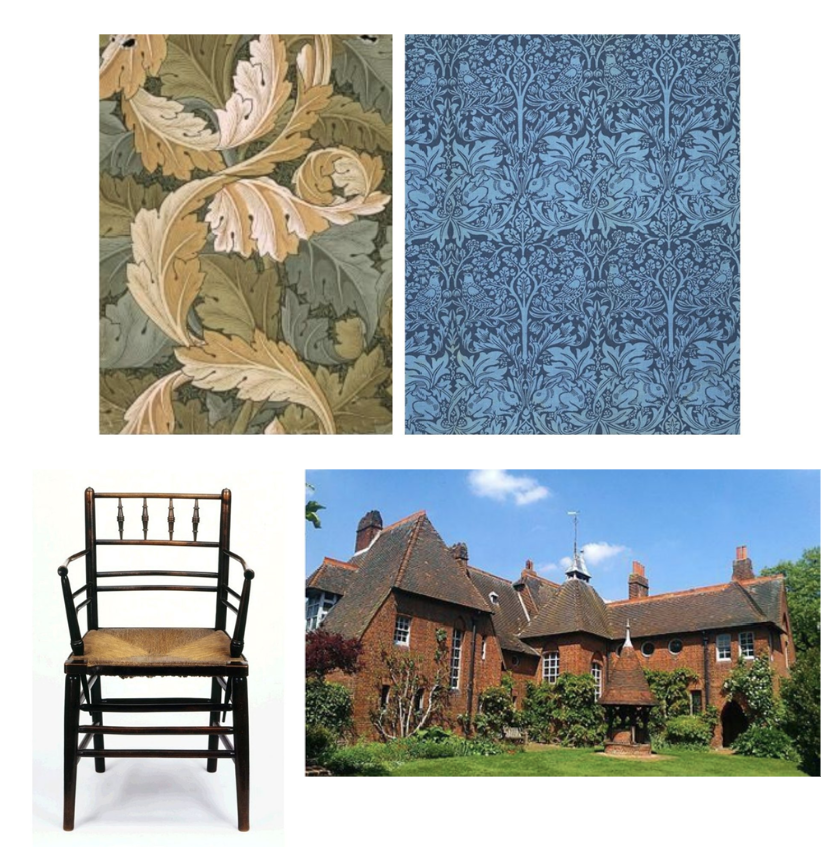

Sussex side chair
Designed in 1865 by D.G. Rossetti for William Morris & Co
Movement: Arts and Craft
It features a simple, vernacular country aesthetic that rejects ornate machine-made luxury in favor of honest, functional utility.
It utilizes traditional craftsmanship and natural materials, such as woven seats and turned wood.
What was Contrasts" by A.W.N Pugin?
An 1836 Book that Critiques contemporary architecture by comparing it unfavorably with medieval Gothic buildings, advocating a return to the moral and aesthetic values of the Middle Ages

Wallpaper designs (Acanthus on the left and Brother Rabbit on the right) were created by William Morris.
They belong to the Arts and Crafts movement and feature flat, stylized botanical patterns that respect surface integrity rather than creating false spatial illusions.
What were some of the design inspirations for Art Nouveau?
Art Nouveau drew heavy design inspiration from nature and organic forms, focusing on dynamic plant stalks (la tige), curving flowy lines, marine life, and insects.
It was deeply influenced by Japonisme, incorporating asymmetrical framing, flat planes of color, and sweeping contour lines inspired by imported Japanese woodblock prints (ukiyo-e) and decorative crafts.
Symbolism: It embraced mystical, psychological, and dreamlike themes, focusing on emotional states, and the supernatural rather than realistic representation
Rococo: It borrowed the 18th-century style's characteristic asymmetrical, swirling, and flowing scrollwork and shell-like curves.
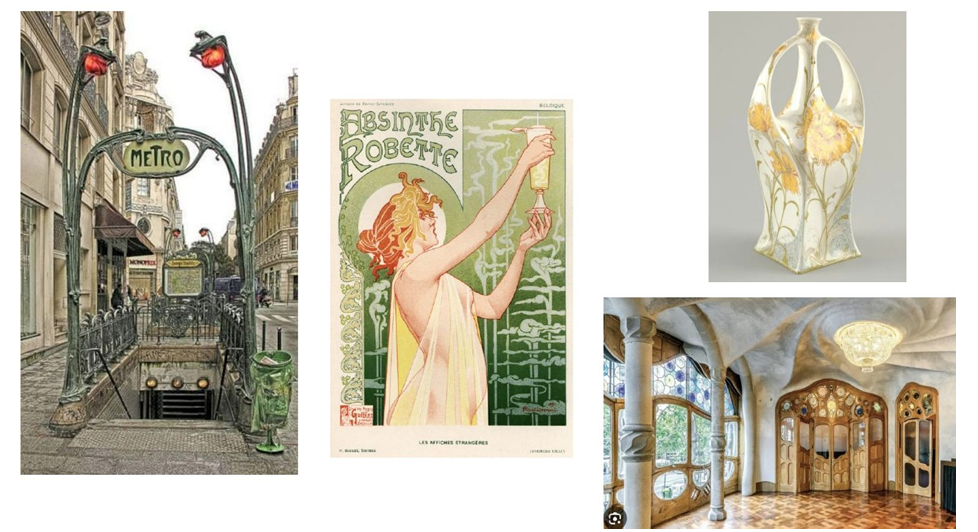
Why was the poster so important at this time? What were some of the innovations in printing?
Importance: Color lithography posters transformed city streets into art galleries, advertising theatrical performances, commercial products, and consumer entertainment
Printing Innovations: Multi-color stone chromolithography allowed artists like Jules Chéret, Henri de Toulouse-Lautrec, and Alphonse Mucha to seamlessly combine hand-lettered typography with bold, saturated fields of color (per the uploaded lecture slide).

Consider the role of women and plant imagery in Art Nouveau design
Representation of Women: Women were frequently depicted with long, cascading "whiplash" hair intertwined with nature, serving as symbolic representations of nature, sensuality, or beauty.
The Duality of Representation: Artists played with portraying women as serene, nurturing allegories of "Mother Nature" and as seductive, dangerous figures (femmes fatales)
Objectification: The pervasive use of female imagery often reduced women to passive, decorative objects, commodifying the female body as a mere vessel to sell products like cigarette papers or food extracts.
Plant Imagery: As architect Victor Horta famously noted, the movement sought "not the flower, but the stalk" (la tige)—emphasizing internal structural tension, organic growth, and energetic movement rather than static decorative blossoms.
How did Art Nouveau design directly impact the colonial extraction of the Congo Free State?`
Mass Death and Depopulation: Historians estimate that between four and eight million Congolese natives died due to the brutal "red rubber" regime established in the Congo Free State under King Leopold II.
Extreme Violence and Forced Labor: The system relied on invasion terror, hostage-taking, forced labor, and widespread atrocities, including the systematic severing of hands as proof that soldiers' bullets were not wasted.
Exploitative Accounting Systems: The enforcement of strict rubber quotas and domanial taxes reduced local populations to forced servitude, stripping them of their land and resources to fuel a global extraction economy.
How did ideas of colonialism have an impact on Art Nouveau design?
Colonial Extraction and Wealth: Per Debora Silverman's study, Belgian Art Nouveau was financially and materially fueled by King Leopold II's brutal extraction of rubber and ivory from the Congo Free State, generating enormous wealth
Style Congo & Imperial Motifs: Colonial importslike elephant shapes, tusks, and twisting rubber vines (la tiges) shaped the flowing, whiplash lines of designers like Victor Horta and Henry van de Velde.
Exhibitions and Trophy Culture: World's fairs and colonial exhibitions (such as the 1897 Tervuren exhibition) displayed ivory sculptures and native artifacts, framing colonial bounty as aesthetic triumphs

This poster, titled Job Cigarette Papers (1896), was created by the artist Alphonse Mucha using color lithography.
It belongs to the Art Nouveau movement and features a stylized woman with long, cascading "whiplash" hair intertwined with organic plant motifs.
Idealized Consumerism: The image uses the seductive, hypnotic mannerism of the woman to equate the pleasure of smoking with beauty & luxury
Commodification of Grace: By blending her cascading hair with abstract smoke and the brand's graphic typography (JOB), the advertisement merges fine art aesthetics directly into everyday commercial consumer culture.

Subject & Movement: This 1893 poster by Jules Cheret advertises the American serpentine dancer Loïe Fuller performing at the Folies Bergère in Paris, capturing a defining icon of Art Nouveau performance and visual culture.
Organic Motion: Fuller's swirling silk garments mimic fluid natural forms such as blooming flowers, flames, or breaking waves embodying the dynamic transformation central to the la tige aesthetic.
Commercial Spectacle: The poster utilizes vibrant typography and dramatic staging to market the live theatrical experience as a high-fashion, captivating, & energetic for the modern urban audience.
Movement: Art Nouveau

Object: Created 1890, this piece is an Émile Gallé Vase utilizing cameo glass with enamel decoration.
The design reflects the movement’s deep fascination with nature features nature directly integrated into the medium, showcasing branches, a bee, and a honeycomb worked into the glass itself.
Movement: Art Nouveau

Object: Created in 1899 by Henry van de Velde, this poster is titled Tropon, l’Aliment le plus concentré, advertising a concentrated protein extract.
Design & Subject Matter: The poster utilizes abstract, sweeping linear forms as a form of commercial advertising rather than figurative realism.
It gives food packaging a more elevated take more aesthetic pleasing to consumers
Movement: Art Nouveau

Victor Horta, Hotel Tassel, 1893. Main façade , Iron railings, First floor landing with view towards staircase, 1893. Brussels.
Movement: Art Nouveau
Example of Gesamtkunstwerk “total work of art” on Art Nouveau

Works & Architect: Designed by Victor Horta, a gate detail from the Hôtel van Eetvelde (1895–97) and a stair mural from the Tassel House (1893).
Movement: Art Nouveau
Core Theory (La Tige): Emphasizes structural vitality through the energetic curved line of the stalk (la tige) rather than the decorative flower itself.
Visual Language: Demonstrates the iconic "whiplash" motif from ironwork to two-dimensional painted surfaces.
Colonial Context: The Hôtel van Eetvelde was commissioned by Edmond van Eetvelde, the Administrator-General of the Congo Free State, directly linking these organic, rubber-like architectural forms to wealth extracted from Belgian imperial exploitation.

Work & Artist: In the Rubber Coils (1896, Punch) by Linley Sambourne.
Visual Imagery: Depicts King Leopold II as a snake strangling a Congolese rubber collector.
Art Historical Key: Connects Debora Silverman’s argument linking Belgian Art Nouveau directly to Congo resource extraction and forced rubber labor.

Visual Pairing: A drawing by Brockensick paired with a botanical plate of the rubber vine.
Core Argument: Illustrates Debora Silverman’s thesis linking the colonial whip and the twisting rubber vine to the signature whiplash lines of Belgian Art Nouveau.
What was the purpose of the 1851 Great Exhibition?
Purpose: To celebrate industrial technology, modern manufacturing, and international trade, while showcasing Britain's absolute dominance as the workshop of the world.
Who were some of the organizers of the Great Exhibition?
Organizers: Prince Albert (who spearheaded the project) and Henry Cole, alongside the Royal Commission for the Exhibition of 1851.
What was the building of the Great Exhibition like? Why was it important?
The Building: The Crystal Palace, designed by Joseph Paxton.
Why It Was Important: It was a revolutionary modular structure made of iron and plate glass, demonstrating mass production, prefabricated architecture, and unprecedented scale.
How did the idea of “Empire” manifest itself at the Great Exhibition?
Imperial Manifestation: Displayed raw materials, trophies, and exotic goods extracted from global colonies, explicitly linking industrial progress to imperial domination and racial hierarchy.
What was displayed at the Great Exhibition? Did everyone approve of it?
Public Reception: Not universally approved; critics like John Ruskin and William Morris deplored mass-produced machine goods for lacking authentic craft, sparking the Arts and Crafts movement.

Hector Guimard, Castel Beranger, Paris. 1895–1898
French Art Nouveau applied to architecture and ironwork, with gate and railing designed as curving, plant-like forms
Movement: Art Nouveau

Hector Guimard, Banquette (For the Castel Beranger.)(Guimard Smoking Room Bench), c. 1897
Furniture with asymmetrical, organic structure.
Movement: Art Nouveau
Material: Exotic imported hardwood (Jarrah wood) carved into seamless, organic structures.
Form: Asymmetrical synthesis of bench, shelving, and display cabinet embodying la tige and Gesamtkunstwerk principles connects to the JOB cigarette poster

Work & Architect: Sagrada Família (begun 1882) by Antoni Gaudí (Barcelona).
Movement Connection: The Catalan regional variant of Art Nouveau (Modernisme), replacing rigid geometry with biomimicry, organic architecture.

Work & Artist: Poster for the Kunstschau Wien 1908 by Bertold Löffler.
Movement: Vienna Secession / Wiener Werkstätte—the Austrian regional variant of Art Nouveau.
Formal Characteristics: Integrates flowing, rhythmic hair lines with flattened, stylized geometry, bold typography to unify graphic art and design.
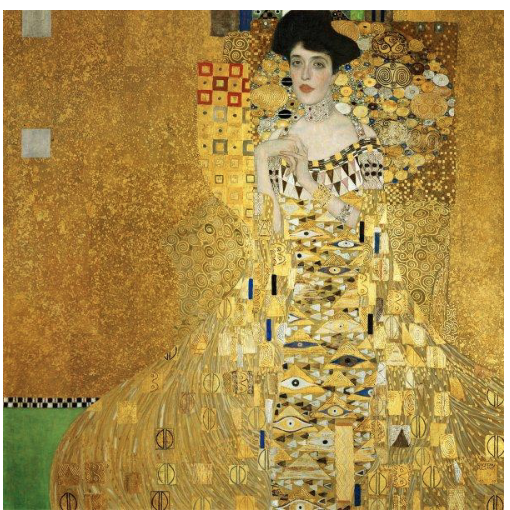
Portrait of Adele Bloch-Bauer I
Artist & Date: Gustav Klimt, 1907.
Movement: Vienna Secession (Austrian Art Nouveau "Golden Phase").
Key Style: Blends naturalistic portraiture with flat, abstract gold leaf and Byzantine-inspired decorative patterns

Artists & Date: Margaret Macdonald, Frances Macdonald, and Herbert MacNair (c. 1895).
Movement: The Glasgow School ("The Four" / Scottish Art Nouveau).
Key Style: Vertical symmetry, elongated mystical figures, and geometric stylized curves defining the distinct Glasgow Style.

Maker & Date: Louis Comfort Tiffany (Tiffany Studios, designed by Clara Driscoll, c. 1900–1906).
Movement: American Art Nouveau.
Key Style: leaded glass and bronze base integrating organic flora (lotus stems/leaves) into functional decorative design.
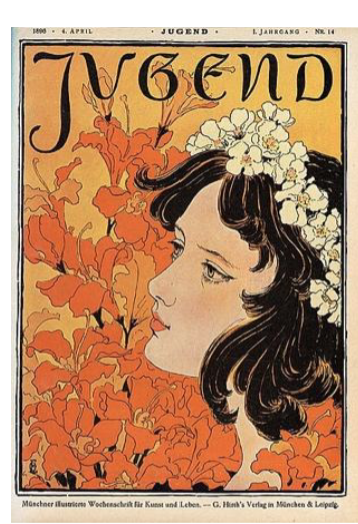
Publication & Date: Jugend magazine cover (April 1896) by Otto Eckmann.
Movement: Jugendstil (German Art Nouveau)
Key Style: Integrates graphic typography with flowing organic motifs, floral backdrops, and stylized natural forms
Why was the 1925 Art Deco exhibition so important to design?
How does the term “exotic” reference Art Deco design?
What are some words that you would use to describe Art Deco?
What role did new materials play in Modernism?
What were some of the common features of Modernism shared across the Soviet Union, Germany and France?
Who were some of the notable designers at the Bauhaus?
What was the Frankfurt kitchen and why is it important?
What was the philosophy of the Bauhaus? What was the difference between the locations in Weimar and in Dessau?