Haemostasis and haemolytic diseases introduction
 Call Kai
 Learn
 Practice Test
 Spaced Repetition
 Match
 Flashcards
 Knowt Play
1/49

Earn XP
Description and Tags
vascular system, platelets, coagulation system, fibrinolytic system, common diseases
Name | Mastery | Learn | Test | Matching | Spaced | Call with Kai | Chat |
|---|
No analytics yet
Send a link to your students to track their progress
50 Terms
4 main systems w/ prevention & arrest of blood loss
vascular system
platelets
coagulation system
fibrinolytic system
what is haemostatic balance between?
the procoagulant environment and the anticoagulant environment
what happens if vascular endothelium is damaged
coagulation is encouraged, collagen exposed, loss of negative coating
thrombopoiesis
formation of platelets
where and by what platelets formed
in bone marrow
by megakaryocytes
modulated by TPO
where is TPO produced and what do plts do
liver and kidney - constant level
platelets remove TPO from circulation
low plts affect of TPO
more TPO reaches bone marrow
TPO mature
they release plts

vascular lumen
vascular endothelium
internal elastic lamina
tunica intima
tunica media
external elastic lamina
tunica adventitia
TPO produced > Blood > Low plt no.s
Less TPO absorbed > more reaches bone marrow > more TPO= more plt production
TPO produced > Blood > High plt no.s
More TPO absorbed > less reaches bone marrow > less TPO= less plt production
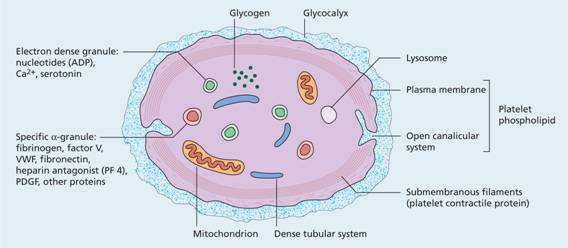
platelet ultrastructure
a granule
electron dense granule
dense tubular system
glycolax
mitochondria
open canalicular system
plasma membrane
submembranous filaments
glycogen
Platelet activation
contact w/ damaged endothelium
2. shape change
3. granule contests released
4. platelet aggregation activated
coagulation system/ cascade
tissue damage
enzyme cascade
thrombin amplification loop
stable fibrin clot
Plts roles
1’ haemostatic plug
contraction of 2’ haemostatic plus - via fibrin meshwork
release growth hormones
plts & 2’ haemostatic plug contraction
formed by coagulation cascade
func. of cytoplasmic contractile elements
reduces endothelial gal
allowing for tissue regrowth
plts release growth promotors
plt derived growth factor ( PDGF)
fibroblast mitogen
chemotactic for fibroblasts, neutrophils, smooth muscle cells
Vascular endothelium role when damaged
exposes subendothelium (collagen)
activates plts
1’ haemostatic plug forms
Vascular endothelium role when intact
Thrombomodulin binds thrombin to vascular endothelium
complexed thrombin doesnt clot fibrinogen
activates protein C
stimulation fibrinolysis
control of coagulation
many inhibitors in loop and cascade
fibrinolytic system function
break down formed fibrin within the circulation
> via rapid & localised formation of plasmin (a powerful proteolytic enzyme)
Intact vascular endothelium produces….(5)
t-PA (tissue plasminogen activator)
plasminogen
plasmin
fibrin
FDP
Main Haemostasis points
clot initiation
clot formation
fibrinolysis
Clot initiation
platelet aggregation
coagulation activation → 2.Thrombin…
Clot formation
Coagulation → 2.thrombin + fibrinogen → fibrin → fibrin polymers → retraction →3. Fibrin fragments
fibrinolysis
retraction → 3. fibrin fragments
Quantitative disorders means…
defect in altered numbers
Qualitative disorders means….
defect in altered functions
disorders may involve
platelets
inhibitor
coagulation proteins
vascular endothelium
systematic disorders
disorders may be…
congenital
acquired
disorders may result in ….
excessive bleeding
excessive clotting
Bernard - Soulier disease
congenital
platelets
glycoprotein deficiency
haemorrhagic
Haemophilia A
congenital
coagulopathies
X- linked recessive
Factor VIII deficiency
haemorrhagic
Haemophilia B
congenital
coagulopathies
X- linked recessive
Factor IX deficiency
haemorrhagic
von Willebrand’s diease
congenital
coagulopathies
pseudo haemophilia
haemorrhagic
DIC (disseminated intravascular coagulation)
Acquired
causes: viral infection, trauma, malignancies, burns, liver failure
decreased clotting factors
decreased platelets
increased fibrinolysis
haemorrhagic
Anti thrombin deficiency & Protein C deficiency
congenital
alteration in homeostatic balance
prevents clot formation
anti-throbin, anti-coagulant deficiency
Thrombotic
arterial & venous thrombosis
acquired thrombophilia
risk factors: increased age, obesity, immobility, smoking
Thrombotic
how to get reference ranges
define normality parameters
define population
measure value of the parameter
Anaemia definitions
a reduction in Hb conc. in blood
( accompanied by a decrease in RBC count)
Anaemic causes: production problems
marrow func. = apoplastic anaemia
diet = iron deficiency, smaller rbcs, microcytic
diet = vit. B12 / folate deficiency, larger rbcs, macrocytic
Anaemic causes: premature destruction
Abnormal rbcs removed
haemoglobinopathies (abnormal globin structure)
Thalassaemias (a/b) -rate of globin synthesis
Hereditary spherocytosis - RBC structural defects
Haemolytic anaemia - auto immune or mechanical
Anaemic causes: blood loss
ulcers
menstruation
trauma
Anaemic symptoms - general
shortness of breath
weakness
lethargy
cardiac failure
pallor of mucous membrane
Anaemic symptoms - specific
spoon nails w/ iron deficiency
leg ulcers w/ sickle cell
haematological malignancies (3)
acute leukaemias
chronic leukaemias
non- leukaemic proliferative disorders
acute leukaemias are…
agressive
rapidly fatal
accumulation of early BM hematopoietic progenitors
chronic leukaemias are…
slow progression
difficult to cure
maturation block at later ontogenetic stage
non- leukaemic proliferative disorders
myeloma
lymphoma
polycythaemia
haematological malignancies definition
clonal
they arise from a single cell in the marrow/lymphoid tissue, which underwent genetic mutation in cellular genes
malignant transformation