Perception chapter 3: visual
 Call Kai
 Learn
 Practice Test
 Spaced Repetition
 Match
 Flashcards
 Knowt Play
1/43

There's no tags or description
Looks like no tags are added yet.
44 Terms
what did Percival Lowell do?
?: He was a Harvard-trained mathematician and famed astronomer
Studied the possibility of canals on Mars
Founded the Lowell observatory in flagstaff, arizona
Predicted the existence of Pluto through mathematical computations
He also claimed to find canals on Venus using a telescope he built
The problem was, he was the only one to see them
Blind spots
what is the energy of the visual system?
Form of electromagnetic radiation
Travels faster than you: 186,000 miles per second
Fastest thing in the universe
Light has both wave and particle properties
What is wavelength? What is complexity?
Wavelength: linear distance between the same point on two successive waves
Complexity: interaction of many different waves

What is amplitude, and what does it mean for color?
Amplitude: height of the wave
Great amplitude–bright colors
Small amplitude–dull colors, soft sounds

What is the shape and size of the eyeball? What are its three layers?
Almost a complete sphere
About 24mm in diameter
Three layers
Fibrous tunic
Middle, vascular tunic(Choroid Layer)
Retina
What is the fibrous tunic of the eye?
Hardened surface to protect the eye
What is the sclera of the eye?
What is the cornea of the eye?
What layer are they a part of?
?: white of eye
?: transparent bulge
fibrous tunic
What is the choroid, and what eye layer is it a part of?
?: spongy structure with a network of blood vessels for nourishment
Middle, vascular tunic
What is the Ciliary body, and what eye layer is it a part of?
?: aqueous humor production
Middle, vascular tunic
What is the iris, and which layer of the eye is it part of?
?: two layered structures in front of the eye. The front layer has pigment. Inner layer contains blood vessels
Middle, vascular tunic
What is the pupil, and which layer of the eye is it part of?
?: center of iris
Middle, vascular tunic
What is the lens, and which layer of the eye is it part of?
?: Transparent structure behind the iris. Performs accommodation(curves or flattens depending on where the light is coming from). Accessory structure
Middle, vascular tunic
what is the vitreous chamber and what layers of the eye is it in?
?: Fluid-filled region. About 2/3s total volume
middle, vascuar tunic
how do lenses function in normal people?
Normal: lens forces directly onto retina

What is myopia?
?: nearsightedness, lens focuses in front of retina

what is Hyperopia?
?: farsightedness, less focuses behind the retina

what is Presbyopia?
?: loss of lens elasticity with age

what are cataracts?
?: Reduced transparency with age, cloduing of the Len

What is the transduction of the retina? And describe the process?
Transduction: turning light into the act of seeing
Light waves→chemical reactions→ neural impulse→ features→objects
What are the three types of cells in the retina, and their amounts?
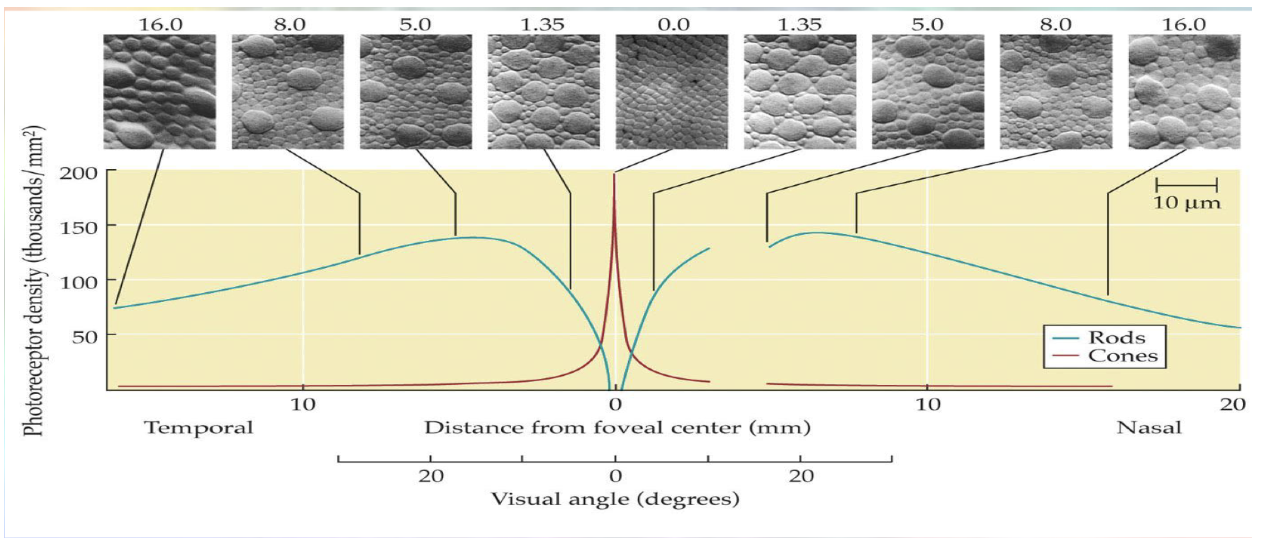
Photoreceptors: 125-140 million
Bipolar cells: 10 million
Ganglion cells: 1 million

What do photoreceptors do?
What forms the optic nerve?
Photoreceptors break things into their fundamental parts and the rest of the system builds it back together
Axons from the ganglion cells form the optic nerve
What is a blind spot?
What is the macula?
where are these things found
?: area where the optic nerve exits the eye
?: the central part of the retina containing the fovea

Describe the retinal image?
Depth is a perception
Done by the brain comparing the image from each eye
It is distorted: everything is curved
Full of holes!
Obscured by blood vessels
upside-down: as light comes in, it flips the image

What does the transduction process in the visual system start with?
The transduction process in the visual system starts in the photoreceptor cells (rods and cones) located in the retina of the eye
Describe the rods? How many, where, illumination levels, “day or night eyes”, how fast is light adaptation, levels of acuity, and level of sensitivity?
120-130 million
Mostly in the periphery
Require low illumination
“Night eyes”
Slow dark adaptation
Low acuity(ability to see details)
High sensitivity(they need less light)


Describe the cones? How many, where, illumination levels, “day or night eyes”, how fast is light adaptation, levels of acuity, and level of sensitivity?
6-8 million
Mostly in the fovea (point of central focus)
Requires high illumination
The “day” system
Rapid dark adaptation
High acuity(ability to see details)
Low sensitivity(they need less light)
Where are cones found tightly compacted?
Cones are found tightly compacted in the fovea

what is the fovea?
Fovea is the point of central focus
are there rods in the fovea?
No rods in the foveal; they are just on the other side of the fovea
The number of rods decreases as you move away from the fovea
What do photoreceptors contain? 2 parts
The photoreceptors contain photopigments (unstable chemical sensitivities to lights) consisting of two component parts
Opsin (a protein)
Retinal (a pigment molecule; vitamin A derivative)

what is the cleaving process in the transduction process?
The presence of light cleaves the photopigment in .0001 second
The cleaving process hyperpolarizes the cell and REDUCES neurotransmitter release(glutamate)

the visual system is the only sensory system in which…
Only sensory system in which stimulus actually reduces the cell’s firing rate!
That response is sent to the bipolar cells
