✔️✔️✔️24 - Stomach & Intestines 🟢
 Call Kai
 Learn
 Practice Test
 Spaced Repetition
 Match
 Flashcards
 Knowt Play
1/147

There's no tags or description
Looks like no tags are added yet.
148 Terms
LECTURE 24 POWERPOINT INFORMATION
LECTURE 24 POWERPOINT INFORMATION
false
T/F - The digestive tract = GI tract
serous, muscular, submucous, & mucous coats
What are the tunics/coats of the GIT?
longitudinal; circular
The muscular coat of the GIT tract consists of _____ and _____ layers
pylorus
Enlarged smooth mm. that regulate the passage of content from the stomach to the small intestine
antrum & pyloric canal
The pyloric part of the stomach includes what parts/sections?
vomit
Involuntary forceful expulsion of content from stomach to the exterior through the mouth
internal
If the content gets in the esophagus and not the exterior, it is known as an _____ vomit
right
The pyloric part and pylorus are located on the [right/left]
left; left hypochondrium
The fundus is located to the [right/left], at the level of the _____
caudal; left
The greater curvature of the stomach points [cranial/caudal] and to the [right/left]
cranial; right
Lesser curvature of the stomach points [cranial/caudal] and to the [right/left]
greater omentum
What courses from the dorsal body wall to greater curvature of stomach?
spleen
What does the superficial leaf of the greater omentum contain?
left limb of the pancreas
What does the deep leaf of the greater omentum contain?
omental (epiploic) foramen
What is the entrance to the omental bursa?
CrDF: Cranial duodenal flexure
DeD: Descending part
CaDF: Caudal duodenal flexure
AsD: Ascending part
DJF: Duodenojejunal flexure
What are the parts of the duodenum?
major duodenal papilla
Openings of bile duct and pancreatic duct
minor duodenal papilla
Opening of accessory pancreatic duct
antimesenteric ileal artery & ileocecal fold
What defines the ileum/serves as its landmark(s)?
cecum, colon, & rectum
What are the parts of the large intestine?
cecocolic orifice
Opening between the cecum and the ascending colon
ileocecal fold
Plica of peritoneum between the cecum and the ileum
Ascending colon
Right colic flexure
Transverse colon
Left colic
Descending colon
What are the parts of the colon?
mesentery
The following are known as _____ (as a group):
-Mesoduodenum
-Mesojejunum
-Mesoileum
-Mesocolon
-Mesorectum
anal triangle, ischiatic tuberosity, & urogenital triangle
What are the parts of the perineum?
somatic
The external anal sphincter is controlled by the _____ nervous system
autonomic
The internal anal sphincter is controlled by the _____ nervous system
columnar zone
Transitional tissue between mucosa and skin associated with the anus
rectum
The internal and external anal sphincter are part of the [rectum/anus]
anus
The cutaneous zone, anocutaneous line, columnar zone, and anal sac opening are part of the [rectum/anus]
LECTURE 24 PRACTICE QUESTIONS
LECTURE 24 PRACTICE QUESTIONS
B. Stomach
Which structure is the first to encounter ingesta after the esophagus?
A. Duodenum
B. Stomach
C. Ileum
D. Cecum
A. Caudal
The cranial duodenal flexure is located in which direction relative to the stomach?
A. Caudal
B. Cranial
C. Right
D. Left
B. Duodenum
Which segment of the intestine connects directly to the stomach?
A. Ileum
B. Duodenum
C. Cecum
D. Ascending colon
B. Caudal
After passing the cranial duodenal flexure, ingesta moves in which direction in the descending duodenum?
A. Left
B. Caudal
C. Cranial
D. Dorsal
A. Right colic flexure
Where does the ascending colon transition to the transverse colon?
A. Right colic flexure
B. Left colic flexure
C. Cranial flexure
D. Caudal flexure
B. Transverse and descending colon
The left colic flexure is located between which segments?
A. Cecum and transverse colon
B. Transverse and descending colon
C. Ascending and transverse colon
D. Descending colon and rectum
C. Left caudal
In what quadrant is the descending colon located?
A. Right cranial
B. Right caudal
C. Left caudal
D. Left cranial
B. Falciform ligament
Which peritoneal attachment secures the liver to the diaphragm and abdominal wall?
A. Greater omentum
B. Falciform ligament
C. Mesoduodenum
D. Lesser omentum
A. Mesoduodenum
The duodenum is attached to the dorsal body wall by which structure?
A. Mesoduodenum
B. Mesoileum
C. Mesocolon
D. Falciform ligament
C. Descending colon
Which organ is not in the right cranial quadrant?
A. Liver
B. Stomach
C. Descending colon
D. Right kidney
A. Fundus
Which portion of the stomach is most cranial?
A. Fundus
B. Pylorus
C. Antrum
D. Body
A. Bile and pancreatic ducts
Which ducts open into the descending duodenum?
A. Bile and pancreatic ducts
B. Hepatic and splenic ducts
C. Pancreatic and cystic ducts
D. Hepatic and gastric ducts
B. To regulate the passage of ingesta to the duodenum
What is the function of the pyloric canal in the stomach?
A. To store ingesta
B. To regulate the passage of ingesta to the duodenum
C. To produce gastric enzymes
D. To prevent reflux
B. Umbilical
The jejunum primarily occupies which region of the abdominal cavity?
A. Right cranial
B. Umbilical
C. Left cranial
D. Pubic
B. Ileum
Which is the distal segment of the small intestine before reaching the large intestine?
A. Jejunum
B. Ileum
C. Duodenum
D. Ascending colon
A. Ascending colon
Which part of the large intestine lies between the cecum and the transverse colon?
A. Ascending colon
B. Descending colon
C. Rectum
D. Ileum
B. Anus
The anal sacs are located within which structure?
A. Perineum
B. Anus
C. Rectum
D. Ileum
D. Pubic
What region is caudal and medial to the right and left inguinal regions?
A. Umbilical
B. Hypochondriac
C. Left flank
D. Pubic
B. Ileocolic orifice
Which segment connects the ileum to the cecum?
A. Mesocolon
B. Ileocolic orifice
C. Pyloric canal
D. Cardia
B. Covers and protects abdominal organs
What is the primary function of the greater omentum?
A. Connects the liver to the diaphragm
B. Covers and protects abdominal organs
C. Connects the ileum to the cecum
D. Supplies blood to the intestines
LECTURE 24 IMAGES
LECTURE 24 IMAGES
muscous coat
A

submucous coat
B

muscular coat
C

serous coat
D

pylorus
A

lesser curvature
B

pyloric part
C

body
D

cardia
E

fundus
F
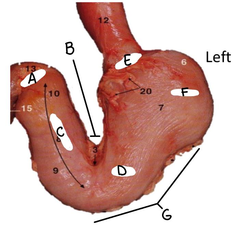
greater curvature
G

pyloric part
A

pyloric canal
B

pylorus
C

pyloric antrum
D

lesser curvature
E/F

body
G

cardia
H

fundus
I

greater curvature
J/K

stomach
A

esophagus
B

lumbar portions or crus
C

esophageal hiatus
D

fundus
A

esophagus
B

stomach
C
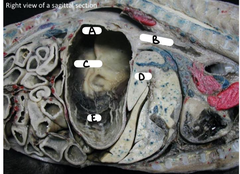
liver
D

body
E

liver
A
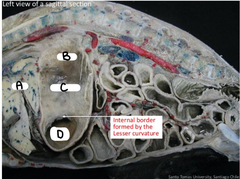
fundus
B

stomach
C

pyloric antrum
D

pylorus
A
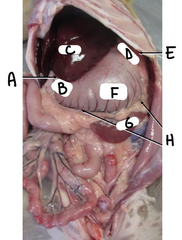
pyloric portion
B
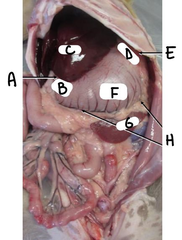
liver
C

fundus
D
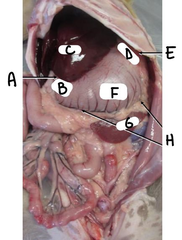
fundus
E

body
F

spleen
G

greater curvature
H
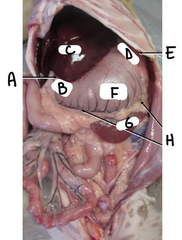
liver
A

diaphragm
B

fundus of stomach
C

pyloric part
A

pylorus
B
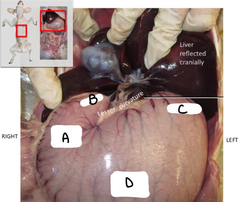
fundus
C
