Chem 5011
 Call Kai
 Learn
 Practice Test
 Spaced Repetition
 Match
 Flashcards
 Knowt Play
1/100

Earn XP
Description and Tags
organic chemistry
101 Terms
Huckle's rule
Planar, fully conjugated, monocyclic systems (one ring of p orbitals) with (4n + 2) pi electrons have a closed shell of electrons all in bonding orbitals and are exceptionally stable. Such systems are said to be aromatic.
Analogous systems with 4n pi electrons are described as anti-aromatic
General Electrophilic aromatic substitution (SEAr) of benzene

Bromination/chlorination of benzene reaction scheme

Bromination/chlorination of benzene generation of electrophile

Bromination/chlorination of benzene mechanism

Nitration of benzene reaction scheme

Nitration of benzene generation of electrophile

Nitration of benzene mechanism

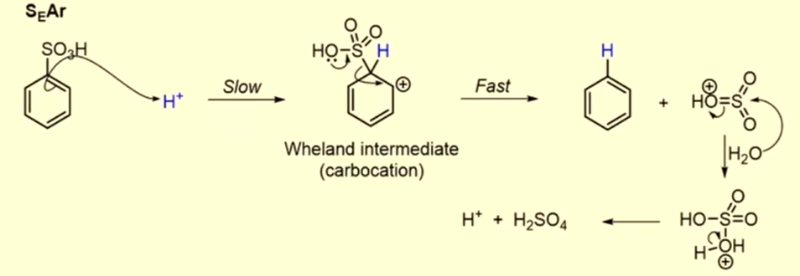
Sulfonation of benzene: reaction mechanism

Sulfonation of benzene: generation of electrophile

Sulfonation of benzene: mechanism

Desulfonation: reaction scheme

Desulfonation: mechanism
Friedel-crafts alkylation: reaction scheme

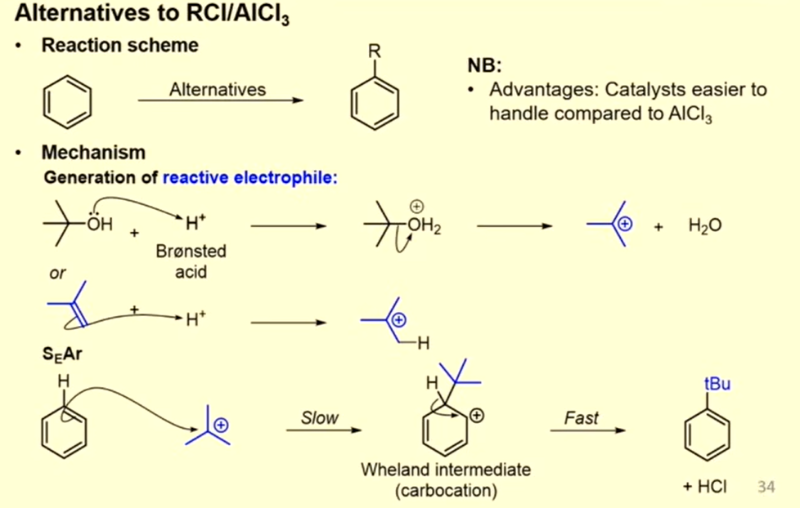
Friedel-crafts alkylation: generation of electrophile

Friedel-crafts alkylation: mechanism

Friedel-crafts acylation: reaction scheme

Friedel-crafts alkylation: alternatives to RCl/AlCl3
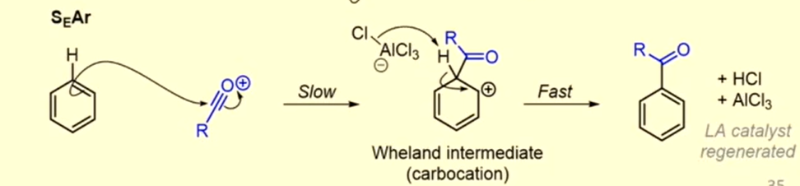
Friedel-crafts acylation: generation of electrophile

Friedel-crafts acylation: mechanism
Friedel-Crafts acylation to access to primary alkyl groups: Clemmensen reduction -> reaction scheme

Friedel-Crafts acylation to access to primary alkyl groups: Wolff-Kishner reduction -> reaction scheme
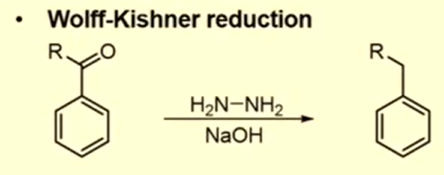
Friedel-Crafts acylation to access to primary alkyl groups: Wolff-Kishner reduction -> mechanism

Effects of substituents on rate of SEAr reaction: Electron donating groups
• Donate electron density to the benzene ring
• Activating groups (double bond more nucleophilic)
• EDG-substituted benzene more reactive than benzene
• Examples of EDG: NR2 , OR, SR, alkyl, aryl
Effects of substituents on rate of SEAr reaction: Electron withdrawing groups
• Withdraw electron density from the benzene ring
• Deactivating groups (double bond less nucleophilic)
• EWG-substituted benzene less reactive than benzene
• Examples of EWG: NO2, SO3H, CO2R, C=O, CN, CF, halides
How to identify EWG
Double bonds from benzene ring can be delocalised onto electronegative atom of
substituent, revealing a positive charge in the benzene ring
Other EWG: perfluoro alkyl groups by negative inductive effect (also called negative
hyperconjugation)

How to identify EDG
Lone pair on EDG can be delocalised revealing a negative charge in benzene ring:
lone pair donation
Other EDG: alkyl groups by pi-donation also called positive inductive effect or
hyperconjugation
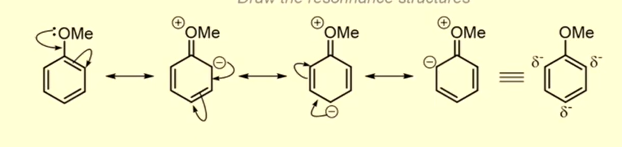
Activating ortho/para (o/p) directing groups (R = EDG)
• Positive mesomeric effect (lone pair or π-bond donation): +M
• Examples: OH, OR, NR2
, SR, Ph
• Positive inductive effect (σ bond donation): +I
• Example: Alkyl groups
Deactivating meta (m) directing groups (R = EWG)
• Negative mesomeric effects (delocalisation of benzene double
bonds onto R group): −M
• Examples: NO2, SO3H, CO2R, C=O, CN
• Negative inductive effects (through σ bond): −I
• Examples: CF3 (and fluoroalkyls)
Deactivating ortho/para (o/p) directing groups (R = halogen)
+M (lone pair donation) and −I (electronegativity of halogen)
Dose mesomeric or inductive effects have a greater effect on directing effect?
generally M > I
Reactivity of multisubstituted benzenes: Rules to predict outcome
Consider the directing effects of each group in turn. You never get substitution
at a position that is occupied with a group
• +M more directing than +I more directing than −M more directing than −I
(+M > +I > −M > −I)
• “Never” get substitution between two meta substituents.
• Sterics can also have an impact
Nucleophilic aromatic substitution (SNAr) general reaction scheme

Three different classes of reaction (different mechanisms) of SNAr
Diazonium (SN1) → Diazonium chemistry Only N2 is a good enough leaving group (LG)
Addition/elimination → No SN2 on sp2 carbon Analogous to nucleophilic substitution reaction with carbonyls
Benzyne → Strained triple bond, Very reactive
SNAr: SN1 pathway (synthesis of diazonium ions) → Reaction scheme

SNAr: SN1 pathway (synthesis of diazonium ions) → formation of nitrosium ion

SNAr: SN1 pathway (synthesis of diazonium ions) → formation of diazonium ion

SNAr: SN1 pathway (reaction of diazonium ions) → general reaction scheme

SNAr: SN1 pathway (reaction of diazonium ions) → phenol synthesis

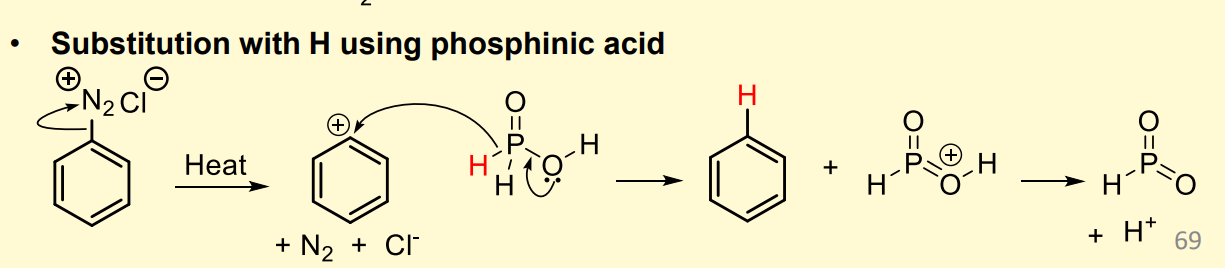
SNAr: SN1 pathway (reaction of diazonium ions) → Substitution with H using phosphinic acid
Diazonium chemistry: Sandmeyer reaction → reaction scheme

Diazonium chemistry: Sandmeyer reaction → mechanism

SNAr: Addition/elimination pathway → general reaction scheme

SNAr: Addition/elimination pathway → important to remember
• SN2 not possible on sp2 carbon
• Nu: H2O, NR2, ROH, CN-
• EWG = NO2, CF3, SO3R, CO2R
• LG (generally): Cl-, F-
• LG ability is unimportant (not involved in RDS)
SNAr: Addition/elimination pathway → mechanism

What if the EWG is Meta to the LG?

SNAr addition/elimination: influence of leaving group (LG)
• Leaving group (LG) ability DOES NOT matter: LG does not depart in rate determining step (RDS)
• But: nature of LG still influences the reaction
• Electronegative LG (- I effects) make C attached to LG electrophilic (δ+):
• favours Nu attack on C in RDS: increased reaction rate
• If LG = halide, reactivity goes as follows: F > Cl > Br > I
• LG- must be a better leaving group than Nu-
What is benzyne?
• Strained triple bond
• Benzyne π-bond (in the plane of the benzene ring) not conjugated with aromatic system (perpendicular to it)
• Very reactive
• Cannot be isolated (formed in situ)
• Electrophilic: reacts with poor nucleophiles
• Can react in concerted reactions (alkene-like)
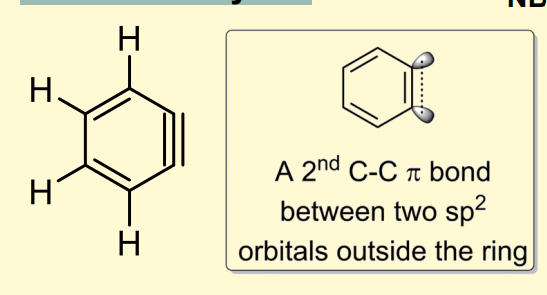
Formation of benzyne

SNAr benzyne pathway: the benzyne reaction → Example: Synthesis of aniline → reaction scheme

SNAr benzyne pathway: the benzyne reaction → Example: Synthesis of aniline → mechanism
The nucleophile can attack at either end of the triple bond.

SNAr benzyne pathway: evidence for a benzyne intermediate

Pyridine
• Fully conjugated, monocyclic ring of p orbitals, 6 π electrons (& flat): aromatic
• Lone pair (in sp2 orbital) is not in π system
• Reactive in SEAr and SNAr
Not (very) reactive in SEAr (unless activated with electron donating groups)
• N atom is more electronegative than C:
• lower electron density in ring
• lower energy π orbitals (compared to benzene), so more stable (less reactive)
• double bond less nucleophilic
• Nitrogen lone pair interacts with chemicals necessary for SEAr
• N-directing effects: directs substitution at 3-/5-positions (Wheland intermediate less
stabilised if substitution at 2-/4-/6-positions)
Very reactive towards SNAr
• SNAr occurs with LG in 2- or 4-position
• Even with moderate nucleophiles (H2O)

Activated Pyridines: Electrophilic Aromatic Substitution (EArS) → reaction scheme
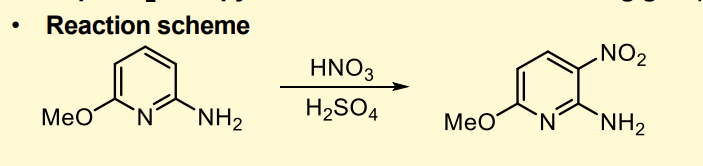
Activated Pyridines: Electrophilic Aromatic Substitution (EArS) → genration of electrophile

Activated Pyridines: Electrophilic Aromatic Substitution (EArS) → mechanism

Pyridines: nucleophilic aromatic substitutions (NArS) → reaction scheme

Pyridines: nucleophilic aromatic substitutions (NArS) → mechanism

Pyridine N-oxides
• Aromatic (3 double bonds = 6 π electrons, flat
monocyclic ring of p orbitals, fully conjugated)
• Stable compound
• Increased electron density
• Reactive in SEAr and SNAr
SEAr
• N-oxide:
• Activating group
• 2- (ortho) and 4- (para) directing
• 4-position preferred
SNAr
• N-oxide
• Stabilises intermediate of SNAr (addition elimination mechanism when LG at 2-and 4-positions only
• Alternative SNAr possible when LG = H (giving a pyridine product)
Pyridine N-oxides: SEAr → Reaction scheme

Pyridine N-oxides: SEAr → mechanism: pyridine N - oxide synthesis

Pyridine N-oxides: SEAr → mechanism: generation of electrophile

Pyridine N-oxides: SEAr → mechanism: SEAr and removal of N-oxide group
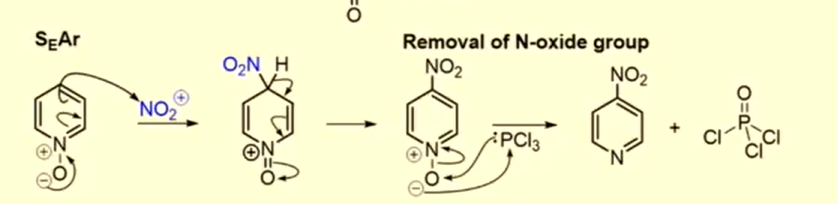
Pyridine N-oxides: example of a different SNAr → reaction scheme

Pyridine N-oxides: example of a different SNAr → mechanism

Pyrrole
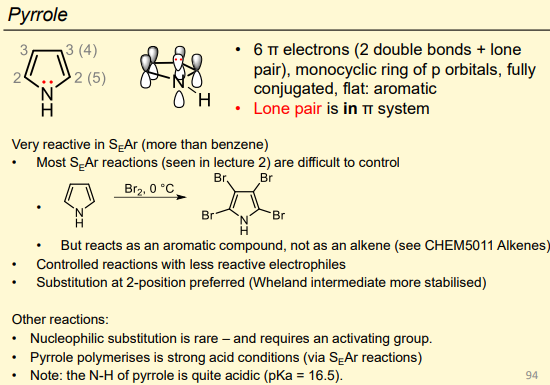
SEAr of pyrrole: regioselectivity

SEAr of pyrrole: Mannich reaction → Reaction scheme

SEAr of pyrrole: Mannich reaction → generation of electrophile

SEAr of pyrrole: Mannich reaction → mechanism

SEAr of pyrrole: Vilsmeier reaction → recation scheme

SEAr of pyrrole: Vilsmeier reaction → generation of electrophile

SEAr of pyrrole: Vilsmeier reaction → mechanism

Indole
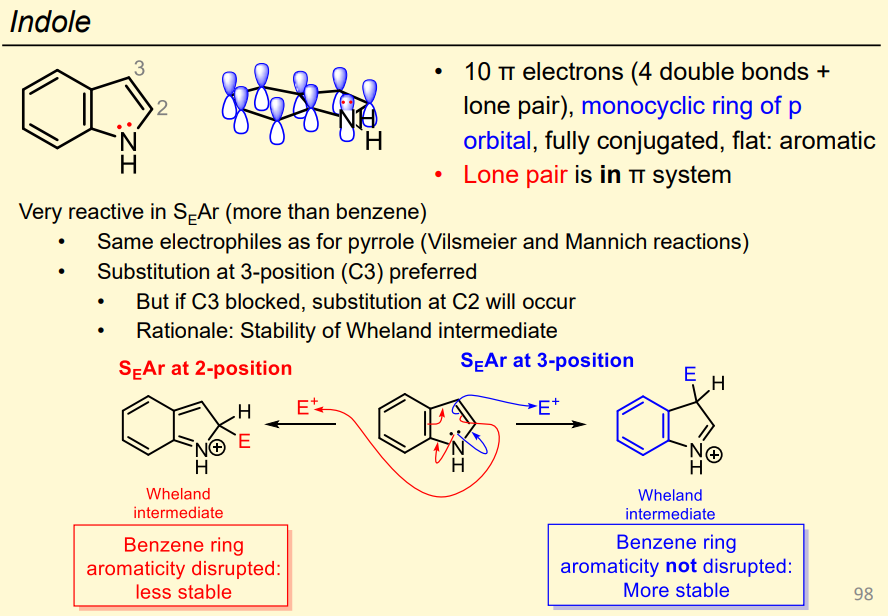
Furan

Alkene as a nucleophile reacting with bromine → mechanism

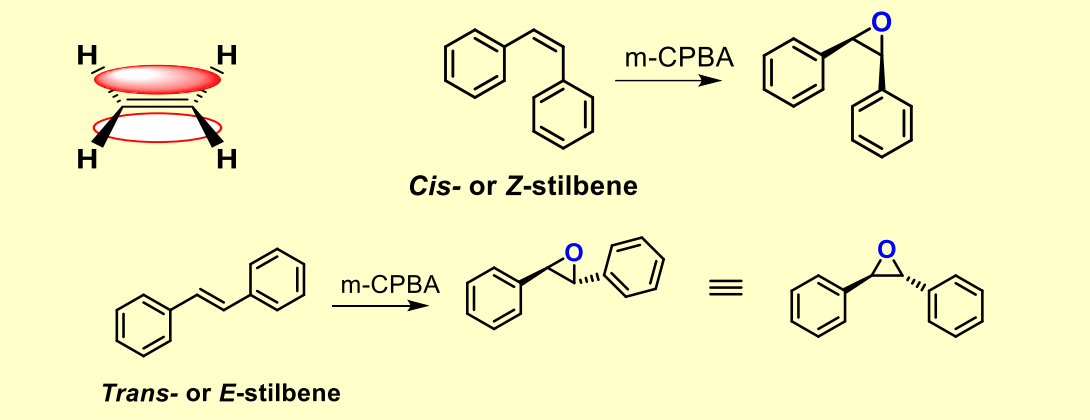
Epoxidation of alkenes → mechanism

Stereochemistry of epoxidation of alkenes
How to achive different carbonyl oxidation sates via ozonolysis

Hydroboration → reaction scheme

Hydroboration of unsymmetrical alkenes
boron adds to the less substituted carbon
Two contributing factors to the selectivity:
1. Electronics: the reaction is governed by donation of the p-electrons into the empty p-orbital. The resultant positive charge is stabilised at the other end of the alkene.
2. Sterics: BR2 is larger than H, and therefore to minimize steric repulsion, the larger group is directed away from the substituent.
Hydroboration → addition pf borane mechanism

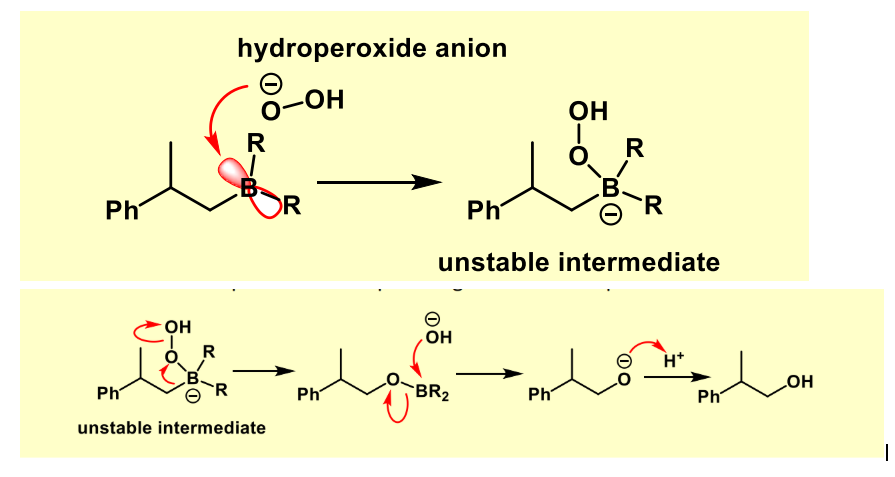
Hydroboration → addition of hydroxyl group → mechanism
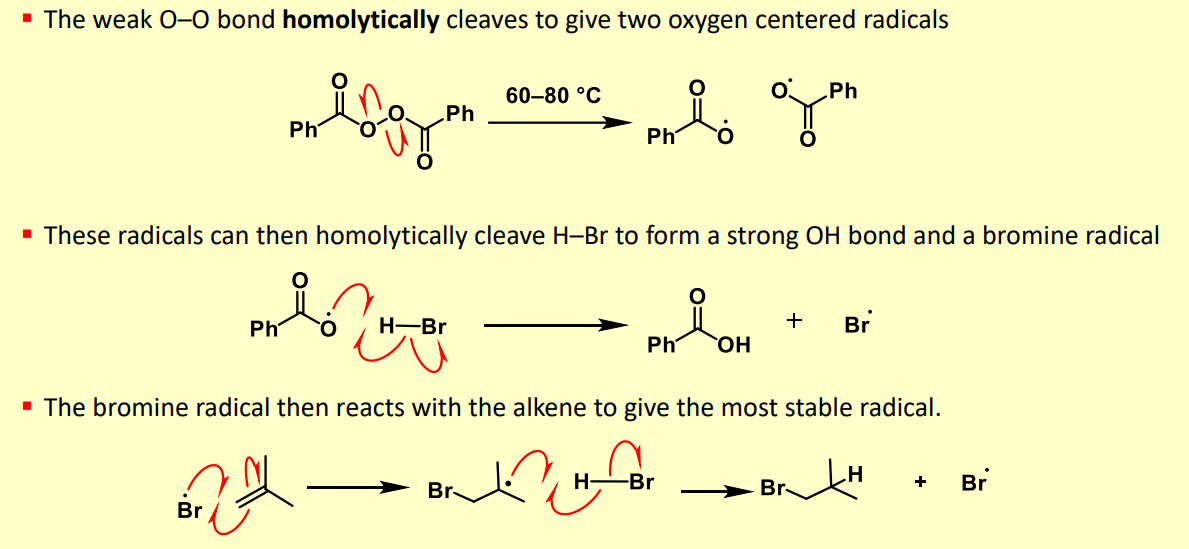
Radical reactions → addition of HBr
switches selectivity → bromine adds to less substituted carbon
Allylic radical bromination → reaction scheme

Allylic bromination (radical) → mechanism

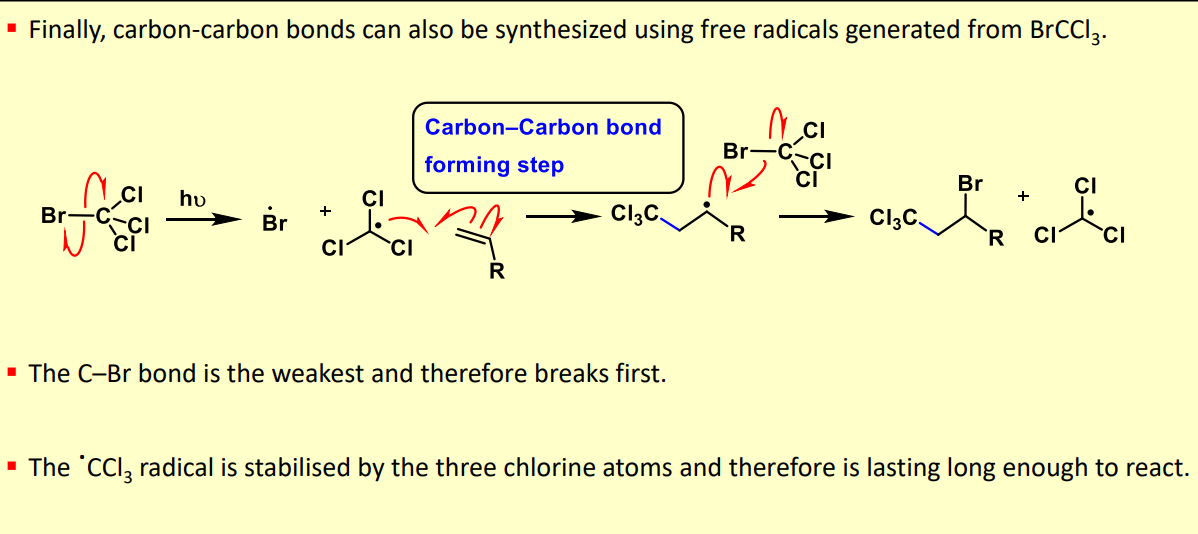
Radical reactions → C-C bond formation
E1 and E2 elimination mechanisms

anit- vs syn- periplanar Newman projections

stereospecificity of E2 elimination

dehydration of alcohols →E1

Stereospecificity of E1

Wittig reaction → reaction scheme
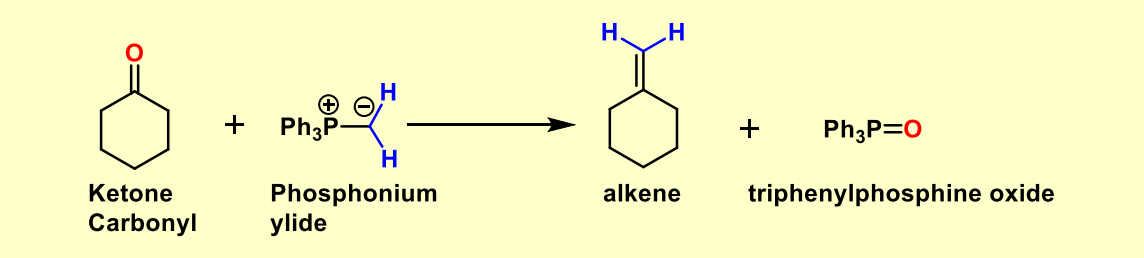
Wittig reaction → mechanism

Wittig reaction → changing stereoselectivity

Wittig reaction → Z selective reasoning

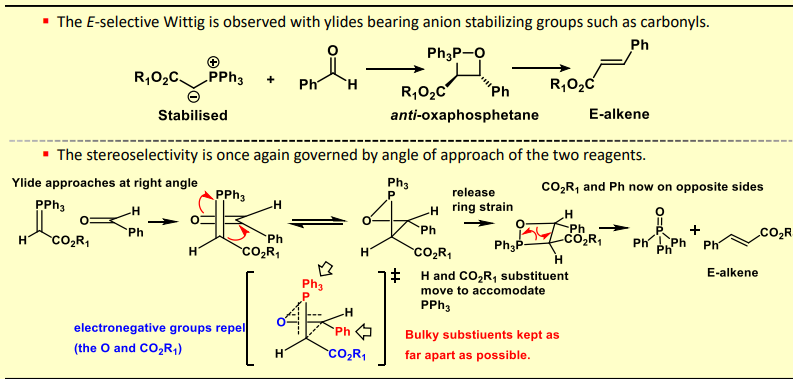
Wittig reaction → E selective reasoning
Julia olefination → reaction scheme
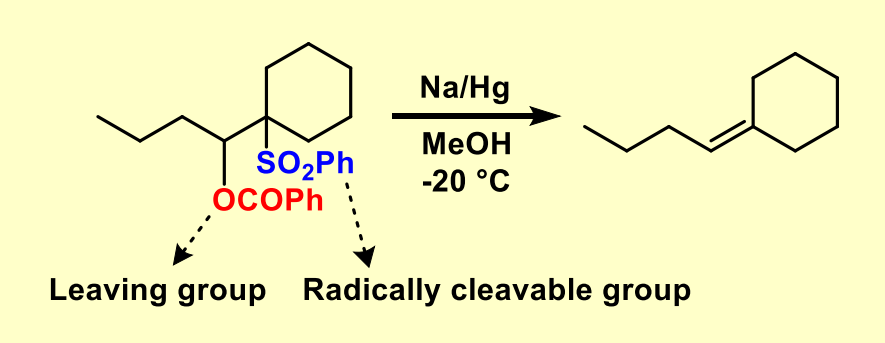
Julia olefination → starting material production

Julia olefination → formation of alkene
