atomic structure + the periodic table
 Call Kai
 Learn
Learn Practice Test
 Spaced Repetition
 Match
Match Flashcards
 Knowt Play
1/71

There's no tags or description
Looks like no tags are added yet.
Name | Mastery | Learn | Test | Matching | Spaced | Call with Kai | Chat |
|---|
No analytics yet
Send a link to your students to track their progress
72 Terms
What is the structure of an atom?
An atom is made up of:
a positively charged nucleus containing protons and neutrons
energy levels that surround the nucleus containing negatively charged electrons

What is the relative mass and charge of protons, neutrons and electrons?

What is the charge on an atom?
Neutral - there is the same number of positive protons as negative electrons, so their opposite charges cancel out.
What is atomic (proton) number?
The number of protons in an atom’s nucleus.
What is mass number?
The number of protons and neutrons in an atom’s nucleus.
How can the number of protons, neutrons and electrons in an atom be determined?
protons/electrons → atomic number
neutrons → mass number - atomic number
How can the number of protons, neutrons and electrons in an ion be determined?
protons → atomic number
electrons → atomic number - charge (if positive) or atomic number + charge (if negative)
neutrons → atomic number - mass number
How can the number of protons, neutrons and electrons in a molecule be determined?
protons/electrons→ sum of the atomic number of each atom present
neutrons → sum of the mass number - atomic number of each atom present
What is an isotope?
An atom of an element with the same number of protons but different number of neutrons.
How do the properties of an isotope differ from an atom of the same element?
Isotopes (as long as their atoms are neutral) have the same chemical properties as atoms of the same element because they have the same electronic configuration.
However, isotopes have different physical properties to atoms of the same element due to their different number of neutrons.
What is relative isotopic mass?
The mass of an atom of an isotope compared to 1/12 of the mass of a single carbon-12 atom.
What is relative atomic mass?
The mean mass of an atom of an element compared to 1/12 of the mass of a single carbon-12 atom.
It takes the relative abundance of different isotopes of that element into account.
What is the difference between relative molecular mass and relative formula mass?
Relative molecular mass is the sum of the relative atomic masses of the atoms in a molecule.
However, relative formula mass is the sum of the relative atomic masses of the atoms in a giant structure (e.g. giant ionic lattice, metallic lattice, giant covalent lattice) where species do not exist as discrete units.
How can relative molecular/formula mass be calculated?
By multiplying the Ar of each element present by the number of atoms of each element.
EX: H2O (H = 1.0, O = 16.0)
Mr = (1.0 × 2) + (16.0 × 1) = 2.0 + 16.0 = 18.0
What is mass spectrometry?
An analytical technique used to determine the relative mass of an element (or molecule) by providing the mass/charge (m/z) ratio and relative abundance of each of its isotopes (or fragments).
How is the relative abundance of an isotope in an element figured out in a mass spectrometer?
The greater the number of times an atom of that isotope hits the detector, the greater its relative intensity/abundance.
What value does the mass/charge ratio of an element’s isotope give us?
Its isotopic mass (atomic mass/mass number).
This is because the charge of the atom is almost always (+)1.
How can data from mass spectrometry be used to calculate an element’s relative atomic mass?
Ar = (Σ (isotopic mass × relative percentage abundance)) / 100

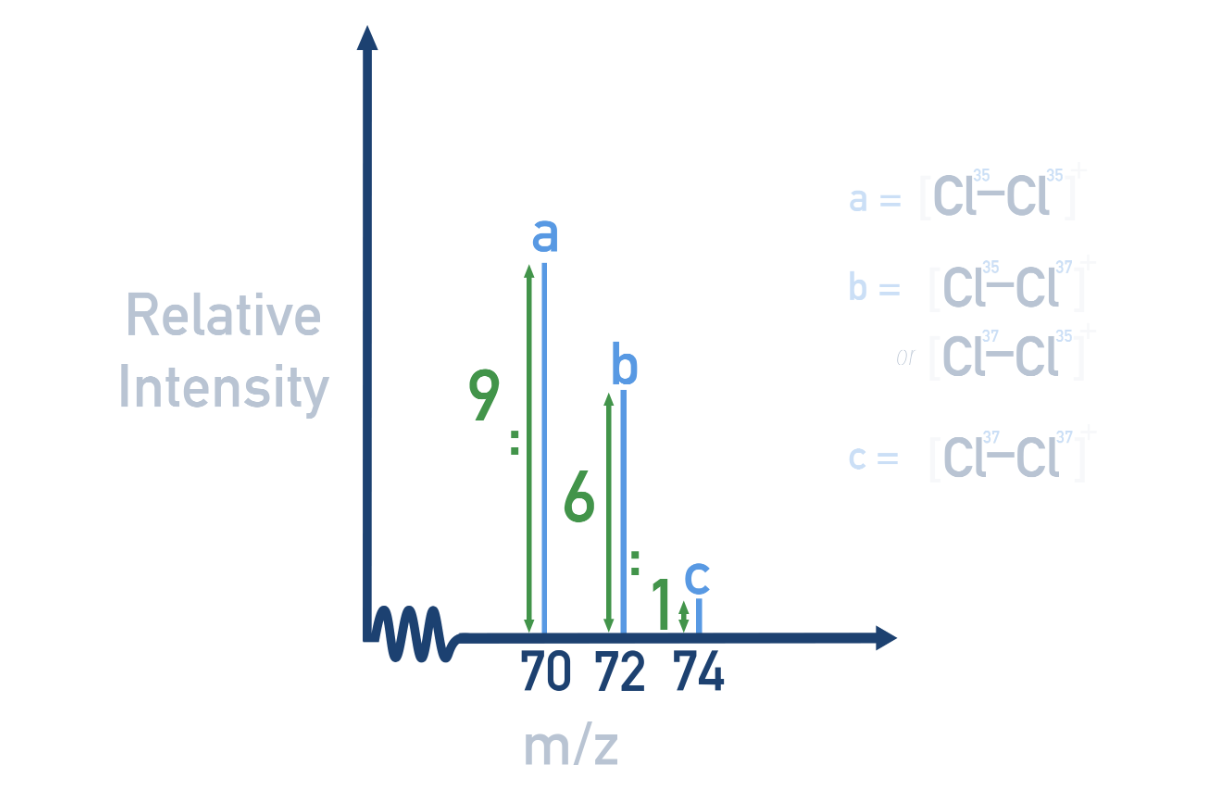
How can the mass spectra for diatomic molecules be predicted?
Chlorine has two common isotopes:
35Cl which has a relative abundance of 75%
37Cl which has a relative abundance of 25%
Thus, there are three possible combinations of Cl isotopes in a Cl2 molecule, giving three different molecular ion peaks in a mass spectra:
35Cl — 35Cl → m/z = 35 + 35 = 70
35Cl — 37Cl or 37Cl — 35Cl → m/z = 35 + 37 = 72
37Cl — 37Cl → m/z = 37 + 37 = 74
The height of the peaks can be calculated by finding the ratio of the probability of each isotope combination occurring:
35Cl — 35Cl → ¾ x ¾ = 9/16
35Cl — 37Cl or 37Cl — 35Cl → 2(¾ x ¼) = 6/16
37Cl — 37Cl → ¼ x ¼ = 1/16
which gives 9:6:1
How can mass spectrometry be used to determine the relative molecular mass of a molecule?
By finding the M+ peak in a mass spectrum - the peak with the highest m/z.
If M+ is at m/z = 60, the molecular mass is 60.
Why do molecules give small peaks in a mass spectrum?
Some molecules are fragmented (broken up into smaller pieces) due to the extreme conditions inside the mass spectrometer.
When these fragments are detected, the calculated m/z ratio is much smaller than the m/z ratio of a whole, unfragmented molecule.
What is ionisation energy?
The amount of energy required to remove one mole of electrons from one mole of gaseous atoms to form one mole of gaseous positive ions.
It is measured in kJ mol-.
What is a quantum shell?
An energy level within which electrons exist.
What is the principle quantum number of an electron?
The number of the quantum shell it belongs to.
It is represented by the symbol ‘n’ and can only be a positive integer, e.g. n = 1, 2, 3…
What does a higher principle quantum number mean?
It means that the electron belongs to a higher energy level and thus:
it has more potential energy
it is further away from the nucleus and less attracted to it
How many electrons can fill the first quantum shells?

What are quantum shells made up of?
Sub-shells, which are made up of orbitals.
What is an orbital?
A region of space around an atom’s nucleus within which there is a high probability (90%) of finding an electron.
How many electrons can one orbital hold?
2 electrons with opposite spins.
What are the three sub-shells?
s, which has one orbital
p, which has three orbitals
d, which has five orbitals
What is the shape of an s orbital?
A sphere.

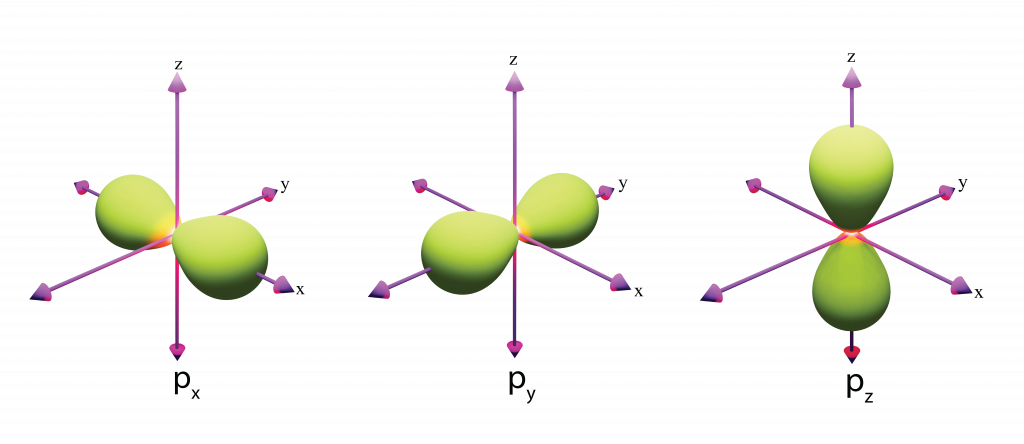
What is the shape of a p orbital?
A dumbell.
It can occupy the x, z or y axes.
How many electrons can fill each sub-shell?
s → 2 (1 × 2)
p → 6 (3 × 2)
d → 10 (5 × 2)
This can be calculated by multiplying the number of orbitals each sub-shell has by 2 (the maximum number of electrons that can fill an orbital)
How do electrons fill sub-shells?
In order of increasing energy: 1s < 2s < 2p < 3s < 3p < 4s < 3d < 4p
Singly, before pairing up

Why is 4s filled before 3d?
4s has a lower energy level than 3d.
However, once 4s is filled, it has a higher energy level than 3d.
How do electrons fill sub-shells singly?
In one sub-shell, one electron fills each separate orbital where possible before pairing up with an electron with opposite spin.
This minimises repulsion between electrons.
What is the 1s notation in terms of electron configuration?
EX: The electron configuration of magnesium is → 1s22s22p63s2

How can the electronic configuration of an atom/ion be predicted?
Find how many electrons the atom/ion has
Occupy the lowest energy sub-shells first until you can’t fill anymore
Remember that cations lose electrons from the highest energy sub-shell while anions gain electrons into the lowest energy sub-shell available
EX: Magnesium has 12 electrons → 1s22s22p63s2
What is the shorthand way of writing electronic configuration?
Find the noble gas in the period before
Put the chemical symbol of the noble gas in square brackets
Write the rest of the element’s electronic configuration by considering the noble gas’ electronic configuration
EX:
The electron configuration of magnesium is → 1s22s22p63s2
The electronic configuration of neon, the noble gas in the previous period, is → 1s22s22p6
Thus, the shorthand electronic configuration of magnesium is → [Ne] 3s2
What is the electrons-in-boxed notation in terms of electronic configuration?
The boxes represent an orbital, while each arrow represents the spin of the electron(s) that are occupying that orbital

What two elements have an unexpected electron configuration?
Chromium → 1s22s22p63s23p63d54s1
Copper → 1s22s22p63s23p63d104s1
How is the 4s sub-shell not full in copper or chromium if its filled first?
Once 4s is filled, one electron is promoted to the 3d sub-shell.
Why does chromium’s electronic configuration end in 3d54s1 and not 3d44s2?
The electronic configuration 1s22s22p63s23p63d54s1 is more stable as all the electrons in the 3d subshell and 4s subshell fill each orbital singly - there are no electron pairs (unlike in the electronic configuration 1s22s22p63s23p63d24s2), which minimises electron-pair repulsion.
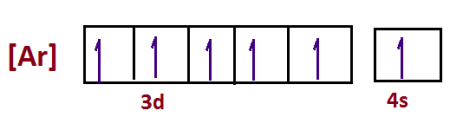
Why does copper’s electronic configuration end in 3d104s1 and not 3d94s2?
The electronic configuration 1s22s22p63s23p63d104s1 is more stable as all the electrons in the 3d sub-shell are paired in each orbital, while the 4s sub-shell is filled by a single electron (reducing electron pair repulsion in this sub-shell).
How can elements be classified?
As s, p or d-block elements.
s-block elements have their electron with the most potential energy in a s orbital
p-block elements have their electron with the most potential energy in a p orbital
d-block elements have their electron with the most potential energy in a d orbital

What does electronic configuration determine?
The chemical properties of an element - more specifically, the number of electrons on the outer shell of an element.
This explains why elements in the same group (that have the same number of electrons on their outer shell) have similar chemical properties.
What factors influence ionisation energy?
Number of protons
Electron shielding
Sub-shell from which the electron is removed
How does the number of protons an element has influence its ionisation energy?
As the number of protons increases, the nuclear charge increases.
This means that the outer electron(s) are more strongly attracted to the nucleus, and so more energy is required to overcome the electrostatic force of attraction between them to remove an electron.
Thus, ionisation energy increases.
How does the electron shielding of an element influence its ionisation energy?
As the number of inner electrons that shield the outer electron(s) from the nucleus increases (the number of quantum shells), the atomic radius increases.
This means that the outer electron(s) are less strongly attracted to the nucleus, and so less energy is required to overcome the electrostatic force of attraction between them to remove an electron.
Thus, ionisation energy decreases.
How does the sub-shell from which the electron is removed in an element influence its ionisation energy?
As the energy of the outer sub-shell increases, the distance of the sub-shell from the nucleus increases.
This means the outer electron(s) are less strongly attracted to the nucleus, and so less energy is required to overcome the electrostatic force of attraction between them to remove an electron.
Thus, ionisation energy decreases.
What is the first ionisation energy of an element?
The minimum amount of energy required to remove one mole of electrons from one mole of gaseous atoms of an element to form one mole of gaseous 1+ ions.
What is the general equation for the first ionisation energy of an element?
X (g) → X+ + e-
What are the trends in first ionisation energy?
It generally increase across a period
It decreases down a group
Why does first ionisation energy generally increase across a period?
Across a period:
atomic number (thus the number of protons in the atom of each element) increases
electron shielding remains the same/similar
Why does first ionisation energy decrease down a group?
Down a group:
atomic radius increases, meaning the electron shielding in the atom of each element increases
atomic number increases, but is outweighed by the increase in electron shielding
What are successive ionisation energies?
The minimum amount of energies required to remove a further mole of electrons from one mole of gaseous atoms to from one mole of gaseous ions with a positive charge greater by +1.
EX: X+ → X2+ + e-
Why do successive ionisation energies increase?
As more electrons are removed from an atom, the positive charge of the ion increases (but the nuclear charge remains the same),
This increases the proton to electron ratio, making the electrostatic force of attraction between the nucleus and outer electrons stronger.
Thus, more energy is required to overcome this force to remove an electron.
From what evidence have ideas about electronic configuration developed from?
Atomic emission spectra
Successive ionisation energies
First ionisation of successive elements
How have atomic emission spectra helped develop ideas about electronic spectra?
When an electron emits energy, it emits it as an electromagnetic wave with a specific wavelength.
This suggests that electrons can only have specific amounts of energy, so can only exist within specific energy levels.
Thus, atomic emission spectra show that electrons exist in quantasised energy levels known as quantum shells.
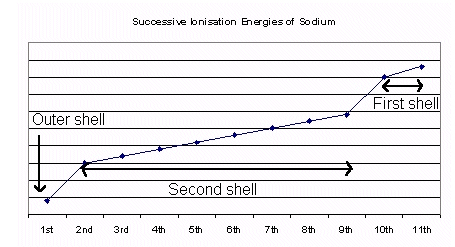
How have successive ionisation energies helped develop ideas about electronic configuration?
The sharp increases in ionisation energy indicate the beginning of a new (lower) energy level.
This is because as the electron has been removed from an orbital closer to the nucleus.
Thus, successive ionisation energies show that electrons exist in quantum shells.
By indicating the number of electrons in the outer shell of an atom, they also provide proof for the groups in the periodic table.
How has the first ionisation energy of successive elements helped develop ideas about electronic configuration?
The fall in first ionisation energy between group 2 and 3:
Al has a first ionisation energy that’s lower than expected as it’s lower than Mg’s, despite having a greater nuclear charge
This is because its outer electron is removed from the 3p sub-shell
The 3p electron is more shielded by inner electrons than Mg’s 3s outer electron, so it experiences less attraction from the nucleus and therefore it requires less energy to overcome this attraction and remove it
The fall in first ionisation energy between group 5 and 6:
S has a first ionisation energy that’s lower than expected as it’s lower than P’s, despite having a greater nuclear charge
This is because in one of S’s 3p orbitals, there is a pair of electrons
The repulsion between the paired electrons means that less energy is required to overcome the attraction between them and the nucleus to remove either of them
Thus, the first ionisation energies of successive elements prove the existence of electron sub-shells.

What is periodicity?
The repeating patterns of physical and chemical properties of elements across different periods in the periodic table.
What properties have a trend across period 2 and 3?
Melting and boiling point
First ionisation energy
How does melting and boiling point change across period 2?
It increases from lithium to carbon, then decreases from boron to neon.

How does melting and boiling point change across period 3?
It increases from sodium to silicon, then decreases from silicon to argon.

Why does melting and boiling point increase from lithium to beryllium in period 2 and from sodium to aluminium in period 3?
Lithium and beryllium are both giant metallic lattices, however:
beryllium’s cations are more positively charged (+1 vs +2) and therefore it has more delocalised electrons
this means there’s a greater electrostatic attraction between beryllium’s cations and sea of delocalised electrons
thus, the metallic bonding in beryllium is stronger and requires more energy to break
Similarly, aluminium’s (+3) cations are more positively charged than sodium’s (+1) or magnesium’s (+2).
Why is melting and boiling point the highest for boron and carbon in period 2 and silicon in period 3?
Boron, carbon and silicon are giant covalent structures.
Their atoms are held together by many strong covalent bonds which require the most energy to break (more than metallic bonds).
Why does melting and boiling point decrease from carbon to neon in period 2 and from phosphorus to argon in period 3?
All the elements after carbon and silicon are simple molecular structures (except neon and argon which are monoatomic).
Their molecules are held together by weak London forces which require the least energy to break.
The strength of these London forces decreases from nitrogen to neon and phosphorus to argon due to the decrease in mass of each successive molecule (or atom), meaning less energy is required to overcome them.
Why does sulfur have a higher melting point than phosphorus?
Sulfur exists as a larger molecule (S8) than phosphorus (P4), thus the London forces between its molecules are stronger and require more energy to overcome.
How does first ionisation energy change across period 2?

How does first ionisation energy change across period 3?

Why do boron and oxygen have first ionisation energies lower than expected?
B has a first ionisation energy that’s lower than expected as it’s lower than Be’s, despite having a greater nuclear charge
This is because its outer electron is removed from the 2p sub-shell
The 2p electron is more shielded by inner electrons than Be’s 2s outer electron, so it experiences less attraction from the nucleus and therefore it requires less energy to overcome this attraction and remove it
O has a first ionisation energy that’s lower than expected as it’s lower than N’s, despite having a greater nuclear charge
This is because in one of O’s 2p orbitals, there is a pair of electrons
The repulsion between the paired electrons means that less energy is required to overcome the attraction between them and the nucleus to remove either of them