9.10 Katie Hayes Lecture - Adult-Onset ND Disorders
 Call Kai
 Learn
Learn Practice Test
 Spaced Repetition
 Match
Match Flashcards
 Knowt Play
1/11

There's no tags or description
Looks like no tags are added yet.
Name | Mastery | Learn | Test | Matching | Spaced | Call with Kai | Chat |
|---|
No analytics yet
Send a link to your students to track their progress
12 Terms
Repeat Expansions
•Repeat expansions are the mechanism of disease in:
•C9ORF72 ALS/FTD
•Huntington disease
•Spinocerebellar ataxia
•Myotonic dystrophy
•Friedreich ataxia
•and more…
- Difficult to ascertain w/ PCR
Dementia - AD
•Extremely common (~1/10); Leading type of dementia (60-80%)
•Multifactorial disease process. Many potential risk factors.
•Pathophysiology: aggregation and accumulation of β-amyloid peptides, abnormal phosphorylation of tau protein, and neuroinflammation.
•Phenotype:
•Mild cognitive impairment (MCI) gradually becomes more severe
•Confusion and geographical disorientation
•Poor judgment
•Language disturbance
•Visual complaints
•Agitation and withdrawal
•Disease duration ~10 years (range from 1 to 25 years)

AD Genetics
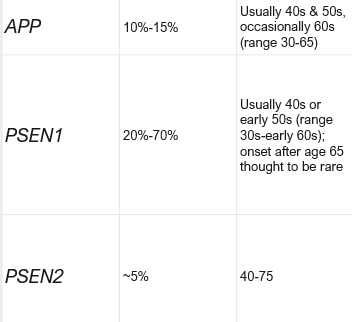
APP, PSEN1, PSEN2 all AD
ALL early onset AD <65yo highly likely to have a genetic component
APOE Genotyping
APOE has three isoforms
APOE e2 – Reduces risk for AD
APOE e3 – most common isoform
APOE e4 – Increases risk for AD
APOE genotyping done for Lecanemad eligibility

Motor Neurons
•

Control movement in the body telling muscles to squeeze (or “contract”), so you can walk, talk, and move.
•Upper Motor Neurons
•Send signals from brain to LMNs
•Lower Motor Neurons
•Send signal from nervous system into muscle
•Motor neuron diseases (MNDs) are a progressive neurological disorders that destroy motor neurons
MND - Amyotrophic lateral sclerosis (ALS) aka Lou Gehrig's disease
•Motor neuron degeneration in the cortex, brain stem, and spinal cord causes progressive paralysis and death, avg 2-5 years post symptom onset.
•90% sporadic, 10% familial
•Key genes: C9orf72, SOD1, FUS, TARDBP
•Genetic testing recommended for all due to available medicine and trials
Spontaneous onset 50s-60s, familial 40s-50s
GTing for ALS
Testing is offered for every patient with ALS
Oftentimes coordinated directly by neurologist and referral to genetic counseling if positive
If family history of ALS, neurologist referral for pre-test counseling discussion
Why does a simple sequencing panel not work for patients with ALS?
A repeat expansion in C9orf72 causes ALS/FTD
Other complexities in ALS genetic testing
Incomplete penetrance
Uncertain results
Hope for treatment leads to disappointment with negative result
MND - Spinocerebellar Ataxia
•Group of >40 genetic disorders affecting cerebellum
•Symptoms:
•Coordination imbalance
•Dysarthria
•Tremor
•Eye movement abnormalities (nystagmus)
•Many are repeat expansion disorders → anticipation possible
•Inheritance: Mostly autosomal dominant
•Genes - ATXN3 (CAG repeat expansion), FGF14 (GAA repeat expansion)
Parkinson’s Disease
•Fastest growing neurological disease in the world
•Multifactorial etiology with environment showing to play an increasingly larger role in disease development
•Symptoms often begin with unilateral tremor and progress to full body tremor, rigidity/stiffness, bradykinesia, sleep problems, cognitive changes
•Monogenic causes more likely in early-onset (<50 yo) cases
•Genes: LRRK2, PARK7, PINK1, PRKN, or SNCA
Possible GBA1 connection ~ FamHx Gaucher, GBA1 homoz OR compound heteroz variants can increase PD risk
Leukodystrophies - CSF1R Leukoencephalopathy
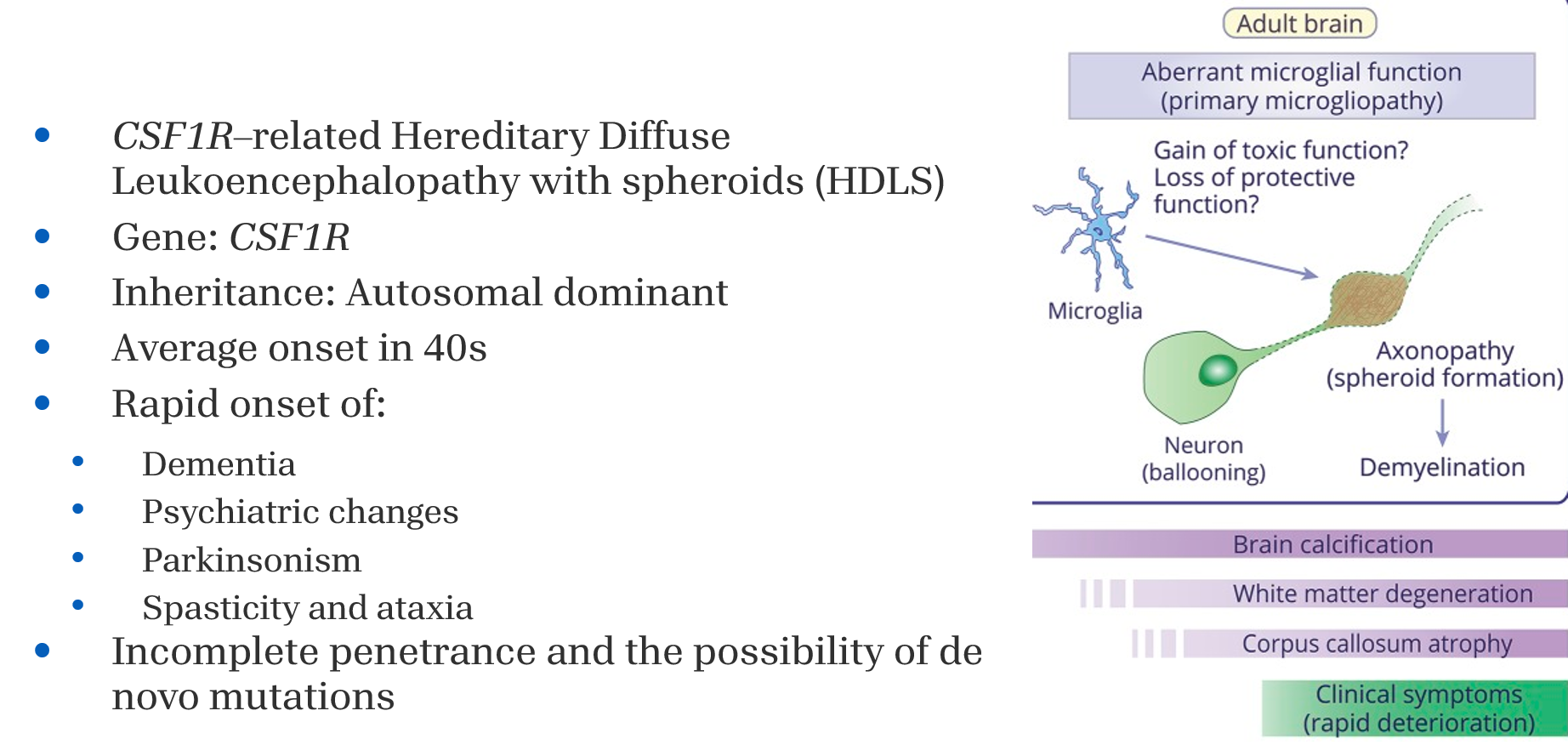
•CSF1R–related Hereditary Diffuse Leukoencephalopathy with spheroids (HDLS)
•Gene: CSF1R
•Inheritance: Autosomal dominant
•Average onset in 40s
•Rapid onset of:
•Dementia
•Psychiatric changes
•Parkinsonism
•Spasticity and ataxia
•Incomplete penetrance and the possibility of de novo mutations
Frontotemporal Dementia
•FTD-ALS (Amyotrophic Lateral Sclerosis)
•Primary Progressive Aphasia (PPA), Semantic and Nonfluent variants
•bvFTD with hyperkinetic movement (often confused for HD)
•bvFTD with psychosis-like symptoms (often confused for other primary psychiatric disease)
Main genes involved across groups - C9orf72, GRN, MAPT
•bvFTD —> non-fluent PPA and semantic PPA —> FTD-ALS.