Protist and Algae Biology: Key Organisms and Traits
 Call Kai
 Learn
 Practice Test
 Spaced Repetition
 Match
 Flashcards
 Knowt Play
1/15

There's no tags or description
Looks like no tags are added yet.
16 Terms

Paramecium
Unicellular freshwater ciliate covered in cilia. It uses cilia for movement and feeding, has an oral groove and food vacuoles, and performs ingestion, digestion, osmoregulation, asexual division, and conjugation.

Trichonympha
Unicellular termite-gut mutualist with many flagella. It helps termites digest cellulose and lignin from wood and reproduces by cell division.

Amoeba
Unicellular freshwater heterotroph with pseudopodia. It moves and feeds through phagocytosis, uses food vacuoles for digestion, and reproduces by asexual cell division.
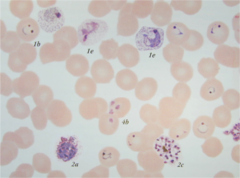
Plasmodium
Intracellular parasite found in red blood cells that causes malaria. It reproduces asexually in humans, sexually in mosquitoes, and is transmitted by mosquito vectors.

Physarum
Plasmodial slime mold and decomposer. Its multinucleate feeding stage uses cytoplasmic streaming, while its fruiting body produces spores.

Euglena
Freshwater mixotroph with a flagellum, stigma, pellicle, and chloroplasts. It photosynthesizes in light but can obtain nutrients heterotrophically when light is limited.

Dinoflagellate
Marine organism with two flagella and often cellulose plates. It moves by rotating, performs photosynthesis, and some species cause red tides or bioluminescence.

Diatom
Marine or freshwater alga with a glass-like silica frustule. It performs photosynthesis and is an important source of oxygen and food in aquatic ecosystems.

Volvox
Spherical colonial freshwater green alga. Its cells coordinate their flagella for movement, perform photosynthesis, and reproduce sexually or asexually.

Spirogyra
Filamentous freshwater green alga with spiral chloroplasts. It performs photosynthesis and reproduces through fragmentation and sexual conjugation.
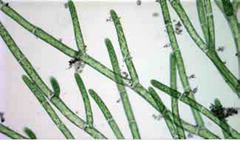
Cladophora
Branching filamentous freshwater green alga. It performs photosynthesis and reproduces through fragmentation and specialized reproductive cells.

Ulva
Marine green alga with a broad, thin sheet-like thallus called sea lettuce. It performs photosynthesis, absorbs nutrients, provides habitat, and has alternation of generations.

Codium
Multinucleate marine green alga with a spongy, finger-like thallus called dead man's fingers. It performs photosynthesis and reproduces sexually and through fragmentation.

Kelp
Large marine brown alga with a holdfast, stipe, and blades. It performs photosynthesis and forms kelp forests that provide habitat for many organisms.

Rockweed
Marine intertidal brown alga with branching fronds, a holdfast, and air bladders. It performs photosynthesis, uses air bladders for buoyancy, and reproduces sexually in conceptacles.

Red algae
Marine algae with red accessory pigments. These pigments allow photosynthesis in deeper water; red algae provide food and oxygen and have complex alternation of generations.