Medical tx of colic
 Call Kai
 Learn
 Practice Test
 Spaced Repetition
 Match
 Flashcards
 Knowt Play
1/39

There's no tags or description
Looks like no tags are added yet.
40 Terms
What are the risk factors for critical colic cases?
Higher pain score
Higher HR (>60)
CRT
Weak pulse
Absence of gut sounds in 1 or more quadrants
What are the indications for medical treatment?
Mild to moderate pain
Good response to analgesia
HR <50 bpm (Normal = 28-40bpm)
GI motility continuing/ improving
No net reflux (Abnormal for 500kg horse = >2L)
Resolving/ no abdominal distension
Normal peritoneal fluid (straw coloured fluid, TP <20g/L)
Normal PCV/ TP and systemic lactate
What general medical treatment principles can you give for a colic case?
Analgesia
consider potency, DOA, sedative / other effects e.g. smooth m. relaxation, potensh side effects
NSAIDs can cause AKI esp. if dehyd
+/- Oral fluids
+/- other specific therapies based on initial diagnosis
IV fluids
Phenylephrine
Psyllium
What are the main analgesic agents you can use in colic cases?
NSAIDs
Alpha 2 agonists
Opiates
Take into account potency and duration of action
Don't want to mask signs of pain completely
What are the options of NSAIDs you can use for colic?
Phenylbutazone
Flunixin meglumine
Metimazole (+ Buscopan compositum —> buscopan = smooth m. relaxant on its own but + compositum = analgesic)
same level of potency as phenylbutazone
Ketoprofen
Meloxicam
What are the features of phenylbutazone as an NSAID for colic?
Moderate potency
12hrs duration
Beware perivascular administration
Good first line analgesic for the colic case with mild/moderate pain
What are the features of flunixin as an NSAID for colic?
Potent analgesia
should be back to normal while taking this, if not, reassess and use diff NSAID
12hrs duration
Very effective in masking incr. in HR w/ SIRS (endotoxaemia) & delays PCV
If do give must be aware & make sure you monitor
Should be used w/ caution in cases of colic showing mild / mod pain where cause is unknown
What are the a2 agonist options for a colic case?
Xylazine
Romfidine
Detomidine
What are the features of xylazine when used for colic?
Good analgesia
Short acting ~ up to 30 mins duration in painful colic cases
V. useful in assessment of painful colic case e.g. for rectal exam
What are the features of romfidine when used for colic?
Around 2-4 hours analgesia
Usually combined w/ butorphanol
Can also be administered IM (off license)
Useful in colic cases showing moderate – severe signs of pain
What are the features of detomidine when used for colic?
Potent analgesia for around 2-4hrs in colic cases
Usually combined w/ butorphanol
Useful in colic cases showing moderate – severe signs of pain
What are the opiate options for colic and their features?
BUTORPHANOL
Usually combined w/ alpha 2 agonist
Can be used on its own
Useful in colic cases that are moderately / severely painful
PETHIDINE
Preparation licenced for use in horses w/ colic but uncommonly used
MORPHINE
Potent analgesia but not appropriate for use in colic cases seen in first opinion practice (other analgesics available & more suitable)
What are the two different forms of butylscopamine /hyoscine?
Buscopan
Buscopan compositum (combined with NSAID metimazole)
What is buscopan use in colic case?
Smooth m. relaxant
Indicated in spasmodic colic cases / mild colic pain
Useful when performing rectal examination where horses are straining —> reduce the risk of a rectal tear occuring
When is flunixin acceptable to give
Acceptable
When referral is not an option & horse is showing mod-severe pain
When exact diagnosis is known & medical tx is appropriate (e.g.- pelvic flexure impaction)
When decision to refer has already been made
Be cautious when mild-mod pain of unknown cause and where referral is an option
Compare giving oral fluids vs IV fluids in horses w/ colic
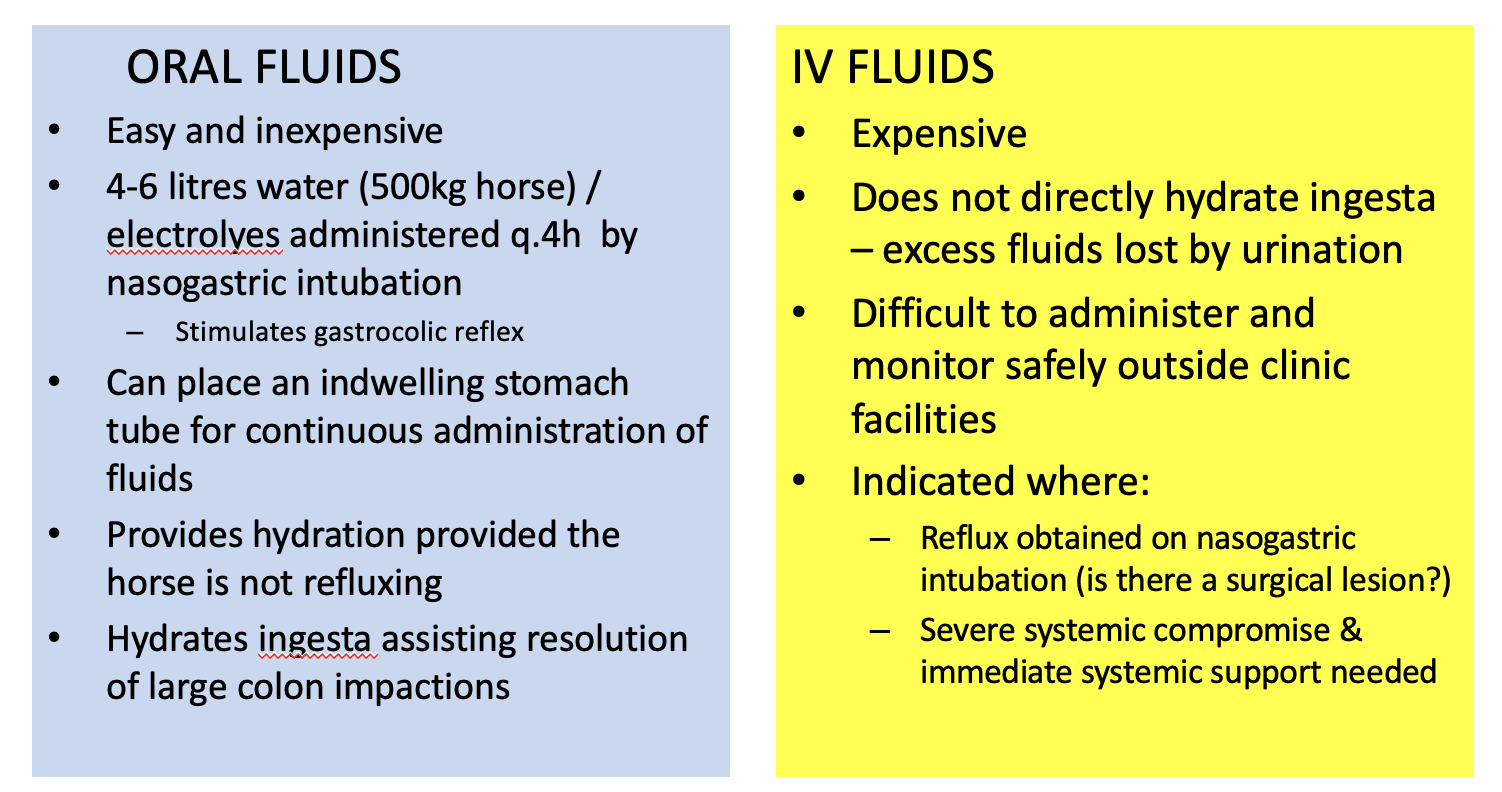
oral fluids stimulates gut motility
What are the features of spasmodic colic?
Due to intestinal spasm
Mild pain
Normal CV parameters
How do you treat spasmodic colic?
Buscopan +/- NSAID (metimazole / phenylbutazone) effective in most cases
What are the features of large colon impaction?
Mild / mod signs of pain
Rectal exam —> doughy, firm structure on LHS of cd. abdo
Epi —> recent increase in stabling (peak in winter months)
How do you treat large colon impaction?
Oral fluid therapy via nasogastric intubation every 4hrs until faeces passed
Can add MgSO4 as osmotic laxative to incr. hydration
Analgesia —> IV flunixin appropriate
Surgery may be required in some cases
No evidence that liquid paraffin is of any use + risk of aspiration
When is surgery required in large colon impactions?
Progressive deterioration in pain / clin parameters
Non-response to therapy —> rectal findings
What are the features of caecal impactions?
Monitor faecal output in hospitalised horses that have been treated for painful ocular/ orthopaedic condtiion & received NSAIDs
Can deteriorate rapidy —> acute caecal rupture
What are the features of gastric impaction?
Uncommon cause of colic
U/S diagnosis & gastroscopy to confirm
gastric distention
IV fluids
Repeated gastric lavage important, IV fluids ± carbonated drinks
What are the indications for medical vs surfical management of a large intestinal displacement?
Medical management:
Horses CV parameters normal
Degree of pain not severe
Marked gaseous distention of the large colon is absent
Surgical management indicated if:
Severe pain / marked or increasing gas distention of colon
Deteriorating CV parameters
Non-response to tx
What initial medical therapy is indicated for large intestinal displacement/ distnesion?
Analgesia —> careful monitoring if using potent analgesia
Light walking / trotting exercise
Oral fluid therapy —> bolus fluids as for primary large colon impaction
Withold feed until faeces start to be passed
How is nephrosplenic entrapment diagnosed?
Rectal exam
U/S
Failure to image left kidney and spleen —> gas distended large colon visualised

When is medical therapy indicated for nephrosplenic entrapment?
Indicated if systemic status good, pain can be controlled & mild degree of gaseous distention.
What medication can be used for nephrosplenic entrapment?
Phenylephrine infusion
3ug/kg/min as infusion in 500ml / 1L sterile saline
Horse lunged for 15mins
Repeat rectal exam to assess if LC has repositioned itself
What causes sand associated colic?
Irritation of the colonic mucosa by sand can result in diarrhoea / recurrent mild colic
Can cause colonic impactions & colon displacement / torsion
How is sand colic diagnosed?
Sand in faeces (suspend faeces in water & transfer into glove → sand should gather in fingers)
Classic ‘seashore’ sound on auscultation
Sand retrieved on abdominocentesis
U/S
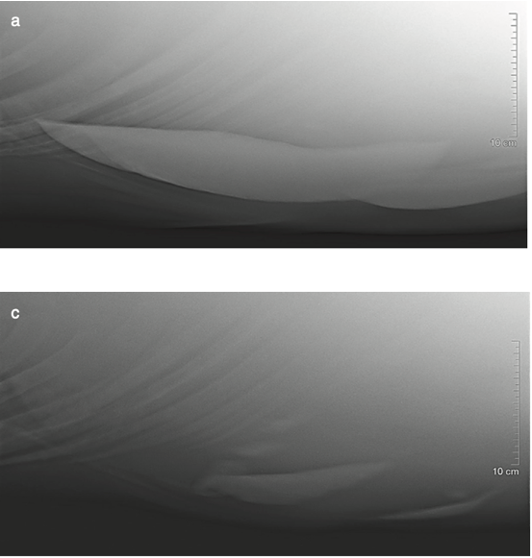
Abdo rads —> sand radiodense
How can sand colic be managed medically?
Intensive medical tx w/ Magnesium sulphate (1g/kg) & psyllium sulphate (1g/kg) once daily for 4d more effective than either tx alone
Monitoring of clearance using rads
How are mild cases of sand colic treated / preventive management in at risk horses?
Provide source of sand
Provide plenty of forage
± psyllium added to feed intermittently
What are the more likely causes of colic in the neonatal foal?
Meconium impaction
(Ruptured bladder)
Enteritis
SI volvulus
Congenital anomalies
How do donkeys usually present with colic?
Dullness —> degree of pain less useful
Colonic impactions common
Always check for dental abnormalities
May be due to ingestion of FBs in working equids
Rectal exam can be performed safely
Spinal needle may be needed for abdominocentesis due to lots of retroperitoneal fat
What advice would you give an owner that is dealing with a colic case?
Remove feed & leave water w/ horse
Ask owners to provide update in 2hrs —> sooner if signs of colic recur no matter time of day
If horse responds to tx offer small amounts of food once faeces passed (incr to normal after 24hrs)
If horse does not respond to tx repeat visit
List the risk factors for recurrence of colic
Known dental problem
Crib-biting / windsucking behaviour
Weaving
Time @ pasture
What may you advise an owner about prevention of recurrence of colic?
Parasite testing / discussion about parasite control
Dental exam / tx
General management (irregular turnout / poor feeding management)
When should you consider euthanasia in a colic case?
Uncontrollable pain despite potent analgesia
Severe CV compromise
HR >90bpm
PCV >60%
Purple MMs
GI rupture
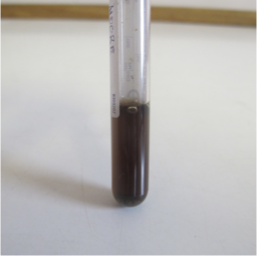
Brown / red ingesta contaminated peritoneal fluid (differentiate from accidental enterocentesis)
Profuse sweating, sudden reduction in pain
What is GI rupture frequently due to?
Rupture of stomach usually along greater curvature
What is the main sign for surgery or euthanasia?
Non response to analgesia / therapy