Chapter 5: Advertising and Media Planning
 Call Kai
 Learn
 Practice Test
 Spaced Repetition
 Match
 Flashcards
 Knowt Play
1/74

There's no tags or description
Looks like no tags are added yet.
75 Terms
1. Chapter focus: what this chapter is about
Textbook pages 177–191 / PDF pages 1–15 1. Chapter focus: what this chapter is about
Chapter 5 explains how advertising is planned and executed. It connects two big areas:
First, advertising strategy and creativity: what message should the ad communicate, what appeal should it use, and how should it be executed?
Second, media planning: where, when and how often the ad should appear to reach the right audience effectively.
This part of the chapter mainly focuses on types of advertising, creative platforms, advertising appeals, and the start of endorsers.
2. Types of advertising
Advertising is paid communication through media by an identifiable sender.
It can be classified in several ways:

By sender
Advertising can come from different types of organisations.
Manufacturer advertising is done by the producer of a brand or product, for example Coca-Cola advertising Coca-Cola.
Collective advertising is done by a group of companies or an industry to promote a product category, for example campaigns encouraging people to drink milk or eat fruit.
Retail advertising is done by retailers, such as supermarkets or clothing stores, to attract people to their shops or websites.
Co-operative advertising happens when manufacturers and retailers jointly promote a product.
Non-profit advertising is done by charities, governments or social organisations, often to change attitudes or behaviours rather than sell a product.
By receiver
Advertising can target consumers, businesses, industry buyers, or trade partners. For example, a consumer ad sells shampoo to individuals, while business-to-business advertising may promote software to companies.
By message
The chapter distinguishes between different message types.
Informational advertising gives factual product information, such as price, features, quality or performance.
Transformational advertising links the product to emotions, experiences, lifestyle or identity. The goal is not just to inform, but to make the brand feel meaningful.
Institutional advertising promotes the organisation itself rather than a specific product. It often tries to build reputation or trust.
Selective advertising promotes one specific brand, while generic advertising promotes a whole product category.
Theme advertising builds long-term brand meaning, while action advertising tries to trigger immediate behaviour, such as buying now, visiting a website or using a discount.
By channel and media
The chapter also lists many advertising channels, including television, radio, print, outdoor, cinema, direct mail, brand placement, guerilla advertising, content marketing, advertorials, viral marketing, online display, search advertising, social media, video, websites, native advertising, mobile and advergames.
Exam idea: If they ask “classify this ad,” do not only say “TV ad.” Think: Who sends it? Who receives it? What type of message is it? What medium is used?
3. Advertising spending and media trends
The chapter shows that advertising spending is increasingly shifting toward digital channels. Search, digital, TV/video and influencer advertising are important categories, while traditional print has declined compared to the past.
For the exam, the key point is not memorising all numbers, but understanding the trend: media planning has become more complex because audiences are fragmented across many online and offline channels. This means advertisers must carefully choose media based on the target group, campaign objective and consumer behaviour.
4. Creative platform
After the message strategy is chosen, the agency develops a creative platform.
A creative platform is the foundation for how the message will be creatively expressed. It includes the campaign idea, tone, style, look, feel and executional direction. It turns the strategy into something consumers can notice, understand and remember.
The chapter stresses that creativity is not just “being funny” or “being original.”
A creative ad should still fit the brand, the target group and the campaign objective.
Creativity in advertising
Creativity has two main dimensions:
Divergence means originality, novelty, surprise or difference. The ad stands out from others.
Relevance means the creative idea is meaningful for the brand, the message and the target audience.
A very important exam point: an ad can be creative but still ineffective if it is not relevant. For example, an ad may be funny or visually impressive, but if people do not understand the brand or message, it is weak advertising.
So, good creativity = original + strategically relevant.
5. Advertising appeals

Advertising appeals are the ways advertisers try to persuade consumers. The chapter distinguishes three broad categories:
Rational appeals focus on information, facts, arguments and product benefits.
Emotional appeals focus on feelings and affect, such as humour, fear, warmth, eroticism or shock.
Endorsers use people or characters to support the brand, such as experts, celebrities, influencers, consumers or mascots.
This links directly to your lectures: rational appeals connect with cognitive persuasion, emotional appeals connect with affective persuasion, and endorsers connect with social influence and source effects.
6. Rational appeals
Rational appeals try to persuade by giving reasons why the product is useful, better or worth buying. They are especially useful when consumers are motivated and able to process information, so this connects to central-route processing / high elaboration.

Talking head
A talking-head ad shows a person speaking directly about the product. This can be a presenter, expert, consumer or company representative. It is simple and direct, but can be boring if not executed well.
Demonstration
A demonstration shows how the product works. This is effective when the product has clear functional benefits. For example, a detergent ad showing stains being removed.
Problem–solution
This format first shows a consumer problem and then presents the product as the solution. For example, “You have dandruff; this shampoo solves it.”
Slice of life
A slice-of-life ad shows a realistic everyday situation where the product helps. It often follows: problem → product use → happy outcome.
Dramatisation
Dramatisation is like problem–solution but more exaggerated or dramatic. It creates stronger interest or tension around the product benefit.
Comparative advertising
Comparative ads explicitly or implicitly compare the advertised brand with competitors. The goal is to show superiority.
The chapter notes that comparative advertising can be effective, but also risky.
Advantages include more attention, better brand/message awareness, more elaborate processing, and stronger association with comparison brands.
Disadvantages include lower credibility, confusion between brands, less favourable attitudes toward the ad, and possible negative reactions if the brand seems aggressive.
Exam sentence: Comparative advertising can increase attention and message processing, but it may also reduce credibility or create confusion, especially if consumers dislike aggressive comparisons.
7. Emotional appeals
Emotional advertising tries to persuade by evoking feelings rather than relying mainly on facts. This connects strongly to your affective persuasion lecture.
The chapter discusses several emotional appeals: humour, eroticism, warmth, fear and shock tactics.
8. Humour
Humour aims to make people laugh or feel amused. It can attract attention, create positive affect and make the ad more enjoyable.
Humour can work well because people like funny ads and may transfer this positive feeling to the brand. This links to Aad → Ab, meaning attitude toward the ad can influence attitude toward the brand.
However, humour is risky. If the joke is too dominant, people may remember the joke but not the brand. Humour can also distract from the message, fail across cultures, or annoy people if repeated too often.
Humour tends to work better for low-involvement products and familiar brands than for serious or high-risk products.
Exam sentence: Humour can increase attention and positive feelings toward the ad, but it may reduce effectiveness if it distracts from the brand or message.
9. Eroticism
An ad can be classified as erotic advertising if one or more of the following elements are present: partial or complete nudity, physical contact between two adults, sexy or provoca- rively dressed person(s), provocative or seductive facial expression and/or suggestive words or sexually laden music. Although people may find the use of eroticism in advertising inap- propriate, erotic appeals are frequently used i n advertising. Apart from the potential danger of (gender) stereotyping and the objectification of the human body, the question is how effective erotic ads are.
Erotic appeals use sexual attraction, nudity, suggestive imagery or sexual themes.
They can attract attention, but the chapter is careful: attention does not automatically mean persuasion. Erotic appeals may improve recall of the ad, but not necessarily recall of the brand or message.
They can also create negative reactions if consumers find them inappropriate, offensive, objectifying or irrelevant to the product.
Erotic appeals are more appropriate when they fit the product category, for example perfume, fashion or beauty products. They are less appropriate when there is no natural link to the product.
Exam sentence: Erotic appeals are attention-grabbing, but they only help persuasion when they fit the brand and product; otherwise they may distract from the message or create negative attitudes.
10. Warmth
Warmth appeals evoke soft, positive emotions such as love, care, friendship, family, nostalgia or tenderness.
Warmth is often used for brands that want to feel trustworthy, human or caring. It can build positive brand attitudes because people associate the brand with comfort and emotional closeness.
Warmth is especially useful when the brand wants to create emotional bonding rather than communicate strong factual claims.
Examples could include family-oriented food ads, insurance ads, holiday campaigns or brands showing care and togetherness.
Exam sentence: Warmth appeals build positive emotional associations by linking the brand to care, family, friendship or tenderness.
11. Fear appeals
Fear appeals show a threat or risk and then present the product or behaviour as a way to avoid that threat.
The chapter discusses different types of threats:
Physical threats, such as illness, injury or danger.
Social threats, such as embarrassment or rejection.
Time threats, such as wasting time.
Product performance threats, such as a product failing.
Financial threats, such as losing money.
Opportunity loss threats, such as missing out on a good deal.
Fear appeals are common in public health, road safety, insurance, security products and environmental campaigns.
The key theory here is Protection Motivation Theory. Fear appeals work best when people believe:
The threat is serious.
They are personally vulnerable.
The recommended action is effective.
They are capable of doing the recommended action.
So, fear alone is not enough. If the ad scares people but gives no clear solution, people may avoid or reject the message.
Exam sentence: Fear appeals are most effective when they combine a serious, personally relevant threat with a clear and doable solution.
12. Shock tactics
Shock advertising deliberately violates norms or uses disturbing, offensive or surprising content to attract attention.
Shock can be useful because it breaks through clutter and creates strong attention. It can also generate word-of-mouth and publicity.
However, shock is very risky. It can offend people, damage brand attitudes, or make consumers focus on the shocking image rather than the intended message.
Shock tactics are often used in charity, health, safety, animal rights or social issue campaigns because these campaigns sometimes need to create urgency.
Exam sentence: Shock tactics attract attention by violating expectations, but they can backfire if consumers feel offended or if the shock distracts from the message.
13. Endorsers
The section starts by explaining that brands can be endorsed by different sources, including experts, celebrities, social media influencers, consumers, mascots or fictional characters.
Endorsers are used because people may trust, like, admire or identify with them. This connects with source credibility, source attractiveness, and social influence.
Expert endorsers
Experts are effective when credibility matters. For example, dentists promoting toothpaste or doctors discussing health products.
Expertise can increase trust and reduce uncertainty, especially for technical or high-risk products.
Celebrity endorsers
Celebrities can create attention, recognition and symbolic meaning. A celebrity can transfer their image to the brand.
However, celebrity endorsement can backfire if the celebrity is not credible, has a scandal, endorses too many brands, or does not fit the product.
Match-up principle
The endorser should fit the product and brand. For example, an athlete fits sportswear more naturally than an unrelated product.
Exam sentence: Endorsers are persuasive when they are credible, attractive or relatable, but their effectiveness depends strongly on fit between the endorser, product and target audience.
Mini exam-ready summary
This section explains that advertising can be classified by sender, receiver, message type and medium. A strong campaign needs a creative platform that is both original and strategically relevant. Advertising appeals can be rational, emotional or based on endorsers. Rational appeals use facts and arguments, such as demonstrations, problem–solution formats and comparative ads. Emotional appeals use feelings, such as humour, eroticism, warmth, fear and shock. These can attract attention and shape attitudes, but they can also backfire if they distract from the brand or feel inappropriate. Endorsers use experts, celebrities or other sources to increase credibility, attractiveness or identification, but they must fit the brand and product.
Textbook pages 192–205 / PDF pages 16–29
textbook pages 192–205 / PDF pages 16–29. This section moves from new advertising formats into brand placement, ambient advertising, stealth/buzz/influencer/content marketing, advertorials, B2B advertising, and cross-cultural advertising. Source: uploaded Chapter 5 screenshot-based PDF.
1. Contemporary advertising formats
This section starts by explaining that traditional advertising is no longer the only way brands communicate. Because consumers are overloaded with ads and often avoid them, advertisers increasingly use contemporary formats that are more integrated into consumers’ everyday media, spaces, entertainment and social interactions.
The key idea is:
Modern advertising often tries to become less interruptive and more embedded in content, experiences, social media, public spaces or consumer conversations.
This includes formats such as:
brand placement,
ambient advertising,
stealth advertising,
buzz marketing,
influencer marketing,
content marketing,
storytelling,
advertorials.
These formats are important because they often blur the line between advertising, entertainment, information and social communication.
2. Brand placement
Brand placement means placing a brand, product, logo or service inside entertainment or media content.
Examples:
a character drinking Coca-Cola in a film,
James Bond driving an Aston Martin,
a laptop brand appearing in a Netflix series,
a game character wearing branded clothing,
a brand appearing in a music video.
Brand placement can happen in:
films,
TV programmes,
streaming series,
video games,
music videos,
social media content,
books,
podcasts.
Why brands use placement
Brand placement is useful because it reaches consumers in an entertainment context, where they may be less resistant than during traditional ads.
It can:
increase brand awareness,
increase brand recall,
create positive associations,
link the brand to characters or lifestyles,
avoid ad skipping,
feel more natural than a commercial.
Types of brand placement
Brand placement can vary in prominence.
Low prominence placement
The brand is visible in the background but not central.
Example:
A Coca-Cola bottle on a table in a scene.
High prominence placement
The brand is central, used by the character, mentioned, or connected to the plot.
Example:
A character talks about a specific car brand and drives it during an important scene.
Fit matters
The brand placement works better when the brand fits the story, character and context.
If the placement feels natural, consumers may accept it.
If it feels forced, it can cause irritation or persuasion resistance.
Exam sentence
Brand placement integrates a brand into entertainment content. It can increase awareness and positive associations, especially when the placement is prominent enough to be noticed but still fits naturally with the story or context.
3. Research insight: book effects and brand attitude
The textbook discusses a research insight about whether brand placements in books affect brand attitudes.
The important exam idea is:
Brand placement is not only visual. It can also be verbal or narrative.
In a book, the brand can be part of the story and become associated with characters, atmosphere or emotions.
If readers are absorbed in the story, the brand may benefit from the positive narrative context. This links strongly to narrative persuasion from Chapter 3.
Exam sentence
Brand placement in books can influence brand attitude because the brand becomes embedded in a narrative context, allowing meanings and emotions from the story to transfer to the brand.
4. Research insight: placement fit
The textbook also discusses when brand placement works best.
The main idea:
Consumers respond more positively when the brand fits the programme, scene or storyline.
Fit can mean:
the product makes sense in the scene,
the brand matches the character,
the placement supports the story,
the brand fits the audience’s expectations,
the brand does not feel artificially inserted.
When fit is low, consumers may become aware of persuasion and react negatively.
Exam sentence
Brand placement is more effective when there is a good fit between the brand and the media context, because high fit makes the placement feel natural and reduces persuasion resistance.
5. Ambient advertising
Ambient advertising places ads in unusual physical locations or everyday environments.
Examples:
ads on pavements,
bus stops turned into brand experiences,
stickers on stairs,
ads in toilets,
creative posters in lifts,
branded objects in public spaces,
ads on shopping bags,
unusual installations in streets.
Ambient advertising tries to surprise consumers by appearing where they do not expect advertising.
Why it works
Ambient advertising can:
attract attention,
create surprise,
increase memorability,
generate word-of-mouth,
make the brand seem creative,
connect the message to the physical environment.
Example:
An anti-smoking ad placed on an ashtray or a health campaign placed on stairs can make the location part of the message.
Risk
Ambient advertising can fail if people do not understand the message or if it is too intrusive.
Exam sentence
Ambient advertising uses unusual physical locations or objects as media, making the environment part of the message. It works through surprise, attention and memorability.
6. Business insight: Skin cancer campaign
The textbook gives an example of a campaign warning people about skin cancer.
The campaign used the environment creatively to make the health message more relevant.
The key point is that ambient advertising can make a message feel immediate and personally relevant because it appears in the exact context where the behaviour occurs.
Example:
A skin cancer warning near beaches, sunbeds or outdoor locations is more powerful than the same message in a neutral magazine ad.
Exam sentence
Ambient advertising is especially powerful when the location is directly connected to the behaviour the campaign wants to influence.
7. Stealth advertising
Stealth advertising is advertising where the commercial source or persuasive intent is hidden or not immediately clear.
Examples:
paid actors pretending to be ordinary consumers,
fake consumer recommendations,
hidden brand promotions in online discussions,
undisclosed sponsored content,
brands secretly influencing conversations.
Why brands use it
Stealth advertising can reduce resistance because people may not realise they are being targeted by advertising.
Ethical problem
It is controversial because it may deceive consumers. If people discover the persuasion attempt, they may feel manipulated and react negatively.
Exam sentence
Stealth advertising hides or disguises the commercial nature of a message, which can reduce resistance but raises ethical concerns because consumers may be deceived.
8. Buzz marketing
Buzz marketing tries to create excitement and word-of-mouth around a brand.
The goal is to get people talking.
Buzz marketing often uses:
unusual events,
teasers,
viral content,
influencers,
social media challenges,
product seeding,
limited releases,
surprising stunts.
Difference from stealth advertising
Buzz marketing does not always hide the brand. It mainly tries to stimulate conversation.
Stealth advertising is specifically about hiding or disguising the commercial intent.§
Exam sentence
Buzz marketing aims to stimulate consumer conversations and word-of-mouth around a brand, often through surprising, interesting or shareable campaign elements.
9. Influencer marketing
The textbook then discusses influencer marketing.
Influencer marketing uses people with social media reach and perceived influence to promote brands.
Influencers can be:
celebrities,
experts,
bloggers,
vloggers,
TikTok creators,
Instagram personalities,
micro-influencers,
ordinary consumers with niche authority.
Why influencers work
Influencers can be persuasive because they combine several source effects:
credibility: they seem knowledgeable,
attractiveness: people like or admire them,
homophily: followers feel similar to them,
parasocial relationship: followers feel they know them personally,
social proof: many followers signal popularity,
authenticity: they may feel more real than traditional ads.
Risk
Influencer marketing can backfire if:
the influencer does not fit the brand,
the post feels fake,
sponsorship is not disclosed,
the influencer is involved in scandal,
the influencer promotes too many brands,
followers feel manipulated.
Exam sentence
Influencer marketing is persuasive because influencers combine credibility, liking, similarity, social proof and parasocial closeness, but effectiveness depends strongly on authenticity and fit with the brand.
10. Business insight: Oatly and influencers
The textbook gives an example of Oatly, which uses influencers and online communities to build brand meaning.
The important idea is that influencer marketing does not only create reach. It can also help position the brand as part of a lifestyle, value system or community.
For Oatly, this connects to:
sustainability,
plant-based consumption,
alternative lifestyles,
humour,
authenticity,
challenger-brand personality.
Exam sentence
Influencer marketing can support positioning when influencers embody the lifestyle, values and identity that the brand wants to represent.
11. Business insight: Polo white studio / brand content
The textbook also gives an example involving Polo and video content.
The point is that brands increasingly produce entertaining or meaningful content rather than only traditional ads.
This links to content marketing and storytelling.
Instead of saying “buy this product,” the brand creates a story, experience or content piece that people want to watch.
Exam sentence
Branded video content can work by entertaining or engaging consumers first, while integrating the brand into a broader lifestyle or story.
12. Content marketing and storytelling
Content marketing means creating and distributing valuable, relevant content to attract and engage a target audience.
The goal is not always immediate selling.
Instead, it builds:
attention,
trust,
expertise,
engagement,
brand relationship,
long-term preference.
Examples:
blogs,
videos,
podcasts,
newsletters,
tutorials,
recipes,
guides,
webinars,
social media series,
branded documentaries.
Storytelling
Storytelling uses narrative structure to communicate brand meaning.
A good brand story often includes:
characters,
conflict,
emotion,
transformation,
values,
brand role,
resolution.
Storytelling is powerful because people remember stories more easily than abstract claims.
This connects to Chapter 3’s narrative persuasion: stories can transport people, reduce counterarguing and create stronger emotional involvement.
Exam sentence
Content marketing attracts consumers by offering valuable or entertaining content, while storytelling uses narrative structure to create emotional involvement and meaningful brand associations.
13. Business insight: Home Centre
The textbook includes the example of Home Centre, which used content marketing to influence home-related preferences.
The key lesson is:
Content marketing can help consumers imagine how a brand fits into their lives.
For example, furniture or home brands can use inspirational content, room ideas, styling advice and stories to help consumers picture themselves using the products.
Exam sentence
Content marketing is effective when it helps consumers imagine product use and connects the brand to their goals, lifestyle or identity.
14. Advertorials
An advertorial is paid advertising designed to look like editorial content.
It combines “advertisement” and “editorial.”
Examples:
a magazine article that is actually paid by a brand,
sponsored newspaper content,
native-style articles,
online “partner content.”
Why advertorials work
They may be processed more like editorial content than advertising, so consumers may see them as more informative or credible.
Risk
Advertorials can be ethically problematic if consumers do not recognise that they are paid advertising.
If consumers discover the commercial intent later, trust may decrease.
Exam sentence
Advertorials are paid ads designed to resemble editorial content. They may seem credible and informative, but they raise ethical concerns if the commercial source is not clearly disclosed.
15. Advertising in a business-to-business context
The chapter then moves to B2B advertising.
B2B advertising targets organisations rather than individual consumers.
Examples:
software for companies,
industrial machinery,
office equipment,
logistics services,
professional consulting,
medical devices,
raw materials.
Differences from consumer advertising
B2B advertising often involves:
more rational decision-making,
more technical information,
longer decision processes,
multiple decision-makers,
higher financial risk,
personal selling support,
trade fairs,
professional media,
relationship building.
However, B2B advertising is not purely rational. Brand reputation, trust and emotional reassurance also matter because business buyers want to reduce risk.
Exam sentence
B2B advertising usually targets professional buyers and supports longer, more rational and higher-risk decision processes, but brand trust and emotional reassurance also remain important.
16. Advertising in a cross-cultural environment
The next section discusses international and cross-cultural advertising.
The key question is:
Should brands use the same advertising strategy across countries, or adapt it to local cultures?
This is the debate between:
standardisation
adaptation
17. Standardisation
Standardisation means using the same campaign or message across different countries.
Advantages
lower costs,
consistent brand image,
economies of scale,
easier global coordination,
one clear international positioning.
Example:
A global luxury brand may use the same visual campaign across many countries to maintain a consistent premium image.
Disadvantages
Standardised campaigns may fail if local cultures, values, humour, language, religion or consumer behaviour differ.
Exam sentence
Standardisation uses the same advertising strategy across countries, creating cost efficiency and consistent brand image, but it may ignore cultural differences.
18. Adaptation
Adaptation means changing the campaign for each local market.
This can involve adapting:
language,
visuals,
humour,
celebrities,
values,
product claims,
colours,
music,
media channels,
legal requirements.
Advantages
better cultural fit,
more relevance,
fewer misunderstandings,
stronger local acceptance.
Disadvantages
higher costs,
less global consistency,
more complex coordination.
Exam sentence
Adaptation modifies advertising to fit local cultural, legal and market conditions, increasing relevance but also increasing cost and reducing global consistency.
19. When to standardise or adapt?
The textbook explains that the best choice depends on several factors.
Standardisation is more likely when:
the product is used similarly across countries,
consumer needs are similar,
the brand has a global image,
the message is mainly visual,
cultural differences are small,
there are strong economies of scale.
Adaptation is more likely when:
cultures differ strongly,
language or humour is important,
religion or values affect product use,
laws and regulations differ,
local competitors differ,
media habits differ.
Exam sentence
The standardisation-adaptation decision depends on cultural distance, consumer needs, product use, language, media habits, legal restrictions and the desired global brand image.
20. Research insight: openness to foreign markets
The textbook includes a research insight about how consumers respond differently to foreign versus local advertising.
The key idea is:
Consumers differ in their openness to foreign cultures, products and advertising.
Some consumers like global or foreign brands because they signal modernity, prestige or cosmopolitan identity. Others prefer local brands because they feel more authentic, familiar or culturally close.
This means international advertising should not only consider countries, but also consumer segments within countries.
Exam sentence
Consumers differ in openness to foreign brands, so international campaigns should consider both cultural differences between countries and consumer differences within countries.
21. Culture and advertising
Culture affects how people interpret advertising.
Culture can influence:
humour,
emotions,
gender roles,
family roles,
individualism vs collectivism,
uncertainty avoidance,
power distance,
masculinity/femininity,
attitudes toward sex or nudity,
attitudes toward authority,
communication style,
symbolism,
colour meanings,
celebrity effectiveness.
For example:
humour may not translate well,
erotic appeals may be acceptable in one culture but offensive in another,
family-based appeals may work better in collectivistic cultures,
individual achievement appeals may work better in individualistic cultures.
Exam sentence
Culture shapes how consumers interpret advertising appeals, symbols and values, so the same campaign can be persuasive in one country but ineffective or offensive in another.
22. Values
The final page in this section discusses values.
Values are deep beliefs about what is important, desirable or appropriate.
Advertising often reflects cultural values, such as:
independence,
family,
tradition,
success,
status,
pleasure,
modesty,
sustainability,
security,
freedom,
achievement,
community.
Brands must understand whether their message fits local values.
Example:
An ad focusing on individual success may work well in a highly individualistic culture, but in a collectivistic culture a message about family or group harmony may be more effective.
Exam sentence
Advertising should align with consumers’ cultural values because values influence what people find meaningful, persuasive, acceptable or offensive.
23. Link to your lectures and Most important exam takeaways and exam paragraph
Link to Lecture 3: Affective persuasion
Brand placement, storytelling, content marketing and emotional content can all create affective associations. Stories can transport consumers and reduce counterarguing.
Link to Lecture 5: Social influence
Influencer marketing, buzz marketing and sWOM/eWOM depend on social influence, source credibility, liking, similarity and social proof.
Link to Lecture 6: Media planning
Contemporary advertising formats help brands avoid ad clutter and ad avoidance by appearing in entertainment, social media, public spaces and relevant contexts.
Link to Chapter 3
Brand placement, storytelling and content marketing link to low-resistance persuasion, narrative persuasion, and affective attitude formation.
24. Most important exam takeaways from pages 192–205
Contemporary advertising formats try to avoid ad clutter by embedding brands in content, experiences or social interaction.
Brand placement integrates brands into entertainment or media content.
Placement fit matters because natural placements create less resistance.
Ambient advertising uses unusual physical environments as media.
Stealth advertising hides commercial intent and is ethically risky.
Buzz marketing stimulates word-of-mouth and conversation.
Influencer marketing works through credibility, liking, similarity, parasocial closeness and social proof.
Content marketing provides valuable or entertaining content rather than direct selling.
Storytelling creates emotional involvement and memorable brand meaning.
Advertorials look like editorial content but are paid advertising, so disclosure matters.
B2B advertising is more rational and risk-focused, but trust and brand reputation still matter.
Cross-cultural advertising requires deciding between standardisation and adaptation.
Culture and values influence which appeals, symbols and messages are persuasive.
Mini exam paragraph
Contemporary advertising formats are used because consumers often avoid traditional advertising and face high media clutter. Brands therefore embed messages into entertainment, social interaction, physical environments or useful content. Brand placement integrates the brand into media content and works best when the placement fits naturally with the story. Ambient advertising uses unusual locations to create surprise and attention. Stealth advertising hides persuasive intent, which may reduce resistance but raises ethical concerns. Buzz and influencer marketing stimulate word-of-mouth through social influence, credibility, liking and similarity. Content marketing and storytelling engage consumers by offering valuable or entertaining narratives rather than direct selling. In international advertising, brands must decide between standardisation and adaptation, depending on cultural values, consumer needs, media habits and legal conditions.
Textbook pages 206–219 / PDF pages 30–43
textbook pages 206–219 / PDF pages 30–43. This part mainly covers cross-cultural advertising, campaign implementation, and the start of offline media planning.
1. Cultural dimensions in advertising
Advertising does not work the same way in every country because consumers interpret messages through their culture. The chapter uses Hofstede’s cultural dimensions to explain how advertising should adapt across countries.

The main dimensions are:
Individualism vs collectivism
In individualist cultures, such as the USA, people value personal goals, independence and individual achievement. Advertising can focus on personal success, uniqueness and “you”. In collectivist cultures, people value group harmony, family, loyalty and social belonging. Advertising should often show family, community, teamwork or social approval.
Power distance
This refers to how much inequality and authority are accepted in a culture. In high power-distance cultures, people are more used to hierarchy and authority, so expert endorsers, celebrities or authority figures can be persuasive. In low power-distance cultures, people prefer equality and may respond better to detailed information that lets them decide for themselves.
Motivation towards achievement and success
Some cultures strongly value competition, success, status and achievement. Ads in these cultures may use performance, ambition, winning and status appeals. Other cultures value care, quality of life, consensus and social support more, so softer or relationship-based appeals may work better.
Uncertainty avoidance
This is about how uncomfortable people are with uncertainty and risk. In high uncertainty-avoidance cultures, consumers prefer clear information, guarantees, safety, reliability and risk reduction. Informative advertising is useful here. In low uncertainty-avoidance cultures, people may be more open to novelty, humour, ambiguity or creative approaches.
Long-term orientation
Long-term oriented cultures value perseverance, thrift, patience and future rewards. Short-term oriented cultures value tradition, social obligations and stability. Advertising should match whether consumers are more persuaded by future benefits or by tradition and immediate social meaning.
Indulgence vs restraint
Indulgent cultures allow enjoyment, pleasure and gratification more openly. Restrained cultures control desires more strongly. This affects whether pleasure-based, fun, sensory or emotional advertising is culturally acceptable.
Exam point: Hofstede’s dimensions help explain broad country-level differences, but they should not be applied too rigidly to individuals. The book warns against the ecological fallacy: assuming that every person in a country has the average national cultural traits.
GLOBE framework
Besides Hofstede, the chapter introduces the GLOBE framework, another model for studying cultural differences. It includes dimensions such as power distance, uncertainty avoidance, collectivism, gender egalitarianism, assertiveness, future orientation, performance orientation and humane orientation.
The important point is not to memorise every GLOBE dimension in detail, but to understand that different cultural frameworks help marketers compare societies and adapt advertising. GLOBE also distinguishes between what people actually do and what people think should be done.
Exam point: Culture is useful for advertising planning, but marketers must avoid stereotypes. Within-country differences can be larger than between-country differences.
members of a society are assertive, confrontational or aggressive in social relationships). Another diference between the Hostede and the GLOBE frameworks is that the former measures the "desired'situation (personal preferences of what people think should be done) while GLOBE measures both society should be the desirable). Based on its nine cultural dimensions, GLOBE proposes cultural practices (what people do in certain cultures) and cultural values in terms of how nine cultural clusters.' Several authors warn against the 'ecological phallacy o f individual-level applications of national cultural dimensions, since intra-cultural (within-nation) variation between people may be much larger than inter-cultural (between-nation) differences. In other words, not all French or German individuals have the stereotypical characteristics of the average nation-wide scores on cultural dimensions. Therefore, between-culture measures should be used to study between-culture differences, for instance the extent to which advertising content and style differs between countries. On the other hand, individual. level measures should b e used to study between-individual differences, for instance how individual perceptions and responses t o advertising messages differ across individuals with different cultural values. '20 A n advertising campaign which has performed very well in one country may not have the same success in a different country, triggering the risk o f damaging the image of the brand. Apart from not taking cultural norms and values into account, this may b e due to several other aspects: improper verbal/non-verbal language and visuals, communication style, and the use o f a certain specific numbers, colours o r symbols. '
Verbal and non-verbal language
Language is one of the most sensitive parts of international advertising. Direct translation can create misunderstanding, offence or even embarrassment.
Some words have no exact translation, and some neutral words in one language may be offensive or strange in another.
Because of this, global advertising often uses symbols, visuals, music or brand imagery instead of relying heavily on words.
Non-verbal communication is also culturally sensitive. Differences may exist in:
eye contact
gestures
personal space
touching
greetings
time orientation
body language
For example, direct eye contact may signal honesty in Western cultures, but in some cultures lowering the eyes can signal respect. Similarly, touching or showing physical closeness may be normal in one culture but inappropriate in another.
Exam point: In cross-cultural advertising, it is not enough to translate the words. Marketers must translate the meaning.
Communication style: high-context vs low-context cultures
A key distinction is between high-context and low-context communication.
In low-context cultures, such as the USA or many Western European countries, communication is more explicit, direct and word-based. Ads often explain benefits clearly and directly. They may use hard-sell arguments, comparisons and product information.
In high-context cultures, such as Japan, much of the meaning comes from the context, symbols, relationships and indirect cues. Ads may be more subtle, emotional, indirect and image-based. The message does not need to explain everything directly because consumers infer meaning from the situation and context.
Exam example: An American-style ad may clearly say why the product is better. A Japanese-style ad may use atmosphere, feelings and symbolism rather than direct claims.
Exam point: Low-context cultures often prefer explicit information; high-context cultures often prefer subtle and symbolic communication.
Colours, numbers and symbols
Colours, numbers and symbols also differ across cultures. A colour that is positive in one country may be negative in another. For example, white may be linked to purity in some Western countries, but to death or mourning in some Asian cultures. Red and gold may be lucky or positive in China. Numbers can also have cultural meanings, such as lucky or unlucky associations.
Symbols can also be interpreted differently. A symbol, image or object may communicate beauty, tradition, religion, danger or offence depending on the culture.
Exam point: Visuals are not automatically universal. Even colours and images need cultural checking.
Products and target groups: when can ads be standardised?
Some products are easier to advertise globally than others.
Tradition-free products are less tied to culture. These include technological, scientific, financial or performance-based products. Because they rely more on facts, performance and measurable benefits, they can often use more standardised global advertising.
Culture-bound products are closely connected to local traditions, values and lifestyles. These include food, entertainment, fashion, sport and travel. These usually need more adaptation to local culture.
Target groups also matter. Young, highly educated and internationally exposed consumers may be more similar across countries. This makes standardised campaigns easier for brands such as McDonald’s, Starbucks, Calvin Klein or Dell.
Luxury products can also often be standardised because they rely on status, image and aspiration rather than detailed product information. Products with a strong country-of-origin effect can also travel well, such as Swiss watches, German cars, Belgian chocolate or Japanese technology.
Exam point: Standardisation works better when the product, target group and appeal are culturally transferable. Adaptation is needed when products are deeply tied to local culture.
7. Campaign implementation
After the creative platform has been chosen, the advertiser must evaluate whether the idea fits the campaign brief. A good creative idea should:
appeal to the target group
achieve the advertising objectives
clearly communicate the brand position
fit the brand’s long-term strategy
work across different media
be financially realistic
be possible within the time frame
Then the ad is produced. This involves technical details such as photography, typography, sound, music, pack shots, presenters, copy, visuals and editing. These elements must work together as one consistent message.
After production, the media plan is developed, ads are placed in media, and the campaign is monitored. Evaluation later depends on having clear measurable objectives from the start.
Exam point: Campaign implementation connects strategy to actual execution. A creative idea is not enough; it must be feasible, consistent and measurable.
8. Integrating advertising in IMC
Advertising can support other marketing communication tools. It can:
reinforce sponsorships
promote events
support sales promotions
drive traffic to stores
drive traffic to websites
support CSR communication
strengthen brand image
create awareness for other communication efforts
For example, an ad can announce a sales promotion, refer to a sponsored event, or tell consumers to visit a website. Offline advertising can support online communication, and online advertising can support physical store visits.
Exam point: In IMC, advertising is not isolated. It works best when connected with sponsorship, sales promotion, PR, online media and in-store communication.
Offline media planning - 9. What is media planning?
Media planning is about choosing the right media, at the right time, with the right budget, to reach the right target audience efficiently.
A media plan specifies:
which media will be used
which media vehicles will be bought
when ads will appear
what the expected reach and frequency are
how much it will cost
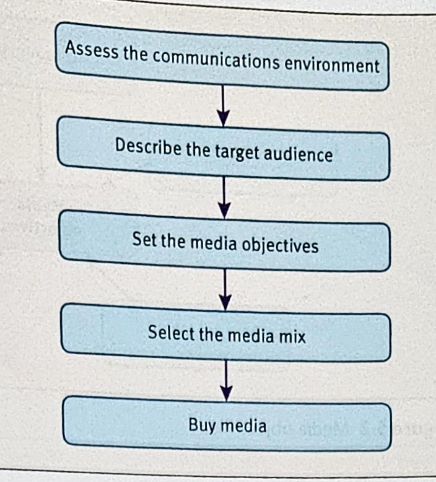
The steps in media planning are:
assess the communications environment
describe the target audience
set media objectives
select the media mix
buy media
evaluate results
10. Assessing the communications environment
Before choosing media, planners must understand the environment. They should look at regulations, local media habits and competitive activity.
Important competitive measures include:
Category spending
How much is spent on advertising in the whole product category?
Share of voice
This is a brand’s advertising spending divided by total category advertising spending. It shows how loud a brand is compared with competitors.
Share of market
This is the brand’s market share. Some argue that if a brand wants to grow, its share of voice should be higher than its share of market.
Media mix
This shows how competitors divide their budgets across TV, radio, magazines, online, outdoor, etc.
Exam point: Media planning is not only about the audience. It also depends on competitors, media habits, legal rules and category spending.
11. Frequency
Frequency means how many times, on average, a consumer in the target group is expected to be exposed to the advertiser’s message during a given time period.
Important distinction: media planners usually estimate exposure to the media vehicle, not guaranteed exposure to the ad itself. For example, someone may receive a newspaper six times, but they may not actually see the ad every time.
The key question is: how often must consumers see an ad before it works?
The chapter explains the two-factor model:

At first, repetition can improve learning and attitude. This is called wear-in. But after too many exposures, people may become bored or irritated. This is called wear-out. Therefore, the relationship between repetition and effectiveness is often shown as an inverted U-shape.
However, the book also explains that wear-out is not always guaranteed. Repetition can also:
improve memory
increase brand recall
increase attitude confidence
make claims seem more believable
signal brand quality
strengthen top-of-mind awareness
The classic industry rule is often 3 to 10 exposures: around three exposures may be needed for wear-in, while more than ten may risk wear-out. But newer research challenges this and suggests that strong creative ads can stay effective much longer.
Exam point: Frequency is about balancing too little exposure, which may not work, and too much exposure, which may irritate consumers. But good ads can often be repeated more than advertisers assume.
12. Signalling theory of repetition
The chapter also explains repetition through signalling theory. Consumers may interpret heavy advertising as a signal that the brand is confident and high quality. The logic is: if a company spends a lot on advertising, it must believe the product is good enough to recover that investment through sales and repeat purchase.
But extremely high repetition can backfire if consumers think the spending is excessive or suspicious.
Exam point: Repetition does not only create memory; it can also signal brand confidence and quality.
Beta-coefficient analysis

The chapter introduces Morgensztern’s beta-coefficient analysis, which estimates how memorisation increases after repeated exposure.
The beta coefficient shows the percentage of consumers who remember the ad after one exposure. Each additional exposure helps some of the people who did not remember it before.
Different media have different beta coefficients. Cinema tends to be very effective for memorisation because the audience is more captive and focused. Outdoor, magazines or online ads may have lower memorisation rates.

Exam point: Not all exposures are equal. One exposure in cinema may be more memorable than one exposure in another medium.
14. Reach and weight
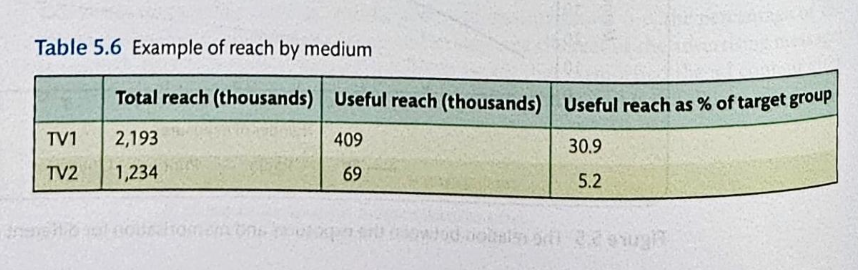
Total reach is the number of people exposed to a media vehicle during a specific period.
Useful reach is the number of people from the target group who are exposed to the media vehicle.
For example, a TV channel may have a very large total audience, but if few viewers are in the target group, its useful reach is low. A smaller specialised magazine may have lower total reach but higher useful reach for a specific target group.
Gross reach counts every exposure, including duplicated exposures. If the same person is reached twice, they count twice.
Net reach, usually just called reach, counts each person only once. It shows how many different people were reached at least one time.
Gross rating points, or GRPs, express campaign weight. GRP is gross reach expressed as a percentage of the target group.

Exam point: Reach tells us how many people we contact. Frequency tells us how often we contact them. GRPs combine reach and frequency to express campaign weight.
15. Research insight: media multitasking
The final page starts a research insight on media multitasking. The key idea is that consumers increasingly use several media at the same time, such as watching TV while using a phone. This means they consume more content in the same amount of time, but their attention becomes fragmented.
Research shows that media multitasking can reduce learning, memory and cognitive processing. Heavy media multitaskers may have more difficulty filtering irrelevant information and switching tasks effectively.
The insight links strongly to the lectures on media planning and attention: in a multitasking environment, ads must compete harder for attention, and exposure to a medium does not guarantee deep processing of the message.
Exam point: Media multitasking increases media exposure but can reduce attention and processing quality.
Super short exam paragraph
Pages 206–219 explain that advertising must often be adapted across cultures because consumers differ in values, language, symbols, communication style and product meanings. Hofstede’s cultural dimensions, such as individualism, power distance and uncertainty avoidance, help explain why certain appeals work better in some cultures than others. The chapter then moves to campaign implementation, where creative ideas are evaluated, produced and integrated into IMC. Finally, it introduces offline media planning: planners assess the environment, target audience and competitors, then set media objectives such as frequency, reach and GRPs. Frequency can create wear-in but also wear-out, although repetition may also strengthen memory and signal quality. Reach measures how many consumers are contacted, while GRPs express total campaign weight.
textbook page 220–236 / PDF page 44–60
textbook page 220–236 / PDF page 44–60, focusing especially on media planning concepts and formulas.
1. Opportunity to see, GRP and effective reach

A key media planning measure is Opportunity to See, often shortened to OTS. OTS means the average number of times a reached target consumer has the opportunity to be exposed to the campaign.
It is not the same as actual attention; it only means the person had the chance to see or hear the ad.
The basic relationship is:
OTS = GRP / Reach
Or rearranged:
GRP = Reach × OTS
Here, reach means the percentage of the target group reached at least once, and GRP means the total campaign weight.
You can also calculate GRP by adding up each media vehicle’s reach multiplied by its frequency:
GRP = Σ frequency × reach
So, for example, if a campaign reaches 65% of the target group and has 719.4 GRPs:
OTS = 719.4 / 65 = 11.1
This means the average reached person had about 11.1 opportunities to see the campaign.
2. Effective reach and effective frequency
Effective reach is the number or percentage of target consumers reached at least the minimum number of times needed for the ad to have an effect.
This connects to effective frequency, which is the minimum number of exposures believed necessary for the ad to work.
For example, if the effective frequency is 3 exposures, then only people exposed 3 or more times count as effectively reached.
From the book’s example:
Exposures | Reach |
|---|---|
1 | 20.0% |
2 | 16.0% |
3 | 11.5% |
4 | 6.0% |
5 | 3.5% |
6 | 1.8% |
7 | 1.2% |
If at least 3 exposures are needed:
Effective reach = 11.5 + 6.0 + 3.5 + 1.8 + 1.2 = 24.0%
So although total reach is 60%, the effective reach is only 24%, because only 24% received enough repetitions.
Effective Gross Rating Points / Effective GRPs
In the business insight example, the campaign has:
GRP = 238
Reach is 50%, so:
OTS = 238 / 50 = 4.76
If effective frequency is at least 3 exposures, the effective reach becomes:
3 + 9 + 8 + 7 + 6 + 3 + 2 + 1 = 39%
Effective GRPs can then be calculated by adding only the reach that received the effective number of exposures multiplied by frequency:
Effective GRP = 221
Exam meaning
A campaign can have high total reach but low effective reach if many people only see the ad once or twice. For exam answers, always distinguish between:
Reach = how many people are reached at least once.
Frequency / OTS = how often reached people are exposed on average.
Effective reach = how many people are exposed enough times to matter.
GRP = total campaign pressure or weight.
3. Balancing reach, frequency and GRP
Good media planning tries to maximize reach, GRP and effective OTS within a fixed budget. But there is a trade-off.
If all money is spent in one medium, frequency and GRP may be high, but reach may be low because the same people are exposed repeatedly. If money is spread across many media, reach may increase, but frequency may become too low. Therefore, media planners must balance:
reaching many people
with
repeating the message enough times
The goal is not simply “maximum reach” or “maximum frequency”, but the best combination for the campaign objective.
4. Continuity: when should advertising take place?
Continuity or scheduling answers the question: When should the campaign run?
The chapter describes three main scheduling patterns.
Continuous schedule
A continuous schedule means advertising runs evenly throughout the campaign period or year.
This is useful for products with stable demand throughout the year, such as everyday consumer goods or services that are bought all year round.
The advantage is that the brand stays constantly visible. The disadvantage is that the audience may become bored or stop noticing the ad, which is called ad fatigue.
Flighting schedule
A flighting schedule means advertising is concentrated in certain periods, with no advertising in between.
This is useful for seasonal products or moments when demand is high. For example, swimwear advertising may focus on spring/summer, while winter coats may advertise before winter.
The advantage is efficient budget use during peak periods. The disadvantage is that during off-periods the brand may be forgotten, especially in digital environments where “always on” presence is important.
Pulsing schedule
A pulsing schedule is a mix of continuous and flighting. The campaign runs throughout the whole period, but with heavier advertising during important moments.
This is often a realistic strategy because it keeps the brand visible while still increasing pressure during sales seasons, launches or promotions.
Exam comparison
Schedule | Meaning | Best for |
|---|---|---|
Continuous | Advertising spread evenly | Stable year-round demand |
Flighting | Bursts of advertising with gaps | Seasonal products or limited budget |
Pulsing | Always present but stronger in key periods | Brands needing both presence and peaks |


5. Factors influencing scheduling decisions
Scheduling depends on several factors:
The campaign objective matters. If the goal is brand awareness for a new launch, a more continuous approach may be needed. If the goal is sales during a promotion, advertising should be concentrated around the promotion period.
The product category matters. Seasonal products need seasonal advertising, while everyday products may need year-round presence.
The target audience’s media habits matter. If consumers mainly consume media on weekends, the schedule should focus on weekends.
The distribution plan matters. There is no point advertising heavily when the product is not available in stores. Mental availability and physical availability should match.
The competitor schedule also matters. Brands often follow or respond to competitor advertising patterns.
The budget matters. With a smaller budget, pulsing or flighting may be more realistic than continuous advertising.
6. Reach versus frequency debate
The chapter discusses a debate: should advertisers prioritize reaching more people or exposing the same people more often?
One view argues that it is better to reach people close to the purchase moment. In this view, one exposure near purchase may be more valuable than repeated exposures earlier.
Another view argues that both reach and frequency matter. If the objective is to inform consumers, more repetition may be needed. If the objective is only to remind consumers about a mature brand, one exposure may sometimes be enough.
Exam-ready answer:
The best choice depends on the objective. Informational campaigns, new products or complex messages usually need more frequency. Reminder campaigns for familiar brands may benefit more from broad reach.
7. Hybrid scheduling and double-spotting
The chapter also mentions hybrid scheduling. For example, a brand may spend:
40% of the budget in month 1
30% in month 2
0% in month 3
10% in each of the next three months
Even if there is no advertising in one month, earlier advertising can create a carryover effect, meaning the impact continues for some time.
Another tactic is double-spotting, where two ads are placed within the same TV programme to increase the likelihood of reaching effective frequency.
Cost: CPM and CPM-TM

Media cost is often expressed as cost per thousand, abbreviated as CPM.
CPM formula
CPM = Cost of the medium / Total reach × 1000
This tells us how much it costs to reach 1,000 people in the total audience.
But total audience is not always useful. A medium may be cheap but reach many irrelevant people. That is why the more useful measure is CPM in the target market, or CPM-TM.
CPM-TM formula
CPM-TM = Cost of the medium / Useful reach × 1000
Useful reach means the number of people reached who actually belong to the target group.
Exam tip
A medium can have a low CPM but a high CPM-TM. This happens when the medium reaches many people overall but only a small proportion of the actual target group.
So, for media planning, CPM-TM is often more useful than CPM, because it focuses on the target audience.
9. Medium selectivity

Medium selectivity refers to how well a medium reaches a specific target group compared with the general population.
The formula is:
Selectivity index = (% of target group in the medium’s reach / % of target group in the total population) × 100
Interpretation:
Selectivity index | Meaning |
|---|---|
Below 100 | Target group is under-represented |
100 | Target group is proportionally represented |
Above 100 | Target group is over-represented; medium is selective |
For example, a TV channel may have a small total audience but be very good at reaching young adults. In that case, it may be more cost-efficient for a youth campaign than a bigger channel with less target-group concentration.
Medium selectivity tells you how well a medium matches your target group.
Example: A magazine where young women are overrepresented has high selectivity for a young female target group.
CPM-TM tells you how much it costs to reach 1,000 people in your target group.
Example: If an ad costs €5,000 and reaches 100,000 target consumers, CPM-TM = €50.
So, exam style:
Medium selectivity measures target-group fit, while CPM-TM measures cost efficiency within the target group. A medium can be highly selective but still expensive, or cheap but poorly targeted.
Exam sentence:
A selective medium is not necessarily the medium with the largest reach; it is the medium where the target group is strongly represented.
10. Selecting media: quantitative, qualitative and technical criteria
When selecting media, planners evaluate the available media and vehicles according to three types of criteria.

Quantitative criteria
These are measurable criteria:
Reach
Frequency
Selectivity
Cost
Speed of reach
Message memorisation
These help answer: how many people can we reach, how often, how quickly, and at what cost?
Qualitative criteria
These concern the nature and quality of the medium:
Geographic flexibility
Message life
Seasonal influence
Image-building capability
Emotional impact
Audience involvement
Active or passive medium
Attention to the medium
Context value
Amount of information possible
Demonstration capability
Flexibility
Clutter
These help answer: does this medium fit the message, brand image and campaign objective?
Technical criteria
These concern practical production and buying issues:
Production cost
Lead time
Cancellation flexibility
Media buying conditions
Exam sentence:
Media selection is not only about cheap reach; it also depends on whether the medium fits the brand, message, target group, timing and practical campaign constraints.
11. Advantages and disadvantages of main media types

Outdoor advertising
Outdoor includes billboards and transit advertising such as ads on buses, trams and stations.
Advantages:
Wide reach
High frequency
Long message lifetime
Immediate reach
Geographic flexibility
Disadvantages:
Low involvement
Low attention
Limited information
Little or no context
Exam example:
Outdoor is good for short, simple, repeated messages, but not for complex arguments.
Magazines
Advantages:
Selective for specific target groups
High-quality context
High involvement
Good reproduction quality
Can provide lots of information
Long message life
Disadvantages:
Long lead time
Geographically inflexible
Possible clutter
Magazines are useful when the brand wants image-building, credibility, target-group selectivity and detailed information.
Newspapers
Advantages:
Wide reach
Short lead time
Flexible
High involvement
Strong informational context
Lots of information
Geographic flexibility
Disadvantages:
Limited selectivity
Lower reproduction quality
Short message life
Newspapers are good for topical, local and informational advertising, but the ad disappears quickly because the newspaper is usually read for only one day.
Door-to-door advertising
This includes local free publications or leaflets.
Advantages:
Geographic flexibility
High reach
Lots of information
Promotion-oriented
Disadvantages:
Limited selectivity
Low involvement
Lower reproduction quality
High clutter
It can work for local promotions, but people may ignore it or react negatively because of clutter and environmental concerns.
Television
Advantages:
Strong emotional impact
Good for image transfer
Supportive context
High reach
Can be selective through niche channels
Disadvantages:
High production costs
Very short message life
High clutter
Seasonal variation
Viewers may skip ads
TV is strong for emotion and brand image, but expensive and increasingly challenged by digital viewing and ad skipping.
Cinema
Advantages:
Very strong emotional impact
Attention-grabbing
Positive context
Selective for young/upmarket groups
Disadvantages:
Limited reach
Slow reach
Very short message life
High production costs
Cinema is powerful because people pay attention and are in a positive mood, but it reaches fewer people.
Radio
Advantages:
High reach
High frequency
Low production cost
Flexible
Very selective
Disadvantages:
Very short message lifetime
Low involvement
Low attention
Radio is useful for repetition and local or demographic targeting, but people often treat it as background noise.
Digital
The table briefly includes digital, though online media planning is mainly handled in Chapter 6.
Advantages:
Cost-efficient
Flexible
Brand-building potential
Activating and interactive
High reach
High frequency
Potentially strong context
Selective
Measurable
Disadvantages:
Potentially intrusive
Low involvement
Low attention
Clutter
12. Media mix and synergy
The chapter’s research insight shows that advertisers should not only choose one medium but consider the optimal media mix.
A study on skin and hair care campaigns found that spreading advertising across television and magazines could increase campaign recognition more than investing everything in one medium.
For example:
With 200 GRPs, the optimal allocation was about 40% magazines and 60% TV, producing higher recognition than using only magazines or only TV.
With 620 GRPs, the optimal allocation shifted more toward TV, around 20% magazines and 80% TV.
The key exam point is:
Media mix synergy occurs when combining media produces better results than using one medium alone.
This matters because different media can reinforce each other. One medium may build emotion or awareness, while another provides detail or credibility.
13. Media context
Advertising is always seen within a context. The chapter distinguishes between:
Receiver context
and
Medium context
Receiver context
This is the situation in which the person is exposed to the ad. For example, they may be at home, at work, alone, with friends, in a good mood, or distracted.
Medium context
This refers to the content or environment in which the ad appears. For example, a TV ad may appear during a funny programme, a violent programme, a commercial break, a magazine article, or a website page.
Context matters because it can influence how people perceive and process the ad.
14. Media context variables
The chapter discusses several context variables.

Medium itself
Context effects are often more pronounced for TV because TV combines image, sound, emotion and programme context.
Vehicle content
The content surrounding the ad matters. For example, violent, sexual or highly arousing programmes may reduce ad memory because people focus on the programme instead of the ad.
Media clutter
Clutter means the audience is exposed to many ads close together. Interestingly, the chapter notes that in some studies, more clutter can sometimes be associated with more positive ad results, but in general clutter makes it harder for individual ads to stand out.
Type of ad block
A distinction is made between:
Interrupting blocks: commercial breaks in the middle of a programme.
Shoulder blocks: commercial breaks between programmes.
The chapter suggests that context effects may be stronger in interrupting blocks because viewers are more emotionally involved during the programme.
Sequence within ad block
Where an ad appears in a block matters.
Ads at the beginning of a block can benefit from primacy effects.
Ads at the end of a block can benefit from recency effects.
So, first and last positions are often more valuable than middle positions.
Placement
Certain positions can increase attention, such as the upper-left corner of a magazine page, the right-hand page, or the cover page.
15. Congruence between ad and context
Ad-context congruence means the ad fits well with the surrounding media content.
For example, a shampoo ad in a beauty magazine is congruent. A computer ad in a computer magazine is congruent.
There are two possible effects:
A congruent context can make the ad easier to understand because the audience already has the relevant knowledge activated.
An incongruent context can attract attention because it feels surprising or novel.
The chapter explains that the best choice depends on product involvement.
For low-involvement products, congruence is usually better because consumers use peripheral processing and need easy fit.
For high-involvement products, contrast or incongruence can sometimes be better because consumers are more willing to think deeply and may appreciate novelty.
Exam sentence:
Context congruence is not always automatically better; for low-involvement situations congruence helps, while for high-involvement situations contrast can sometimes increase attention and processing.
16. Intensity and valence of context responses
The chapter also discusses the emotional intensity and valence of the surrounding context.
Intensity
Some researchers argue that highly intense contexts reduce ad effectiveness because consumers have less mental capacity left for the ad.
Others argue that intense contexts can increase attention and arousal, making people process ads more strongly.
The overall evidence is mixed, but many results suggest that stronger context responses can have a positive effect on attitudes and purchase intention.
Valence
Valence means whether the context creates a positive or negative emotional response.
A positive context can sometimes improve ad evaluation because positive feelings transfer to the ad. This links to affect transfer from earlier chapters.
However, the book also notes that positive moods may sometimes reduce detailed processing, because people want to maintain their good mood and avoid effortful thinking.
Exam answer:
Positive context can improve ad effectiveness through feelings transfer, but it may also reduce deep processing. The effect depends on whether the campaign needs emotional transfer or careful message processing.
17. Content of the programme or medium
The content around the ad also matters. For instance, violent or sexual TV programmes can impair/weaken ad memory because they attract so much attention that viewers have less capacity to process the commercials.
This effect was found across different groups, even among people who liked those types of programmes.
Humorous programmes may sometimes be better for ad recall than news or drama.
Exam point:
An ad is not processed in isolation; the surrounding programme or editorial content can either help or hurt attention, memory and evaluation.
Key formulas to memorize
Concept | Formula | Meaning |
|---|---|---|
GRP | GRP = Reach × OTS | Total campaign weight |
OTS | OTS = GRP / Reach | Average exposure opportunity among reached people |
GRP by vehicle | GRP = Σ frequency × reach | Adds media vehicle contributions |
CPM | CPM = Cost / Total reach × 1000 | Cost to reach 1,000 people overall |
CPM-TM | CPM-TM = Cost / Useful reach × 1000 | Cost to reach 1,000 target consumers |
Selectivity index | % target group in medium reach / % target group in population × 100 | How selective a medium is |
Final exam-ready takeaway
This section explains how advertisers make media planning decisions after the message is designed. The key task is to decide which media to use, when to advertise, how often to repeat the message, and at what cost. Media planners must balance reach, frequency, GRP, effective reach and budget. They also need to compare media using quantitative, qualitative and technical criteria. A good media plan does not simply choose the cheapest medium; it chooses the combination of media that reaches the target group effectively, fits the campaign objective, uses the right timing, and takes account of media context. Context matters because ads are always processed within surrounding programmes, articles, websites, emotions and situations, which can influence attention, memory, attitudes and purchase intentions.