ECS 160 Design Pattern
 Call Kai
 Learn
 Practice Test
 Spaced Repetition
 Match
 Flashcards
 Knowt Play
1/20

There's no tags or description
Looks like no tags are added yet.
21 Terms
Encapsulation
internal details of a class are hidden, access is controlled using public, private, protected
Abstraction
a simplified representation of something more complex. Abstractions allow you to hide details to help you manage complexity, focus on relevant concepts, and reason about problems at a higher level.
Inheritence
allows the reuse of code, this would be a child that extends of a parent
Abstract Class
a class that cannot be instantiated, only single inheritance allowed, can choose to override any methods already written but needs to implement any methods not yet implemented, must be extended, "is-a"
Abstraction via Interface
defines a contract for what a class must do but not how, multiple inheritances allowed, is a contract you must follow, must be implemented, "can do"
Runtime Polymorphism
The compiler cannot make the determination but instead the determination is made while the program is running
Static Class Member
single copy of the field is created, belongs to the class
What are the three types of design pattern categories and what are the differences?
creational (how objects are created), structural (how objects and classes are composed and deal with the relationships between objects), behavioural (control how objects distribute responsibilities)
Singleton DP, what situation you'd use, explain how to implement, the category, the pros and cons
this is when you want one object of a class to exist and accessed
case study is logger
creational DP
to implement we need a private constructor + private static object + getter,
pro: include controlled access to the instance
con: are potential bottlenecks and difficulty in testing and can create hidden dependencies

Abstract Factory DP, what situation you'd use, explain how to implement, the category, the pros and cons
creates a family of related objects without the client having to know the exact classes being created
case study is UI toolkit
creational DP
we would have the abstract family class, an application class that contains the fields of the children, and the children will extend the application class and implement what is needed, the application class has a private object that tells us which child we should go to
pro: promotes consistency, catches error at compile time
con: more classes = more complexity

Adapter DP, what situation you'd use, explain how to implement, the category, the pros and cons
adapter converts the interface of a class to another interface the client expects
case study is payment with app and stripe
structural DP
we will create an adapter wrapper (stripeAdapter) that implements our interface (payProc) and in this will let us know what interface to go to, we wrap our third party in it (stripeProc), anytime we called our regular payProc it can check if it is the stripe
pro: don’t modify app logic, remove “if” logic
con: overcomplicated with many layers + wrappers

Proxy DP, what situation you'd use, explain how to implement, the category, the pros and cons
mediated by intercepting a call, user accesses the proxy instead of the real object, and some additional logic can be added
case is adding logging functionality
structural DP
we have our proxy object that extends our person class and overrides the functions, has the same API as the inner object but with some extra functionality
pro: adds additional functionality without changing class
con: additional classes = additional complexity, may need to override many objects

Bridge DP, what situation you'd use, explain how to implement, the category, the pros and cons
splits one hierarchy into two separate ones that are connected, helps prevent class exploision
case study is vehicle and energy source
structural DP
our vehicle class will have a private energy object, our energy class will have multiple types of energy children, our vehicle class will have multiple vehicle children
pro: decouples abstraction and implementation, improves extensibility
con: it is still more classes, can have combos we don’t want

Facade DP, what situation you'd use, explain how to implement, the category, the pros and cons
a simple front door to a complex subsystem
case study is translation
structural DP
our client will have access to a class in which that contains all of the background stuff
pro: shields client from subsystem components, provides a unified interface, weak coupling between subsystem and client (client does’t need to know)
con: many tasks can mean a lot of orchestration in the background
Decorator DP, what situation you'd use, explain how to implement, the category, the pros and cons
dynamically attaches additional functionality by wrapping objects inside another object
case study is fraud detection
structural DP
create an wrapper abstract class decorator (PayProcDecor) that wraps the inner object which extends the interface (payProc), create the method decorator and extend to our wrapper decorator (fraudDetectDecor) and this will contain the additional functionality, you can stack decorators
pro: avoids feature-laden classes high up in the hierarchy and instead have subclasses, pay as you go approach
con: can be hard to debug
Observer DP, what situation you'd use, explain how to implement, the category, the pros and cons
when an object changes, all interested objects in that change are automatically notified, coupling between subject and observer
case study is the graphs
behavioural DP
we will have an overall class (dataModel) that contains a list of the observers, adding observers, removing, notifying graph loop, and setting the data which calls notifying, while we also have our observer interface with an update method, and our different subclass of graphs will implement the observer interface with its specific update functionality
pro: supports broadcast communication
con: can cause cascading updates without knowing, one trigger update can cause many others to update

State DP, what situation you'd use, explain how to implement, the category, the pros and cons
lets objects behave differently depending on its current state without filling the main class with lots of i else
case study is music player
behavioural DP
we will have an interface mediaPlayerState that contains subclasses for the different state (stop, play, pause), and then the different states are classes that extend the interface and overrides the methods, our main class will keep track of the current state with this
pro: can’t miss a state due to the interface, avoid large if-else, extensible in adding new states
con: more classes

Template DP, what situation you'd use, explain how to implement, the category, the pros and cons
defines the overall steps of an algorithm but allows subclasses to change certain steps
case study is traversing source to dest note
behavioural DP
in our abstract class, we will have concrete methods that is shared between algorithm, and a protected abstract method that is different from class to class, in these separate class, we will override that protected method, we can have a template where subclasses can optionally implement the methods (hook) or they must implement the abstract methods (abstract operations)
pro: allows code reuse, we have an “inverted” structure where parents call the operation of the child class
con: lots of override and more subclasses

Visitor DP, what situation you'd use, explain how to implement, the category, the pros and cons
all logic for one op should be kept together, “all in one place”
case study is shapes
behavioural DP
our abstract class visitor will contain the visits for all shapes and a visit method that loops thorough our shape have an abstract shape class that our shapes will extend
pro: keep logic all together
con: can get complicated
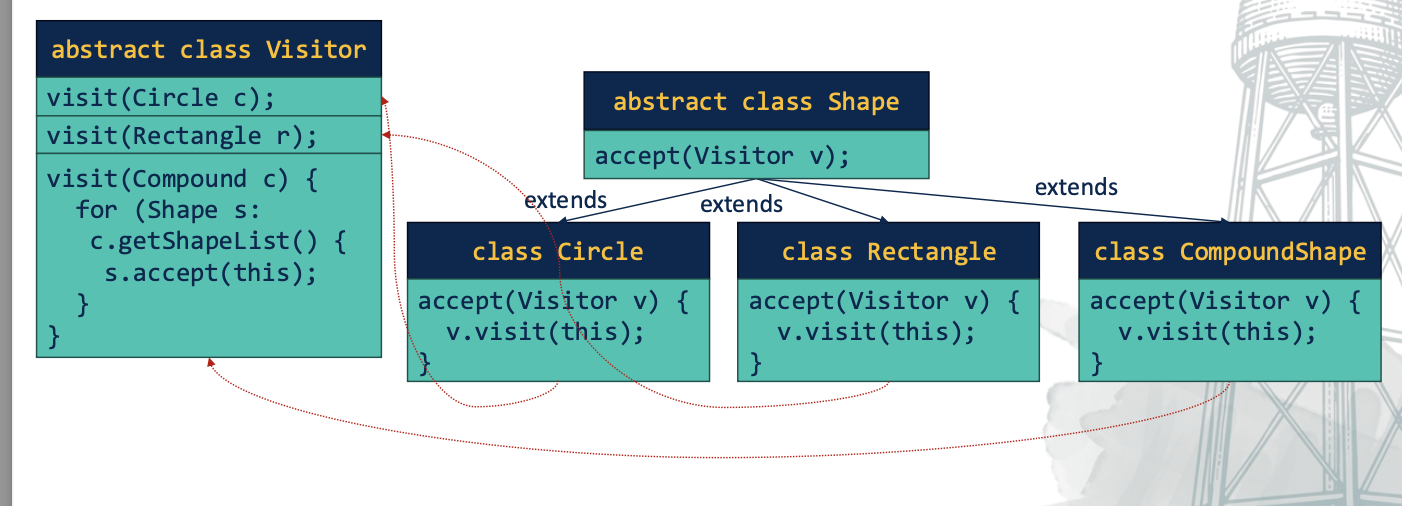
Single Dispatch
we only check the runtime of the object being called on
Z w = new W()
X x = new Y()
w.p(x)
we will check the runtime of argument w which is object W, and we will go to the method p that takes in an argument X of the compile time which is object X
Double Dispatch
we check the runtime type of the objects
Z w = new W()
X x = new Y()
w.p(x)
we will check the run time of both, so we will go to object W’s, find the method p that takes in an object Y
because of this, we do not need an accept